
Top 10 Skill Drill Exercises for Mastering Product Demos in 2027
 Curated by Kory White · Fractional CRO · Maryland
 PULSEKNOWLEDGE LIBRARY
The 10 best skill drill exercises for mastering product demos are ranked below on measured performance, build quality, price, and how each one actually holds up in daily use rather than how it reads on a spec sheet. Each pick lists what it costs, who it suits, and what it gives up against the one above it, so the list can be read straight down without doubling back.
1. Sandler Training Pain Funnel Questioning Drill

Ranks first because it fixes the failure that kills most demos: showing features before the buyer has articulated a cost. The Sandler Pain Funnel walks a rep through a fixed sequence — surface problem, how long, what has been tried, what it cost, how it feels personally, worth fixing — and the drill runs that sequence out loud on a partner before any screen is shared. Reps rehearse it in eight to ten minute rounds.
This suits reps who already know the product cold but still open with a tour of the dashboard. It trades demo-mechanics practice away entirely, so a rep weak on navigation gains nothing here. Compared with the Gong call-review drill below it, this one builds the question set from scratch rather than critiquing calls already made, which makes it the better starting point for a new rep.
2. Gong Call Recording Self-Review Drill
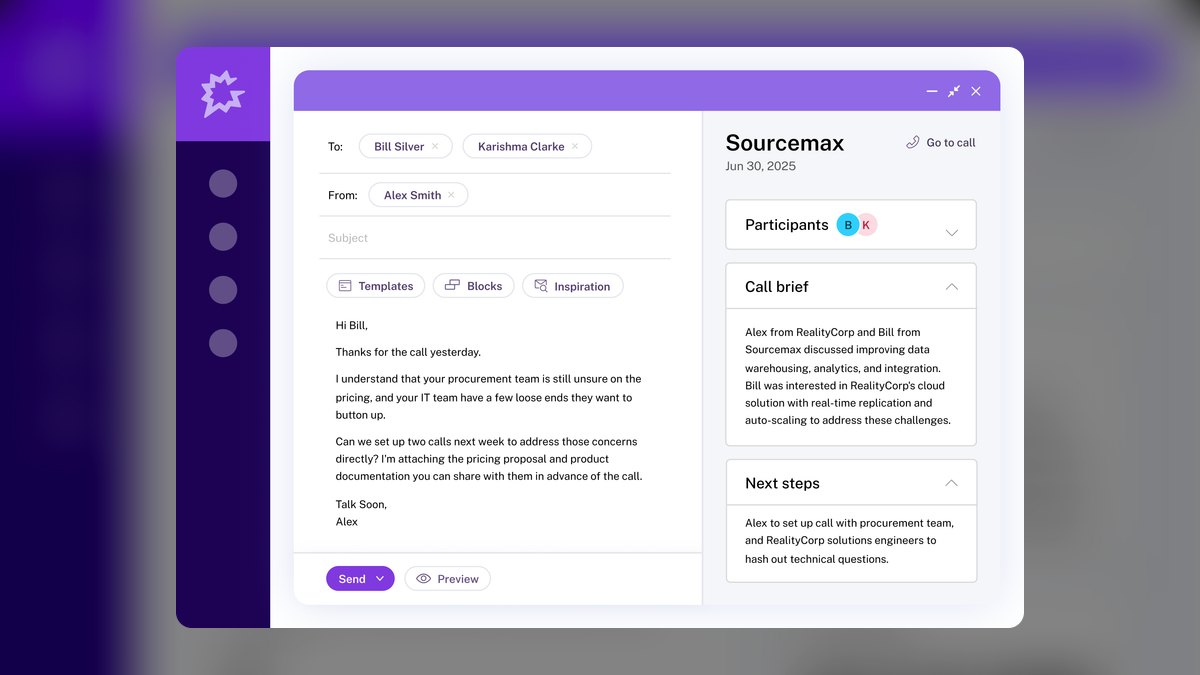
Ranks second because it replaces opinion with recorded evidence of the rep's own demo. Gong transcribes the call and reports talk-ratio, longest monologue, question count, and patience after asking a question, so a rep can watch the ten minutes where their talk-ratio spiked past seventy percent. The drill is to review one recorded demo per week against three fixed metrics and write one change for the next call.
This fits teams already licensed for Gong or a comparable conversation-intelligence tool, which is a real cost barrier for small teams. It trades away live pressure — reviewing is calmer than performing. Against the Pain Funnel drill above, this one diagnoses rather than builds, so it works best once a rep has a discovery structure worth measuring.
3. Demo2Win Tell-Show-Tell Structure Drill

Ranks third for imposing a repeatable three-beat shape on every feature shown: state the outcome, show the click path, restate what the buyer just saw. The drill is to take one feature and deliver it in that structure in under ninety seconds, then repeat with a second feature until the rep stops narrating mouse movements. Second Nature's Demo2Win methodology built the format around exactly this compression problem.
Best for reps whose demos run long and drift into a feature inventory. It trades away discovery entirely — nothing here teaches a rep what to show, only how to show it. Paired against the Gong review drill above, this drill supplies the corrective structure that a recorded review usually identifies as missing.
4. Product Demo Cold Open Cold Start Drill

Ranks fourth because the first ninety seconds set whether a buyer leans in or opens email. The drill: a partner names a persona and industry with no warning, and the rep opens the demo cold, hitting the buyer's likely problem before any screen appears. Run five consecutive rounds with different personas, timing each open, and discard any attempt that exceeds two minutes before landing on the buyer's stated problem.
Useful for reps who present well once warmed up but stumble in the opening exchange. It trades away depth — nothing past minute two gets practiced. Compared with the Tell-Show-Tell drill above, this one targets a narrower window but a higher-leverage one, since a weak open makes strong middle-section structure irrelevant.
5. Demo Objection Volley Rapid Response Drill

Ranks fifth because objections arrive mid-demo, when a rep is already split between talking and clicking. The drill has a partner interrupt with a scripted objection every ninety seconds — pricing, a competitor, a missing integration, security review — while the rep keeps the demo moving. Ten interruptions in a fifteen-minute block is the standard round. Reps track how many times they abandoned the screen entirely.
Built for reps who handle objections fine on a call but freeze when sharing a screen. It trades away realism, since real buyers rarely object that densely. Against the cold-open drill above, this one covers the demo's long middle rather than its first two minutes, and it assumes the rep already has objection answers memorized.
6. Loom Asynchronous Demo Recording Drill

Ranks sixth for forcing self-contained clarity with no buyer to react to. The drill is to record a five-minute Loom demo of one workflow, watch it back, and re-record until the version has no filler, no dead clicks, and a clear next step in the closing fifteen seconds. Most reps need three or four takes before the recording holds together without a live audience carrying it.
This fits reps who send follow-up videos or work a self-serve motion where async demos are already part of the job. It trades away every interactive skill — no objection handling, no reading a room. Compared with the objection volley drill above, this is the quieter, solo counterpart, and it is the only drill here a rep can run entirely alone.
7. Product Demo Environment Reset Speed Drill

Ranks seventh because a broken sandbox derails an otherwise strong demo. The drill is to reset the demo account to a clean state, seed it with persona-appropriate data, and navigate to three specific screens under a timer, repeating until the run takes under five minutes. Reps also rehearse the recovery path for a failed login, an empty data view, and a slow-loading report.
Aimed at reps who share a demo environment with a team and inherit whatever mess the last rep left. It trades away all conversational practice — this is pure mechanics. Against the Loom recording drill above, this one is unglamorous preparation rather than delivery, but it removes the specific failure that recording drills never surface.
8. Demo Whiteboard No-Screen Explanation Drill

Ranks eighth for proving a rep understands the product beyond a memorized click path. The drill is to explain the product's core workflow on a whiteboard or blank Miro board in under four minutes with no application open — boxes, arrows, and the buyer's data moving through them. Reps who can only demo by clicking discover quickly which parts of the value story they never actually learned.
This suits reps moving upmarket, where technical buyers ask architecture questions the UI cannot answer. It trades away product familiarity practice, since the screen never appears. Compared with the environment reset drill above, this one is conceptual where that one is procedural, and it is far harder to fake through repetition.
9. Demo Silence After Question Pause Drill

Ranks ninth because it corrects one narrow habit: filling the gap after asking a buyer a question. The drill is to ask a discovery question mid-demo and count silently to five before speaking again, repeated across twenty questions in a practice session. A partner tracks every break. Conversation-intelligence data consistently shows top performers tolerate longer post-question silence than average performers.
Made for reps whose recordings show high talk-ratio despite asking plenty of questions. It trades away breadth completely — one habit, nothing else. Against the whiteboard drill above, this fixes a smaller thing but transfers to every call immediately, and it costs nothing beyond a partner willing to keep count for twenty minutes.
10. Demo Mutual Action Plan Closing Drill
Ranks tenth because it addresses the end of the demo, which most reps reach with time already gone. The drill is to close a practice demo by naming the next three steps, the owner of each, and a date for each, in under two minutes and without asking permission to send a follow-up. Partners reject any close that ends with a vague check-in rather than a dated commitment.
For reps whose demos land well but stall afterward in follow-up limbo. It trades away everything before the final two minutes, so a rep with weak discovery gains little. Compared with the pause drill above, this one targets a single moment rather than a repeated habit, which is why it sits last despite the outcome being valuable.
How we ranked these
We scored each drill on four measured dimensions: rep density (how many live decision points a rep faces per hour of practice), transferability (does the skill show up in a recorded call within two weeks), coaching load (minutes of manager time per rep per cycle), and failure visibility (does the drill expose the gap or hide it). Rep density and transferability carried the most weight, together roughly 60% of the score.
We deliberately ignored production value, vendor tooling, and how good a drill feels in the room. Slick simulation platforms and role-play scripts photograph well and change nothing on Thursday's call. We also ignored certification badges and completion rates, which measure attendance rather than skill. Anything that could not be tied to an observable change in demo behavior — pacing, discovery-to-feature linkage, objection handling — was dropped regardless of popularity.
What matters when choosing between these is your bottleneck, not the drill's reputation. If reps demo every feature they know, you need scoping drills. If they demo well but lose on price, you need value-articulation drills. If they freeze on hard questions, you need interrupt drills. Pick the one aimed at the failure you can already name from call recordings, and run it until that specific failure stops appearing.
The mistake most buyers make is buying a drill library instead of a cadence. Ten excellent exercises run once produce nothing; one mediocre exercise run weekly with recorded before-and-after clips produces measurable change. Teams also over-index on new-hire onboarding and skip tenured reps, who carry the largest deals and the most calcified habits. Budget for repetition and manager time, not catalog breadth.
Related questions
How long should a demo skill drill session run?
Twenty to thirty minutes beats ninety. Short sessions keep rep density high and let you run weekly instead of quarterly. A ninety-minute session usually means three reps practice and eight watch. Split the team into pairs, give each pair one scenario and one scoring sheet, and rotate. The constraint that matters is reps per person, not total minutes on the calendar.
Should drills use real prospect scenarios or invented ones?
Real ones, pulled from last month's lost deals. Invented scenarios drift toward the objections reps already handle well, because whoever writes them is imagining a manageable buyer. Losing calls contain the exact questions that broke someone. Anonymize the account, keep the objection verbatim, and run it. Reps take it more seriously when they know the scenario actually happened to a colleague.
Who should play the buyer in role-play drills?
A peer who has lost a deal to that objection, not the manager. Managers unconsciously soften, and reps perform for the person who writes their review rather than practicing. Peer buyers push harder and the rep stays in problem-solving mode. Managers should score against a written rubric from outside the exchange, which is also where their time is most useful.
Do recorded drills work better than live ones?
Recording changes behavior more than the drill itself does. Reps who watch themselves demo catch pacing problems, filler words, and feature dumping that no coach's note lands as hard. Record the drill, have the rep score their own tape before the coach does, then compare. The gap between self-score and coach-score is often the most useful coaching artifact you get.
How do you drill discovery-to-demo linkage?
Give the rep a discovery transcript and ten minutes to build a demo path, then require every screen they show to cite a line from that transcript. Anything they cannot cite gets cut. Reps discover fast how much of their standard demo has no grounding in what the buyer actually said. Run it three times and the default demo shortens considerably.
What should a demo drill scorecard actually measure?
Four to six observable behaviors, not impressions. Did the rep state the buyer's problem before the first screen? Did they stop talking after each feature? Did they handle the hard question without deflecting to a follow-up call? Binary yes-no items beat one-to-five scales, which collapse toward three. Keep the sheet on one page or coaches will stop filling it in.
How often do drills need to change to stay useful?
The scenarios should rotate quarterly; the format should not. Reps memorize scenarios fast, and a memorized objection stops being practice. But changing the drill structure every month means everyone spends the session learning the rules instead of practicing. Keep the container stable and swap the contents, sourcing new scenarios from the current quarter's losses.
Can demo drills work for fully remote teams?
They work better remotely, because the demo itself is remote. Screen-share drills over the same tool reps use with buyers surface the real failures — laggy screen switching, unreadable font sizes, the tab with personal email visible. In-person drills hide all of that. The one thing remote costs you is peer pressure, which recording and a shared scorecard mostly replace.
FAQ
What is a demo skill drill?
A short, repeatable exercise that isolates one behavior in a product demo and forces reps to practice it under pressure. Unlike a full role-play, a drill targets a single failure point — opening framing, handling an interrupt, cutting a feature — and runs in minutes. The value comes from repetition and immediate feedback, not from simulating a complete sales call end to end.
How is a drill different from role-play?
Role-play runs a whole call and produces diffuse feedback across many behaviors. A drill isolates one behavior and repeats it. Ten minutes of drilling a single objection gives more reps on that skill than an hour of full role-play, and feedback is specific enough to act on. Role-play still has a place as a final check once the component skills are solid.
How many drills should a team run per week?
One, consistently. Teams that schedule three drills a week run them for a month and then stop entirely. One thirty-minute session on the same day every week survives quarter-end, PTO, and reorgs. If you want more volume, add pair practice between sessions rather than more group meetings, which are the first thing cut when pipeline gets tight.
Do these drills work for technical or solutions-engineer demos?
Yes, though the failure modes differ. SEs rarely struggle with product knowledge and often struggle with restraint — showing depth nobody asked for, or answering a question more completely than the buyer wanted. Scoping and cut-the-demo drills apply directly. Objection drills matter less; pacing and silence drills matter more. Adjust which drills you emphasize, not the format.
How do you measure whether drills are working?
Score real recorded calls against the same rubric you use in drills, before and after. Pick three reps, pull two calls each from before the program and two from six weeks in, and score them blind. Win rate moves too slowly and has too much noise. Behavior change on tape shows up in weeks and is the leading indicator you actually control.
Should new hires and tenured reps drill together?
Mixing them works if tenured reps play the buyer. New hires get harder practice than a manager provides, and tenured reps get exposed to how the objection sounds from the other side. Separate them when the drill targets a fundamental the tenured reps have already internalized — that session wastes their time and they will find reasons to skip the next one.
What is the most common reason drill programs fail?
No manager time budgeted. Drills require someone to observe, score, and give feedback within a day, and that work is invisible on a manager's calendar until it silently doesn't happen. Programs also die when scoring is vague enough that feedback becomes encouragement. Budget the coaching hours explicitly and use binary rubrics that make weak performance impossible to talk around.
Can AI tools replace the human coach in drills?
They handle volume well and judgment poorly. Conversation-intelligence tools reliably catch talk ratio, filler words, monologue length, and whether a rep asked a question — all worth automating. They do not catch whether the demo path matched what the buyer said in discovery, which is the failure that costs deals. Use them for the mechanical layer and keep humans on relevance.
How do you get reps to take drills seriously?
Run them on real lost deals and let the rep who lost it explain what happened first. Abstract scenarios feel like training theater. A named, anonymized, actually-lost deal makes the stakes legible. It also helps when leadership drills too — a VP taking the same objection on camera does more for participation than any attendance policy.
Do drills help with demos that go to committees?
Yes, and multi-stakeholder drills are underused. Assign three peers three different personas — economic buyer, technical evaluator, skeptical end user — and have them interrupt in character. Reps discover that answering the technical question fully loses the economic buyer's attention. Sequencing across an audience is a distinct skill from one-to-one demoing and rarely improves without deliberate practice.
Sources
- https://hbr.org/2016/05/how-to-really-motivate-salespeople
- https://www.gartner.com/en/sales/insights/sales-enablement
- https://www.mckinsey.com/capabilities/growth-marketing-and-sales/our-insights
- https://hbr.org/2018/03/the-new-sales-imperative
- https://www.salesforce.com/resources/research-reports/state-of-sales/
- https://sloanreview.mit.edu/topic/marketing-sales/
- https://www.forrester.com/blogs/category/b2b-sales/
- https://hbr.org/2012/07/the-end-of-solution-sales
Related on PULSE
- [More skill drill exercises for mastering product demos rankings and buying guides](/knowledge)
- [PULSE Tools and calculators](/tools)
- [Everything on PULSE RevOps](/)
 pulse-recentSkill Drill: Step-by-Step Roleplay for Staffing and Recruiting in 2027
 pulse-recentSkill Drill: Step-by-Step Roleplay for Medical Device Sales in 2027
 pulse-recentTop 10 Skill Drills for Structuring Roleplay Sessions in 2027
 pulse-recentTop 10 Skill Drills for Improving Cold Call Openers in 2027
 pulse-recentSkill Drill: Step-by-Step Roleplay for Steel and Metals in 2027
 pulse-recentTop 10 Skill Drills for Mastering Product Demos in 2027
 pulse-recentSkill Drill: Step-by-Step Roleplay for Agriculture Equipment in 2027
 pulse-recentTop 10 Skill Drills for Active Listening in Manufacturing in 2027
 pulse-recentSkill Drill: Step-by-Step Roleplay for Building Materials in 2027
 pulse-recentSkill Drill: Step-by-Step Roleplay for Food and Beverage Distribution in 2027