
Ronald Reagan’s A Time for Choosing (1964) — Key Passages and Lessons
 Curated byKory White · Fractional CRO · Maryland
 PULSEKNOWLEDGE LIBRARY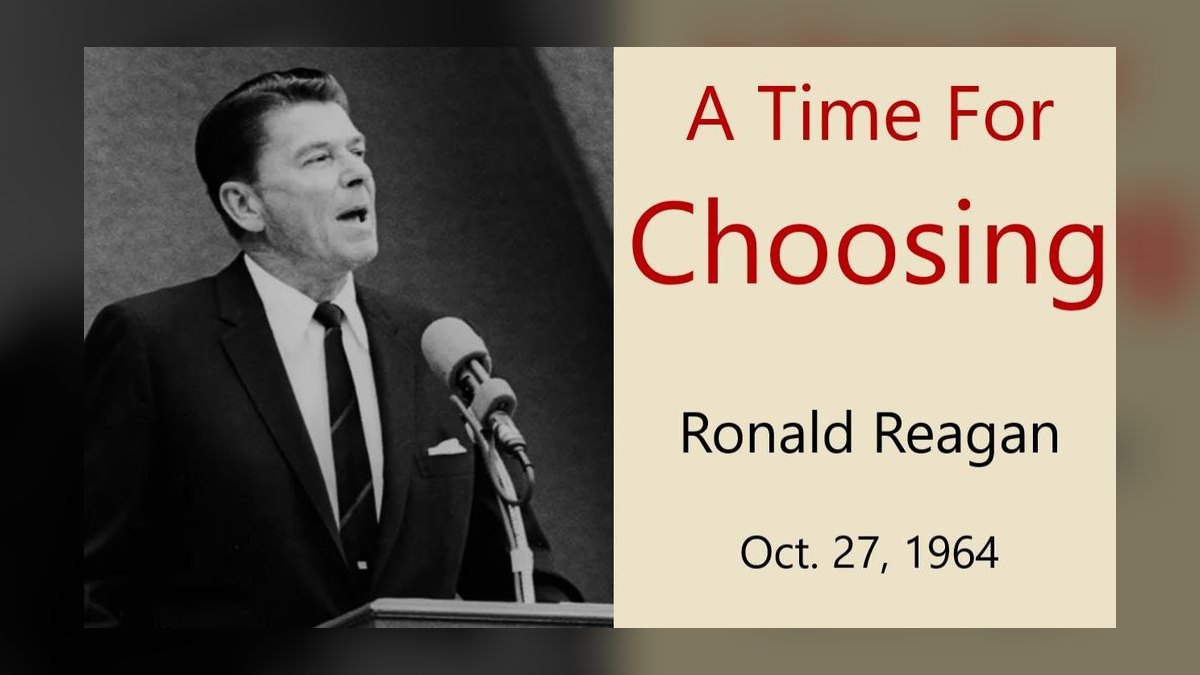
In "A Time for Choosing," Ronald Reagan articulates the core conservative principles of limited government, individual freedom, and the dangers of centralized planning, using stark contrasts between liberty and socialism. Key passages warn against the erosion of constitutional rights and the expansion of federal power, framing the 1964 election as a pivotal choice between two opposing visions for America. The speech’s enduring lessons include the power of clear moral conviction in political rhetoric and the importance of defending free markets against government overreach. Delivered as a televised address supporting Barry Goldwater’s losing campaign, this speech became the foundational text of modern American conservatism and launched Reagan’s own political career.
How Did Reagan Structure His Argument to Maximize Persuasive Impact?
Reagan’s rhetorical architecture in "A Time for Choosing" is a masterclass in persuasive structure. He begins by establishing personal credibility through his conversion narrative—“I have spent most of my life as a Democrat”—which disarms partisan resistance before making any policy argument. This opening move allows listeners who might disagree with conservative politics to trust the speaker as someone who has changed his own mind. He then reframes the entire electoral contest from a horizontal left-right spectrum to a vertical moral choice: “There’s only an up or down.” This rhetorical pivot is crucial because it removes the debate from partisan squabbling and places it on the terrain of fundamental values.
The speech builds through a series of escalating contrasts, each more urgent than the last. Reagan moves from specific examples of government waste—job training programs for nonexistent jobs, farm subsidies that destroy markets—to broad philosophical principles about individual liberty versus collectivist control. He uses what communication scholars call the “ladder of abstraction,” starting with concrete, relatable anecdotes and climbing toward universal truths. The emotional gradient is carefully calibrated: he begins warm and conversational, becomes increasingly serious about the stakes, and ends with a peroration that invokes “the last best hope of man on earth” and warns of “a thousand years of darkness.” This structure ensures that listeners are carried along an emotional journey rather than receiving a flat recitation of facts.

The speech’s persuasive power also comes from Reagan’s use of what rhetoricians call “the common man’s appeal.” He never lectures from a position of intellectual superiority; instead, he positions himself as a fellow citizen who has come to an uncomfortable realization. This technique, combined with his actor’s training in timing and delivery, makes complex political philosophy feel like common sense. Modern communicators can learn from this structure: establish trust through vulnerability, reframe the debate on your terms, prove arguments with stories, and build emotional intensity without losing warmth.
What Specific Rhetorical Devices Made the Speech Memorable?
Reagan deployed several rhetorical devices that transformed a campaign endorsement into a landmark of political oratory. The most famous is his use of antithesis, or the juxtaposition of contrasting ideas: “You and I are told we must choose between a left or right. Well, I’d like to suggest there is no such thing as a left or right. There’s only an up or down.” This creates an unforgettable image that simplifies a complex political landscape into a moral binary. The device works because it offers clarity in an election year defined by confusion and fear—listeners remember the contrast long after they forget the specific policy proposals.

Another key device is his use of aphorism, or concise, memorable statements that encapsulate larger truths. “A government bureau is the nearest thing to eternal life we’ll ever see on this earth” is a line that survives because it is portable and witty. Listeners can repeat it at dinner that night, spreading Reagan’s argument through word of mouth. Similarly, his warning that “if we lose freedom here, there’s no place to escape to” transforms a political argument into a existential one. Reagan understood that persuasion depends on creating lines that can be carried out of the room and shared. For modern speakers, the lesson is clear: invest time in crafting one or two quotable lines that distill your argument into a form others can easily transmit.
Reagan also mastered the use of rhetorical questions to engage the audience without demanding a response. “Are we to believe that the government has become so powerful that it can’t be trusted?” he asks, inviting listeners to answer silently in their own minds. This technique creates a sense of participation and ownership over the argument. Combined with his warm, conversational delivery—he never shouts or hectors—these questions feel like invitations to reflection rather than accusations. The result is a speech that persuades by drawing listeners into the speaker’s worldview rather than by overwhelming them with data or authority.

How Did the Speech’s Economic Arguments Anticipate Modern Fiscal Debates?
While "A Time for Choosing" is often remembered for its Cold War rhetoric, its economic framework is surprisingly prescient. Reagan argued that government spending inevitably leads to higher taxes, which in turn destroys economic growth and individual initiative. “A government can’t spend a trillion dollars more than it takes in without eventually facing bankruptcy,” he warned—a statement that resonates with contemporary debates about the national debt, which has exceeded $34 trillion. The speech’s economic logic rests on a simple premise: the size of government is inversely proportional to the freedom of the individual. Every dollar taken in taxes and every regulation imposed represents a direct reduction of personal liberty.
Reagan’s economic arguments were grounded in the Austrian School of economics, particularly the work of Friedrich Hayek and Ludwig von Mises, though he never named them directly. Instead, he translated complex economic theory into accessible metaphors and examples. He described how government welfare programs create dependency, how progressive tax rates punish success, and how regulatory agencies stifle innovation—all arguments that remain central to conservative economic policy today. The speech also anticipated the supply-side revolution of the 1980s by arguing that lower tax rates would stimulate economic growth and ultimately increase government revenue.

For contemporary audiences, the speech’s economic lessons are perhaps more relevant than its Cold War framing. Reagan’s critique of “a little intellectual elite in a far-distant capitol” planning citizens’ lives resonates with modern concerns about bureaucratic overreach. His warning that “the government is the people, and the people have a right to decide how their money is spent” echoes through contemporary debates about tax reform and federal spending. While the specific numbers have changed—the national debt was $316 billion in 1964—the underlying principle that unchecked government spending crowds out private investment remains unchanged. This economic framework, articulated with clarity and conviction, helped shape American fiscal policy for decades and continues to influence political discourse.
What Lessons Can Modern Communicators Learn from Reagan’s Delivery Style?
Reagan’s delivery in "A Time for Choosing" offers enduring lessons for anyone seeking to persuade through speech. The most important lesson is the power of tonal contrast: he delivers dire warnings about “a thousand years of darkness” in a calm, almost conversational voice. This tonal disjuncture between grim content and friendly delivery is precisely what makes the speech persuasive. When a speaker sounds angry or aggressive, audiences brace themselves and become defensive. But when hard truths come in a warm voice, listeners remain open, processing the message without resistance. Reagan understood that persuasion requires emotional safety—the audience must feel respected, not attacked.

Another lesson is the strategic use of pause and pacing. Reagan, trained as an actor, knew exactly when to slow down for emphasis and when to accelerate for momentum. He allowed key lines to land in silence, giving listeners time to absorb their weight. The phrase “the last best hope of man on earth” is followed by a beat of silence before he completes the sentence, creating dramatic tension. Modern communicators often rush through their most important points, fearing silence. Reagan’s example shows that silence is not emptiness—it is the space in which persuasion happens.
A third lesson is the importance of physical presence and eye contact. Though the speech was televised, Reagan addressed a live audience, and his ability to connect with both groups simultaneously was remarkable. He looked directly into the camera as if speaking to one person, creating intimacy at scale. His gestures were measured and natural, never distracting from his words. For contemporary speakers, the lesson is that delivery is not separate from content—it is the vehicle through which content reaches the audience. Even the most brilliant argument fails if delivered poorly, while a modest argument can succeed if delivered with conviction and warmth.

How Did “A Time for Choosing” Transform American Conservatism?
Before 1964, American conservatism was a fragmented movement divided between traditionalists, libertarians, and anti-communists with little common ground. Reagan’s speech provided a unifying vision that brought these factions together under a single banner: limited government, individual freedom, and a strong national defense. The speech demonstrated that conservative principles could be articulated in a way that appealed to mainstream Americans, not just ideological purists. It transformed conservatism from a collection of grievances into a coherent, optimistic vision for the country’s future.
The speech’s impact on the conservative movement can be measured by the political careers it launched. Reagan went from political amateur to California governor in two years, then to the presidency in 1980. The speech also inspired a generation of conservative activists, writers, and politicians who would shape American politics for decades. Figures like William F. Buckley Jr., who introduced Reagan that night, saw the speech as validation of their intellectual project. The think tanks, advocacy groups, and media organizations that would later form the conservative infrastructure all trace their lineage, in part, to this single address.

The speech also changed how conservatives communicated. Before Reagan, conservative rhetoric often sounded angry or defensive. Reagan showed that conservatism could be warm, optimistic, and forward-looking. He replaced the language of loss and grievance with the language of hope and opportunity. This tonal shift was crucial to conservatism’s political success. For more on how Reagan’s communication style shaped political rhetoric, see our analysis of his “Tear Down This Wall” speech and its lessons for modern oratory.
Related questions
Why did Reagan choose to deliver this speech for Barry Goldwater’s campaign?
Reagan was a longtime Democrat who had become disillusioned with the party’s direction under FDR’s New Deal. He saw Goldwater as the only candidate willing to challenge the expansion of federal power and agreed to deliver the speech as a last-minute effort to revive Goldwater’s struggling campaign.
What was the immediate political impact of “A Time for Choosing”?
The speech raised an estimated $1 million for the Goldwater campaign overnight—a massive sum in 1964. It also made Reagan a national political figure, leading directly to his successful run for California governor two years later.
How does the speech compare to Reagan’s later presidential addresses?
“A Time for Choosing” contains the same rhetorical DNA as Reagan’s later speeches: moral clarity, anecdotal evidence, warm delivery, and soaring perorations. However, it is more ideologically explicit than his presidential addresses, which often moderated his conservatism for a broader audience.
What critiques have been leveled against the speech’s arguments?
Critics argue that Reagan oversimplified complex policy issues, presented a misleading dichotomy between freedom and government, and ignored the benefits of New Deal programs that had lifted millions out of poverty. Some also contend that his anti-government rhetoric contradicted his support for military spending.
How did the speech influence Reagan’s own political philosophy?
The speech crystallized Reagan’s worldview and provided the ideological foundation for his entire political career. He would repeat its themes—limited government, individual responsibility, American exceptionalism—in virtually every major address he gave for the next 25 years.
What can modern politicians learn from the speech’s rhetorical structure?
Modern politicians can learn the importance of reframing debates on their own terms, building emotional arcs in speeches, using concrete examples over abstract statistics, and delivering hard truths in a warm, accessible voice.
FAQ
What was the main message of Reagan’s “A Time for Choosing” speech? The speech argued that America faced a fundamental choice between individual freedom and expanding government control. Reagan warned that centralized planning and high taxes threatened economic liberty and personal responsibility, framing the 1964 election as a crossroads for the nation’s future.
Why is this speech considered a turning point in Reagan’s political career? It was his first major national address, delivered in support of Barry Goldwater’s 1964 presidential campaign. The speech’s powerful rhetoric and clear ideological stance catapulted Reagan into the national spotlight, laying the groundwork for his successful run for California governor two years later.
Does the speech still resonate with modern political debates? Yes, many of its themes—limited government, lower taxes, and skepticism of federal programs—remain central to conservative discourse today. Contemporary politicians and commentators frequently reference its arguments about fiscal responsibility and individual liberty, though the specific policy examples from 1964 are often updated to reflect current issues.
What were Reagan’s key criticisms of government in the speech? He criticized the expansion of federal welfare programs, high marginal tax rates, and what he saw as a loss of personal freedom. Reagan argued that government solutions often created dependency and stifled economic growth, using specific examples such as farm subsidies and Social Security to illustrate his points.
How did the audience and critics react to “A Time for Choosing” at the time? The speech was widely praised by conservatives for its eloquence and clarity, but it also drew sharp criticism from liberals who disagreed with its premises. Many political observers noted its emotional impact, even if they opposed its conclusions, and it raised a significant amount of campaign funds for Goldwater’s struggling bid.
What lessons can modern speakers learn from Reagan’s delivery in this speech? Reagan’s calm, conversational tone and use of simple, vivid examples made complex ideas accessible. He employed repetition and rhetorical questions to engage listeners without sounding combative. The speech demonstrates how a clear moral framework and relatable storytelling can strengthen a persuasive argument.
How long was the original speech? The full address ran approximately 28 minutes and contained roughly 3,400 words, making it a sustained television argument rather than a short rally cry.
Did Reagan write the speech himself? Reagan heavily edited and contributed to the speech, working with speechwriter Peter Hannaford. The ideas and rhetorical style were distinctly Reagan’s, reflecting years of refining his message as a corporate spokesman for General Electric.
Sources
- The American Presidency Project
- The Ronald Reagan Presidential Foundation & Institute
- C-SPAN Video Library
- The Miller Center at the University of Virginia
- National Review
- PBS NewsHour
- Reagan: The Life by H.W. Brands
- The Rhetorical Presidency by Jeffrey K. Tulis
Related on PULSE
- [Nelson Mandela’s I Am Prepared to Die (1964) — Key Passages and Lessons](/knowledge/sp0014)
- [Reagan’s Tear Down This Wall (1987) — Key Passages and Lessons](/knowledge/sp0013)
- [Steve Jobs’s Stanford Commencement (2005) — Key Passages and Lessons](/knowledge/sp0021)
- [Barbara Jordan’s 1976 DNC Keynote — Key Passages and Lessons](/knowledge/sp0018)
- [Demosthenes’ The Third Philippic — Key Passages and Lessons](/knowledge/sp0026)
- [Mark Antony’s Funeral Oration (Shakespeare) — Key Passages and Lessons](/knowledge/sp0028)
@Kory-White- · if Venmo asks, the last 4 of my number are 2012
 pulse-moviesTop 10 Movies on Netflix 2027
 pulse-moviesTop 10 Movies on Max 2027
 pulse-moviesTop 10 Fantasy Movies of All Time in 2027
 pulse-moviesTop 10 Documentaries of All Time in 2027
 pulse-moviesTop 10 Superhero Movies of All Time in 2027
 pulse-moviesTop 10 Romance Movies of All Time in 2027
 pulse-moviesTop 10 Westerns of All Time in 2027
 pulse-moviesTop 10 Musical Movies of All Time in 2027
 pulse-moviesTop 10 Thriller Movies of All Time in 2027
 pulse-moviesTop 10 Crime Movies of All Time in 2027