
What to Wear on Your First Day at a New Job in 2027
 Curated byKory White · Fractional CRO · Maryland
 PULSEKNOWLEDGE LIBRARY
Dress one notch above the office's everyday code on your first day: a structured layer over a neutral top, tailored trousers, and clean leather shoes. Bring a blazer or cardigan you can remove within the first hour once you read the room. Prioritize fit, pressed fabric, and broken-in footwear over labels or brand-new purchases.
What the first-day outfit is actually doing for you
The first-day outfit is not a fashion statement — it is a low-cost signal that you understood the environment you were hired into. Nobody gets promoted for what they wore on day one, but plenty of people spend their first month quietly correcting an impression they made in the lobby. The outfit's job is to be forgettable in the right way: correct enough that no one thinks about it, considered enough that it reads as respect for the room.
Three things are happening simultaneously on that first morning. First, you are meeting between eight and thirty people in rapid succession — your manager, your team, adjacent teams, IT, facilities, possibly a skip-level. Most of those interactions last under ninety seconds. In ninety seconds, nobody registers your ideas; they register your posture, your handshake, and whether your shoes are scuffed. Second, you are being placed on an internal map. Colleagues are unconsciously sorting you into a slot — peer, junior, senior, "one of us," "not sure yet." Dressing at or slightly above the room's baseline puts you in the "belongs here" bucket without effort. Third, you are calibrating yourself. Wearing something you feel good in genuinely changes how you carry a conversation, and day one is the day you have the least contextual confidence to fall back on.
The "one notch above" rule exists because the two failure modes are wildly asymmetric. If you overdress slightly, you remove the jacket at 10 AM and the problem evaporates — you might even collect a friendly joke about it, which is a conversation starter, not a liability. If you underdress, there is no fix. You cannot manufacture a blazer at 10 AM. You spend the day slightly self-conscious in a room where everyone else looks more put together, and that self-consciousness costs you in the meetings that matter. Given that one error is reversible in sixty seconds and the other is not, the expected-value math is not close.

What has genuinely shifted going into 2027 is the baseline, not the principle. Hybrid schedules have made in-office days more deliberate — people who come in three days a week tend to dress a little better on those days than people who came in five days a week ever did, because the in-office day now carries meeting density and social weight. The office day is the "seeing people" day. That pushes the practical baseline toward smart casual with a layer rather than toward the sweatpants drift many predicted. Meanwhile, the matching two-piece suit has narrowed to genuinely formal industries — traditional law, high-end finance, some government and client-facing consulting roles. Outside those, an unmatched blazer over contrasting trousers has become the workhorse of professional dress, and it reads as more current than a full suit in most offices.
The anchor that has not moved: fit, pressure-free grooming, and shoe condition still dominate. A well-fitted mid-priced trouser beats an expensive one that puddles at the ankle, every time. Wrinkles and scuffs are the two details people notice fastest, and both are free to fix the night before. That is the whole trade — spend your money on tailoring and footwear, spend your attention on the iron.
The step-by-step process from offer letter to lobby
Treat this as a short project with a deadline, not a morning-of decision. The entire sequence takes about ninety minutes of active work spread across a week, and it eliminates almost every way this goes wrong.
Seven to ten days out — gather evidence. Do the LinkedIn audit: open the company page, filter to your department, and look at fifteen to twenty profile photos. Weight the people with one-to-three years of tenure most heavily; they reflect the culture as it is now, not as it was when the founders set it. Note the modal look — collared shirts, knitwear, blazers, or plain tees — and note the outliers so you know the range. Then check the company's public feeds for candid photos of team events and office tours. Candid beats staged: what people wear at a team lunch is closer to the truth than a headshot. Pay attention to footwear specifically, because footwear is the single most legible dress-code tell. Sneakers throughout means genuinely casual. Loafers and boots means business casual. Polished oxfords means formal.

Five days out — ask directly. This is the most underused move available and it costs one email. Write your recruiter, HR contact, or onboarding coordinator: "Looking forward to starting Monday. Could you share a quick note on the typical dress code so I'm appropriately dressed without overdressing?" You will usually get a concrete one-line answer within a day. The email has a second benefit: it reads as thoughtful and low-maintenance, which is exactly the impression you want in the file before you arrive. If nobody replies, call the main office line and ask the person who answers — receptionists know the dress code better than anyone in HR.
Five days out — cross-check the language. Re-read the job description and the careers page. "Fast-paced startup," "remote-first," and "builder culture" correlate with casual. "Professional services," "client-facing," "white-glove," and "established" correlate with formal. This is a weak signal on its own and a useful tiebreaker when your other evidence is split.
Four days out — inventory what you own. Lay out the candidate pieces on the bed and check three things: does it fit at the shoulder and the waist right now (not at last year's weight), is the fabric free of pilling and shine at the elbows and seat, and can it be cleaned or pressed in time. Anything that fails goes back in the closet. This is where you find out you need one item, not five.

Three to four days out — tailoring and the haircut. Hem length and sleeve length are the two alterations that change how an outfit reads, and both are cheap and fast at most alteration shops. Book the haircut for three to five days before, never the day before — fresh cuts settle over about seventy-two hours and a day-old cut can look severe in fluorescent office lighting.
Two days out — walk in the shoes. Wear whatever you plan to wear on your feet for at least two hours around the house or on an errand. Day one involves more walking and standing than a normal workday: building tours, badge photos, lunch with the team, the trek from parking or transit. A blister at 11 AM will occupy more of your attention than anything your manager says.
The night before — assemble it completely. Press or steam every piece and hang the full outfit together, including belt, socks, and bag. Pack the bag: notebook, two pens, charger or power bank, water bottle, any ID or paperwork onboarding requested, breath mints. Charge the phone. Check the weather and set out the outer layer. The point is to remove every decision from the morning, because morning-of decisions on a high-adrenaline day are consistently worse than the ones you made calmly the night before.
Morning of — the two-minute check. Full-length mirror, front and back. Lint roll. Check the shoe backs and soles, which you cannot see and everyone behind you can. Phone to silent before you enter the building, not after.

What it costs and how long each piece takes
Budget realistically and you will spend less than you expect, because the goal is one correct outfit, not a wardrobe. Build the wardrobe over your first three months once you actually know the culture.
The tiered build. If you own most of what you need and are filling one or two gaps, plan on roughly $80 to $200 — typically a pair of trousers, or a knit layer, or getting existing pieces tailored and cleaned. If you are assembling a complete outfit from nothing at the mid-market level, a realistic range is $180 to $350 for a full look: a shirt or knit, trousers, shoes, and a belt. Adding a blazer or structured jacket pushes that to roughly $280 to $500. Stepping up to better fabrics — real wool rather than a synthetic blend, full-grain leather rather than corrected grain — puts you in the $400 to $700 band. Above that you are buying longevity and finish, not first-day impressions; nobody in the lobby can tell.
Where the money should go. Weight your spend toward shoes and tailoring. Shoes are the piece people examine, they wear out fastest, and cheap ones look cheap in a way cheap trousers do not. Tailoring is the highest-return spend in all of clothing: hemming trousers, taking in a shirt body, or shortening jacket sleeves typically costs a modest fraction of the garment's price and takes a good garment from acceptable to obviously well-dressed. A tailored mid-priced trouser outperforms an untailored expensive one at a fraction of the cost.

Where to save. Belts, basic knitwear in neutral colors, and undershirts are commodity items. A plain merino or cotton crew in charcoal or camel from a mid-tier retailer does the same visual work as a designer one under a jacket. Skip logos entirely — they date the outfit and add nothing on day one.
Timelines that actually bind. Basic alterations — hemming, sleeve shortening, simple taking-in — typically run a few days to about a week at a standard shop, faster if you pay a rush fee. Shoe break-in for leather soles or stiff boots takes several wears; synthetic-soled or softer leather shoes are often fine after one or two hours of walking. Standard shipping on an online order is a few business days, but returns and exchanges are the real risk — if you are ordering, do it at least ten days out so a size swap doesn't leave you with nothing. Dry cleaning is usually two to four days standard; same-day exists but costs a premium and is not worth planning around. Haircut: three to five days before, as covered.
The honest cheapest path. If money is genuinely tight, the minimum viable first-day outfit is: the best-fitting trousers you already own, pressed; a plain neutral knit or button-down, pressed; and clean shoes — polished if leather, scrubbed if not. That combination costs the price of an iron and twenty minutes, and it clears the bar in the large majority of offices. Nobody has ever been penalized for looking clean and simple. They get penalized for looking careless.
Cost of getting it wrong. Underdressing costs you nothing in dollars and something diffuse in perception. Overbuying costs real money for clothes you may not wear again if the office turns out to be more casual than you guessed — which is the actual argument for buying one flexible outfit rather than a week's worth before you have seen the place.

Where people get this wrong
Wearing brand-new shoes. The single most common self-inflicted wound. New leather needs breaking in, and day one is the longest walking day of the first month. If the shoes are new, wear them for two hours beforehand or wear a broken-in pair instead.
Buying a full week's wardrobe before day one. You do not yet know the culture, the temperature, or the actual density of client meetings. Buy one outfit. Observe for a week. Then buy against what you have learned. People who front-load the purchase almost always overshoot toward formal and end up with unworn jackets.
Dressing for the interview instead of the job. Interview attire is deliberately conservative because you were an outsider. On day one you are an insider, and continuing to wear full interview formality can read as not having updated your model of the place. The correction is small — one notch down from interview attire is usually the right day-one target if the interview was in-person and formal.

Ignoring the thermostat. Office temperature is genuinely unpredictable and often uncomfortable in one direction or the other. Going in without a layer means you spend the day cold, and a visibly cold person reads as uncomfortable regardless of why. A cardigan, blazer, or fine-knit layer solves both the temperature problem and the formality-calibration problem with one garment. This is why the removable layer is the load-bearing element of the whole recommendation.
Overcorrecting to blend in. Some people, having learned the office is casual, show up in something genuinely sloppy on day one to signal cultural fit. This backfires. Casual offices still notice effort, and the people evaluating you on day one — your manager, the skip-level, HR — are frequently the most formally dressed people in the building. Dark jeans with a clean knit and decent shoes is the casual-office version of dressing up; a wrinkled tee is not.
Strong fragrance. Onboarding involves small rooms, shared desks, and close-quarters introductions, and many workplaces have scent policies. Skip it entirely on day one. There is no upside and a real downside.
Forgetting the back view. You will spend a meaningful fraction of the day walking ahead of people — down hallways, into conference rooms, on the building tour. Check the back of the outfit and the backs of the shoes in a mirror. Scuffed heel counters and a wrinkled seat are invisible to you and obvious to everyone behind you.

Untested comfort. A shirt that pulls when you reach, trousers that dig when you sit for three hours, a collar that chafes — none of these show up in a thirty-second mirror check and all of them dominate your attention by hour four. Sit down, reach up, and walk around in the full outfit before the night before.
Leaving it to the morning. Adrenaline plus a time constraint produces bad decisions and missed details. Everything that can be done the night before should be.
Treating the phone as invisible. A buzzing phone during introductions or the first team meeting undercuts everything the outfit accomplished. Silent, in the bag, before you enter.

Choosing your look by office type and career stage
Start with the office type, then adjust for career stage. The office type sets the formality band; career stage adjusts the cut, fabric, and palette within it.
Casual office — most in-house tech, creative studios, many startups. Target: dark denim or chinos, a clean knit or button-down, and leather sneakers, loafers, or boots. Bring a light layer. Skip the tie entirely.
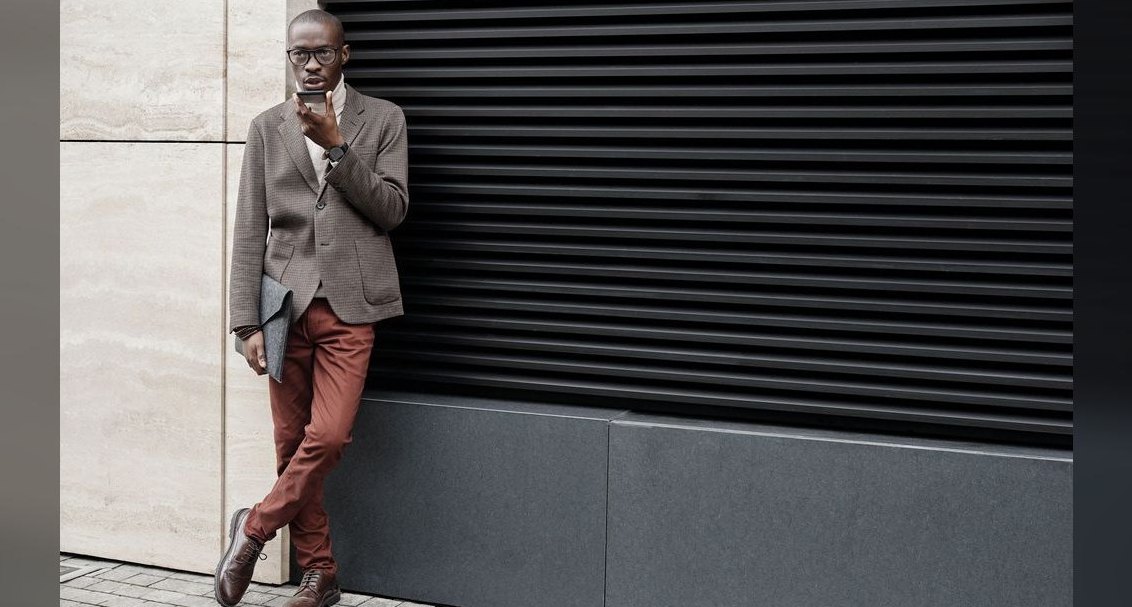
Smart casual / business casual — the modal American office, and the default when your evidence is ambiguous. Target: tailored trousers in charcoal, navy, or khaki; a neutral knit or collared shirt; an unstructured blazer or cardigan; leather shoes with a matching belt. This look is correct in the large majority of workplaces and you can subtract the jacket to drop a full notch on the fly.
Formal — traditional law, banking, high-end client-facing consulting, certain government roles. Target: a suit or a sharply tailored jacket with contrasting trousers or a knee-length sheath; a crisp shirt or blouse; polished leather footwear. Verify rather than assume, because even formal firms have loosened in places.

Field, lab, healthcare, or safety-regulated — the dress code is functional and non-negotiable. Ask before you buy anything, confirm PPE and footwear requirements, and wear something clean and modest for the classroom or onboarding portion of the day.
Within whichever band applies, adjust for stage. In your twenties, keep the cut modern and slim, lean on one strong knit or button-down, and let clean footwear carry the look — you are not expected to own a deep wardrobe and trying to look senior usually reads as costume. In your forties, add the structured layer: a blazer or a sheath does most of the work of projecting settled competence, and a real structured bag rather than a backpack reinforces it. In your sixties, favor classic cuts, better fabric, and a quieter palette — a fine-gauge knit, well-cut trousers, and a low, comfortable leather shoe convey authority without effort, and the finer fabric is the tell that separates classic from dated.
Two rules cut across every band and every stage. Keep the palette neutral and coordinated — navy, charcoal, gray, camel, ecru, olive — with the belt matched to the shoes, and keep accessories to one or two quiet pieces: a simple watch, a wedding band, studs. Save the personality for week three, when people know what you do and the outfit is no longer the primary data point. And whatever the band, the removable layer is the hedge that makes the whole system work: it is the one garment that lets you correct a wrong guess in under a minute.
Related questions
Should I wear what I wore to the interview?
Usually one notch down. Interview attire is deliberately conservative because you were an outsider; on day one you are staff. If the interview was formal and in-person, drop the tie or swap the suit jacket for an unmatched blazer.
What if the office is fully remote and day one is on video?
Dress the top half properly — a collared shirt or clean knit in a solid color, no busy patterns that shimmer on camera. Check your framing and lighting before the first call. Comfortable bottoms are fine; standing up mid-call is the only risk.
How much should I actually spend?
One outfit, not a wardrobe. Roughly $180 to $350 assembles a complete mid-market look; $80 to $200 covers filling a gap or two. Weight the spend toward shoes and tailoring, and buy the rest after you have seen the office.
What if I get it wrong on day one?
If you overdressed, remove the layer within the first hour and correct tomorrow — nobody remembers by Wednesday. If you underdressed, dress up the next day without commenting on it. One day's miscalibration has no lasting cost; the visible anxiety about it does more damage than the outfit did.
Do tattoos, piercings, or dyed hair need covering?
Look at what current employees show in candid photos and on-site. Most workplaces have relaxed substantially, but customer-facing and regulated roles vary. If your evidence is thin, keep it low-key on day one and recalibrate once you see the room.
FAQ
Should I wear a suit if I'm unsure about the dress code?
Only if you have evidence the culture is formal. Outside law, banking, and client-facing consulting, a matching suit can read as not having researched the place. The safer play is a blazer over neutral trousers or a structured dress — you can remove the jacket in the first hour and land exactly at the room's level.
What if the dress code is genuinely casual — jeans and tees?
Still go one notch up: dark, clean denim with a button-down or a good knit, and leather sneakers or loafers. It reads as taking the day seriously without looking like a visitor. Match the team's actual baseline from day two onward.
How much do shoes really matter?
More than almost anything else in the outfit. Shoes are examined, they signal care, and scuffs are visible from across a room. Clean leather loafers, oxfords, boots, or minimalist leather sneakers in a neutral color all work — condition matters far more than style or price.
Can I wear color or a pattern?
Keep day one to muted neutrals — navy, charcoal, camel, gray, olive. A single quiet accent is fine. Bold color and busy pattern read as a statement before people have any context for you, and you want the first data point to be competence, not taste. Introduce personality from week two.
What should be in my bag?
A notebook and two pens, a charger or power bank, a water bottle, any onboarding paperwork or ID they asked for, breath mints, and a lint roller if you have one. Choose a clean, structured bag in a neutral color with no visible logos, large enough for a laptop but not oversized.
Does any of this change if I'm the most senior person on the team?
The band doesn't change, the execution does. Senior hires are read faster and more critically, so fit and fabric quality carry more weight — a well-cut jacket or a good knit in real wool does the work. Stay within the office's band rather than above it; visibly outdressing the team you now lead creates distance you'll spend weeks closing.
Sources
- https://hbr.org/ — Harvard Business Review, research and commentary on first impressions, onboarding, and workplace norms
- https://www.shrm.org/ — Society for Human Resource Management, employer guidance on dress codes and onboarding practices
- https://www.bls.gov/ooh/ — U.S. Bureau of Labor Statistics Occupational Outlook Handbook, occupational and industry work-environment data
- https://www.linkedin.com/blog/ — LinkedIn Official Blog, career advice and workplace trend coverage
- https://www.gartner.com/en/human-resources — Gartner HR research on hybrid work and evolving workplace expectations
- https://www.mckinsey.com/featured-insights/future-of-work — McKinsey, future-of-work and return-to-office research
- https://www.pewresearch.org/ — Pew Research Center, survey data on remote and hybrid work in the U.S.
- https://www.gallup.com/workplace/ — Gallup, workplace and hybrid-work survey research
Related on PULSE
- [What to Wear to Your First Day at a New Job in Fall in 2027](/knowledge/sy0620)
- [What to Wear to Your First Day at a New Job in 2027](/knowledge/sy0265)
- [What to Wear to a New Year's Day Brunch in 2027](/knowledge/sy0484)
- [What to Wear in New York City in Summer in 2027](/knowledge/sy0823)
- [What to Wear in New Orleans in 2027](/knowledge/sy0654)
- [What to Wear in New York City in Fall in 2027](/knowledge/sy0628)
@Kory-White- · if Venmo asks, the last 4 of my number are 2012
 pulse-styleWhat Should You Wear to a Work Sports Game in 2027?
 pulse-styleTop 10 Men’s Dress Shoes for Work in 2027
 pulse-styleWhat to Wear to a Client Meeting in 2027
 pulse-styleWhat to Wear to a Networking Event in 2027
 pulse-styleWhat Is Smart Casual in 2027?
 pulse-styleTop 10 Dress Socks for Work in 2027
 syHow do you get started with Style in 2027?
 pulse-styleWhat are the most common mistakes in Style in 2027?
 pulse-styleWhat to Wear in London in Summer in 2027
 pulse-styleWhat to Wear to a Wine Country Trip in 2027