
What is the recommended Food Delivery Marketplace sales and operations tech stack in 2027?
 Curated byKory White · Fractional CRO · Maryland
 PULSEKNOWLEDGE LIBRARY
The recommended Food Delivery Marketplace tech stack pairs a proprietary in-house dispatch and matching engine with bought restaurant-integration middleware — Olo Dispatch, Otter, ItsaCheckmate, or Chowly — because no marketplace operator can outsource three-sided optimization but every operator loses money building POS integrations from scratch. Layer in Mapbox, Snowflake, Databricks, Stripe Connect, and Sift for routing, forecasting, payments, and fraud in normal sales and operations flow.
The Build-vs-Buy Split Across the Stack
Every serious Food Delivery Marketplace operator faces the same fork at each layer of the stack: build proprietary technology where the three-sided matching problem is the actual product, or buy commodity infrastructure where a vendor has already solved the problem for hundreds of other companies. Getting this split wrong in either direction is the single biggest source of wasted engineering time in the category.
The build side is narrow but non-negotiable. Dispatch and matching — deciding which courier picks up which order, in what batch, with what estimated time of arrival — has to be proprietary because it encodes the operator's specific density, restaurant mix, and courier supply curve. No commercial dispatch product exists that a DoorDash-scale or even a regional operator can license, because the moment you buy someone else's matching logic you have handed over your only defensible moat. The same logic applies to the marketplace platform itself: menu display, cart, checkout, and the courier-facing app are all built in-house at every operator past the earliest pilot stage. Loyalty and subscription programs (DashPass-style, Uber One-style) also stay in-house, because eligibility rules, free-delivery thresholds, and cross-pillar bundling are too close to core unit economics to hand to a vendor — though they are typically built on top of a bought billing primitive like Stripe Billing rather than a custom ledger.
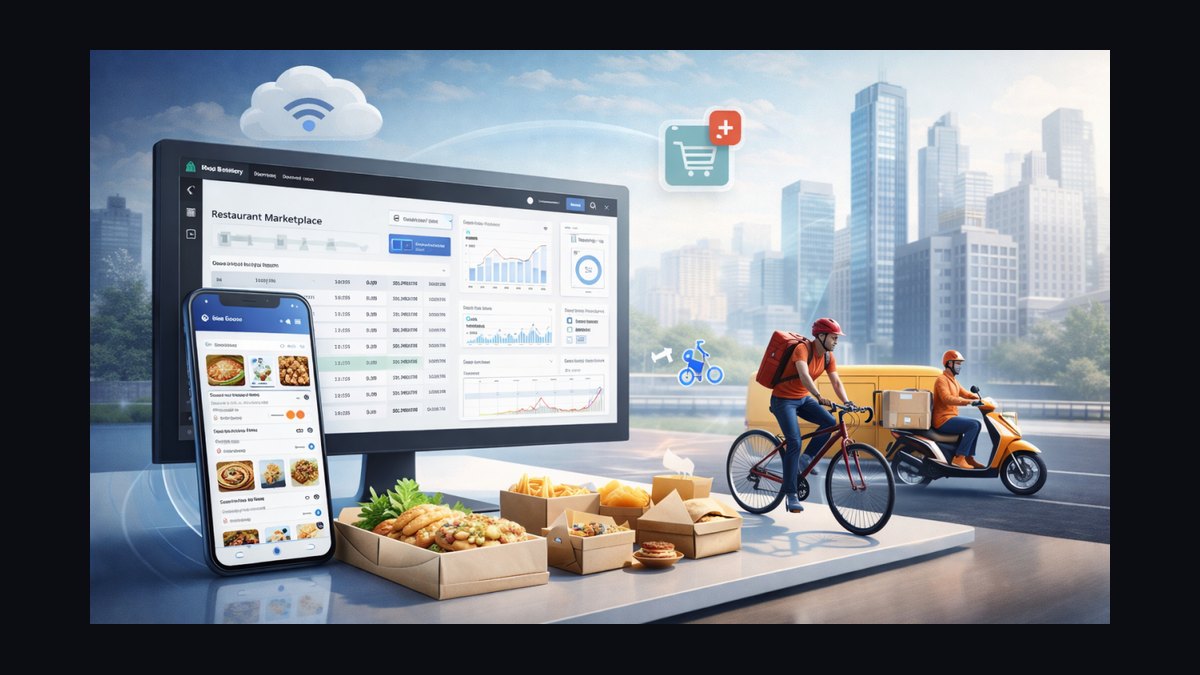
The buy side is where restaurant-integration middleware sits, and it is the layer that makes food delivery structurally different from rideshare. Vendors like Olo Dispatch, Otter, ItsaCheckmate, and Chowly exist because pushing an order into a restaurant's point-of-sale system — Toast, Square, Aloha, Micros, Brink — in real time, and getting a "ready" signal back, is a deep, unglamorous integration problem against hundreds of thousands of restaurant locations running dozens of legacy POS platforms. No operator that has tried to build this in-house has kept it in-house past a few dozen restaurants; the maintenance burden of one-off integrations scales linearly with restaurant count and never levels off. Buying this layer is not a compromise — it is the correct operations decision, freeing engineering time for the dispatch and marketplace layers that actually differentiate the business.
Maps and routing, payments, fraud, courier onboarding, customer support, and lifecycle marketing all sit firmly on the buy side too, following the same pattern established in rideshare: Mapbox or Google Maps for routing, Stripe Connect or Adyen for split payments, Sift or Forter for fraud scoring, Checkr and Persona for courier background checks and identity verification, Zendesk and Intercom Fin for support, and Braze or Iterable for consumer lifecycle messaging. None of these are differentiating enough to justify a build, and all of them are mature enough as vendor categories that buying gets an operator to production faster and cheaper than building.
How to Decide Between In-House and Vendor Middleware
The decision rule is simpler than the stack looks: build where the technology directly encodes your competitive matching logic across all three sides of the marketplace, buy where the problem is shared by every operator in the category and a vendor has already amortized the solution cost across hundreds of customers. Restaurant POS integration specifically should never be built in-house past the pilot stage — treat that decision as settled, not open, for any operator planning to scale past a handful of markets.
Applying this decision tree in practice means an operator entering a new market should never start by asking "which vendor should we use for dispatch" — that question has already been answered by the category, and the answer is always build. The live decision each quarter is which restaurant-integration vendor combination covers the local restaurant base best: chain-heavy markets lean toward Olo Dispatch because its 100+ POS connections concentrate on enterprise systems like Toast and Micros, while independent-restaurant-heavy markets lean toward Otter's tablet-aggregation model or Chowly and ItsaCheckmate's direct POS sync, since those vendors were built for the long tail of single-location restaurants that will never get a custom Olo integration. Most operators running multiple markets end up contracting with two or three of these middleware vendors simultaneously rather than standardizing on one, because restaurant POS mix varies city by city and no single vendor has 100% coverage of every system in the field.
Concrete Numbers Behind Each Layer
Budget and pricing vary sharply by layer, and getting the order of magnitude wrong on any one of them distorts the entire operations plan. Restaurant-integration middleware runs $40 to $300 per restaurant per month depending on vendor and integration depth — Olo Dispatch's enterprise POS push commands the higher end of that range against chain accounts, while Otter, Chowly, and ItsaCheckmate's SMB-oriented tiers sit closer to the floor. At 5,000 active restaurants, that is $200,000 to $1.5 million a month just for the POS-integration layer, which is why middleware contract renegotiation is a recurring line item on every regional operator's budget review.
Maps and routing costs scale with request volume rather than restaurant count: Mapbox's in-app turn-by-turn navigation runs roughly $0.50 to $5.00 per 1,000 requests, while Google Maps Platform's geocoding and place-data calls run $5 to $17 per 1,000 at scale — most operators run both in parallel for redundancy and use whichever is cheaper for a given call type. Payments processing through Stripe Connect typically lands between 0.5% and 2.9% plus a fixed fee per transaction depending on card type and payout configuration, while Adyen's cross-border and high-volume rate sits closer to 0.6% plus interchange, which is why the largest global operators layer Adyen on top of a Stripe Connect core specifically for international volume.

Fraud and risk tooling is priced per event rather than per restaurant or per transaction: Sift runs roughly $0.05 to $0.20 per scored event, and promo abuse alone — stacked referral codes, courier-restaurant collusion, stolen-card orders — typically leaks 1% to 3% of gross order value at any operator running without a real fraud stack, which means the fraud vendor's cost is recovered many times over once daily order volume clears roughly 100,000. Courier onboarding costs $25 to $60 per Checkr background and MVR check plus $1 to $3 per Persona identity verification, a one-time cost per courier rather than a recurring one. Customer support blends a $115-per-agent-per-month Zendesk seat cost with a roughly $0.99-per-resolution Intercom Fin fee for AI-deflected tickets, and Intercom Fin resolving 60% to 70% of contact volume before it reaches a human agent is the single biggest support-cost lever available to an operations team.
Rolled up by operator size, an early-stage operator running one to three cities under 20,000 orders a day should expect roughly $80,000 to $200,000 a month in combined software and cloud spend. A regional operator spanning 10 to 50 cities at 200,000 to 2 million orders a day moves into the $2.5 million to $12 million a month range once Snowflake, Databricks, dual middleware vendors, and a full fraud and support stack are all live. A national or global operator running 100-plus cities at 10 million-plus orders a day scales to $35 million to $200 million-plus a month all-in, with cloud infrastructure alone consuming 35% to 50% of that total — a ratio that surprises operators used to thinking of cloud as a minor line item relative to headcount.
Implementation Details and Sequencing
The correct rollout sequence protects restaurant supply first, because restaurants churn off a marketplace faster than couriers do the moment order accuracy slips — a restaurant that gets three wrong orders from a stale menu sync will pause its listing before a courier quits over a bad week of pay. That means the earliest priority in any new market is not the flashiest layer of the stack; it is getting exactly one restaurant-integration vendor live cleanly rather than half-integrating three.
In the first 30 days, stand up the in-house dispatch and matching MVP, wire Mapbox for courier navigation, turn on Stripe Connect for restaurant and courier payouts, and choose a single POS-integration vendor matched to the market's restaurant mix — Otter for SMB-heavy markets, Olo for chain-heavy ones. Get Checkr and Persona live immediately so courier onboarding runs without a human reviewer in the loop, since manual onboarding review is the most common early bottleneck on courier supply. Zendesk covers support on day one; nothing else needs to be live yet.

Between days 31 and 60, add Snowflake and a Databricks workspace, route every order event through Kafka, and ship the first prep-time prediction model — without it, the dispatch engine has no way to know whether a restaurant will have food ready in six minutes or sixteen, and couriers either idle at the counter or arrive before the order exists. Layer in Sift for promo-abuse defense before growth marketing ramps up, since fraud patterns compound faster once acquisition spend increases. Add Intercom Fin to deflect routine support tickets, stand up Braze or Iterable for the first lifecycle campaign, and bring on a second restaurant-integration vendor to close POS coverage gaps the first vendor cannot reach.
Days 61 through 90 harden the stack for expansion into a second and third city rather than adding new categories of vendor. Add a second map provider as a routing fallback so a single vendor outage never stalls dispatch citywide. If international expansion is on the roadmap, bring Adyen on top of Stripe Connect for cross-border settlement. Deploy Twilio Flex for a dedicated restaurant-and-courier phone line, since chat-only support cannot handle time-critical issues like an order not showing up at all. This window is also the right moment to start an in-house sponsored-listings MVP, because a proprietary ad auction consistently outperforms any third-party ad-tech integration on marketplace margin once restaurant count supports competitive bidding. By the end of day 90, the stack should be able to scale from three cities to thirty without a re-platform — the sign of a healthy sequence is that nothing built in the first 90 days needs to be ripped out to support the next twenty markets, only extended.

Related questions
Should I use one restaurant-integration vendor or several?
Most operators run two or three simultaneously — Olo for chain accounts, Otter or Chowly for independents — because no single middleware vendor covers every POS system a restaurant base will include.
Is in-house dispatch ever the wrong choice for a small operator?
No. Even at three cities, a lightweight in-house matching engine outperforms any licensed alternative, since dispatch logic must encode local density and restaurant timing that no vendor product captures.
When should Adyen be added on top of Stripe Connect?
Add Adyen once international or high-volume cross-border payment settlement becomes a real percentage of order volume — Stripe Connect alone covers single-country operations well past regional scale.
How much of the budget should go to fraud tooling?
Treat fraud spend as self-funding: Sift or Forter costs pennies per event but typically prevents 1% to 3% of gross order value from leaking to promo abuse and collusion once volume passes 100,000 orders a day.
FAQ
Can a Food Delivery Marketplace launch without any restaurant-integration middleware? Not past a handful of restaurants. Manual order entry or tablet farms collapse once a restaurant runs multiple platforms, since 86'd items and price changes stop syncing and cancellations spike.
Is Snowflake or Databricks the higher priority in the first 90 days? Neither is needed on day one. Both matter starting around day 31, when prep-time prediction and demand forecasting become necessary to keep dispatch accurate as order volume grows.
Does the recommended stack change for a grocery-plus-restaurant hybrid operator? The core stays the same, but hybrid operators typically add a second, grocery-specific dispatch path alongside the restaurant dispatch engine, since grocery orders have different weight, batching, and substitution logic.
What is the fastest way to lose restaurant supply in a new market? Order errors from unsynced menus and inventory. This is why choosing one working POS-integration vendor in the first 30 days outranks every other operations priority at launch.
Should courier onboarding be manual in an early market? No. Checkr and Persona should be live from day one; manual review of background checks and identity verification is the most common early bottleneck on courier supply growth.
Is a proprietary ad server necessary at launch? No. Sponsored listings and an in-house ad auction are a days 61-90 or later priority — they depend on having enough restaurant density for competitive bidding to generate meaningful revenue.
Sources
- https://stripe.com/connect
- https://www.olo.com/dispatch
- https://docs.mapbox.com/help/getting-started/maps/
- https://www.snowflake.com/
- https://www.databricks.com/
- https://www.zendesk.com/
- https://www.twilio.com/en-us/flex
- https://www.braze.com/
- https://checkr.com/
- https://www.adyen.com/
Related on PULSE
- [What is the recommended Rideshare and Mobility Marketplace sales and operations tech stack in 2027?](/knowledge/tk0213)
- [The Marketplace Platform Tech Stack in 2027](/knowledge/tk0495)
- [What is the recommended Online Grocery and Q-Commerce Delivery sales and operations tech stack in 2027?](/knowledge/tk0209)
- [The Restaurant Operations Tech Stack: POS, Inventory, and Delivery in 2027](/knowledge/tk0492)
- [Top 10 Mobile Tech Stacks for On-Demand Delivery Apps](/knowledge/tk0368)
- [Tech Stack for Food Trucks in 2027](/knowledge/tk0280)
This page will be disappearing soon. Save it to your device for $1 — or read it free while it is here.
@Kory-White- · if Venmo asks, the last 4 of my number are 2012
 pulse-tech-stacksWhat is the recommended Vector Database vendor sales and operations tech stack in 2027?
 pulse-tech-stacksWhat is the recommended Post-Quantum Cryptography (PQC) Crypto-Agility Vendor sales and operations tech stack in 2027?
 pulse-tech-stacksWhat is the best tech stack for a flooring contractor in 2027?
 pulse-tech-stacksTech Stack for Nail Salons in 2027
 pulse-tech-stacksWhat is the best tech stack for a nonprofit organization in 2027?
 pulse-tech-stacksWhat is the best tech stack for a commercial plumbing contractor in 2027?
 pulse-tech-stacksTech Stack for Private Daycares in 2027
 pulse-tech-stacksWhat is the best tech stack for an independent retail pharmacy in 2027?
 pulse-tech-stacksWhat is the best tech stack for a residential solar installation company in 2027?
 pulse-tech-stacksWhat is the best tech stack for a family entertainment center in 2027?