
What is the recommended Endpoint Detection and Response (EDR) Vendor sales and operations tech stack in 2027?
 Curated byKory White · Fractional CRO · Maryland
 PULSEKNOWLEDGE LIBRARY
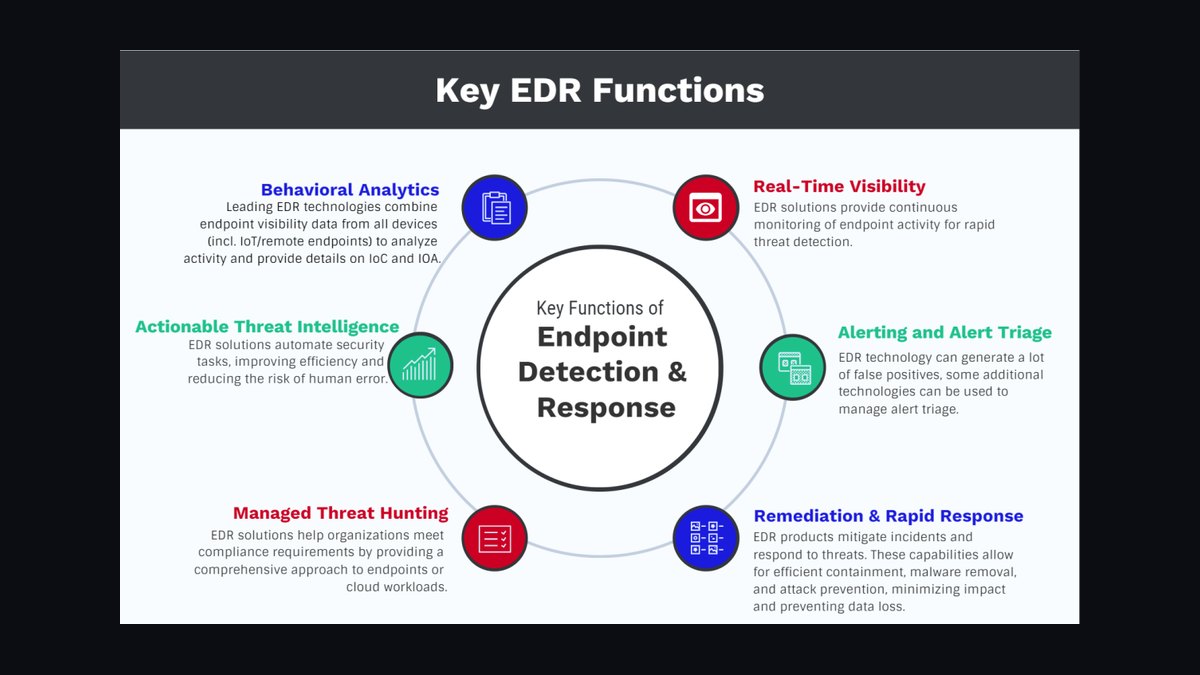
The recommended 2027 EDR vendor stack pairs eBPF/kernel-mode endpoint agents with Confluent Kafka ingest, ClickHouse plus Iceberg/S3 storage, and Apache Flink correlation feeding a Sigma-based detection engine and ML behavioral models. Operations run on Salesforce Sales Cloud, Clari, Gong, and Outreach for sales; Zuora and NetSuite for billing; Gainsight and Pendo for adoption; and Vanta, Drata, Hyperproof, and AuditBoard for the SOC 2, ISO 27001, and FedRAMP compliance stack buyers now demand.
The two (or more) options compared
Every EDR vendor building or refreshing its stack in 2027 faces a binary choice at the storage and detection layer, and a parallel binary choice at the sales-motion layer. On storage: ClickHouse Cloud + Iceberg/S3 versus Snowflake or Databricks. ClickHouse wins unit economics at trillion-event scale — sub-second analyst queries on hot data at $0.30-$1/GB, with Iceberg + S3 handling the cold tier for a fraction of that cost — but it demands an engineering team that can operate a distributed columnar store under load. Snowflake wins time-to-market: a two-person data team can stand up ingestion and query in weeks, not quarters, but the per-query and per-TB-scanned pricing compresses margin badly once a vendor crosses a few hundred billion events per day. The rule of thumb operators use: under $25M ARR, take Snowflake's speed; above that, the migration to ClickHouse/Iceberg pays for itself within 12-18 months in gross margin alone.
On detection engineering, the choice is build proprietary correlation on Apache Flink versus buy/partner via SIEM integration (Splunk, Microsoft Sentinel, Google Chronicle). Building wins for enterprise-tier positioning — the vendor owns detection latency, owns the ATT&CK coverage story, and can push new content without a partner's release cycle. Partnering wins for a vendor targeting SMB or mid-market accounts that already run a SIEM and don't want a second console; the EDR vendor ships telemetry outward and lets the SIEM do correlation, cutting the vendor's own R&D headcount by 30-80 threat researchers it would otherwise need to hire. On the sales side, the same fork appears between Salesforce Enterprise + Clari + Gong (the enterprise-motion default once ACV crosses roughly $30K and cycles stretch past 90 days) and HubSpot Enterprise + Stripe for a vendor still proving product-market fit under $30-50M ARR — HubSpot's lower total cost of ownership matters more than Salesforce's customization depth until deal complexity (multi-year ramps, platform-module attach, channel splits) actually requires it.
How to decide between them (mermaid)
The decision tree below is not about which tool is objectively better — it is about which stage of company a vendor is in and which constraint binds hardest: capital, headcount, or time-to-enterprise-credibility. A vendor with venture runway but no enterprise logos yet should optimize for speed (Snowflake, HubSpot, SIEM partnership) even at worse unit economics, because the alternative — spending 18 months building proprietary infrastructure before closing a single $200K deal — burns more cash than the margin loss ever would. A vendor already closing $1M+ ACV enterprise deals should flip the calculus: at that ACV, buyers expect proprietary detection IP, sub-5-minute alert latency at their endpoint volume, and a CRM sophisticated enough to model multi-year ramps and platform-module expansion. Running HubSpot against a Fortune 500 security team signals under-investment before the demo even starts.
The migration point itself deserves a number: most operators who cross from the "speed" branch to the "scale" branch describe an 8-14 month dual-running period where both the old (Snowflake/HubSpot) and new (ClickHouse/Salesforce) stacks operate simultaneously against live customer data, because cutting over a security product's telemetry pipeline in a single weekend risks the exact kind of outage that costs renewals.
Concrete numbers behind each option
Storage cost is the clearest lever. A vendor ingesting 500 billion events/day (roughly the range for a $50-100M ARR EDR company with 1,000-3,000 customers) pays in the range of $150K-$400K/month on ClickHouse Cloud hot tier plus Iceberg/S3 cold tier, versus $600K-$1.5M/month running the equivalent query volume through Snowflake's compute-and-storage pricing — the gap widens as event volume grows because Snowflake's per-query compute cost scales with data scanned, not just stored. Confluent Kafka ingest itself runs roughly $0.11/GB written on Confluent Cloud; a vendor at that same 500B events/day volume, assuming ~1KB average event size, is writing ~500TB/day, which pushes a fully-managed Kafka bill into six figures monthly — enough that vendors above $100M ARR typically self-manage Kafka on EKS/GKE to cut that line by 50-70%, accepting the operational burden in exchange.
On the sales-stack side, Salesforce Enterprise runs $165/user/month before add-ons; layering Clari ($80-130/user/month), Gong ($1,600/user/year, so ~$133/user/month), and Outreach ($130/user/month) puts a fully-loaded AE seat at roughly $500-550/month before CPQ or LeanData. Against a rep quota of $1-2M ARR annually, that's under 0.5% of quota — a rounding error next to the cost of a slow or blind sales motion. HubSpot Enterprise, by contrast, bundles CRM, sequencing, and reporting for roughly $150-200/user/month all-in, a genuine 60-70% discount, which is precisely why it remains the correct choice pre-$30M ARR even though it lacks Salesforce's custom-object depth for tracking incumbent-vendor displacement and platform-module attach. Compliance spend follows a similar step function: Vanta or Drata alone runs $30K-$100K/year for SOC 2 automation, but a vendor pursuing FedRAMP High on top of that is looking at $3M-$10M in direct authorization cost over 30-48 months — a number so large it should only be committed against a already-qualified $50M+ federal pipeline, never speculatively.
Implementation details and sequencing (mermaid)
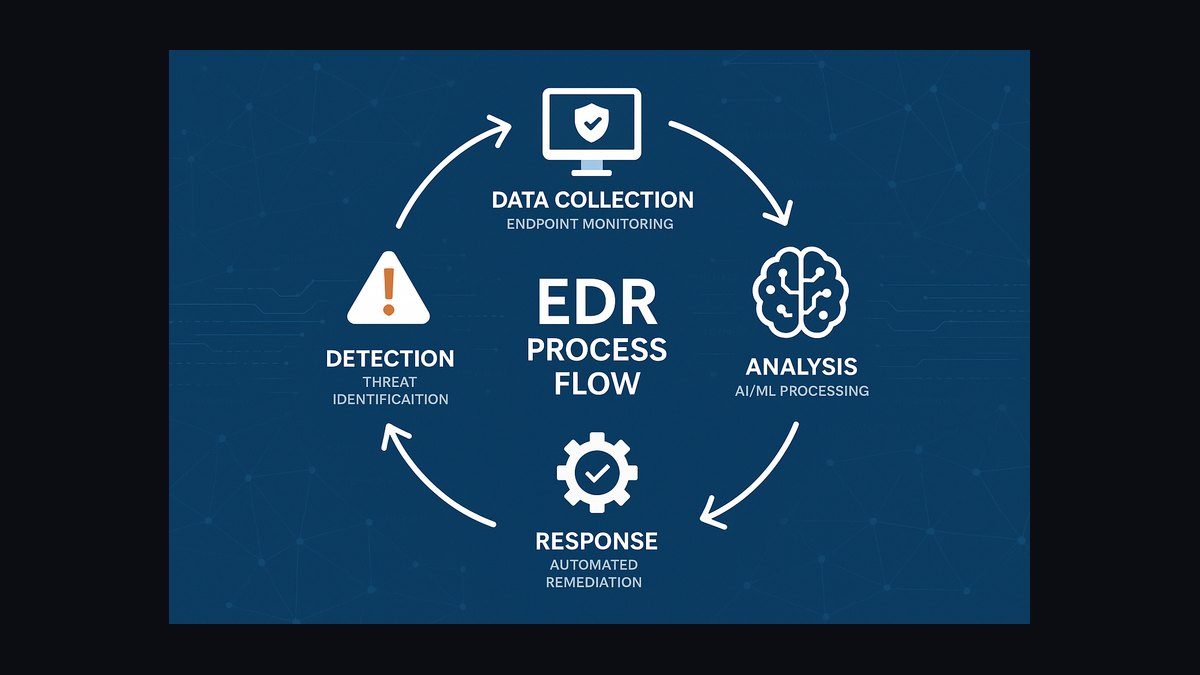
Sequencing matters more than tool selection, because an EDR vendor's stack has a hard dependency order: telemetry infrastructure must exist before detection content can be tested, and detection content must be stable before a sales team can credibly sell it into an enterprise bake-off. The 90-day plan below reflects the sequencing that operators actually run, compressed from the fuller build-out that continues for 12-24 months in parallel with the compliance and channel work.
In the first four weeks, the priority is getting real telemetry flowing end to end — even a single Windows agent against a small design-partner base — because every downstream decision (which storage tier, which detection framework) is easier to validate against live event volume than against projections. Weeks five through eight are where the detection engine gets built and, critically, tested against MITRE ATT&CK's Atomic Red Team corpus and internal red-team exercises before any customer sees an alert; skipping this step is the single most common cause of an EDR vendor's first enterprise bake-off failing on false-positive rate. By weeks nine through twelve, the sales stack needs to be live with the custom objects that matter for this specific product category — incumbent vendor being displaced (Symantec, McAfee, Defender, CrowdStrike, SentinelOne), endpoint count, and which platform modules (identity, cloud workload, email) the prospect is evaluating — because generic CRM fields cannot support the platform-consolidation pitch that wins or loses most EDR deals in 2027. Compliance evidence collection through Vanta or Drata should start in this same window, not after, since SOC 2 Type II requires a minimum observation period before the audit can even begin, and enterprise procurement gates increasingly block on compliance status before technical evaluation starts at all.
Related questions
Should a new EDR vendor build its own agent or license one?
Licensing (via OEM agreements or open-source eBPF frameworks like Cilium Tetragon) saves 30-100 engineer-years per OS but caps differentiation. Vendors targeting enterprise typically build within 18-24 months once funded.
How does channel partner revenue affect the sales stack choice?
Channel-heavy vendors (CDW, Optiv, GuidePoint) need CRM support for deal registration and partner-sourced pipeline tracking, which pushes toward Salesforce's partner community features over HubSpot even at lower ARR.
What triggers the move from Snowflake to ClickHouse?
Typically crossing $25-50M ARR or roughly 100 billion events/day, whichever forces query costs above what a dedicated data engineering hire would cost to operate ClickHouse instead.
Does XDR expansion change the core stack choice?
Yes — adding identity, cloud, and email correlation multiplies ingest volume 2-4x, which accelerates the ClickHouse/Iceberg migration timeline regardless of current ARR.
FAQ
Is Snowflake ever the permanent answer, even at scale? Rarely for pure-play EDR. A few hyperscale vendors keep Snowflake for business intelligence and customer-facing analytics while running ClickHouse or custom storage for the raw telemetry pipeline — the two serve different query patterns.
Can a vendor run HubSpot and still close $1M+ enterprise deals? It's possible but uncommon past a handful of deals; the lack of CPQ-grade ramp modeling and custom-object depth becomes a visible gap once legal and procurement start requesting complex multi-year terms.
Does the storage choice affect detection latency directly? Yes — ClickHouse's columnar design supports the sub-second scans that real-time Flink correlation depends on; Snowflake's query latency, even when fast, is not built for the streaming-join patterns detection engines need.
How much does the eBPF vs kernel-module choice affect the sales conversation? Directly — buyers post-2024 explicitly ask about kernel-mode footprint and rollback procedures during technical evaluation, so eBPF's lighter footprint has become a talking point AEs are trained to lead with.
Is partnering with a SIEM a permanent strategy or a stepping stone? Usually a stepping stone. Vendors that stay SIEM-dependent past $100M ARR tend to lose platform-consolidation deals to CrowdStrike and Microsoft, who own both the endpoint and correlation layers natively.
What's the minimum viable compliance posture to start selling to enterprise? SOC 2 Type II plus ISO 27001 covers most commercial enterprise gates; FedRAMP and Common Criteria are additive investments reserved for vendors with a qualified federal or highly-regulated pipeline.
Sources
- MITRE ATT&CK — https://attack.mitre.org
- MITRE Engenuity ATT&CK Evaluations — https://mitre-engenuity.org/cybersecurity/attack-evaluations/
- ClickHouse Cloud documentation — https://clickhouse.com/docs
- Confluent Cloud pricing and architecture — https://www.confluent.io/confluent-cloud/
- Cilium Tetragon eBPF runtime security — https://tetragon.io
- Salesforce Sales Cloud pricing — https://www.salesforce.com/sales/pricing/
- Vanta compliance automation — https://www.vanta.com
- FedRAMP Program Management Office — https://www.fedramp.gov
- Apache Flink documentation — https://flink.apache.org
- Snowflake documentation — https://docs.snowflake.com
Related on PULSE
- [What is the recommended Managed Detection and Response (MDR) Provider sales and operations tech stack in 2027?](/knowledge/tk0229)
- [What is the recommended Incident Response (IR) Firm sales and operations tech stack in 2027?](/knowledge/tk0241)
- [What is the recommended Fraud Detection and AML Software vendor sales and operations tech stack in 2027?](/knowledge/tk0226)
- [The Social Media Analytics Stack: Real-Time Sentiment and Trend Detection with Apache Flink and Elasticsearch](/knowledge/tk0430)
- [Top 10 Machine Learning Stacks for Fraud Detection Systems](/knowledge/tk0372)
- [The ELK Stack for Real-Time Fraud Detection in E-Commerce](/knowledge/tk0367)
This page will be disappearing soon. Save it to your device for $1 — or read it free while it is here.
@Kory-White- · if Venmo asks, the last 4 of my number are 2012
 pulse-tech-stacksWhat is the best tech stack for a specialty food or grocery retailer in 2027?
 pulse-tech-stacksWhat is the best tech stack for an independent retail pharmacy in 2027?
 pulse-tech-stacksTech Stack for Music Schools in 2027
 pulse-tech-stacksWhat is the best tech stack for a pawn shop in 2027?
 pulse-tech-stacksWhat is the best tech stack for a tax preparation service in 2027?
 pulse-tech-stacksWhat is the recommended AI Coding Tools sales and operations tech stack in 2027?
 pulse-tech-stacksWhat is the best tech stack for a roofing contractor in 2027?
 pulse-tech-stacksWhat is the best tech stack for an e-commerce or DTC brand in 2027?
 pulse-tech-stacksWhat is the recommended Grocery Retail sales and operations tech stack in 2027?
 pulse-tech-stacksTech Stack for Barbershops in 2027