
What is the recommended GenAI / Enterprise RAG Platform sales and operations tech stack in 2027?
 Curated byKory White · Fractional CRO · Maryland
 PULSEKNOWLEDGE LIBRARY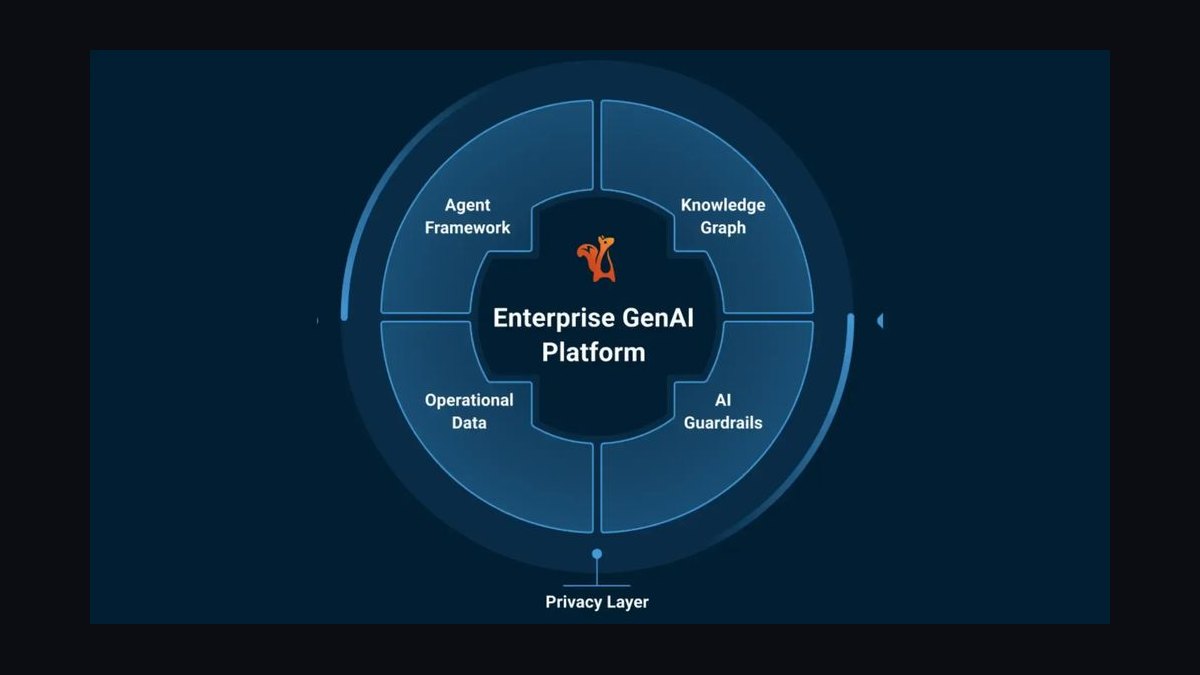
The recommended 2027 GenAI/Enterprise RAG platform stack pairs a retrieval pipeline — connectors, parsing, chunking, embeddings, vector storage, hybrid retrieval, re-ranking, permission-aware filtering, generation — with an enterprise revenue engine: Salesforce, Clari, Gong, Outreach, usage billing via Metronome or Stripe, NetSuite, Gainsight, and Vanta-class compliance covering SOC 2, ISO 42001, and GDPR.
The two build paths every RAG platform vendor must choose between
Every GenAI/Enterprise RAG platform vendor faces the same architectural fork within its first eighteen months, and the choice cascades into pricing, hiring, and the shape of the entire sales motion. Path one is assemble-and-differentiate: license the commodity layers — managed vector storage from Pinecone or Weaviate, parsing from Unstructured.io or LlamaParse, embeddings from OpenAI, Cohere, or Voyage AI, re-ranking from Cohere Rerank — and concentrate all engineering capital into the two layers customers actually cannot buy off the shelf: native source-system connectors and permission-aware retrieval. Path two is own-the-pipeline: build parsing, chunking, indexing, and retrieval in-house, self-host embedding models like BGE or Nomic, and run vector storage on pgvector or Milvus you operate yourself.
The trade-off is not ideological, it is a cash-flow and gross-margin question. Assemble-and-differentiate gets a working platform in front of design partners in roughly one quarter, but it carries per-query and per-document COGS that compress gross margin into the 55–70% band that SaaS investors punish. Own-the-pipeline pushes gross margin back toward the 78–85% range enterprise software buyers' boards expect, but it front-loads twelve to twenty-four months of infrastructure engineering before the first differentiated feature ships. Most vendors that survive start on path one, then selectively repatriate the highest-volume layers — embeddings first, then vector storage — once query volume makes the API bill exceed the fully loaded cost of an infra team.
There is a third option worth naming honestly because it kills more startups than either path: wrap a hyperscaler managed RAG service — AWS Bedrock Knowledge Bases, Azure AI Search paired with Azure OpenAI, or Google Vertex AI Search — and sell workflow on top. This is the fastest path to a demo and the shortest path to commoditization, because the layer you added is the layer the hyperscaler ships next. It is defensible only when the wrapper is a genuine vertical product with proprietary content, workflow, and compliance posture, the way Harvey approaches legal or Hebbia approaches financial-services research. Selling "managed RAG, but friendlier" against a cloud provider's own catalog is a losing motion.
The product decision and the go-to-market decision are the same decision. Assemble-and-differentiate vendors sell speed-to-value and connector breadth; they win departmental deals at $50K–$250K ACV and expand. Own-the-pipeline vendors sell data residency, on-premises deployment, and cost predictability at volume; they win CIO-sponsored platform deals at $500K–$5M ACV with correspondingly longer cycles. Trying to run both motions from one sales team is the most common commercial failure in this category — the discovery questions, the security review depth, and the champion profile are genuinely different jobs.

How to decide between them
The decision framework is mercifully concrete. Start with query volume at steady state. Below roughly ten million retrieval queries per month across the customer base, third-party embedding and re-ranking APIs are cheaper than the engineers required to self-host and keep GPUs utilized. Above that, the arithmetic inverts, and every additional month on the API path is margin you are permanently donating to a model provider. Model this before you pick, not after — the migration cost from managed vector storage to self-hosted is measured in engineering quarters, not sprints.
Second, weigh deployment-mode demand in your actual pipeline, not your aspirational one. If more than a third of qualified opportunities require single-tenant VPC, on-premises, or air-gapped deployment — common in defense, healthcare, and European financial services — the assemble path becomes structurally hard, because you cannot ship a customer a managed vector database that lives in someone else's cloud account. Count the deals in your CRM that carry that requirement; if the number is small, do not architect for it.
Third, assess regulatory surface. Serving EU customers under the EU AI Act, healthcare customers under HIPAA, or federal customers under FedRAMP each impose distinct data-flow constraints. Every third-party API in the pipeline is a subprocessor you must disclose, contract with, and defend in security review. Vendors chasing FedRAMP Moderate frequently discover mid-authorization that half their pipeline dependencies lack FedRAMP-authorized offerings, forcing a costly late repatriation. Decide the compliance target first; let it constrain the architecture rather than surprise it.

Fourth, be honest about team composition. Self-hosting embeddings and vector search demands ML-infrastructure engineers who can profile GPU utilization, tune approximate-nearest-neighbor index parameters, and debug recall regressions. That is a scarce and expensive hire. A team of strong application engineers with no ML-infra depth should assemble, ship, and revisit the question after the next funding round.
The framework's output is not just an architecture, it is a go-to-market configuration. The left branch produces a land-and-expand motion where a departmental champion runs a two-week proof of concept against their own documents and expands laterally. The right branch produces a platform sale where a CIO or Chief AI Officer sponsors a formal evaluation, security review runs eight to sixteen weeks, and procurement involves legal review of model-provider subprocessor terms. Instrument your CRM to track which motion each opportunity actually is, because forecasting them with a single stage model produces wildly inaccurate commit numbers.

Concrete numbers behind each option
Document ingestion connectors. Each native connector costs roughly two to six engineer-months to build to enterprise quality — meaning it handles incremental sync, change detection, deletion propagation, rate-limit backoff, and permission extraction, not merely a bulk file pull. Budget ongoing maintenance at fifteen to twenty-five percent of the initial build per connector per year, because source-system APIs deprecate on their own schedules. A vendor supporting fifty connectors is carrying a permanent integration team. The licensed alternative — Workato, Tray.io, Merge.dev, or Paragon as an integration backbone — reaches breadth far faster but typically delivers shallower permission fidelity and change detection, which is precisely the capability enterprise buyers scrutinize. The pragmatic split most successful vendors run: build the top fifteen to twenty sources natively, license the long tail.
Parsing. Unstructured.io runs from low five figures into the low-to-mid six figures annually depending on document volume and whether you self-host the open-source distribution. LlamaParse sits materially lower for table-heavy and complex-document workloads. Reducto targets high-accuracy structured extraction; Mistral OCR serves European data-residency requirements; Azure Document Intelligence and AWS Textract are the natural picks when the customer is already committed to that hyperscaler and wants the subprocessor list short. Parsing quality is the single most underestimated determinant of RAG quality — a scanned PDF with handwritten annotations parsed badly produces garbage chunks that no frontier model can rescue.

Embeddings and vector storage. Costs scale with corpus size and re-embedding frequency, and re-embedding is the line item teams forget: every model upgrade or chunking-strategy change re-embeds the entire corpus. A corpus of ten million chunks re-embedded quarterly is four full passes a year. Managed vector storage from Pinecone prices on pods or serverless reads and writes; pgvector on Postgres you already run is effectively free at small scale and becomes an operational burden past roughly fifty million vectors, where dedicated engines like Qdrant, Weaviate, Milvus, or TurboPuffer earn their keep.
Retrieval and re-ranking. Hybrid retrieval combining BM25 with dense vector search consistently beats either alone: pure vector search misses exact-match queries like part numbers and error codes, and pure BM25 misses semantic paraphrase. Adding a cross-encoder re-ranker — Cohere Rerank, Voyage Rerank, or Mixedbread — costs additional per-query latency, typically a few hundred milliseconds on a candidate set of fifty to one hundred, and delivers a meaningful precision lift. Budget the latency explicitly: enterprise users abandon a search experience that exceeds roughly three seconds to first token.

Revenue and operations stack. Salesforce Sales Cloud Enterprise runs in the mid-hundreds-of-dollars-per-user-per-month range at list, with Unlimited higher; Gong, Clari, and Outreach each add four-figure annual per-seat costs. Usage billing is non-optional in this category because pricing is a blend of per-seat, per-query, and per-document-indexed — Metronome and Orb are the enterprise-grade metering choices, Stripe Billing covers self-serve. NetSuite anchors revenue recognition once ASC 606 treatment of usage overages gets complicated, which happens sooner than founders expect. Gainsight and Pendo instrument adoption; the health score that actually predicts renewal in this category is weekly active queriers as a percentage of licensed seats, not logins.
Compliance. Vanta, Drata, or Secureframe automate SOC 2 Type II and ISO 27001 evidence collection at a cost most Series A companies absorb comfortably. The step-function costs arrive later: ISO 42001 for AI management systems, HIPAA for healthcare, and above all FedRAMP, which is a multi-year, multi-million-dollar program requiring a sponsoring agency and a Third Party Assessment Organization. Do not start FedRAMP without a named federal pipeline that justifies it.

Implementation details and sequencing
The sequencing principle: ship retrieval quality before breadth, and permissions before either. A platform with five connectors and flawless permission inheritance closes enterprise deals. A platform with fifty connectors and stale permissions fails security review and generates an incident that ends the account. Order the roadmap accordingly.
Days 1–30 — pipeline spine. Ship connectors for the five sources that appear in nearly every enterprise corpus: SharePoint or OneDrive, Google Drive, Confluence, Slack, and Notion. Stand up parsing with Unstructured.io or LlamaParse with an OCR fallback path configured from day one. Choose a default embedding model, wire managed vector storage, and — critically — build the evaluation harness in the same sprint. You need a golden set of one hundred to three hundred question-and-expected-passage pairs drawn from real customer documents before you tune anything, because without it every subsequent retrieval change is a guess. Instrument recall@k and mean reciprocal rank from the first commit.

Days 31–60 — permissions and the revenue engine. Build permission propagation: sync users and group membership from Microsoft Entra ID, Okta, or Google Workspace, pull per-document ACLs from every source system, and enforce filtering at query time rather than post-generation. Target under five minutes of permission staleness, and add a query-time re-check against the source system for documents tagged sensitive. In parallel, stand up the commercial side — Salesforce with custom objects tracking source-system inventory, corpus size, sensitive-data classification, and departmental rollout plan; Gong for call capture; usage metering in Metronome or Stripe; Vanta for SOC 2 evidence. Those custom CRM objects matter: forecast accuracy in this category depends on knowing which connectors a deal is blocked on.
Days 61–90 — precision, multi-model, and outcomes. Add hybrid retrieval with a cross-encoder re-ranker and measure the precision lift against the golden set rather than assuming it. Add multi-model generation so customers can route by cost, latency, or regulatory constraint — cheap models for extractive lookups, frontier models for multi-document synthesis. Enforce citation-required generation where every claim maps to a retrieved chunk, add confidence scoring, and implement abstention when retrieval confidence falls below threshold. Abstention is a feature enterprise legal teams specifically ask about. Close out with Gainsight for customer success, Pendo for adoption analytics, and ISO 42001 evidence collection.
Four failure modes deserve engineered defenses rather than good intentions. Permission staleness — a user loses SharePoint access, sync lags a day, and the assistant answers from a document they can no longer open. Defend with near-real-time sync, query-time re-verification for sensitive classes, and alerting on permission drift. Parsing collapse on a customer's actual document mix, discovered during a proof of concept when it is most expensive. Defend with a layered parser strategy, per-customer parser configuration, and a parse-success dashboard segmented by document type. Hallucination beyond tolerance — a confident answer unsupported by any retrieved passage. Defend with citation enforcement, confidence thresholds, abstention, and continuous eval monitoring rather than spot checks. Connector breakage when a source-system API changes and hundreds of customers stop syncing. Defend with continuous integration tests against live source-system versions, deprecation tracking, multi-version connector support, and a hotfix release channel that does not require a full release train.
Where the competitive field sits and what it means for positioning
Positioning has to account for four distinct competitor classes, because each requires a different displacement argument. Horizontal enterprise AI search — Glean is the reference point — competes on connector breadth, permission depth, and end-user experience. Displacing it means being materially better in a specific dimension the buyer cares about, not broadly comparable. Hyperscaler managed RAG — AWS Bedrock Knowledge Bases, Azure AI Search with Azure OpenAI, Google Vertex AI Search — wins on procurement simplicity, existing committed cloud spend, and a short subprocessor list. You beat it on retrieval quality, connector fidelity outside the hyperscaler's own ecosystem, and multi-cloud neutrality.
Incumbent enterprise search — Elastic, Coveo, Lucidworks — arrives with installed base and existing contracts. The displacement argument is generative synthesis and permission-aware conversational retrieval rather than ranked link lists, and the risk is that incumbents ship credible AI layers on top of indexes they already run. Vertical specialists — Harvey in legal, Hebbia in financial research, Sana Labs in corporate learning — win on domain-specific document understanding and workflow integration, and command meaningful pricing premiums for it. A generalist platform competing head-on in a vertical specialist's home turf usually loses on evaluation criteria it did not know were being scored.

The practical consequence for revenue operations is that competitor identity must be a required field on every qualified opportunity, with close-rate and cycle-length reported by competitor class. Most RAG vendors discover, once they measure it, that win rates diverge by twenty points or more across those four classes. That single report should drive territory design, battlecard investment, and which deals a solutions architect is allowed to spend two weeks on. It is the highest-leverage operations instrument available in this category, and it costs one picklist field plus a dashboard.
Also treat the proof of concept as a governed motion, not a favor. A RAG proof of concept run against a customer's real corpus consumes real engineering time — connector configuration, parsing tuning, permission mapping, eval-set construction. Require a written success criterion signed before kickoff, a named business owner, a defined document scope, and a decision date. Vendors that skip this run permanent unpaid pilots. Vendors that enforce it convert proofs of concept at rates high enough to make solutions-architect headcount an obviously profitable investment rather than a cost center.
Related questions
Should a RAG platform vendor build its own vector database?
Almost never. Vector storage is a deep specialty with well-funded dedicated players. Bundle Pinecone, Weaviate, Qdrant, or pgvector as a customer choice and spend that engineering capital on connectors and permission-aware retrieval, where differentiation actually persists.
How many source connectors are enough to close enterprise deals?
Roughly fifteen to twenty native connectors covers the corpus of most enterprises, provided they include SharePoint, Google Drive, Confluence, Slack, Salesforce, ServiceNow, and a major object store. Depth of permission inheritance matters more to security reviewers than raw connector count.
What customer health metric actually predicts RAG renewal?
Weekly active queriers as a percentage of licensed seats, segmented by department. Logins and total query volume both flatter the picture. A shrinking active-querier ratio predicts churn one to two quarters ahead, giving customer success time to intervene.
Is FedRAMP worth pursuing for a Series B RAG vendor?
Only with a named federal pipeline. FedRAMP Moderate is a multi-year, multi-million-dollar program requiring an agency sponsor and a 3PAO. Pursue it when federal opportunity value clearly exceeds that investment, not speculatively.
How should usage-based pricing be structured for RAG?
Blend a per-seat platform fee with metered per-query and per-document-indexed components, with tier breakpoints. Pure per-query pricing punishes the adoption you need; pure per-seat leaves value uncaptured when a customer indexes a very large corpus.
FAQ
Should connectors be built in-house or licensed from an integration platform?
Build the top fifteen to twenty natively and license the long tail through Workato, Tray.io, Merge.dev, or Paragon. Native connectors deliver superior permission inheritance, change detection, and sync performance — exactly the attributes enterprise security reviewers probe. Integration backbones reach breadth faster but are typically shallower on ACL extraction, so relying on them for your primary sources creates a defensibility gap that surfaces in competitive evaluations.
How important is permission-aware retrieval, really?
It is existential for enterprise deals. A single incident where the assistant surfaces content a user should not see ends the account and damages the brand across the buyer's peer network. Permissions must sync from Entra ID, Okta, or Google Workspace plus per-document ACLs from each source system, filter at query time rather than after generation, and re-verify against the source for sensitive classes. Vendors with weak permission models simply lose enterprise.
Which embedding model should be the default?
Support several rather than betting on one. Offer a strong general-purpose commercial model as the default, a multilingual option for global corpora, a retrieval-specialized option where precision matters most, and a self-hostable open-weight option for regulated or air-gapped customers. Multi-model support is a sales asset because it lets buyers optimize on cost, quality, or data-residency independently — and it protects you when a provider changes pricing.
How do you prevent hallucination in an enterprise RAG deployment?
Enforce citation-required generation so every claim maps to a retrieved passage, score retrieval confidence, and abstain when confidence falls below threshold rather than generating anyway. Run continuous evaluation against a golden question set rather than periodic spot checks. Enterprise legal teams specifically ask about abstention behavior; being able to demonstrate it in a proof of concept converts a risk objection into a differentiator.
What does the sales cycle actually look like at enterprise ACVs?
Six to eighteen months, structured in three gates: technical evaluation via proof of concept against the customer's own documents; security review covering data residency, encryption, subprocessor disclosure, and permission inheritance; and business case built on measurable productivity or deflection outcomes. Staff a solutions architect on every proof of concept, and track connector-blocked deals as a distinct CRM state so forecasting reflects engineering dependencies.
Which compliance certifications are table stakes versus optional?
SOC 2 Type II is table stakes for any enterprise conversation, and ISO 27001 is effectively required for international buyers. ISO 42001 is rapidly becoming expected for AI-specific governance, and GDPR posture is mandatory for EU customers. HIPAA, PCI-DSS, FedRAMP, and CMMC are pipeline-driven — pursue each only when named opportunities justify the cost and the multi-quarter timeline they impose.
Sources
- https://cloud.google.com/vertex-ai/docs
- https://docs.aws.amazon.com/bedrock/latest/userguide/knowledge-base.html
- https://learn.microsoft.com/en-us/azure/search/
- https://docs.pinecone.io/
- https://python.langchain.com/docs/introduction/
- https://docs.llamaindex.ai/
- https://www.iso.org/standard/81230.html
- https://artificialintelligenceact.eu/
- https://www.elastic.co/guide/en/elasticsearch/reference/current/index.html
- https://docs.unstructured.io/
Related on PULSE
- [The LLM Application Stack: RAG, Vector DBs, and Orchestration in 2027](/knowledge/tk0515)
- [What is the recommended Fine-Tuning Platform sales and operations tech stack in 2027?](/knowledge/tk0257)
- [What is the recommended AI Eval Platform sales and operations tech stack in 2027?](/knowledge/tk0261)
- [What is the recommended GRC Governance Risk and Compliance Platform Vendor sales and operations tech stack in 2027?](/knowledge/tk0242)
- [The CPQ and Deal-Desk Stack for Enterprise Sales in 2027](/knowledge/tk0478)
- [The Low-Code Enterprise App Stack: Microsoft Power Platform, Azure Functions, and SharePoint](/knowledge/tk0443)
This page will be disappearing soon. Save it to your device for $1 — or read it free while it is here.
@Kory-White- · if Venmo asks, the last 4 of my number are 2012
 pulse-tech-stacksWhat is the best tech stack for a uniform or linen rental service in 2027?
 pulse-tech-stacksWhat is the best tech stack for an auto repair or body shop in 2027?
 pulse-tech-stacksWhat is the complete software stack for a towing company in 2027?
 pulse-tech-stacksWhat is the recommended Ski Resort Operations sales and operations tech stack in 2027?
 pulse-tech-stacksWhat is the best tech stack for a physical therapy clinic in 2027?
 pulse-tech-stacksWhat is the best tech stack for a nonprofit organization in 2027?
 pulse-tech-stacksWhat is the best tech stack for an auto parts distributor in 2027?
 pulse-tech-stacksWhat is the recommended Grocery Retail sales and operations tech stack in 2027?
 pulse-tech-stacksWhat is the best tech stack for an e-commerce or DTC brand in 2027?
 pulse-tech-stacksWhat is the best tech stack for a commercial plumbing contractor in 2027?