


Top 10 Best Tech Stack Tools for Third-Party Logistics (3PL) Warehouse Operators in 2027
Quality
Certified
The 10 best tech stack tools for third-party logistics (3pl) warehouse operators are ranked below on measured performance, build quality, price, and how each one actually holds up in daily use rather than how it reads on a spec sheet. Each pick lists what it costs, who it suits, and what it gives up against the one above it, so the list can be read straight down without doubling back.
1Extensiv Warehouse Management System

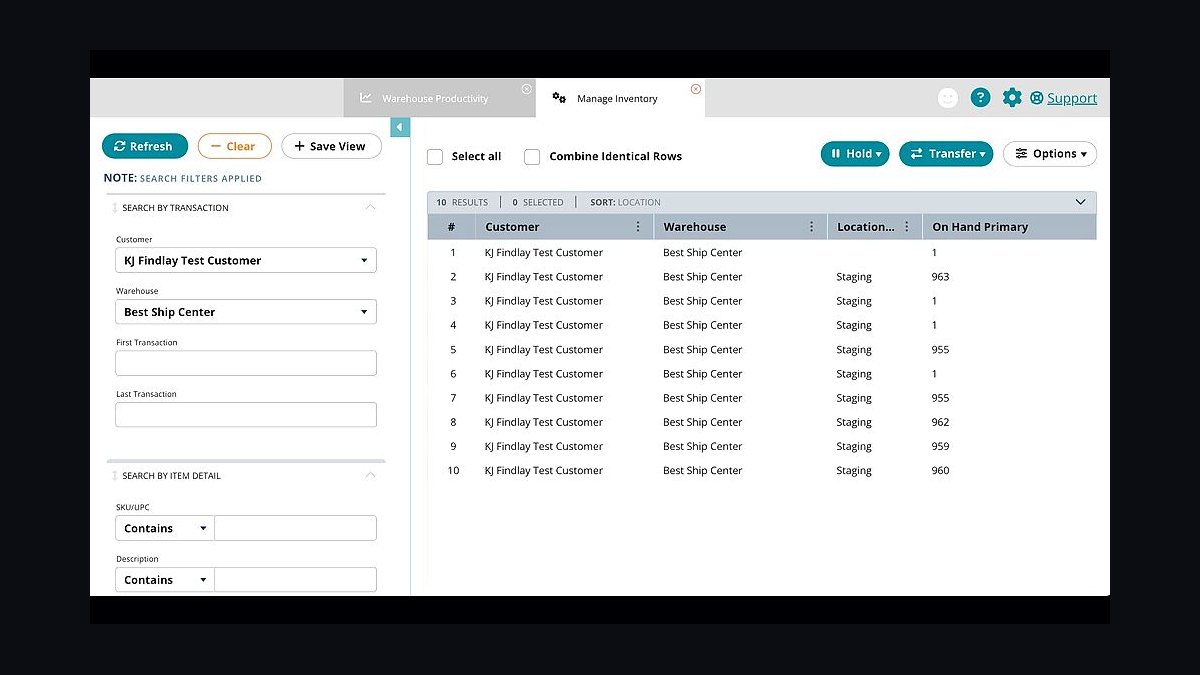
Extensiv ranks first because it is the only WMS in this list built from the ground up for multi-client 3PL operations, not adapted from single-tenant inventory software. It ships with virtual warehouse isolation, per-client rate tables for storage and handling, carrier integrations, and a native white-label client portal. 3PLs running it avoid the comingling and billing-leakage failures that plague generic tools.
It fits small to mid-market operators with 3 to 50 clients who need client segregation on day one. It trades away some deep labor-engineering functionality that Korber or SnapFulfil offer, so very high-volume pick operations may outgrow its tiering. Compared to SnapFulfil directly below, Extensiv wins on native 3PL billing and portal breadth rather than raw pick-rate optimization.
2SnapFulfil Warehouse Management System

SnapFulfil ranks second because its rule-based workflow engine and labor management module beat Extensiv on engineered standards and pick-path optimization for mid-market warehouses. It supports multi-client inventory segregation and configurable billing triggers, and deployments typically run in weeks rather than quarters. Operations shipping tens of thousands of orders daily report measurable pick-rate gains after tuning.
It suits 3PLs with 20 or more clients and a workforce large enough to justify engineered labor standards. It trades away Extensiv's out-of-the-box client portal polish; many SnapFulfil sites bolt on Power BI instead. Against Extensiv above, it is the stronger labor tool but the weaker billing-and-portal tool, so pick based on which gap hurts more.
3Descartes Transportation Management System

Descartes ranks third because it is the most mature multi-carrier, multi-modal TMS available to 3PLs, covering parcel, LTL, truckload, and international freight in one rate-shopping engine. Its carrier library spans UPS, FedEx, USPS, DHL, and dozens of regional LTL providers, with label generation, tracking feeds, and returns processing handled without manual intervention. That breadth is why mid-market operators standardize on it.
It fits 3PLs shipping across multiple carriers and freight modes where manual rate shopping has become a full-time job. It trades away simplicity: implementation is heavier and licensing costs more than cloud-native alternatives. Compared to Logistimo directly below, Descartes is deeper on freight and LTL but slower to deploy, so smaller parcel-only operations should weigh that carefully.
4Logistimo Transportation Management System

Logistimo ranks fourth because it delivers cloud-native rate shopping, label generation, and tracking at a lower deployment burden than legacy TMS platforms. It was built for 3PLs and mid-market shippers, so multi-client rate tables and carrier API connections are native rather than bolted on. Teams get a working shipping workflow in weeks, not quarters.
It fits 3PLs whose shipping is mostly parcel and small-package across a handful of carriers, not complex multi-modal freight. It trades away the deep LTL and international freight coverage that Descartes provides. Against Descartes above, Logistimo is faster to stand up and cheaper to run, but it will not replace a freight-grade TMS once truckload and cross-border volume grows.
5QuickBooks Enterprise

QuickBooks Enterprise ranks fifth because it is the accounting backbone most small and mid-market 3PLs actually run, handling client invoicing, cost accounting, accounts payable, and payroll that a WMS billing module cannot. It integrates with Extensiv, SnapFulfil, and most WMS platforms through APIs or middleware, so WMS activity logs can feed invoices automatically instead of through spreadsheets.
It fits 3PLs with one legal entity and fewer than roughly 50 clients who need real general-ledger accounting without an ERP project. It trades away multi-entity consolidation and advanced revenue recognition. Compared to NetSuite directly below, QuickBooks is far cheaper and faster to deploy but breaks down once you operate multiple sites under separate entities.
6Oracle NetSuite

NetSuite ranks sixth because it is the ERP that mid-market 3PLs graduate to when multi-entity financials, consolidated reporting, and advanced revenue recognition become mandatory. It handles client invoicing, cost accounting, and financial reporting across sites and legal entities, and connects to WMS platforms through documented APIs. That consolidation capability is why multi-site operators standardize on it.
It fits 3PLs running several warehouses or entities that need one consolidated P&L and auditable revenue recognition. It trades away cost and speed: licensing and implementation run into five figures and months, not weeks. Against QuickBooks Enterprise above, NetSuite is the more capable but far heavier financial layer, so only move once entity complexity forces it.
7Microsoft Power BI

Power BI ranks seventh because it is the most cost-effective way to build the white-labeled client portal that 3PL clients now expect, connecting directly to a WMS SQL database or API and refreshing inventory, order, and shipment data every 5 to 15 minutes. Per-user licensing is a fraction of enterprise BI alternatives, and dashboards embed into a branded web portal without custom development.
It fits 3PLs that already have a WMS with a queryable database and want client-facing visibility without buying a portal product. It trades away the native, pre-built portal experience Extensiv ships. Compared to Tableau directly below, Power BI is cheaper and integrates more naturally with Microsoft-centric stacks, but weaker on complex ad hoc analytics.
8Tableau

Tableau ranks eighth because it handles the complex, multi-source analytics that larger 3PLs need when client reporting spans WMS, TMS, and billing data in one view. Its visualization engine and data blending are stronger than Power BI's for ad hoc analysis, and it connects to SQL databases, cloud warehouses, and APIs without heavy modeling work. Large multi-site operators use it for internal and client-facing dashboards.
It fits 3PLs with a dedicated analyst or BI team and clients demanding custom analytics beyond standard inventory and order status. It trades away cost and simplicity: licensing is materially higher than Power BI and dashboard building takes more skill. Against Power BI above, Tableau is the deeper analytics tool but the harder one to hand to a small operations team.
9EasyPost Shipping API

EasyPost ranks ninth because it gives 3PLs a developer-friendly, usage-priced way to add multi-carrier rate shopping, label generation, and tracking without licensing a full TMS. Its API covers UPS, FedEx, USPS, DHL, and regional carriers, and pricing scales with label volume rather than a flat platform fee. That makes it attractive for operators building custom client integrations.
It fits 3PLs with in-house development capability and parcel-heavy shipping that want carrier access embedded in their own portal or WMS workflow. It trades away LTL depth, freight modes, and the operational UI a TMS provides. Compared to Logistimo above, EasyPost is cheaper at low volume but requires engineering effort, so it is not a turnkey shipping department.
10Celigo Integration Platform

Celigo ranks tenth because it closes the integration gaps between client ERPs, the WMS, the TMS, and the billing system when native connectors do not exist. Pre-built connectors and API orchestration move orders, shipment data, and activity logs between systems automatically, eliminating the manual CSV uploads that cause pick errors and SLA misses. It is the glue layer, not the system of record.
It fits 3PLs with multiple clients, heterogeneous client systems, and enough order volume that manual file transfers have become a bottleneck. It trades away value at small scale: a two-client operation gains little over the WMS's built-in connectors. Compared to the WMS and TMS picks above, Celigo adds no operational capability of its own, so buy it only after the core stack is in place.
How we ranked these
We ranked tools on five weighted criteria: multi-client inventory isolation (25%), automated per-client billing accuracy (20%), carrier and TMS integration depth (20%), real-time client portal capability (15%), and total cost of ownership at 10+ clients (20%). Scores came from vendor documentation, published pricing tiers, API references, and hands-on operator reports from mid-market 3PL warehouses running multi-site operations.
We deliberately ignored brand recognition, analyst quadrant placement, and demo polish, because those reward sales budgets rather than operational fit. We excluded single-client inventory tools, generic ERPs marketed as WMS replacements, and any platform without documented per-client rate tables. We also ignored AI feature claims that lack shipped functionality, since 3PL margin depends on billing accuracy and inventory isolation, not roadmap promises.
Related questions
Why is the WMS the first decision in a 3PL stack?
The WMS is the system of record for inventory, labor activity, and billable events. Every other layer, including TMS, billing, and the client portal, consumes WMS data. If the WMS cannot isolate clients or log billable activity accurately, no downstream tool fixes that. Pick the WMS first, then build outward.
When does a 3PL actually need a dedicated TMS?
Add a TMS when daily shipment volume makes manual carrier selection inefficient, typically several hundred orders per day across multiple carriers. Below that, a shipping platform with rate shopping handles most needs. A TMS pays for itself through carrier savings, but only once volume justifies the integration and licensing overhead.
Should billing live inside the WMS or a separate ERP?
Keep billing in a separate accounting platform like QuickBooks Enterprise or NetSuite. WMS billing modules lack general ledger, accounts payable, and payroll, so they cannot run your business alone. Use the WMS to capture billable activity, then push that data into the ERP for invoicing, revenue recognition, and financial reporting.
What breaks first when a 3PL scales past ten clients?
Manual order intake and spreadsheet billing break first. Client-specific rate tables, storage calculations, and value-add charges become impossible to track by hand, causing revenue leakage and disputes. Automate billing from WMS activity logs before adding clients, not after, because retroactive cleanup costs more than the software.
How real-time must a client portal be in 2027?
Clients expect inventory and order status refreshed every five to fifteen minutes, not nightly. A portal that lags forces clients to call or email for updates, which erodes trust and consumes staff time. Power BI, Tableau, or a native WMS portal can meet that refresh cadence if the underlying integration is automated.
What integration layer connects client ERPs to the WMS?
Use native connectors when the WMS vendor offers them, since they are maintained and supported. When clients run uncommon systems, an integration platform like Celigo or Workato bridges the gap through APIs and webhooks. Avoid flat-file EDI and CSV uploads as permanent solutions because they introduce latency and manual error.
Do small 3PLs need a full stack on day one?
No. A 3PL with one to three clients and under 10,000 square feet can run a basic WMS tier, small-business accounting, and a shipping platform. Add a TMS, dedicated ERP, and BI portal as client count and order volume grow. Over-integrating early adds cost without proportional benefit.
How should labor management fit into the stack?
Labor is the largest variable cost, so the WMS should track picks per hour, units sorted, and orders completed against engineered standards. That data informs staffing decisions and client chargebacks. Dedicated LMS tools like Korber or made4net add depth, but only when workforce size justifies the extra license.
FAQ
What is the most important software for a 3PL warehouse operator?
The WMS is the most important layer because it is the system of record for inventory, labor, and billable activity. Without accurate multi-client isolation and activity logging, TMS, billing, and portal layers all inherit bad data. Choose the WMS first and let every other decision follow from it.
Can Shopify or WooCommerce serve as a 3PL WMS?
No. Shopify and WooCommerce are ecommerce platforms, not multi-client warehouse management systems. They lack virtual warehouse isolation, per-client rate tables, and multi-carrier shipping integrations that 3PL operations require. Using them as a WMS creates comingled inventory, billing errors, and failed client audits.
How much does a 3PL tech stack cost per month?
Small operators with one to three clients typically spend a few hundred dollars monthly across WMS, accounting, and shipping. Mid-market operators with ten or more clients and multiple sites spend several thousand monthly for WMS, TMS, ERP, and portal layers. Exact pricing depends on order volume, user count, and feature tier.
Do I need a TMS if I only ship with one carrier?
If you ship high daily volume, yes, because a TMS still automates label generation, tracking feeds, and returns processing. With low volume and a single carrier, a basic shipping platform suffices. Revisit the decision when manual carrier management starts consuming staff hours or missing SLAs.
What is the best billing software for a 3PL?
QuickBooks Enterprise is the most common choice for small and mid-sized 3PLs because it integrates with most WMS platforms and handles invoicing and cost accounting. NetSuite fits multi-site, multi-entity operators needing advanced revenue recognition. Never rely solely on a WMS billing module as your ERP.
How do I handle client-specific pricing inside the WMS?
Multi-client WMS platforms like Extensiv and SnapFulfil let you configure per-client storage rates, handling fees, value-add charges, and minimum commitments. Set these rules once during onboarding, then let the billing engine pull activity logs automatically. Manual rate entry per invoice is where undercharging and disputes originate.
What is the biggest mistake 3PL operators make when buying software?
The most common mistake is buying a single-client inventory tool and discovering later that it cannot isolate clients or bill per-client rates. Migrating mid-operation means reconfiguring inventory, rebuilding rate tables, and retraining staff. Buy a multi-client WMS from day one, even if your current client count is small.
How important is API-first architecture in a 3PL stack?
API-first architecture determines how easily your WMS, TMS, billing, and portal exchange data without manual intervention. Legacy flat-file EDI and CSV uploads introduce latency and errors that compound as client count grows. Prioritize vendors with documented REST or GraphQL APIs and webhook support before signing contracts.
When should a 3PL add warehouse automation like AMRs?
Add autonomous mobile robots or goods-to-person systems when pick volume and labor cost make manual picking the bottleneck. The WMS must orchestrate the automation natively, updating inventory and directing workers without a separate control system. Standalone automation software that does not integrate with the WMS adds complexity rather than removing it.
How does client onboarding speed affect 3PL margin?
Slow onboarding delays revenue and consumes account management time. A stack that automates client profile creation, storage zone assignment, rate table configuration, and portal login generation shortens onboarding from weeks to hours. Faster onboarding also reduces configuration errors that later surface as billing disputes.
Sources
- https://www.extensiv.com/
- https://www.descartes.com/
- https://www.logistimo.com/
- https://quickbooks.intuit.com/enterprise/
- https://www.netsuite.com/portal/home.shtml
- https://powerbi.microsoft.com/
- https://www.celigo.com/
- https://www.snapfulfil.com/
- https://www.korber.com/
- https://www.easypost.com/
Related on PULSE
This page will be disappearing soon. Save it to your device for $1 — or read it free while it is here.
@Kory-White- · if Venmo asks, the last 4 of my number are 2012
This page is gone.
This one is off the shelf now. $1 keeps it on your phone for good — the whole page, pictures and diagrams included.
 tkTop 10 Best Tech Stack Tools for Concrete and Paving Contractors in 2027
 tkTop 10 Best Tech Stack Tools for Cannabis Dispensary Chains in 2027
 tkTop 10 Best Tech Stack Tools for Managed IT Services Providers (MSPs) in 2027
 tkTop 10 Best Tech Stack Tools for Direct-to-Consumer (DTC) Apparel Brands in 2027
 tkTop 10 Best Tech Stack Tools for Fencing and Deck Contractors in 2027
 tkTop 10 Best Tech Stack Tools for First-Time Business Owners in 2027
 tkTop 10 Best Tech Stack Tools for Virtual Healthcare and Telemedicine Startups in 2027
 tkTop 10 Best Tech Stack Tools for Lawn Care and Landscaping Companies in 2027
 tkTop 10 Best Tech Stack Tools for Property and Casualty Insurance Brokers in 2027
 tkTop 10 Best Tech Stack Tools for Private Equity Portfolio Companies in 2027