
What is the best tech stack for a cannabis cultivation facility in 2027?
 Curated byKory White · Fractional CRO · Maryland
 PULSEKNOWLEDGE LIBRARY
The best 2027 cultivation stack layers four things: state-mandated seed-to-sale reporting (Metrc or BioTrack, whichever your license requires), an industrial environmental controller running HVAC and fertigation, LED fixtures with dimming and spectrum control, and a sensor network feeding both. Buy the compliance layer first, the controller second, and everything else against measured bottlenecks.
What it is and why it matters
A cannabis cultivation stack is not one product. It is three loosely coupled systems that most operators mistakenly shop for as a single purchase, and understanding the split is the difference between a build that scales and a build you rip out in year two.
The first system is the regulated reporting layer. In most U.S. licensed markets this is not a choice — the state contracts a track-and-trace provider and you report into it. Metrc is the contracted system in a large majority of adult-use and medical states; BioTrack holds several state contracts and has significant deployment in Canada and in Washington's history. You do not evaluate this vendor. You look up your state's regulatory agency page, find which system the state mandates, and budget for its per-license fee and its RFID tag costs. Every plant gets a tag, every plant batch gets an ID, every transfer gets a manifest. What you *do* choose is the commercial software that sits on top and pushes data into that API — cultivation ERPs, inventory systems, and grow platforms that hold an integration certification. That's the real decision, and it's a different one than "which track-and-trace."
The second system is the environmental control layer: the industrial controller that decides when the dehumidifier runs, when the lights dim, when the irrigation valves open, and what CO2 setpoint each room holds. This is the closest thing to a "brain" in the facility, and it is the single component that is most expensive to change later, because it is physically wired into every piece of equipment in every room. Argus Controls and Priva come from the commercial greenhouse world and bring decades of horticultural control logic. Growlink and similar cannabis-native platforms brought cloud-first interfaces and easier remote access. The tradeoff is real and it is not a quality question — it's a support-model question. Legacy greenhouse controllers are typically installed and serviced by a dealer network with local field techs; cannabis-native cloud platforms are typically self-installed or contractor-installed with remote support. If your facility is three hours from the nearest controls integrator, that changes your answer more than any feature list does.

The third system is the sensing and actuation layer — sensors, LED fixtures, dosing injectors, valves, VFDs, and everything the controller commands. This layer is genuinely modular and genuinely competitive. You can swap a sensor brand next season. You cannot swap a control platform next season without pulling wire.
Why the layering matters: operators who buy a bundled "everything from one vendor" solution frequently discover the bundle is strong in one layer and weak in another. A lighting company's controls software is usually a lighting-control product with an environmental feature bolted on. A compliance software company's cultivation module is usually a data-entry screen, not a control system. Buy each layer from someone whose core business is that layer, and demand documented integration between them.
The stakes are concrete. A room that drifts out of its vapor-pressure-deficit band for a weekend during late flower can produce a botrytis event that condemns the harvest. A track-and-trace discrepancy that goes unreconciled — plant counts in the state system not matching plant counts on the floor — is a routine trigger for regulatory action in most markets. Both failures are preventable by systems that alarm and by staff who trust the alarms.
The step-by-step process
Build the stack in dependency order. Skipping ahead is the most common and most expensive mistake in a cultivation build-out.
Step 1 — Pull your state's actual rulebook, not a summary. Go to the licensing agency's website and read the track-and-trace and reporting requirements verbatim. Note the mandated system, the reporting deadlines (many states require transfers reported before the truck moves, and daily plant reconciliation), the tag ordering process, and the required data fields for waste destruction. This document determines your compliance budget and several hardware decisions — for example, whether you need handheld RFID readers on the floor or whether tags are scanned at fixed stations.
Step 2 — Define your room count, cycle plan, and canopy square footage. Everything downstream is sized off this. Four flower rooms on a staggered two-week flip is a completely different control problem than a single large flower room. Staggered rooms mean simultaneous different setpoints, different light schedules, and different irrigation recipes running in parallel — which raises the minimum capability bar for your controller and multiplies your zone count.
Step 3 — Do the mechanical design before the software design. HVAC and dehumidification sizing is driven by transpiration load, which is driven by canopy size and light intensity. If you install lights first and size HVAC second, you will be under-dehumidified in late flower. A mechanical engineer with cannabis experience should produce the load calculation. Software cannot compensate for undersized equipment; it can only tell you precisely how badly you are losing.
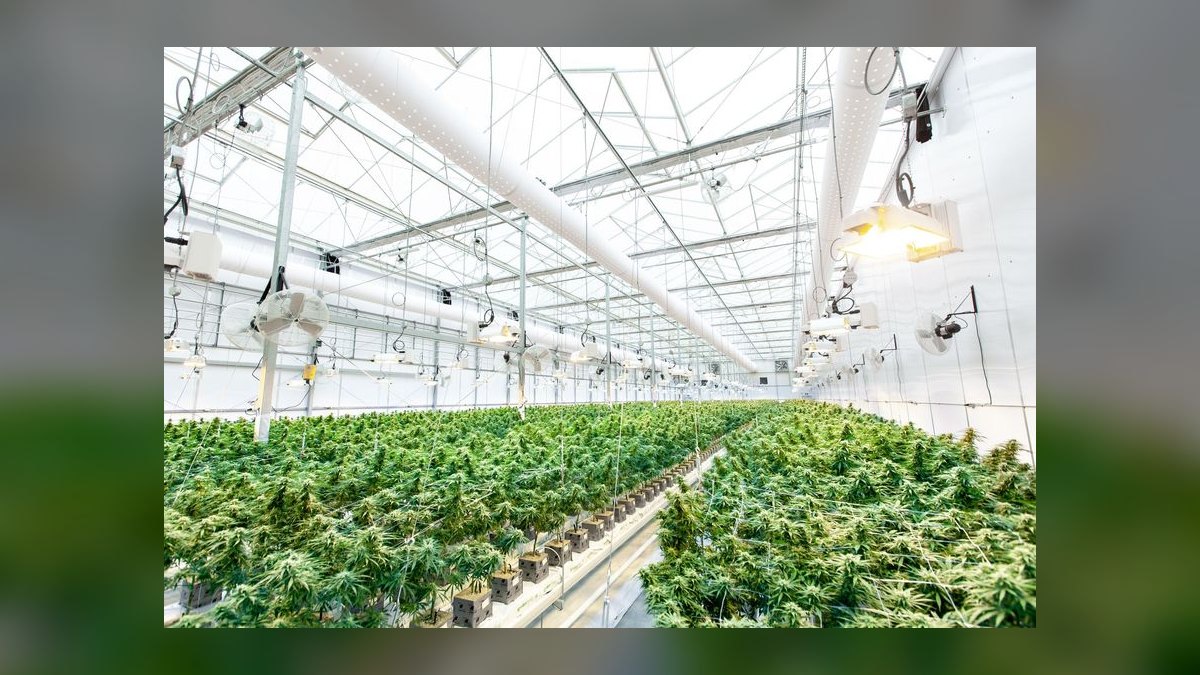
Step 4 — Select the control platform, then let it constrain equipment selection. Ask every controller vendor one question: give me the list of equipment you natively control, and the list you control only through dry-contact relays. Native integration means the controller can read equipment state and modulate it; a dry contact means it can only turn it on and off. A dehumidifier you can only switch on and off is a dehumidifier that will overshoot.
Step 5 — Specify sensors per zone, not per room. A single sensor in the center of a room reports a fiction. Canopy-level conditions at the wall differ meaningfully from canopy-level conditions under the supply diffuser. Plan for multiple sensor points per room at canopy height, plus at least one above canopy, and treat the spread between them as a commissioning metric — if two canopy sensors in the same room disagree persistently, you have an airflow problem, not a sensor problem.
Step 6 — Wire irrigation and fertigation as a controlled loop with feedback. Injectors mix; the controller schedules; but you need EC and pH probes on the output line and, ideally, runoff measurement. Dosing without measuring output is dosing blind. Substrate moisture sensors close the loop further and are what make crop-steering strategies possible at all.
Step 7 — Commission with deliberate failure testing. Before plants go in, run each room through forced-fault scenarios: kill power to a dehumidifier and confirm the alarm fires to the on-call phone; disconnect a sensor and confirm the controller fails to a safe state rather than driving equipment off a null reading. Document the results.
Step 8 — Integrate compliance last, and reconcile weekly from day one. Once plants are tagged, establish a standing weekly reconciliation between physical plant count and state-system plant count. Discrepancies found weekly are bookkeeping. Discrepancies found at inspection are enforcement.
Costs, timelines, and typical ranges
Public, verifiable pricing in this sector is thin — most vendors quote per project and most published figures come from operator anecdote rather than audited data. So treat the following as structural guidance about *where money goes and in what proportion*, and get written quotes for your own square footage before you commit to a number.

What is actually published and reliable: state track-and-trace programs publish their fee schedules. Licensees typically pay a recurring per-license system fee plus per-tag costs for plant and package tags, and those schedules are on the state agency or vendor site — look yours up rather than trusting a national average, because they differ by state. Utility rebate programs are the other well-documented cost input: many utilities in cannabis-legal states run horticultural lighting rebate programs with published per-fixture or per-watt incentives, and the DesignLights Consortium maintains a public Horticultural Lighting qualified products list that most of those rebate programs require fixtures to appear on. Checking the DLC list before you buy fixtures is free money — a fixture that isn't listed usually isn't rebate-eligible.
Where the capital actually concentrates. In a typical indoor build, the mechanical package — HVAC, dehumidification, and air distribution — is usually the largest single line, ahead of lighting. Lighting is second. Controls, sensors, and software together are typically a small fraction of the build, often in the low single-digit percentage range, which is why underspending on controls to save money is such a poor trade: you're economizing on the cheapest layer to protect the most expensive assets.
Operating cost reality. Electricity is the dominant recurring cost for indoor cultivation, driven by lighting and by the HVAC load that lighting creates. This is why LED conversion economics are attractive: LEDs draw less power for equivalent photosynthetic photon flux than legacy HPS, and — the second-order effect people forget — they shed less heat into the room, which reduces cooling load on top of the direct lighting savings. The payback math on an LED retrofit depends almost entirely on your local electricity rate and your available rebate, and both vary enormously by jurisdiction. Run the calculation with your actual utility rate and your actual rebate offer. Do not use a vendor's national-average payback slide.
Timelines that hold up in practice. Track-and-trace onboarding and staff training is measured in weeks, not months, but it must be complete before plants are tagged. Control system installation and wiring runs concurrent with mechanical installation. Commissioning — the phase everyone compresses — deserves a genuine multi-week window before first plants, because that is when you discover the sensor that was mounted in the supply airstream and the valve that was wired backwards. Finding those with plants in the room costs a cycle.
The recurring software line. Budget for annual subscriptions on the control platform's cloud tier, the cultivation ERP if you run one separately, and the mandated state system fee. These are small relative to power but they are permanent, and they escalate. Ask every vendor, in writing, what the renewal price looks like at year three and whether your historical data is exportable in a usable format if you leave. A control platform that holds your multi-year environmental history hostage has real switching-cost leverage over you.
Where to spend marginal dollars. Redundancy on dehumidification and on the alarm path. A dehumidifier that fails in week seven of flower with no alarm is the most expensive event in this business. Spare capacity and a phone that rings are cheap insurance against a condemned room.
Where teams get it wrong
Buying analytics before instrumentation. Operators get sold on yield prediction and machine-learning dashboards while running three sensors for a twelve-thousand-square-foot facility. Predictive models trained on sparse, unvalidated data produce confident nonsense. The sequence is: instrument densely, log reliably for several full cycles, validate that the logs match reality, and only then ask software to find patterns. Any vendor promising accurate yield prediction from a facility with no clean historical dataset is selling you a demo, not a capability.
Treating VPD as a number instead of a control strategy. Vapor pressure deficit is genuinely the right lens for transpiration management, and it's correctly emphasized. But VPD calculated from a single air sensor is not the VPD the plant experiences — leaf surface temperature runs below air temperature under transpiration, and the deficit at the leaf is what drives stomatal behavior. Facilities that chase an air-temperature-derived VPD setpoint without ever measuring leaf temperature are optimizing a proxy. Add infrared leaf temperature sensing if you're serious about steering.
Consumer-grade hardware in a production room. This one is correctly flagged in every guide and still happens constantly, usually as "temporary." Consumer smart plugs and hobby sensors are not rated for continuous duty in high-humidity environments, do not have documented calibration drift specs, have no local fallback when the cloud service is down, and cannot be integrated into a controller's alarm hierarchy. The failure mode isn't that they're inaccurate — it's that they fail silently and nobody notices until a room is lost.
No local fallback for cloud-dependent controls. Ask directly: if the internet connection drops for six hours, what happens? The correct answer is that the local controller continues executing its schedule and setpoints autonomously and syncs when connectivity returns. If the answer is that control degrades or equipment reverts to a default state, that is a facility-risk issue, not a convenience issue. Rural facilities on marginal connections should weight this heavily.
Compliance data entry as an afterthought done by whoever is free. Track-and-trace accuracy is an operational discipline, not a software feature. Name one accountable person, give them a defined daily and weekly routine, and audit it. Most compliance failures are process failures that the software faithfully recorded.
Ignoring calibration schedules. EC and pH probes drift. Humidity sensors drift. CO2 sensors drift, often substantially over a year. A calibration schedule with logged results is unglamorous and it is the thing that keeps your dataset trustworthy. An uncalibrated CO2 sensor reading low will have your controller injecting expensive CO2 into a room that doesn't need it, indefinitely, with no error message anywhere.
Overbuilding automation before the SOPs exist. Automation encodes a process. If your process isn't stable, you are automating chaos at speed. Run manual or semi-automated for a cycle or two, write down what actually works, then automate that.

Decision framework: when to choose what
The right stack is a function of four variables: mandated compliance system, facility scale, connectivity and support availability, and multi-site ambition. Work them in that order.
Compliance system: not a decision. Look it up, implement it. Your only choice is which certified commercial software you use to interface with it. Prefer software with a documented, currently-active integration certification in *your* state — certifications are per-state and vendors do lapse.
Scale determines control platform class. A single-room or small multi-room operation can run well on a cannabis-native cloud platform with self-service configuration; the feature set matches the problem and the cost is proportionate. Once you are running multiple staggered flower rooms with independent setpoints, complex fertigation recipes, and equipment that needs modulating rather than switching, you are in commercial-greenhouse controller territory — Argus, Priva, and peers exist because that problem is hard and they've been solving it for decades in tomato and ornamental production. The crossover isn't a fixed square footage; it's a complexity threshold. Count your independently controlled zones. If that number is climbing past a handful and each has distinct recipes, buy the industrial platform.
Connectivity and local support are veto variables. Excellent software with no local field tech within three hours is worse than adequate software with a dealer who answers the phone. Ask every vendor for the name and location of the integrator who would actually service you, then call that integrator before you sign.

Multi-site ambition changes the architecture, not just the license count. If site two is real and near, you want a platform with genuine multi-site rollup — common recipes pushed to all sites, comparative reporting across sites, one alarm console. Retrofitting multi-site onto per-site independent installs is painful and usually means re-standardizing everything.
Sensors and fixtures: choose late, choose replaceably. Because this layer is swappable, don't agonize. Constraints that matter: fixtures should be on the DLC Horticultural QPL if you want utility rebates, should be dimmable and controllable by your chosen platform, and should have published photosynthetic photon efficacy figures you can compare directly. Sensors should have published accuracy and drift specs and a documented calibration procedure. Anything without published specs is a marketing product.
Blockchain: not a 2027 requirement. State track-and-trace obligations are met by the state's mandated system. Immutable-ledger products for cannabis supply chain exist and some are interesting for brand-level provenance claims, but nothing about them is required for a cultivation license and none of them substitutes for the state system. Do not let a blockchain pitch displace budget from dehumidification.
Related questions
Do I need a separate cultivation ERP if my control platform already logs everything?
Often yes. Control platforms manage environment; ERPs manage inventory, labor, batch costing, and the compliance push. Some products cover both adequately at small scale. At multi-room scale, the two jobs diverge enough that separate best-in-class tools with a documented integration usually beat one product doing both.
How many environmental sensors does a flower room actually need?
More than one, at canopy height, spread across the room's airflow zones — plus at least one above canopy. The exact count follows room geometry and diffuser layout. Treat persistent disagreement between canopy sensors in the same room as an airflow defect to fix, not a sensor to recalibrate.
Is it worth buying a control platform before the facility is built?
Yes — select it during mechanical design, not after. The platform's native integration list should constrain which HVAC, dehumidification, and irrigation equipment you buy. Choosing equipment first and controls second is how facilities end up with dry-contact on/off control of equipment that should be modulated.
What should I demand in writing from any software vendor?
Data export in a documented, machine-readable format; year-three renewal pricing; current integration certification status for your state's track-and-trace; the local support arrangement by name; and the documented behavior of local control when internet connectivity is lost.
FAQ
Which track-and-trace system will I use — Metrc or BioTrack?
Whichever your state contracts. Metrc holds contracts across a large share of U.S. regulated markets; BioTrack holds others and has a substantial Canadian presence. This is set by regulators, not by you. Look it up on your state licensing agency's website and build around it. The real choice is which certified commercial software you use to interface with the mandated system.
Do I need blockchain for compliance?
No. Your compliance obligation is satisfied by reporting into your state's mandated track-and-trace system. Blockchain-based provenance products exist and may support brand or supply-chain claims, but nothing about them is a licensing requirement, and they do not replace state reporting. Spend that budget on dehumidification redundancy instead.
Can I run any of this on consumer smart-home devices?
No. Consumer sensors and smart plugs lack continuous-duty ratings for high-humidity grow environments, publish no calibration drift specifications, have no local fallback when their cloud service is unavailable, and cannot participate in a controller's alarm hierarchy. Their dangerous failure mode is silent failure — the room degrades and nothing alerts anyone.
What happens to my facility if the internet goes down?
That depends entirely on your platform, and you should ask before buying. A well-architected system keeps the local controller executing setpoints and schedules autonomously, buffering data and syncing when the connection returns. Some cloud-first products degrade during outages. For a rural facility on a marginal connection, this single answer can decide the vendor.
How do I know if an LED fixture is worth buying?
Check three things: whether it appears on the DesignLights Consortium Horticultural Lighting qualified products list (usually required for utility rebates), its published photosynthetic photon efficacy so you can compare fixtures on equal footing, and whether it dims and is natively controllable by your chosen platform. Then get your utility's actual rebate offer and run payback with your real electricity rate.
Where should marginal budget go once the basics are covered?
Redundant dehumidification capacity and a genuinely reliable alarm path to an on-call phone. Late-flower humidity excursions are the failure that condemns harvests, and the cost of spare capacity plus a working alarm is trivial next to losing a room. Analytics and prediction come after you have several cycles of clean, calibrated, densely sampled data.
Sources
- Metrc — official site
- BioTrack — official site
- DesignLights Consortium — Horticultural Lighting program
- U.S. Department of Energy — Solid-State Lighting: Horticultural Lighting
- Argus Controls
- Priva — horticulture climate and process control
- Netafim — drip irrigation
- Dosatron — water-powered dosing injectors
- Grodan — stone wool substrates and root-zone sensing
- Fluence — horticultural LED lighting
Related on PULSE
- [What is the recommended Cannabis Retail Dispensary sales and operations tech stack in 2027?](/knowledge/tk0223)
- [What is the best tech stack for a cannabis dispensary chain in 2027?](/knowledge/tk0550)
- [What is the best tech stack for a cannabis dispensary in 2027?](/knowledge/tk0049)
- [What is the best tech stack for a furniture or home goods retailer in 2027?](/knowledge/tk0052)
- [What is the best tech stack for a pet grooming or boarding facility in 2027?](/knowledge/tk572)
This page will be disappearing soon. Save it to your device for $1 — or read it free while it is here.
@Kory-White- · if Venmo asks, the last 4 of my number are 2012
 pulse-tech-stacksWhat software stack should a Architecture & Engineering business run in 2027?
 pulse-tech-stacksWhat is the recommended Grocery Retail sales and operations tech stack in 2027?
 pulse-tech-stacksWhat is the best tech stack for a hedge fund in 2027?
 pulse-tech-stacksTop 10 Data Warehouses for AI Workloads in 2027
 pulse-tech-stacksWhat is the recommended AI Code Review sales and operations tech stack in 2027?
 pulse-tech-stacksWhat software stack should a Consulting business run in 2027?
 pulse-tech-stacksTop 10 Tech Stacks for a Multi-Location Specialty Retailer in 2027
 pulse-tech-stacksThe Odoo vs. SuiteCRM Stack for a Multi-Location Specialty Retailer in 2027
 pulse-tech-stacksWhat software stack should a Telecom business run in 2027?
 pulse-tech-stacksWhat software stack should a Roofing & Exteriors business run in 2027?