
Should I Hire a Fractional CRO If I Have Missed Quota Two Quarters in a Row?
 PULSEKNOWLEDGE LIBRARY
Two missed quarters justifies a diagnosis, not an automatic hire. A fractional CRO fits when the root cause is revenue leadership, sales process, or forecasting discipline. If the cause is empty pipeline, product-market fit, or a quota set 40% above bottoms-up capacity, fix that first — no fractional leader outruns those.
This versus the common alternatives
The instinct after a second consecutive miss is to reach for the biggest available lever, and "senior revenue leader" feels like the biggest lever on the board. But a fractional CRO is only one of roughly six moves available to you, and the honest comparison matters more than the enthusiasm of whoever is pitching you.
Do nothing and give the existing leader one more quarter. This is a legitimate option, and it is underrated because it feels passive. If you already have a VP of Sales who correctly diagnosed the miss — say, they identified that discovery calls were being skipped on inbound leads because reps were compensated on meetings booked rather than qualified opportunities — and they have a fix already ramping, layering in a fractional CRO undermines them for no gain. The cost of this option is one quarter of runway. The cost of getting it wrong is that you enter a three-quarter trend, at which point your board and your A-players both start treating it as a leadership failure regardless of the underlying cause. The tiebreaker is whether the existing leader produced a written, specific diagnosis without being asked. Vague diagnoses ("the market got harder," "we need more leads") mean the leader does not actually know why you missed, and one more quarter buys nothing.
Hire a full-time CRO. All-in cost typically lands somewhere in the range of a 250K–400K base plus variable plus equity — call it 400K–600K fully loaded, though this varies widely by market, stage, and equity structure. The search-and-ramp cycle runs three to five months before they are productive, which means the decision you make today produces its first real effect roughly two quarters out. For a company already two quarters into a miss, that timeline is the problem. Full-time makes sense above roughly the mid-eight-figures in ARR, where the revenue org is large enough that a leader needs to be in the building every day managing managers, and where the fixed cost is a rounding error against the revenue base.

Hire a VP of Sales instead. This is the alternative most often confused with a fractional CRO, and the distinction is altitude. A VP of Sales runs the floor: coaches reps, sits in on calls, manages the daily execution, and personally intervenes in slipping deals. A CRO owns the revenue *system*: the ICP definition, the comp plan design, the forecasting cadence, the cross-functional handoff between marketing, sales, and customer success. If your reps are individually competent but nobody is holding a weekly pipeline review with teeth, that is a VP gap. If your reps are executing fine against a strategy that is itself wrong — chasing an enterprise motion with a mid-market product, or a self-serve motion staffed with enterprise AEs — that is a CRO gap. Getting this backwards is expensive in both directions.
Hire a demand-gen lead or an agency. If the actual failure was top-of-funnel volume, this is the correct spend and a fractional CRO is an expensive detour. A revenue leader cannot manufacture pipeline that marketing never created; they can design the outbound motion and define the ICP, but somebody still has to execute the campaigns and the sequences.
Bring in a sales consultant or a training firm for a fixed-scope project. Cheaper than fractional leadership, narrower in what it changes. Useful when the diagnosis is genuinely one thing — discovery quality, negotiation, a specific competitive displacement motion. Useless when the problem is systemic, because a training engagement produces skills that decay against a comp plan that rewards the opposite behavior.
Hire a fractional RevOps lead instead of a fractional CRO. This is the underrated adjacent option. If your CRM data is so bad that nobody can tell you a reliable stage-conversion rate, if your forecast is a spreadsheet somebody rebuilds by hand every Friday, if your pipeline stages mean different things to different reps — a fractional CRO's first three weeks will be spent discovering that they cannot diagnose anything because the instrumentation does not exist. In that situation, a RevOps operator who fixes the data layer first makes any subsequent leadership hire dramatically more effective. Plenty of companies that think they have a leadership problem actually have a measurement problem wearing a leadership problem's clothes.
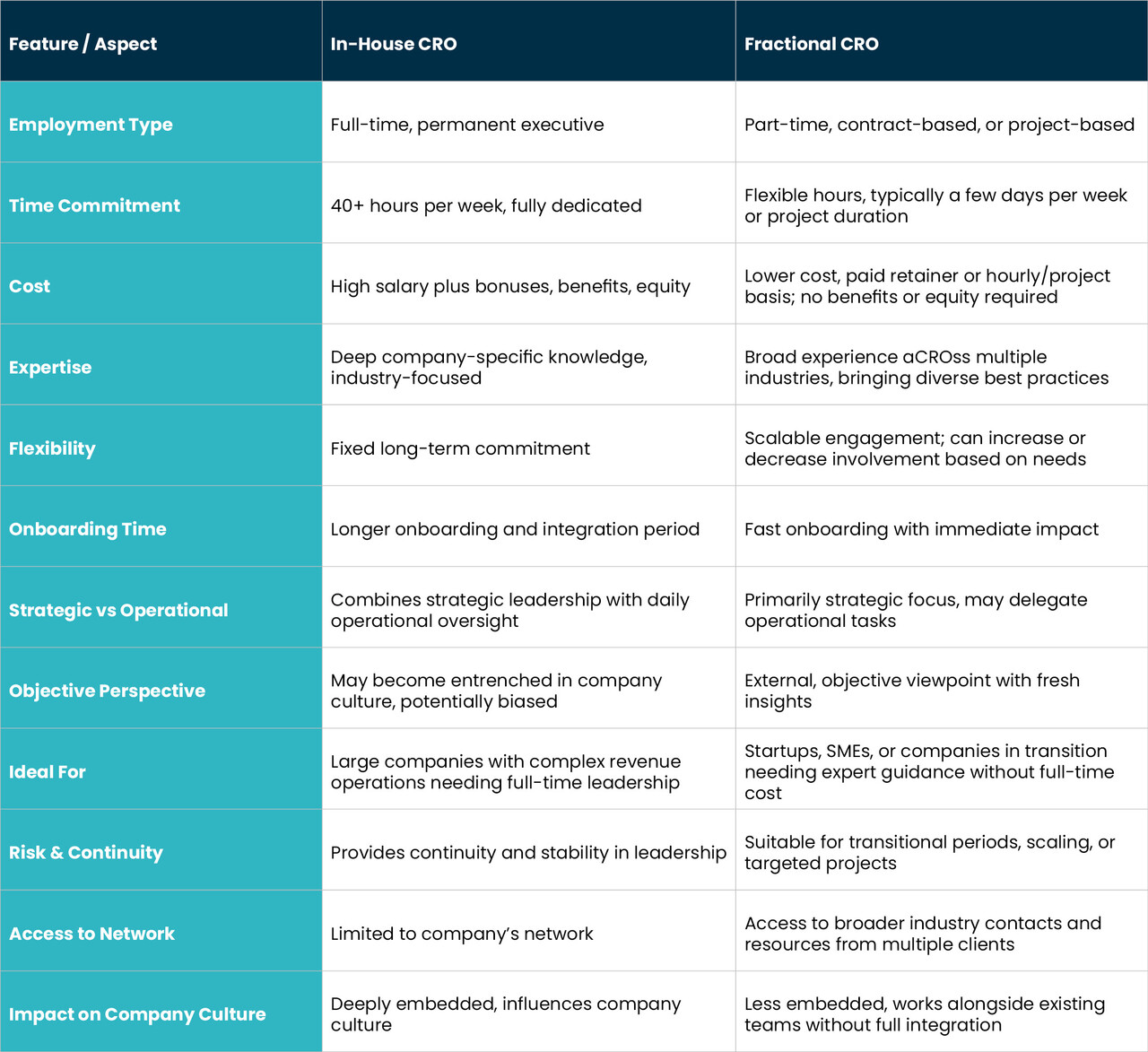
How to choose between them
The choosing framework is a four-layer diagnosis run in order, because each layer can disqualify the layers below it. Run this before you take a single intro call with a fractional operator. It takes days, not months, and it is the single highest-return work you will do this quarter.
Layer one: demand and pipeline coverage. Pull your qualified pipeline coverage entering each of the two missed quarters. Below roughly 3x coverage of target, you did not have a sales-execution problem — you had a demand problem, and no revenue leader closes deals that were never created. Be honest about the word "qualified" here. Raw pipeline includes deals reps refuse to mark closed-lost because it makes their number look thin. A useful audit: pull every open opportunity with no activity in 30 days and no scheduled next step, and see what your coverage looks like with those excluded. Many teams discover their real coverage was 1.8x while the dashboard said 4x.
Layer two: conversion and sales motion. Compare stage-to-stage conversion and sales-cycle length across the two missed quarters against your trailing four-quarter baseline. A sharp drop concentrated at one stage is a fixable execution issue — bad discovery, weak technical validation, no mutual close plan, discounting late to save deals. A gradual, broad decline across every stage is a different animal: it usually means the market moved, a competitor repositioned, or your product-market fit eroded while nobody was watching. Sales-cycle length is the underused signal here. Cycles stretching by 30% or more while win rates hold usually means more stakeholders are entering deals — a buying-committee change, not a rep-skill change, and the fix is enablement content for the new stakeholder rather than more pipeline review pressure.

Layer three: planning and quota integrity. Rebuild the quota bottoms-up: number of carrying reps, adjusted for ramp, times realistic per-rep productivity against your historical attainment distribution. If the assigned number sat 30–40% above what that model supports, you did not miss quota — you were handed a number nobody could hit. This is more common than founders admit, because quotas often get set top-down from a board-approved growth rate and then divided by headcount. The tell is the attainment distribution: if your top rep hit 85% and your median hit 55%, the number was wrong. If your top rep hit 140% and your median hit 40%, the number was fine and your talent distribution is broken. Same headline miss, completely different remedy.
Layer four: talent and leadership. Is there a clear revenue owner? A founder wearing the sales hat 20% of the time is not a revenue owner. Missing quota under a strong leader with a credible plan in motion is categorically different from missing quota with nobody at the wheel. Absent revenue leadership is the strongest single signal that fractional help will pay for itself.
Two boxes in that flow — execution problem and leadership gap — are where fractional leadership genuinely earns its retainer. Everything else routes elsewhere. If you land in "demand problem" or "PMF problem" and hire a fractional CRO anyway, you will pay a senior operator three months to tell you what the diagnosis already told you for free.
There is a second-order question worth asking once you land in a box: how reversible is the move? Giving your existing leader another quarter is fully reversible. A fractional engagement with a 30-day notice period is nearly reversible. A full-time CRO hire is the least reversible move on the board — a bad one costs you a year plus a severance negotiation plus the credibility hit of two leadership changes in eighteen months. When the diagnosis is genuinely ambiguous, bias toward the reversible option and buy yourself better information.

Costs, timelines, and expected impact
Commercials for fractional revenue leadership vary enormously by market, seniority, time commitment, and whether equity is involved, so treat any single number you hear as one data point rather than a benchmark. The structural facts are more useful than the price points.
The engagement is typically priced as a monthly retainer against a defined time commitment, most commonly one to three days per week. That commitment level is the variable that actually drives cost, and it is worth thinking about carefully. One day a week buys you strategy, a weekly forecast review, and a monthly plan — it does not buy you someone who will personally rebuild your comp plan and sit through fourteen deal reviews. Two to three days a week buys real operating involvement. Founders who negotiate hard down to one day and then expect three days of output are the most common source of failed engagements, and the failure gets blamed on the operator.
Many fractional CROs blend a retainer with a modest equity grant or a performance component. Structure any performance component around *leading* indicators — pipeline coverage, stage conversion, forecast accuracy — rather than bookings, for a straightforward mechanical reason: bookings in the first one to two quarters are almost entirely determined by pipeline created before the operator arrived. Paying them on inherited pipeline is paying them on a coin flip, and it distorts their behavior toward pulling deals forward rather than fixing the machine.

Against the full-time alternative, the cost delta compounds beyond salary. A full-time CRO carries recruiting fees, a three-to-five-month search, a ramp period, equity dilution, and severance exposure if it does not work. A fractional engagement typically carries a 30-day notice period and no equity dilution beyond whatever modest grant you negotiate. That asymmetry is the entire economic argument, and it is strongest exactly when your diagnosis is uncertain — which, after two missed quarters, it usually is.
On timelines, set expectations against a realistic curve. Onboarding is days, not months, because there is no notice period at a prior employer and no relocation. A written diagnosis should land by week three; if it has not, that is information about the operator, not just the situation. Process-level signal — forecast accuracy tightening, junk pipeline getting purged, pipeline reviews becoming useful — typically shows in the first 30 to 45 days because those are pure process wins that do not depend on the sales cycle. Bookings impact lags by one to two full sales cycles, which for a 90-day cycle means you are looking at quarter three before the lagging number is a fair scorecard.
The expected impact is worth being sober about. A fractional CRO does not typically produce a step-function jump in bookings. What they produce, when the engagement works, is a set of durable system changes: a quota model you can defend to a board, a forecast that lands within a tolerable band of actuals, a qualification framework that keeps unwinnable deals out of the pipeline, a comp plan that pays for the behavior you actually want, and — most importantly — a named human who will own the revenue number after they leave. The compounding value is in the machine, not the quarter.
A related cost worth budgeting: internal time. The engagement consumes founder attention, rep interview time, and RevOps or analyst hours to pull the data the diagnosis needs. Companies that treat the fractional as a self-service resource get self-service results. Budget four to six hours a week of your own time for the first month.

Implementation and handoff details
Structure the engagement in three phases with explicit deliverables, because the single most common failure mode is an open-ended arrangement that drifts into a permanent advisory relationship nobody is measuring.
Phase one, weeks one through three — diagnose. The operator runs the four-layer diagnosis, sits in on live deal reviews rather than reading summaries of them, interviews every rep individually, audits CRM data quality, and rebuilds the quota model bottoms-up. The deliverable is written: why you missed, ranked by contribution, plus a prioritized 90-day plan. Insist on the written artifact. It is the only way to judge their thinking before you are three months in, and it is the thing you will hand to the permanent leader later.
Give them real access during this phase — Slack, CRM, deal reviews, your calendar, and the reps without a manager sitting in. An operator interviewing reps with the VP of Sales in the room learns nothing useful.
Phase two, weeks four through eight — stabilize. Fix the highest-leverage broken systems first, in this order: install a weekly pipeline review with actual disqualification authority, tighten qualification to a framework matched to your deal size (MEDDICC and its variants for enterprise, something considerably lighter for transactional motions), rebuild the forecast so it is defensible, and make the one or two personnel decisions that cannot wait another quarter. This phase is triage. Resist the urge to perfect anything.
The personnel piece deserves a specific warning. A competent fractional CRO will surface at least one uncomfortable truth — that a tenured rep is bottom-quartile, that the comp plan rewards volume over quality, that the "enterprise motion" is a mid-market motion in a nice suit. If leadership is not prepared to act on hard findings, the engagement produces a well-argued deck and zero change. Decide before you sign whether you actually want the diagnosis or just the appearance of one.
Phase three, week nine onward — build and hand off. Build the durable assets: the ramp playbook, the comp plan, the ICP and messaging, the RevOps instrumentation that makes next quarter's diagnosis take a day instead of three weeks. Then either develop your existing sales manager into the permanent revenue owner or run the search for the full-time hire. A good fractional operator is working themselves out of a job from day one. Be suspicious of one who seems to be building permanent dependence, and equally suspicious of an engagement with no defined end state.
Measure the engagement on leading indicators for the first two quarters. Forecast accuracy should tighten meaningfully within 30 to 45 days — that is a process win available immediately. Qualified pipeline coverage should grow relative to target while raw pipeline may actually *shrink* as junk deals get purged; a falling raw number alongside a rising qualified number is a good sign, not a bad one, and you should tell your board that before it happens. The specific leaking stage identified in the diagnosis should start holding. The gap between top-quartile and bottom-quartile rep performance should narrow through coaching or, where necessary, exits. Sales-cycle length should stabilize or shorten as qualification tightens.

Only after two full quarters do lagging indicators — bookings, quota attainment, net-new ARR — become a fair scorecard. Set that expectation explicitly in the engagement letter so nobody is tempted to pull the plug in month two based on a number that was baked before the operator arrived.
Define the off-ramp up front, in writing. What does "done" look like? Is the goal a full-time replacement or an internal promotion? What is the notice period, and what happens to any equity component on early termination? Who owns the documentation, models, and playbooks the operator builds? A well-run fractional engagement ends on purpose, on a defined timeline, with a functioning revenue machine handed to a named person who can run it — not with an awkward conversation about whether the retainer is still worth it.
One last adjacent consideration: whatever you decide, fix the instrumentation. The reason the diagnosis above takes weeks instead of an afternoon is almost always that nobody can trust the data. A durable RevOps layer — clean stage definitions, enforced next-step fields, a forecast built from the system rather than from memory — means the next time you miss a quarter, you will know why within days. That capability outlasts any individual leader you hire, fractional or otherwise, and it is the cheapest insurance against ever having this conversation again.
Related questions
How much does a fractional CRO cost compared to a full-time CRO?
Fractional engagements are priced as a monthly retainer against a one-to-three-day-per-week commitment, with no equity dilution beyond a modest grant and a typical 30-day notice period. Full-time CROs carry base plus variable plus equity, recruiting fees, a three-to-five-month search, and severance exposure.
Can a fractional CRO fix a demand-generation problem?
Not directly. If the top of funnel is empty, a revenue leader cannot manufacture pipeline. They can define the ICP, design the outbound motion, and diagnose the gap precisely — but campaign and sequence execution lives with marketing or an SDR team you still need to build or fund.
Should I hire a fractional RevOps lead instead?
If nobody can produce a reliable stage-conversion rate, yes — fix the instrumentation first. A fractional CRO's opening three weeks get consumed discovering the data does not exist, and every subsequent recommendation rests on numbers nobody trusts.
How long should a fractional CRO engagement last?
Most run two to four quarters: three weeks to diagnose, roughly five weeks to stabilize, then a build-and-handoff phase. Shorter diagnostic-only engagements of three to four weeks are a legitimate standalone option when you mainly need to know what broke.
Is two missed quarters enough to justify the expense?
Two consecutive misses is a real pattern signal and puts you on the clock before a third read as leadership failure. Whether it justifies the spend depends entirely on the diagnosis — strategy or leadership gap, yes; demand or product-market fit, fix those first.
FAQ
What exactly does a fractional CRO do that a VP of Sales doesn't?
A CRO owns the revenue system end to end: strategy, forecasting discipline, comp design, ICP definition, and the cross-functional alignment between sales, marketing, and customer success. They typically mentor a VP or sales manager rather than running the floor themselves. A VP of Sales lives closer to the reps and the daily execution — coaching calls, deal inspection, individual performance management. The fractional CRO operates one altitude up, which is exactly why hiring one when you actually need floor management produces frustration on both sides.
How quickly can a fractional CRO start making an impact?
Onboarding takes days rather than the three to five months a full-time search requires, because there is no notice period at a prior employer. A written diagnosis should be complete inside three weeks. Process-level fixes — forecast discipline, a real pipeline cadence, qualification standards — start producing measurable signal in the first 30 to 45 days. Bookings impact lags by one to two full sales cycles, because the first quarter's number was largely determined by pipeline created before they arrived.
What's the biggest risk of hiring a fractional CRO?
Misdiagnosing your own problem. Hiring revenue leadership to solve what is actually a demand-generation or product-market-fit issue wastes the retainer and, more damagingly, delays the real fix by a quarter you cannot spare. The second-biggest risk is hiring one and then declining to act on the uncomfortable findings they surface — the engagement then produces an excellent document and no behavioral change anywhere in the org.
Will my current sales team resent a fractional leader?
They can, if the engagement is framed as blame or arrives with no explanation. Frame it as bringing in senior help to build systems that make everyone's number reachable, give the operator genuine access and visible air cover from the founder, and most teams come around within a few weeks — particularly once the quota model becomes defensible and pipeline reviews turn useful rather than punitive. Resentment usually traces back to ambiguity about who the fractional reports to and what authority they hold.
Should the fractional CRO be paid on the bookings number?
Partly at most, and not in the first two quarters. Because they inherit pipeline created before they arrived, tie the majority of any performance component to leading indicators they can genuinely move inside a quarter: forecast accuracy, qualified-pipeline growth, stage-conversion improvement. Shift weight toward lagging bookings metrics only after two full quarters, when they have influenced a complete cycle from creation to close.
What if my quota was just set too high?
Then you may not have a sales-org problem at all. Rebuild the number bottoms-up from ramp-adjusted rep capacity before blaming execution. If the assigned quota sat 30 to 40 percent above what capacity realistically supports, the fix is a defensible plan and better board expectation-setting. A fractional CRO helps with exactly that conversation, but the miss was a planning artifact rather than a broken team — and treating it as a talent problem will cost you good reps.
Sources
- Harvard Business Review — Sales topic hub
- SaaStr — SaaS go-to-market and revenue leadership
- First Round Review — scaling sales and revenue leadership
- Bessemer Venture Partners — State of the Cloud and GTM benchmarks
- The Bridge Group — SaaS inside sales and quota benchmarks
- Pavilion — revenue leadership community and resources
- Winning by Design — revenue architecture frameworks
- MEDDICC — qualification methodology reference
Related on PULSE
- [Should I Hire a Fractional CRO If I Have Great Marketing but Weak Sales in 2027?](/knowledge/tl0552)
- [Should I Hire a Fractional CRO If I Have No Sales Enablement Function in 2027?](/knowledge/tl0572)
- [Should I Hire a Fractional CRO If We Are Integrating Two Sales Teams After a Merger in 2027?](/knowledge/tl0364)
- [Should I Hire a Fractional CRO If I Have No RevOps Function Yet in 2027?](/knowledge/tl0372)
- [Should I Hire a Fractional CRO If My Two Co-Founders Disagree on GTM Strategy in 2027?](/knowledge/tl0395)
- [Should I Hire a Fractional CRO If My Last Two Sales Hires Failed in 2027?](/knowledge/tl0557)
 pulse-toolsHow do I find a fractional CRO in Hampstead in 2027?
 pulse-toolsWho is the best fractional CRO in Carney in 2027?
 pulse-toolsShould I Hire a Fractional CRO If I Am Entering a Regulated Market in 2027?
 pulse-toolsWhat should I look for in a fractional CRO in Tempe in 2027?
 pulse-toolsHow do I hire a fractional CCO in Oshkosh in 2027?
 pulse-toolsWhat should I look for in a fractional CRO in Honolulu in 2027?
 pulse-toolsWhat does a fractional CRO cost in Wheaton in 2027?
 pulse-toolsWhat should I look for in a fractional CRO in Santa Monica in 2027?
 pulse-toolsHow do I hire a fractional VP of Sales in Roswell in 2027?
 pulse-toolsWhere do I find a fractional CRO in South Carolina in 2027?