
Should I Hire a Fractional CRO If I Am a PE Operating Partner Standardizing a Portfolio Company?
 Curated byKory White · Fractional CRO · Maryland
 PULSEKNOWLEDGE LIBRARY
Quality
Certified
Yes, hire a fractional CRO when the portfolio company sits between roughly $5M and $30M ARR, has never had senior revenue leadership, and needs a replicable playbook rather than a culture builder. Scope it to a six-to-twelve-month mandate with defined 90-day milestones, then convert, rotate, or replace once processes hold without daily oversight.
The end-to-end process from mandate to embedded playbook
The engagement you are buying is not "a person for two days a week." It is a sequenced installation project with a defined handoff, and the sequence matters more than the individual. PE Operating partners who skip the diagnostic phase and jump straight to comp plan redesign consistently end up rebuilding the same plan twice, because they changed the incentive before they understood what the pipeline data was actually telling them.
Month 1 is audit and diagnose. The fractional CRO pulls the last four quarters of closed-won and closed-lost data out of Salesforce or HubSpot, interviews every rep individually, sits in on the existing forecast call without speaking, and produces a written assessment naming the top three process bottlenecks. Expect the audit to surface things the CEO will not enjoy hearing: stage definitions that mean nothing because reps advance deals on gut feel, a pipeline that looks healthy only because dead deals were never closed out, and a forecast that has been directionally wrong in the same direction for four straight quarters. The deliverable is a document, not a slide deck of generic best practices.
Month 2 is design and train. This is where the standardization mandate gets real. The fractional CRO writes the forecast template, the deal review agenda, the stage exit criteria, the territory map, and the comp plan adjustments. Then they train the team on it — not a one-hour lunch-and-learn, but working sessions where reps run their own live deals through the new qualification framework and get corrected in real time. If the company is adopting MEDDIC, MEDDPICC, or a hybrid, this is when role-play scripts get built and practiced.

Month 3 is implement and coach. The fractional CRO runs the first two forecast calls themselves using the new template, then hands the third to the VP of Sales and coaches from the side. This is the single most important transition in the entire engagement. A fractional CRO who is still running the forecast call in month seven has failed, regardless of how good the numbers look, because you are now buying a permanent dependency at a part-time price.
Months 4 through 6 are monitor and refine. Weekly call attendance, pipeline health review, incremental adjustments as real data exposes where the stage definitions were too loose or the territory split created a coverage gap. By month six the team should be running the process without daily oversight, and you should be able to read the pipeline dashboard yourself and know whether the quarter is real.
Months 7 through 12 are transition. Three outcomes are legitimate: reduce to one or two days a month of advisory check-ins, convert the person to a full-time CRO if the fit and the company's scale both justify it, or exit on the 30-day notice because the process is stable and the company no longer needs the seat. Rotating the same fractional CRO to your next portfolio company is the outcome that compounds best for a PE firm, because they carry the installed playbook with them and the second installation runs materially faster than the first.

The reason this arc works in a PE context specifically is that it maps to your hold period rather than to a career. A full-time CRO is optimizing for a five-to-seven-year story arc that includes building their own org. A fractional CRO on a twelve-month mandate is optimizing for a documented, transferable system — which is exactly the asset you want on the balance sheet at exit.
Where it creates or leaks revenue
The revenue impact of a fractional CRO engagement is almost never in deals the fractional CRO personally closes. They do not carry a bag. The impact shows up in four mechanical places, and it is worth being precise about them because vague expectations are how these engagements get judged as failures despite working.
Forecast accuracy is the first place value appears. A portfolio company that has never had senior revenue leadership typically forecasts by asking reps "what are you going to close" and adding it up. That produces a number that is wrong by a wide margin in a predictable direction. Installing stage exit criteria and a commit/best-case/pipeline discipline does not create new revenue in the quarter it lands — it creates the ability to plan. For a PE Operating partner, a forecast you can trust is directly monetizable: it changes what you tell the lenders, when you green-light a hire, and whether you pull an acquisition trigger. This is the leading indicator worth tracking first, because it moves within one quarter while revenue moves in three.
Pipeline hygiene is the second, and it is where most of the near-term dollars actually sit. A company with a $40M "pipeline" against a $10M ARR base almost always has a real pipeline in the $12M–$18M range once dead deals are closed out and stages are reclassified honestly. That sounds like value destruction on a dashboard. It is the opposite: reps who stop spending time on deals that were never going to close redirect that capacity into deals that will. The recoverable revenue here is capacity, not deals. Expect the headline pipeline number to drop 40–60% in the first cleanup and expect the CEO to be alarmed by it — brief them before it happens.
Comp plan misalignment is the third and the most expensive to leave in place. Common patterns a fractional CRO should catch in the first thirty days: reps paid entirely on bookings with no retention clawback, so churn is somebody else's problem; accelerators structured so that a rep hits their kicker faster by discounting to volume than by holding price; and a plan where the highest-paid rep in the company is the one with the oldest, most inherited account list rather than the one generating new logos. Fixing discount-encouraging accelerators alone tends to move blended ASP in a way that shows up in gross margin within two quarters.
Territory and quota design is the fourth. Under-covered segments look like weak demand until someone maps them. Over-covered segments look like strong performance until you divide by headcount. A portfolio company that grew by hiring reps into whatever territory the last rep was complaining about will have both problems simultaneously.
The leak side deserves equal attention. A fractional CRO leaks money when they are used as a project manager. If you hand them a task list — clean the CRM, rebuild the dashboard, update the deal stages — you get those tasks done and nothing else. You have paid senior operator rates for coordination work. The second leak is authority. A fractional CRO who cannot change a comp plan, cannot remove an underperforming rep, and gets overridden by the founder on pipeline calls is generating recommendations into a void. The third leak is duplication: if the portfolio company is simultaneously mid-migration from HubSpot to Salesforce or deploying a new CPQ tool, the fractional CRO's methodology work will be rebuilt on top of a system that does not exist yet. Sequence the systems work first, or hire full-time.
Concrete numbers and benchmarks
Be disciplined about what you can actually benchmark, because the fractional market has wide variance and very little published, verifiable pricing data. What is structurally reliable is the shape of the cost drivers rather than a single number.
The cost drivers, in order of impact. Days per week is the dominant variable — two days a week is generally the floor at which a fractional CRO can produce real change rather than commentary, and five days a week converges on full-time economics without full-time commitment, which is usually the worst square on the board. Scope is the second driver: pure process and methodology consulting prices below hands-on team management, because the latter puts the fractional CRO on the hook for people decisions and daily availability. Stage is the third: work at sub-$10M ARR is more foundational and typically prices lower than work at $30M+ where the org complexity, the number of stakeholders, and the systems surface are all larger. Equity is the fourth and mostly irrelevant to you — some fractional CROs will trade cash rate for a 0.5%–2% stake, but in a PE context with a fixed exit timeline and an existing cap table, that trade is rarely available or desirable.
The comparison that actually matters is total cash outlay, not rate. Against a full-time CRO you are comparing the fractional retainer to base plus variable plus equity plus benefits plus a retained search fee, which for an executive search typically lands in the $30K–$60K range as a percentage of first-year comp. You are also comparing against time-to-productivity: an executive search for a CRO commonly runs three to six months from kickoff to start date, and a full-time CRO then takes another quarter to be useful. A fractional CRO who has run this playbook before is delivering the written audit in week four. In a hold period measured in a few years, six months of latency is a meaningful fraction of the value creation window.
Benchmarks to hold the engagement to, rather than revenue. Set 3–5 measurable 90-day outcomes at signing and write them into the contract. Good ones are concrete and verifiable: pipeline coverage ratio moved to a defined target and sustained for two consecutive months; forecast accuracy within a stated band at the commit level for two consecutive quarters; every open deal over a dollar threshold carrying documented qualification criteria; the VP of Sales running the forecast call unassisted by a named date; a written comp plan for the next fiscal year delivered before the board meeting that approves it. Bad ones are "improve sales performance," "help us grow," and "build a high-performing culture."
Coverage and cadence numbers to instrument. Pipeline coverage ratio by segment and by rep, refreshed weekly. Win rate by rep and by stage, so you can distinguish a rep who loses late (qualification problem) from one who loses early (targeting problem). Average sales cycle length by segment. Forecast confidence by deal stage. Stage conversion rates, which is where you find the stage that everything enters and nothing leaves. Six numbers on one page, weekly, is the right reporting surface for an Operating partner — anything more granular and you are doing the VP of Sales' job.
Engagement length. Six to twelve months is the working range. Under six months you get an audit and a design with no proof the team can run it. Past twelve months without a conversion decision, you have quietly created a permanent part-time executive, which is the structure with the worst cost-to-authority ratio available. Set the decision point at month seven and honor it.
Pitfalls and how to avoid them
Hiring before product-market fit. If the company is under roughly $2M ARR with weak retention, the revenue process a fractional CRO builds will be invalidated by the next product pivot. Retention below a healthy threshold is a product signal, not a sales signal, and no forecast cadence fixes it. The avoidance is a precondition: do not start the engagement until net retention is stable enough that the sales motion you are standardizing is the one the company will still be running in eighteen months.
Treating the fractional CRO as a fix-all. They can fix the revenue process. They cannot fix a broken product, a toxic sales culture that the CEO tolerates, or a founder who will not delegate the pipeline. Naming what is out of scope in the engagement letter is not defensive paperwork — it is what lets you evaluate the engagement fairly at month seven instead of blaming the fractional hire for a product gap.
Withholding authority. This is the most common structural failure. A fractional CRO needs the ability to change comp plans, enforce forecast discipline, and initiate the removal of underperforming reps. If the CEO overrides those decisions — particularly on the pipeline call, in front of the team — the engagement is dead and everyone will spend four more months pretending otherwise. In a turnaround, get the authority granted explicitly at the board level before the start date, in writing.
Expecting them to close deals. Fractional CROs build the machine that helps reps close. If the company genuinely needs someone to carry a bag and hold reps accountable on a Monday morning call, that is a VP of Sales hire or a senior AE, and it is a different, cheaper, more available role. Buying a CRO to do VP of Sales work is the most expensive way to fill that seat.
Letting them report to a CEO without revenue experience. The misalignment is subtle and it compounds: a non-revenue CEO evaluates the fractional CRO on how helpful and responsive they seem rather than on whether the playbook is being installed, and the fractional CRO drifts toward whatever makes the CEO comfortable. Have the fractional CRO report to you, the Operating partner, for the first quarter, then transition reporting into the portfolio company once the playbook is embedded and there is something objective to be measured against.
Failing to secure the IP. If your reason for going fractional is to build a template you can replicate across the Portfolio, then playbooks, templates, dashboards, and training materials must become the portfolio company's property on termination, stated in the contract. Without that clause you have rented a framework that walks out the door, and the next portfolio company starts from zero. This one clause is the difference between a consulting expense and a firm-level asset.

Overlapping with a live systems migration. Fractional leaders rarely have the bandwidth to own a multi-month CRM or CPQ rollout while simultaneously coaching reps and writing methodology. If your Standardizing plan requires deep RevOps integration across marketing, sales, and customer success, either sequence the systems work ahead of the fractional engagement or hire full-time and own the whole transformation timeline under one person.
Capacity overcommitment. Many experienced fractional CROs run two or three engagements at once, which is fine and often the point. Confirm capacity in writing, and specifically confirm availability during quarter-end and board weeks, which is exactly when three clients need the same person on the same Thursday.
Selection checklist for PE-specific fractional CRO vetting
Not every capable fractional CRO understands an Operating partner's constraints. The vetting criteria that separate them are specific and testable in a single conversation.
Prior PE-backed experience, named and explained. At least two engagements, and they should be able to walk you through how they handled board reporting, hold-period compression, and exit-readiness diligence without you prompting for those topics. Someone who has only worked with venture-backed or founder-owned companies will optimize for the wrong horizon.
A specific methodology, evidenced by artifacts. Ask for a redacted sample playbook, a one-page framework, a forecast template, or a territory map from a prior engagement. Generic advice delivered fluently is the failure mode to screen out. The artifact request is the single highest-signal question in the interview because it cannot be answered from a general vocabulary.
Tool fluency, tested against your stack. Salesforce, HubSpot, Clari, Gong, Outreach, Salesloft. A strong candidate can audit the CRM in the first week and name the top three data quality issues. Ask what they would look at first in a CRM they had never seen and listen for whether the answer is a process (stage-by-stage aging, close-date pushes, ownerless open deals) or a shrug.
Teaching capability over doing capability. Ask directly: how do you train the existing VP of Sales or RevOps manager to run this without you? A candidate whose answer is essentially "I run the calls" is selling you a dependency. A candidate who describes a coaching handoff with a date on it is selling you a system.
A referral network of other fractional executives. CFO, COO, CMO. Portfolio companies at this stage rarely have exactly one gap, and a fractional CRO who can bring a vetted fractional CFO is worth more to a Portfolio than one who cannot.
Contract shape. Flat monthly retainer, 30-day out for either party, IP assignment on termination, a defined conversion path to full-time at a pre-agreed comp level, and the 90-day milestone list attached as an exhibit. Avoid long-term commitments and minimum-hour guarantees — PE timelines shift with exit plans, and the 30-day out is what keeps a mediocre engagement from becoming a year-long line item.
Run the checklist as a gate, not a scorecard. Any single "no" in the first four boxes is disqualifying, because each one predicts a specific failure you have already read about above.
Related questions
Can one fractional CRO cover multiple portfolio companies at once?
Usually yes, and that is often the point — two or three concurrent engagements is common. Confirm capacity in writing and specifically protect quarter-end and board weeks, when every client needs the same person simultaneously.
What if the sales team resists the new process?
Expect it, especially where deal reviews were informal. The fractional CRO should spend the first thirty days building rapport and explaining the why behind each change. Your visible sponsorship as Operating partner does more for adoption than any training deck.
Should the fractional CRO own marketing and customer success too?
Generally no. Full P&L ownership across marketing, sales, and CS is a full-time CRO mandate. A fractional engagement scoped that broadly spreads too thin to install anything properly in six months.
When does converting to full-time make sense?
When the company passes roughly $30M ARR, the revenue team exceeds twenty people needing daily management, or your hold period extends past the original plan. Scale and management load, not satisfaction with the individual, should drive the decision.
FAQ
What is the actual difference between a fractional CRO and a full-time CRO in a PE-backed company?
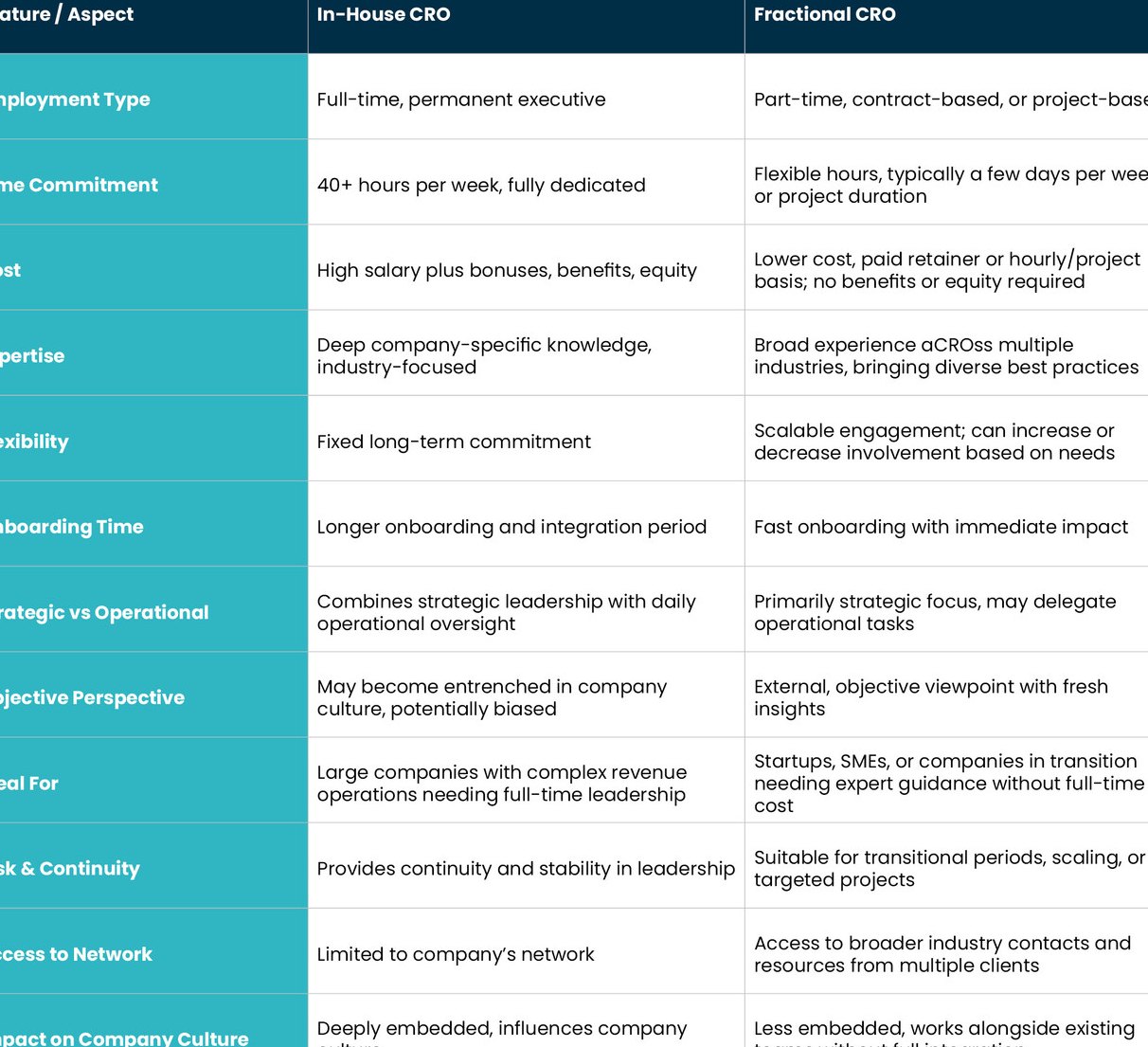
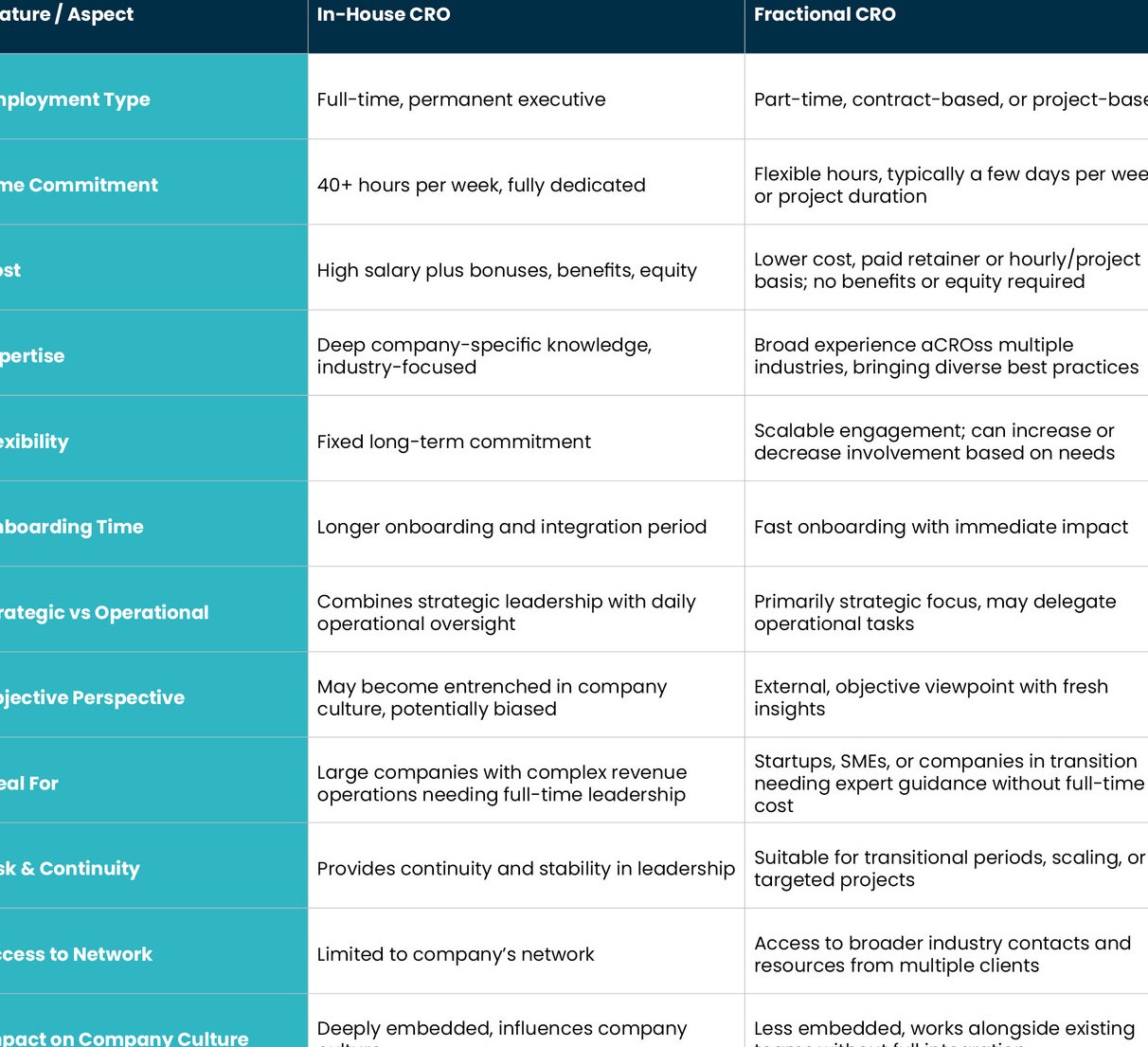
The fractional CRO builds repeatable systems on a limited-time, part-time basis — typically one to three days a week — and is measured on whether the playbook survives their departure. The full-time CRO owns the organization: hiring, firing, culture, and often the broader revenue P&L. For an Operating partner, the fractional model buys you a tested revenue framework without committing to an executive compensation package, and gives you three clean exits at month seven: convert, rotate, or end.
How long should the engagement run?
Six to twelve months. That is enough time to audit the revenue stack, install a standardized methodology, and train the team to run it unassisted. Shorter than six months and you get a design nobody has proven can operate. Longer than twelve without a conversion decision and you have created a permanent part-time executive with part-time authority, which is the worst available structure. Put the decision point on the calendar at month seven.
What should I ask to see from their past work?
Concrete artifacts from prior PE-backed engagements: a redacted playbook, a territory map, a comp plan template, a forecast dashboard. Ask what changed measurably — pipeline coverage, forecast accuracy, stage conversion — and how they know. Candidates who can only describe frameworks in the abstract, without showing how they adapted one to a specific company's data and team, are selling vocabulary rather than installation experience.
How do I structure the contract to protect flexibility?
Flat monthly retainer with a 30-day out for either party. Skip long-term commitments and minimum-hour guarantees, because PE timelines move with exit plans. Include a conversion clause specifying full-time comp if the engagement works, an IP assignment making all playbooks and training materials the portfolio company's property on termination, and the 90-day milestone list attached as a contract exhibit rather than living in email.
How do I measure success if revenue is a lagging indicator?
Measure against the playbook. Track pipeline coverage ratio, win rate by rep and by stage, forecast accuracy at commit, stage conversion rates, and average cycle length — weekly, on one page. Forecast accuracy typically moves within one quarter while revenue takes three, so it is the earliest honest signal. Also track the handoff itself: is the VP of Sales running the forecast call unassisted by the agreed date?
What if the portfolio company is mid-migration on its CRM or CPQ?
Wait, or hire full-time. Fractional leaders rarely have bandwidth to own a multi-month technical rollout while coaching reps and writing methodology, and a playbook built on a system that is about to be replaced gets rebuilt. Fractional works best when the core RevOps stack is already stable and the gap is genuinely methodology and execution discipline rather than infrastructure.
Sources
- Harvard Business Review — sales management and leadership research
- McKinsey & Company — private equity and growth insights
- Bain & Company — Global Private Equity Report
- SaaStr — SaaS go-to-market and sales leadership content
- Pavilion — community for revenue leaders
- First Round Review — startup sales and leadership essays
- Salesforce — CRM and pipeline management documentation
- HubSpot — sales process and CRM resources
Related on PULSE
- [Does a PE-backed martech company need a fractional CRO in 2027?](/knowledge/tl13255)
- [Does a manufacturing company need a fractional CRO or a full-time CRO in 2027?](/knowledge/tl10475)
- [Does a bootstrapped edtech company need a fractional Chief Revenue Officer in 2027?](/knowledge/tl16296)
- [Does a founder-led government contracting company need a fractional Chief Revenue Officer in 2027?](/knowledge/tl16576)
- [Should I hire a fractional CRO in Bethany Beach in 2027?](/knowledge/tl20031)
- [Should I hire a fractional Chief Revenue Officer in Clinton in 2027?](/knowledge/tl20305)
This page will be disappearing soon. Save it to your device for $1 — or read it free while it is here.
@Kory-White- · if Venmo asks, the last 4 of my number are 2012
 pulse-toolsHow do I hire a fractional CRO in Myrtle Beach in 2027?
 pulse-toolsHow do I hire a fractional CCO in Santa Fe in 2027?
 pulse-toolsHow do I hire a fractional CSO in Roswell in 2027?
 pulse-toolsWhat should I look for in a fractional CRO in Harrisburg, Pennsylvania in 2027?
 pulse-toolsHow do I hire a fractional CSO in Myrtle Beach in 2027?
 pulse-toolsHow do I hire a fractional Chief Revenue Officer in Ogden in 2027?
 pulse-toolsHow do I hire a fractional CCO in Nashua in 2027?
 pulse-toolsHow do I hire a fractional CSO in Monroe in 2027?
 pulse-toolsShould I Hire a Fractional CRO If I Need a 30-60-90 Plan Before a Board Meeting in 2027?
 pulse-toolsShould I Hire a Fractional CRO If I Need to Build a Partner Channel in 2027?