
How does a fractional CRO build pipeline for a dev tools company in 2027?
 Curated byKory White · Fractional CRO · Maryland
 PULSEKNOWLEDGE LIBRARY
Quality
Certified

A fractional CRO builds dev tools pipeline in 2027 by treating product usage as the primary lead source, not outbound. They audit open source and free-tier signals, define which usage patterns predict buying, build technical outreach to engineering leaders on top of those signals, and instrument the CRM to prove which motion actually converts.
Where this sits against the common alternatives
The realistic options for a dev tools company that needs pipeline are narrower than the market makes them sound. There are four, and each one solves a different problem.
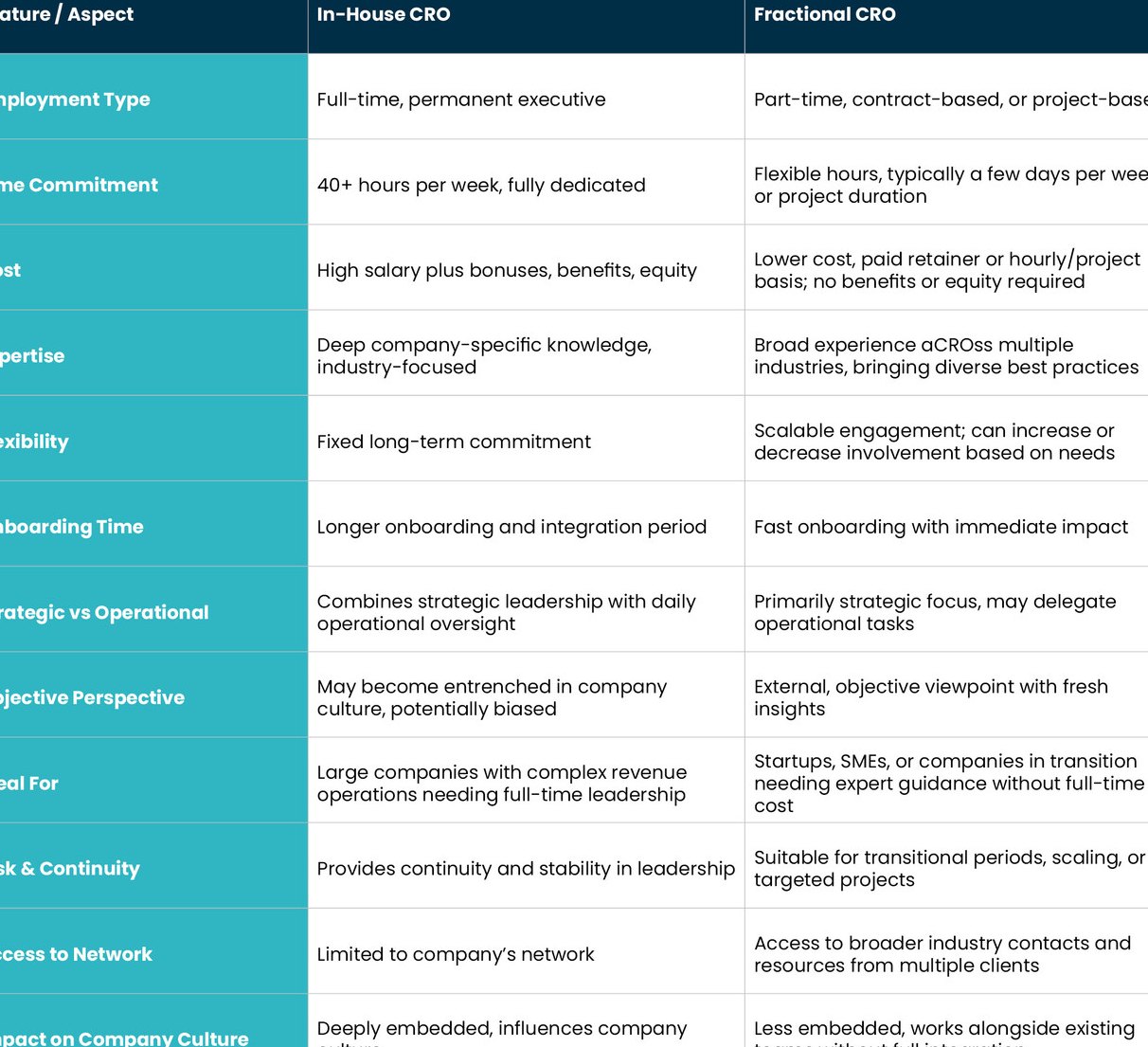
A full-time VP of Sales is the default assumption, and for a company past roughly $8-10M ARR with a proven motion, it is usually right. You get someone in every standup, owning the number daily, hiring and firing their own team. The cost is a base salary plus a variable component plus equity, and — more importantly — a 6-12 month ramp before that person is fully productive. If your motion is not yet defined, you are paying a senior operator to discover it slowly while carrying full-time cost. Worse, a VP of Sales hired from a traditional enterprise SaaS background often arrives with a playbook that actively damages a developer audience: 10-touch sequences, gated content, SDRs cold-calling ICs who have no budget and considerable influence.
A fractional CRO is a 10-20 day/month commitment on a 3-12 month engagement. The value is not cheaper labor — it is that you are buying the diagnostic and architecture phase from someone who has done it before, without committing to a permanent org chart. For dev tools specifically, this matters because the first six months of revenue work is mostly figuring out which product signals mean anything. That is a design problem, not a headcount problem. A fractional operator can also scale down once the motion is documented, which a full-time hire structurally cannot.

A sales-focused advisor — two hours a month, a monthly call, Slack access — costs a fraction of a fractional engagement and delivers roughly a fraction of the outcome. Advisors give you opinions. They do not sit in your Salesforce instance, they do not write the sequences, they do not run the weekly pipeline review. If your founder is already a strong seller and only needs sanity checks, an advisor is efficient. If nobody in the building owns pipeline as a system, an advisor will not create one.
Hiring SDRs first is the most common and most expensive mistake for dev tools. Two SDRs cost roughly what a fractional CRO does, and they arrive with no target list, no message, no qualification criteria, and no idea which of your 4,000 free-tier accounts are worth a call. They will burn through your best-fit accounts with generic outreach and permanently poison a small, gossipy audience. Developers talk. A bad sequence sent to a well-known engineer at a well-known company becomes a screenshot on social media, and that screenshot outlives the campaign.
The honest framing: a fractional CRO is a bet that your problem is *architecture*, not *effort*. If you already know exactly who to call, what to say, and which signals predict a deal — and you simply are not making enough calls — do not hire a fractional CRO. Hire reps. If you cannot answer those questions with data, adding reps just adds noise faster.

There is also a version of this that shows up in adjacent categories — infrastructure, API companies, security tooling, data platforms — where the buyer is technical and the product is self-serve. The same logic holds. The more your product can be evaluated without a human, the more your revenue problem is about *reading* the evaluation rather than *starting* one.
How to choose between them
The decision is not about budget. It is about which of four things is actually broken: product-market fit, signal legibility, message quality, or execution volume. Each one has a different correct answer, and hiring for the wrong one wastes two quarters.
Start with a blunt test. Pull your last 20 closed-won deals. Can you write down, for each, where the first touch came from and what the buyer did in the product before talking to anyone? If you cannot reconstruct that for at least 15 of them, you have a signal legibility problem, and that is the case a fractional CRO is built for. If you *can* reconstruct it, and the pattern is obvious and repeatable, your problem is volume — go hire reps and a manager.

Second test: what is your free-tier or trial conversion rate, and is anyone in the company able to name the top ten accounts using your product right now by usage depth? At a healthy dev tools company, someone can answer that in under a minute from a dashboard. If the answer requires a data pull and three days, the instrumentation work comes before any hiring decision at all.
Third test — the uncomfortable one — is whether the founder will sit in sales calls. Dev tools buyers ask questions that a non-technical seller cannot answer, and in the first two quarters the founder is frequently the only credible voice in the room. A fractional CRO who cannot get founder time on calls will produce a beautiful process document and no revenue. If the founder's honest answer is "I do not want to be in sales," the right move is a technical full-time hire, not a fractional one, because that person needs to be embedded permanently enough to build their own credibility with the audience.
A useful cross-check comes from adjacent categories. Companies selling to designers, to data scientists, to security engineers, and to platform teams all share the same structural feature: the end user is not the budget holder, and the end user's opinion can veto the budget holder. In every one of those markets, the winning sequence is the same — earn the practitioner first, then give them internal ammunition to justify the spend upward. If your prospective fractional CRO's answer to "how would you build our pipeline" does not include the phrase "help the champion sell internally" in some form, they are describing a motion built for a different kind of buyer.

Costs, timelines, and what impact actually looks like
Be skeptical of anyone who quotes a fixed price without seeing your data. What is consistent across the market is the *shape* of the engagement, not the number.
Structure. Fractional CRO engagements are typically retainer-based, priced against a committed day count — commonly 10-15 days a month at early stage and 15-20 at growth stage. Equity frequently forms part of the package, particularly below Series A, and often vests on a standard schedule with a cliff. Some engagements include a performance component tied to qualified pipeline created or to sourced ARR, though pipeline-based bonuses are easier to game than revenue-based ones and should be defined precisely if used. Term is usually 3-12 months with a 30-day out on either side.
The month-by-month reality. Month one is almost entirely diagnostic and produces no pipeline. Expect the operator to spend that time in your product analytics, your CRM, your GitHub, your support tickets, and on calls with your last ten won and lost deals. Months two and three are testing — several small experiments run in parallel, most of which will fail, with the goal of finding one or two channels worth scaling. Months four through six are where compounding starts and where the number should begin to move. A company expecting revenue in month two is buying the wrong thing.

Reasonable output targets. For an early-stage dev tools company, a functioning motion means a handful of genuinely qualified opportunities per month — not MQLs, not demo requests, but accounts with a named champion, a defined use case, and a budget path. At growth stage, that figure scales into the low tens. The number matters less than whether it is *repeatable*: three opportunities per month that arrived the same way is a business; twelve that each arrived differently is luck.
The hidden costs. Budget for tooling on top of the retainer. Realistically that means CRM licensing, call recording, a sequencing tool, and a product analytics layer that can push usage events into the CRM. The last one is where dev tools companies most often discover they need engineering time — usually a small but non-trivial amount of work to pipe usage events into the CRM so that a seller can see them. That work is unglamorous, it competes with the product roadmap, and skipping it is the single most common reason a fractional engagement underdelivers. Negotiate the engineering time up front, in writing, as part of the engagement scope.

What failure looks like early. If at the end of month two nobody in the company can name the three signals that qualify an account, the engagement is drifting. If the weekly pipeline review has become a status update rather than a working session where deals get changed, it is drifting. If the operator is producing decks rather than sitting on calls, it is drifting. Those are 30-day-conversation problems, not end-of-engagement surprises.
Comparative math. Against a full-time VP of Sales, a fractional engagement typically costs meaningfully less per month and carries no severance risk, but you get a fraction of the hours and no daily presence. Against two SDRs at similar total cost, you get design instead of activity. Against an advisor, you pay several times more and get someone who actually executes. Which is correct depends entirely on the diagnostic in the previous section — and any operator worth hiring will tell you when the answer is "not me."
Why dev tools pipeline behaves differently
The structural difference is that in dev tools, evaluation happens before contact. A developer finds you through a search result, a Stack Overflow answer, a conference talk, a colleague's recommendation, or a dependency in someone else's repo. They install it. They use it on a side project. They bring it to work. By the time anyone at your company knows their name, they have already formed an opinion about your product that no seller will change.

This inverts the classic funnel. Traditional B2B pipeline generation is about *creating* awareness and then qualifying interest. Dev tools pipeline generation is about *detecting* interest that already exists and helping it convert. A fractional CRO's first job is therefore instrumentation, not activity — figuring out which behaviors inside your product distinguish "someone playing on a weekend" from "a platform team running a real evaluation."
Those signals are specific and worth naming. Multiple users from the same email domain signing up within a short window is a strong indicator of a team evaluation. Usage moving from a personal environment to CI is a strong indicator of production intent. Someone reading your pricing page and your security or compliance documentation in the same session is a strong indicator that procurement has entered the picture. A spike in API calls followed by a support ticket about rate limits is a buying signal wearing a support ticket's clothes. None of these are exotic — they are just invisible unless someone deliberately makes them visible.
The second structural difference is the veto. In most dev tools purchases, the person who decides *what to buy* and the person who decides *whether to buy* are different humans, and the first can kill the deal instantly while the second cannot force it through. Developers evaluate on ergonomics, documentation quality, performance, and whether the tool respects their time. Engineering leaders decide on cost, consolidation, security posture, and support terms. A pipeline motion that speaks only to one of them stalls at the other.

The third difference is memory. Developer communities are small, connected, and have long institutional memory. A tone-deaf outbound campaign, an aggressive trial paywall, or a licensing change perceived as a bait-and-switch will be discussed publicly, and the discussion will surface in search results for years. This is the practical reason a fractional CRO working in this category is usually *more* conservative about outbound volume than one working in traditional SaaS — the downside of a bad campaign is not a low reply rate, it is reputational damage that outlasts the quarter.
The fourth, and the one most often missed: in dev tools, documentation is a revenue asset. Docs pages that rank for real problems ("how do I deploy X in Y environment," "how do I migrate from A to B") pull in evaluators at exactly the moment of intent. A fractional CRO who understands the category will push for docs improvements as a pipeline intervention, which sounds like marketing overreach until you look at where your best deals actually originated.
Implementation, instrumentation, and the handoff
The engagement should produce an operating system, not a person. Everything below is meant to survive the operator's departure.

Weeks one through four: instrumentation. Define deal stages that reflect how developers actually buy, rather than generic enterprise stages. Something like: usage signal detected → champion identified → team evaluation active → technical validation complete → commercial and security review → closed. Each stage needs an exit criterion a third party could verify. "Champion identified" means a named person who has said they want this, not a hopeful guess. Attribution gets wired at the same time: every opportunity carries a first-touch source and a usage-signal timestamp, so that in three months you can answer which channel produced which revenue without a data archaeology project.
Weeks two through eight: the signal-to-outreach path. Once usage events reach the CRM, build the trigger logic. Not a static list — a queue that surfaces accounts *when* they cross a threshold. The outreach that follows should be short, technical, specific to what that account did, and written by someone who can hold a conversation about the product without a script. One email, one message on a professional network, then stop. The temptation to build a ten-step sequence should be resisted; in this category, persistence reads as desperation and gets you blocked rather than booked.
Weeks four through twelve: the community-to-pipeline loop. Conference talks, workshops, deep technical content, and open source participation generate the top of the funnel. The pipeline discipline is capture: every workshop requires registration, every talk has a landing page, every meaningful community interaction gets logged. This is where most dev tools companies leak — the community work happens, it works, and nobody records it, so six months later there is no evidence to justify continuing it.

Ongoing: the weekly review. Ninety minutes, founder present, every open opportunity examined. Not "how's it going" — specifically: what changed since last week, what is the next verifiable step, who is the champion, what is the risk. This meeting is the single highest-leverage artifact of the engagement, and it is the one that most often dies within a month of the fractional operator leaving. Build it so someone internal runs it by month four.
The handoff is the deliverable. A fractional engagement that ends with the founder unable to run the motion has failed regardless of the pipeline number. The exit artifacts should include: documented stage definitions and exit criteria, the signal scoring logic and where it lives, the message library with performance data, the target account criteria, the weekly review agenda and who owns it, and a recommendation on the first two full-time hires with a defined ramp plan. If the operator resists documenting any of that, you are hiring a dependency rather than buying a capability — and that distinction is worth asking about directly in the first conversation.
Adjacent RevOps consequences. Building this well tends to force improvements outside sales. Pricing usually gets revisited, because usage-based signals reveal that the packaging boundaries do not match how teams actually adopt. Support gets pulled closer to revenue, because the highest-intent conversations often start as tickets. Product analytics gets cleaned up, because the sales motion now depends on it. Those are second-order benefits, and they are a large part of why the exercise is worth doing even at companies where the immediate pipeline number is modest.
Related questions
Should a dev tools company hire a fractional CRO before product-market fit?
No. If retention is weak and usage is shallow, no revenue leader can compensate. Fix activation and retention first. A fractional CRO hired pre-fit will spend the engagement telling you that, at retainer prices.
Can the same fractional CRO run both self-serve and enterprise motions?
Usually yes, and they should — the two are connected, not separate. Self-serve usage produces the signals that make enterprise outbound work. Splitting them into independent teams too early is a common and expensive structural mistake.
What should be in the contract?
Committed days per month, term length, notice period, equity terms and vesting, defined access to engineering time for instrumentation, named handoff deliverables, and a clear statement of what the operator does and does not own.
How is this different for an API-first company?
Barely. API companies have even cleaner usage signals — call volume, error rates, endpoint mix — which makes the instrumentation work easier and the argument for a signal-driven motion stronger, not weaker.
Who owns marketing during the engagement?
Typically not the fractional CRO, but they should have significant influence over developer-facing content and documentation priorities, because those directly generate pipeline in this category.
FAQ
How long before a fractional CRO produces measurable pipeline for a dev tools company?
Plan on three to six months. Month one is diagnostic and instrumentation with no output. Months two and three are channel testing where most experiments fail. Months four through six are where a repeatable motion should be visible. Anyone promising results in month two is either inheriting an existing pipeline or overselling.
What if we have almost no community and no open source presence?
Then the engagement looks different and takes longer. Without existing usage signals, the operator has to build top-of-funnel from content, documentation, partnerships, and targeted outbound simultaneously — which is slower and riskier. Set expectations accordingly, and consider whether founder-led selling for another two quarters is the cheaper path to learning who your buyer is.
Should we hire SDRs at the same time?
Generally not at the start. Bring reps in once the target criteria, message, and qualification bar are documented and proven — usually month four or later. SDRs hired into an undefined motion burn through your best-fit accounts learning what the fractional CRO could have told them in week three.
How do we evaluate a fractional CRO's dev tools experience in an interview?
Ask them to describe the specific product usage signals they would instrument for your tool, and what they would do differently versus a traditional SaaS company. A strong answer is concrete: named signals, named stage definitions, an opinion on outbound volume. A weak answer talks about general sales process and headcount.
What is the most common reason these engagements fail?
Founder absence, followed closely by unavailable engineering time for instrumentation. The motion depends on usage data reaching the CRM and on a technically credible voice in early calls. Remove either and the engagement produces documentation instead of revenue.
Can this work for a company with a small team and no dedicated RevOps function?
Yes — in fact that is the common case. Part of the value is that the fractional operator builds the minimum viable RevOps layer as a byproduct: clean stages, working attribution, a functioning forecast. Just be realistic that a lean team means fewer parallel experiments and a slower ramp.
Sources
- Stack Overflow Developer Survey
- GitHub Octoverse
- CNCF
- Y Combinator Library
- First Round Review
- Harvard Business Review
- a16z
- SaaStr
- Pavilion
Related on PULSE
- What should an SMB company look for in a fractional CRO in 2027?
- Is there a fractional CRO available near me in Boise in 2027?
- Is there a fractional CRO available near me in Massachusetts in 2027?
- Is there a fractional Chief Revenue Officer available near me in Detroit in 2027?
- Who is the best fractional Chief Revenue Officer in Middletown in 2027?
- Is there a fractional CRO available near me in Pasadena in 2027?
This page will be disappearing soon. Save it to your device for $1 — or read it free while it is here.
@Kory-White- · if Venmo asks, the last 4 of my number are 2012
This page is gone.
This one is off the shelf now. $1 keeps it on your phone for good — the whole page, pictures and diagrams included.
 pulse-toolsHow do I hire a fractional CCO in Olympia in 2027?
 pulse-toolsShould I Hire a Fractional CRO If I Need to Fix Attribution Before Raising in 2027?
 pulse-toolsHow do I hire a fractional COO in South Bend in 2027?
 pulse-toolsShould I Hire a Fractional CRO If I Need to Rebuild Trust After a Failed CRO in 2027?
 pulse-toolsHow do I hire a fractional CCO in Santa Fe in 2027?
 pulse-toolsHow do I hire a fractional CRO in Olympia in 2027?
 pulse-toolsShould I Hire a Fractional CRO If I Need a 30-60-90 Plan Before a Board Meeting in 2027?
 pulse-toolsHow do I hire a fractional CRO in Melbourne in 2027?
 pulse-toolsHow do I hire a fractional CCO in Appleton in 2027?
 pulse-toolsHow much does a fractional CRO cost in Evansville, Indiana in 2027?