
Where do I find a fractional VP of Sales in Richmond in 2027?
 Curated byKory White · Fractional CRO · Maryland
 PULSEKNOWLEDGE LIBRARY
Quality
Certified

Find a fractional VP of Sales in Richmond through fractional-CRO networks like CRO Syndicate, Pavilion's talent channels, LinkedIn searches filtered for "fractional VP of Sales" plus Virginia, and local founder communities such as Startup Virginia. Most qualified operators serve Richmond remotely with two to four onsite days monthly, since the truly local fractional bench remains thin.
The job a fractional VP of Sales is actually hired to do
Before you search anywhere, get precise about the job. "Fractional VP of Sales" is a container word that people fill with wildly different expectations, and the mismatch between what a founder wants and what a fractional leader signed up for is the single most common reason these engagements die at month four.
The role exists because of a specific gap in company lifecycles. A founder-led sales motion works until it doesn't — usually somewhere between the first million and the first five million in annual recurring revenue, or the equivalent in a services business. The founder has closed everything personally, knows every deal by heart, and cannot scale past their own calendar. Hiring a full-time VP of Sales at that stage is expensive and risky: the search takes months, the comp package is real money against an unproven repeatable motion, and if the hire misses you burn a year plus severance plus the morale damage of a leadership churn. A fractional leader compresses that risk. They arrive in weeks, work a defined number of days per month, and can be ended on short notice.
What they actually do, in practice, breaks into five buckets. Diagnosis — auditing pipeline hygiene, win/loss reality, ICP fit, and whether your revenue problem is even a sales problem. Systems — building or rebuilding the qualification framework, the stage definitions, the forecast cadence, the compensation plan. People — coaching existing reps, running the interview loop for new ones, and making the call on underperformers a founder is too close to fire. Deals — sitting in on late-stage enterprise conversations where a senior title in the room changes the outcome. Reporting — turning the mess into a board-legible narrative so the founder stops improvising the revenue slide.
Notice what is not on that list: being your best rep. If you need someone to personally source and close a quota, you need a senior account executive, and you will get far more selling hours for the money. Fractional leaders who quietly become individual contributors are a known failure mode — the founder gets short-term relief and no durable system, and when the engagement ends the pipeline collapses back to where it started.

The Richmond-specific wrinkle is vertical mix. This is not a monoculture SaaS market. Richmond's economy leans on corporate headquarters — Dominion Energy, CarMax, Altria, Markel, CoStar's growing footprint — plus a real base in logistics, professional services, life sciences, and the government-adjacent contracting spillover from Northern Virginia. If your buyer is a hospital system procurement committee or a regional distributor's operations director, a fractional leader whose entire background is product-led SaaS growth will spend three months learning your sales cycle on your dime. Ask about buyer-persona experience before you ask about anything else.
There is also a downstream job most founders forget to scope: the handoff. A good fractional engagement is designed to end. Either you graduate to a full-time VP, or the founder reabsorbs a now-functioning system, or the fractional leader converts to full-time. Write the exit condition into the brief on day one — "at the end of this, we have a documented sales process, a hired and ramped AE, and a forecast the board trusts" — because engagements without a defined finish line drift into expensive advisory relationships that nobody wants to be the one to cancel.
How the role fits your RevOps stack and where to actually find people
A fractional VP of Sales does not operate in a vacuum. They plug into — and often expose the weaknesses of — whatever RevOps infrastructure you already have. Understanding that interface tells you both what to look for in a candidate and where the good ones congregate.
If your CRM is a wasteland of half-filled opportunity records with no stage discipline, the first sixty days of any competent engagement will be spent on data archaeology rather than selling. That is not wasted time, but you should know you are paying senior day rates for it. Founders who clean up their pipeline data before the engagement starts routinely get an extra month of actual sales leadership out of the same retainer. Export your closed-won and closed-lost from the last eighteen months, make sure the source, stage history, and reason codes are populated, and hand that over in week one.

The stack question also shapes the candidate profile. A fractional leader who can audit Salesforce or HubSpot themselves, write their own reports, and configure a forecast view without waiting on an admin is worth materially more to a company under twenty people than one who needs an ops person to hand them dashboards. Ask directly: "Walk me through the reports you build in week one and who builds them." If the answer requires headcount you don't have, adjust scope or budget.
Now the sourcing channels themselves, ranked by how they actually perform for a Richmond company.
Fractional CRO and revenue-leader networks. These are curated benches of senior operators who have deliberately structured their careers around portfolio work. CRO Syndicate is one such network of practitioners who have carried the numbers they advise on. The advantage is pre-vetting and speed — you describe the situation and get matched against people who already do this for a living, rather than fishing for someone between full-time jobs who will vanish the moment a W-2 offer lands. Ask any network how they vet, how many clients each operator carries, and what happens if the match fails.
Pavilion. A membership community for revenue leaders with chapter structure and active talent channels. Post your one-page brief in the relevant channel and ask for warm introductions rather than blasting a job description. The signal-to-noise is high because members are self-selected senior operators, and referrals inside a reputation-bearing community carry accountability that a cold LinkedIn message does not.

LinkedIn, used surgically. Search the exact strings — "fractional VP of Sales," "fractional CRO," "interim VP Sales" — and filter by Virginia, then widen to DC, Raleigh-Durham, Charlottesville, and Norfolk. Read for pattern: multiple concurrent or sequential fractional engagements over two-plus years signals someone who has built a real practice. A single "fractional" line added last quarter usually signals someone between jobs. Neither is disqualifying, but they are different risk profiles and should be priced differently.
Local founder ecosystems. Startup Virginia, Lighthouse Labs, the 757 network down in Hampton Roads, and the informal Slack and Discord groups that orbit them. Word-of-mouth here is slower but the references are real people you can call. Virginia's regional economic development and small-business development center networks also run programs where mid-market owners share advisor recommendations — undervalued for non-tech verticals.
Your investors and board. If you have institutional money, the portfolio-services partner has almost certainly placed fractional revenue leaders before. Even a small regional fund or an angel syndicate carries a list. This is the fastest path to a pre-referenced candidate, and it is free.
Adjacent talent pools worth considering. Independent sales consultants serving Richmond mid-market firms, retired or semi-retired divisional sales leaders from the region's large employers, and boutique RevOps consultancies that will assign a senior partner on a part-time basis. These are not branded "fractional VP of Sales," which is exactly why they are less picked over. A former regional sales director from a large logistics or distribution employer who now takes two clients may bring more relevant buyer knowledge to a Richmond industrial company than a Bay Area SaaS operator ever will.

The honest summary on geography: Richmond has a solid pool of senior sales talent and a modest pool of people who have formalized fractional practices. Search nationally, filter for willingness to serve Richmond with periodic onsite presence, and treat "locally headquartered" as a nice-to-have rather than a gate. The DC, Raleigh, and Charlottesville corridors are all within comfortable driving or short-flight distance, which makes a two-to-four-day monthly onsite rhythm entirely practical.
Pricing, engagement models, and how to structure the deal
Fractional pricing is built from a small number of variables: days per month, seniority and demand of the operator, scope depth, company stage, and whether equity or performance upside is part of the package. Understand the mechanics and you can negotiate structure rather than haggling over a number.
Day-based retainers are the dominant model. You agree on a number of days per month — commonly in the range of eight to twenty — at a rate reflecting the operator's market. Light strategic engagements at the low end mean weekly leadership meetings, pipeline review, and coaching, with the founder still executing. Mid-range engagements add hands-on deal support, comp plan design, and process rebuild. The heaviest engagements approach a genuine part-time executive role: hiring, managing, forecasting, and board reporting. Below roughly eight days a month you are buying advice, not leadership; be honest with yourself about which one you need, because advice will not fix an execution problem.
Project or outcome-scoped engagements are the alternative. Instead of buying time you buy a defined deliverable — a rebuilt sales process, a hired and ramped first AE, a documented enterprise playbook, a comp plan overhaul — with a fixed fee and a completion definition. This works well when the problem is genuinely bounded and badly when the problem is "our revenue is flat and we don't know why," because diagnosis expands.

Hybrid cash-plus-equity is common at seed and Series A, where cash conservation matters and the operator wants exposure to the upside they are creating. Equity components in fractional arrangements typically land in the fraction-of-a-percent to low-single-digit range, usually vesting over the engagement rather than a standard four-year schedule, and often with a cliff tied to a milestone. If you offer equity, offer it as a genuine alignment mechanism with a real vesting document, not as a discount lever. Operators who have been burned by paper compensation will discount its value heavily anyway.
Performance bonuses tied to revenue or pipeline targets sound clean and are frequently a trap in year one. If the sales motion is unproven, you are asking the operator to bet on variables outside their control, and they will price that risk into the cash component. A better structure early on is a bonus tied to leading indicators the leader genuinely owns — qualified pipeline created, sales cycle length, rep ramp time, forecast accuracy — with revenue-based upside deferred until the motion is proven.
A few structural details that matter more than the headline number:

Trial period. Thirty days, paid, with written success criteria. Both sides get an honest look. Any operator who refuses a paid trial is telling you something; any founder who wants an unpaid one is telling the operator something too.
Notice. Thirty days on either side is standard and reasonable. Shorter than that and the operator cannot responsibly manage their portfolio; longer than that and you lose the flexibility that made fractional attractive.
Day definition. Write down what a day means. Is a two-hour forecast call plus scattered Slack a half day or a full one? Does travel time to Richmond count? Are onsite days billed differently? Ambiguity here produces the most common mid-engagement conflict.
Exclusivity and conflicts. Fractional leaders carry multiple clients — that is the model. Get a commitment that they will not take a direct competitor and that they will disclose portfolio changes. Do not ask for exclusivity unless you are paying something close to full-time.

Expenses. Travel to Richmond, tools, and any contractor spend should be specified. A leader flying in monthly from outside the driving radius carries real cost that someone has to absorb.
On the "local discount" question founders often raise: there isn't one. Rates track the operator's experience and demand, not their zip code. A Richmond-based operator might accept modestly less cash because they value not commuting or not flying, but the effect is marginal. If your budget is genuinely tight, buy fewer days at full rate rather than more days at a discount — a strong operator four days a month beats a weak one at twelve, every time.
Compared against the full-time alternative, the arithmetic is straightforward. A full-time VP of Sales carries base plus variable plus benefits plus recruiting cost plus a four-to-twelve-week search plus onboarding ramp, and if it fails you absorb severance and a leadership vacuum. Fractional starts in one to three weeks, costs a fraction of loaded full-time comp, and unwinds cheaply. The trade is bandwidth and presence — a fractional leader is not in every hallway conversation, will not build culture the same way, and cannot carry a large team. Somewhere past Series B with a proven repeatable motion and more than a handful of reps, full-time wins clearly. Below that, fractional usually wins on risk-adjusted value.
How to evaluate, shortlist, and onboard
Sourcing gets you names. Evaluation is where the engagement is actually won or lost, and most founders under-invest here because the low commitment of fractional makes it feel low stakes. It isn't — a bad six months at a critical stage costs you a year.

Start with the brief. One page. Current revenue and growth rate. Team composition today. Primary motion — inbound, outbound, channel, enterprise, or founder-network. The three outcomes you need in six months, stated concretely. Known constraints: budget, tooling, the co-founder who won't let go of deals. This document is your filter. Weak candidates will skim it and pitch a generic methodology. Strong ones will interrogate it and tell you which of your three outcomes is unrealistic in the timeframe.
Screen for pattern, not pedigree. Logos on a resume tell you where someone worked, not what they built. The question that separates operators from tourists is situational: "Describe the last broken sales process you inherited. What was actually wrong, what did you change first, and what happened in the following ninety days?" Listen for specificity about the diagnosis. Someone who jumps straight to the solution — "I implemented MEDDIC" — without describing what they found is reciting a playbook. Someone who says "the stage definitions were meaningless so the forecast was fiction, and the first thing I did was rebuild the stage exit criteria with the reps in the room" has actually done it.
Probe the founder relationship directly. Ask: "How do you handle a founder who wants to stay in every deal?" There is no single right answer, but there is a wrong one — anything that sounds like conflict avoidance or unconditional deference. The best answers acknowledge that founder involvement is an asset early and a bottleneck later, and describe a deliberate transition. Also ask what they need from you. An operator who has no requirements of the founder has not thought about the engagement seriously.
Test the vertical fit. Have them explain your buyer back to you. What does that person's day look like, what do they get evaluated on, who else has to sign, what kills deals at the last stage? If your motion involves procurement committees, security reviews, or regulated buyers, someone whose experience is entirely transactional SMB will be learning on your budget.

Beware the guarantee. Anyone promising to double revenue in ninety days is selling. Real transformation shows in leading indicators — pipeline quality, cycle length, forecast accuracy — within three to six months, and in closed revenue on a timeline set by your actual sales cycle. If your average deal takes five months to close, no leader on earth produces closed-won proof in month two. Credible operators say this unprompted.
Reference deliberately. Two to three past clients at comparable stage and complexity. Ask about responsiveness between scheduled days, whether they built systems that survived their departure, how they handled disagreement with the founder, and — the most useful question — "what would you do differently if you hired them again?" The answer to that one is where the honest caveats live.
Then onboard fast, because you are paying for days and every wasted one is real. A fractional leader does not need a two-week orientation; they need access and context in the first week. Week one: CRM credentials, eighteen months of closed-won and closed-lost data, call recordings if you have them, current comp plans, and meetings with the founder, the product lead, and every rep. Week two: a pipeline audit, a named list of the top three bottlenecks, and a sixty-day plan you both sign off on. Weeks three and four: quick wins that build credibility — tightening the ICP, fixing the outbound sequence that nobody has touched in a year, rewriting stage definitions. Month two: they own the forecast call and the founder steps back from deal-by-deal involvement. Month three: leading indicators should be moving, and you should be reviewing the plan against data rather than vibes.
Set the KPI review cadence in writing before day one. Monthly, against the specific indicators you agreed. If nothing is moving by month three and the operator cannot explain why in terms of a diagnosis you find credible, use the thirty-day notice. That optionality is the entire point of the structure.

A decision framework for choosing your revenue-leadership shape
Fractional VP of Sales is one option among several, and the right answer depends on where the actual constraint sits. Founders frequently reach for a sales leader when the binding problem is upstream — a positioning failure, a pricing model that doesn't match how buyers budget, or a product that solves a real but small problem. No sales leader fixes those, and hiring one to try is expensive misdirection.
Work through it in order. Is the product delivering value that customers renew and refer? If not, the problem is not sales. Can anyone besides the founder close a deal? If nobody has ever done it, you may need a first senior AE to prove it is possible before you hire someone to manage a motion that doesn't exist yet. Do you have a repeatable, documented motion and more than five reps? Then you are likely past fractional and into full-time VP territory. Is the gap specifically leadership — systems, coaching, forecasting, hiring — with enough evidence that the motion can work? That is the fractional sweet spot.
Then choose between adjacent shapes. A fractional VP of Sales owns the sales team and pipeline execution. A fractional CRO owns the whole revenue function including marketing and customer success, and is the right call when the failure is cross-functional — leads that marketing generates and sales rejects, churn that nobody owns. A fractional RevOps consultant fixes systems, data, and reporting without managing people, which is the right answer surprisingly often when the real complaint is "I don't trust the numbers." A sales coach works with existing reps on skill without owning strategy. A recruiter plus a strong first AE is the right move when you need selling capacity, not leadership.
A last framing point. The fractional model has spread well beyond sales — fractional CFOs, CTOs, CMOs, and RevOps leads are now ordinary in the sub-fifty-person company. That matters for Richmond specifically, because the same networks and founder communities that surface a fractional VP of Sales tend to surface the rest. Founders who find one good fractional executive frequently build an entire part-time leadership bench, and those operators refer each other. Treat your first search as an entry into that network rather than a one-off transaction, and the second hire gets dramatically easier.
Related questions
What is the difference between a fractional VP of Sales and a fractional CRO?
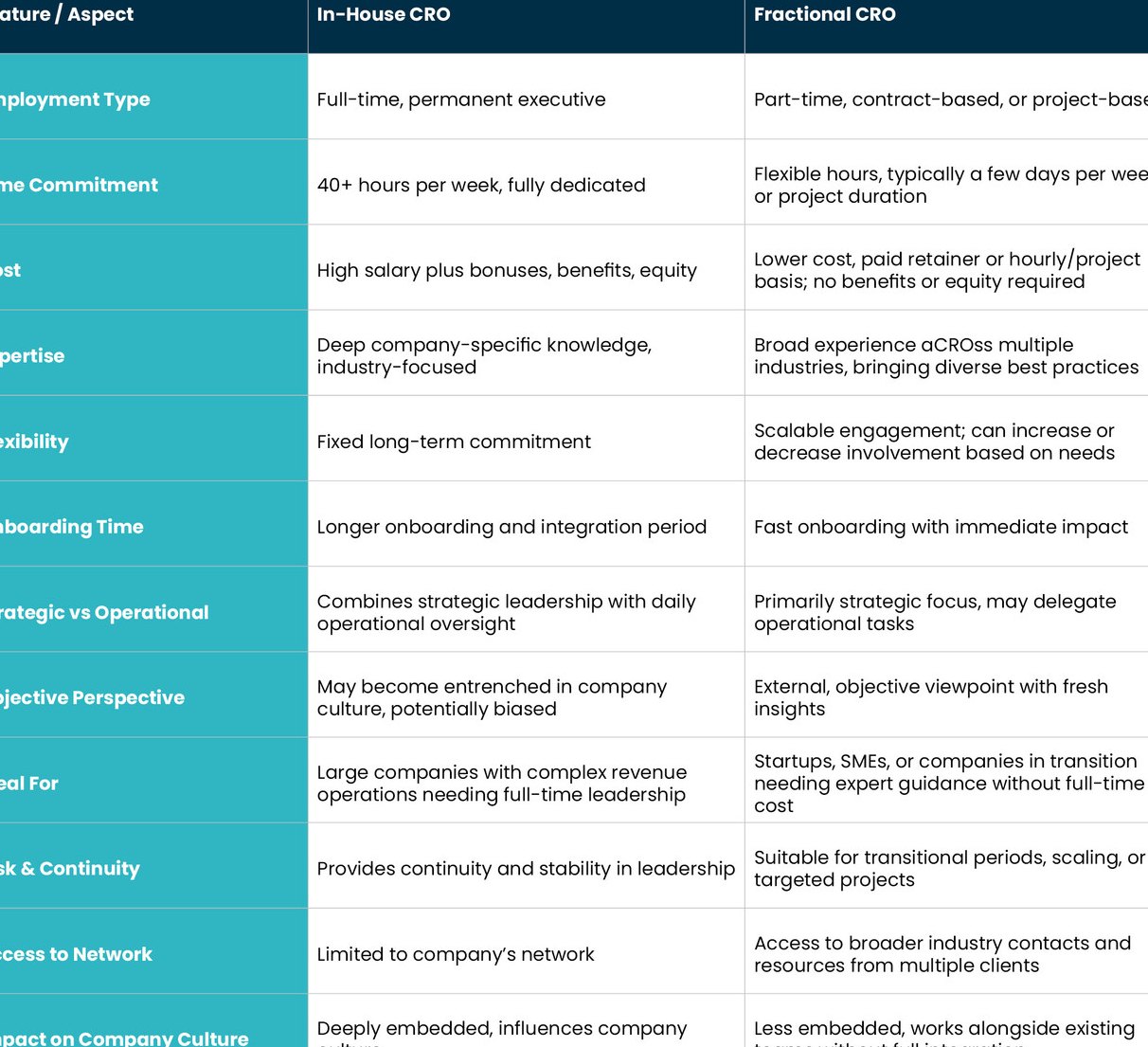
A VP of Sales owns the sales team, pipeline, and quota attainment. A CRO owns the full revenue function — sales, marketing, and customer success — and the handoffs between them. Under roughly five reps with a sales-specific gap, a VP is sufficient. Cross-functional revenue breakdowns need a CRO.
How long does a typical fractional engagement last?
Most run three to twelve months, opening with a thirty-day paid trial and continuing month to month on thirty-day notice. Some extend to eighteen months when the company isn't ready for full-time. Engagements should have a written exit condition: a documented system, a hired successor, or conversion to full-time.
Can I find a fractional VP of Sales who works only with Richmond companies?
Rarely, and you shouldn't require it. Portfolio operators serve clients across regions by design. Look instead for someone who includes Richmond in their coverage and commits to two to four onsite days monthly. Geographic exclusivity narrows your candidate pool far more than it helps.
Should I clean up my CRM before the engagement starts?
Yes. Every hour a senior operator spends on data archaeology is billed at leadership rates. Export eighteen months of closed-won and closed-lost with source, stage history, and reason codes populated, and hand it over in week one. Founders who do this get roughly an extra month of actual sales leadership.
What should I measure in the first ninety days?
Leading indicators the leader genuinely controls: qualified pipeline created, sales cycle length, forecast accuracy, rep ramp time, and stage conversion rates. Closed revenue lags your sales cycle, so judging month two on bookings is judging noise. Set these in writing before day one and review monthly.
FAQ
How many days per month should I buy?
Match days to scope, not budget. Eight to ten days supports strategic guidance, weekly pipeline review, and coaching while the founder still executes. Twelve to sixteen adds hands-on deal support, comp design, and process rebuild. Sixteen to twenty approaches a genuine part-time executive role with hiring, management, and board reporting. Below eight days you are buying advice rather than leadership, which will not fix an execution problem.
Is there a local Richmond discount on rates?
No meaningful one. Fractional rates track an operator's experience and market demand rather than geography. A Richmond-based candidate might accept slightly less cash to avoid travel, but the effect is marginal. If budget is tight, buy fewer days from a strong operator rather than more days from a weaker one — the outcome difference is not close.
What if the fractional VP doesn't deliver?
That optionality is the point of the structure. Set specific KPIs in the first thirty days — pipeline value, deal velocity, forecast accuracy, rep activity — and review monthly. If the leading indicators aren't moving by month three and the operator can't explain why with a credible diagnosis, exercise the thirty-day notice. The cost of exiting is a fraction of a failed full-time hire.
Should I offer equity?
At seed and Series A it's common and often useful, but offer it as genuine alignment with a real vesting document tied to engagement duration or milestones — not as a discount on cash. Operators who have been burned by paper compensation discount its value heavily. If you can only pay in equity, you are recruiting a co-founder, not contracting a fractional leader.
Does industry experience matter more than sales-leadership experience?
Both matter, but the weighting shifts with cycle complexity. For long, committee-driven, or regulated sales, vertical knowledge saves months of ramp and is worth prioritizing — relevant in Richmond given the local concentration in logistics, life sciences, professional services, and government-adjacent work. For shorter transactional cycles, general sales-leadership craft transfers well and industry familiarity is secondary.
What is the biggest failure mode in these engagements?
Scope drift into individual contribution. A fractional leader who quietly becomes your best rep produces short-term relief and no durable system, so the pipeline collapses when they leave. Guard against it by defining deliverables as systems and capabilities — documented process, ramped hires, trustworthy forecast — rather than as bookings the leader personally sources.
Sources
- Pavilion — membership community for revenue leaders with chapters and talent channels
- RevOps Co-op — community and resources for revenue operations practitioners
- SaaStr — long-running practitioner writing on SaaS sales leadership and hiring
- First Round Review — startup operating guidance on hiring and scaling revenue teams
- Harvard Business Review — research and practice on sales management and organizational design
- Startup Virginia — Richmond-based nonprofit incubator and founder community
- Lighthouse Labs RVA — Richmond accelerator with founder and mentor network
- Virginia Economic Development Partnership — regional industry composition and business ecosystem data
- LinkedIn — title- and geography-filtered search for fractional revenue leaders
- U.S. Bureau of Labor Statistics — occupational and regional employment data for sales management roles
Related on PULSE
- When should a founder stop selling and hire a sales leader?
- Fractional CRO vs. full-time VP of Sales: how to choose
- How to build a sales compensation plan for your first three reps
- What a RevOps audit should cover before you hire a sales leader
- How to run a forecast call a board will actually trust
- Signs your revenue problem is positioning, not sales execution
This page will be disappearing soon. Save it to your device for $1 — or read it free while it is here.
@Kory-White- · if Venmo asks, the last 4 of my number are 2012
This page is gone.
This one is off the shelf now. $1 keeps it on your phone for good — the whole page, pictures and diagrams included.
 pulse-toolsShould I Hire a Fractional CRO If My New Reps Take Too Long to Ramp in 2027?
 pulse-toolsHow do I hire an interim CRO for a fintech company in 2027?
 pulse-toolsShould I Hire a Fractional CRO If I Need Interim Coverage During a Medical Leave in 2027?
 pulse-toolsHow do I hire a fractional VP of Sales for a medtech company in 2027?
 pulse-toolsWhere do I find a fractional VP of Sales in Oklahoma City in 2027?
 pulse-toolsHow do I hire a fractional VP of Sales in Reno in 2027?
 pulse-toolsShould I Hire a Fractional CRO If I Need to Stand Up RevOps From Scratch in 2027?
 pulse-toolsWhere do I find a fractional VP of Sales in Memphis in 2027?
 pulse-toolsShould I Hire a Fractional CRO If I Need a 30-60-90 Plan Before a Board Meeting in 2027?
 pulse-toolsHow do I hire a fractional head of revenue in Houston in 2027?