
How do I hire a fractional head of revenue in Boulder in 2027?
 Curated byKory White · Fractional CRO · Maryland
 PULSEKNOWLEDGE LIBRARY
Quality
Certified

Define the revenue gap first, then hire for it. Scope a fractional head of revenue at 5–15 days a month, source through Pavilion, RevOps Co-op, and local VC referrals, and open with a paid 30-day pilot carrying fixed deliverables and a mutual opt-out. Budget two to four weeks from search to signed agreement.
The end-to-end process from brief to signed pilot
Most Boulder founders start this search in the wrong place — they start with candidates. Start with the diagnosis instead, because the diagnosis determines which of four fairly different people you are actually hiring: a fractional CRO, a fractional VP of Sales, a RevOps contractor, or a demand-gen consultant wearing a revenue title. Those roles get conflated constantly, and the conflation is where the money leaks.
Write a one-page brief before you talk to anyone. Put five things on it: current ARR, headcount in any customer-facing role, average deal size, average sales cycle in days, and the single sentence that describes what is broken. That last sentence has to be specific enough to be falsifiable. "We need to grow faster" is not a brief. "We close 40% of deals under $15K and 8% of deals over $50K, and we don't know why" is a brief. The second version tells a candidate exactly what pattern to reach for in the first conversation, and it lets you screen out anyone whose whole answer is a generic methodology deck.
Then decide days per month, which is the variable that drives everything downstream — cost, candidate pool, and how deeply someone can actually get into your business. Five days a month is one day a week: enough for a strategic operating cadence, a weekly forecast review, and coaching a founder or an existing sales lead. It is not enough for someone to manage reps, sit in deals, or rebuild your CRM themselves. Ten to fifteen days is closer to a half-time role — a player-coach who runs your pipeline meeting, joins late-stage calls, and personally rewrites your qualification framework. Fifteen days is roughly the ceiling; past that you are paying fractional rates for something you should be hiring full-time.
Sourcing runs on three parallel tracks and you should run all three at once rather than sequentially, because the sequential version is what turns a three-week search into a three-month one. Track one is community: the Pavilion Boulder chapter, RevOps Co-op, and the Colorado-specific Slack groups where operators already know each other. Track two is investor and accelerator referral — Techstars Boulder, Boomtown, and whoever led your last round have all watched a dozen portfolio companies hire this exact role and know who actually delivered. Track three is direct outbound on LinkedIn to people who list two to four concurrent clients, because that pattern is the tell for a real fractional practice rather than someone between full-time jobs treating you as a bridge.

Interview for pattern recognition, not credentials. The question that separates the field is some version of: walk me through how you diagnosed a revenue problem at a company at our stage — what data did you pull first, and what did it tell you? Strong candidates go straight to specifics: won/lost by segment, stage conversion rates, time-in-stage, rep-level variance, pipeline coverage against a real quota. Weak candidates describe a framework. Frameworks are free; knowing which three numbers to look at on day one is the thing you are buying.
Reference checks are where founders get lazy, and it costs them. Ask past clients two uncomfortable questions. First: what did they *not* fix? Every engagement leaves something on the table, and a reference who can't name anything is either being polite or wasn't paying attention. Second: would you rehire them for a company at a different stage? That surfaces whether the person is genuinely stage-flexible or has one playbook they run everywhere regardless of fit.
Close with a 30-day pilot rather than a six-month contract. Fixed scope, fixed fee, named deliverables, mutual opt-out on 7–14 days notice. The pilot is not a discount — you pay full rate — it is a structured way for both sides to discover fit before either is trapped. Good fractional executives usually propose this themselves; if a candidate resists any trial structure at all, that resistance is information.
Where the money actually gets made or lost
The value of a fractional head of revenue is rarely the strategy document. It is the compounding effect of decisions that stop being made badly. Understanding where that compounding happens tells you what to scope and what to measure.
The largest single source of value at the sub-$5M stage is usually segmentation discipline. Founder-led companies say yes to everyone, which produces a customer base with three or four incompatible motions inside it — a self-serve tier, a mid-market motion, an enterprise deal that ate four months, and one logo that demanded custom work nobody priced. A fractional revenue leader who spends two weeks in your won/lost data can usually tell you which segment converts fastest, which one has the shortest cycle, and which one is quietly consuming disproportionate delivery capacity. Killing or repricing one bad segment frees more capacity than most hiring plans do.

The second lever is qualification. Sales cycles stretch because unqualified deals sit in the pipeline generating activity without generating decisions. Tightening entry criteria at the top of the funnel feels like shrinking the pipeline, and in raw count it does. What it actually does is move the forecast closer to reality and give reps time back. If your pipeline coverage looks healthy at 4x but you close 12% of it, the coverage number is fiction and everyone in the weekly meeting knows it.
The third is handoff quality between marketing, sales, and customer success. This is where RevOps as a discipline earns its keep, and it is why the fractional revenue hire and the RevOps function are so tangled. Leads that arrive without context get requalified from scratch. Closed deals that arrive at onboarding without documented expectations produce churn in month four that nobody traces back to a sales promise made in month one. A fractional leader who defines the fields, the exit criteria, and the actual handoff meeting is doing revenue work even though none of it looks like selling.
Now the leaks. The most expensive one is hiring a fractional executive into an organization that will not change. The engagement produces a well-reasoned plan, the leadership team nods, and nothing gets implemented because implementation requires the founder to stop doing something they enjoy — usually running deals personally. If your honest read is that you want validation rather than change, you will get a $40K–$90K second opinion and no revenue movement. That is not the executive's failure.
The second leak is scope drift into staff-augmentation. Retainers quietly become "available for questions." A fractional revenue leader answering Slack messages is the most expensive support function you will ever buy. Scope outputs, not availability: a documented qualification framework by day 30, a weekly forecast the team runs without you by day 45, a segment-level pricing recommendation by day 60. Written into the SOW, with dates.

The third leak is the transition nobody plans. Engagements end. If the playbook lives in the fractional executive's head and their Notion account, you rent the improvement rather than own it. Require documentation as a deliverable, in your systems, from month one — not as a closing gesture in the final week when everyone is already mentally elsewhere.
Concrete numbers, ranges, and the benchmarks worth tracking
Cost varies by a wide multiple, and the variance is explainable rather than random. Days per month is the dominant term. Stage and complexity are the second — a company with one motion and a founder selling is a different job than eight reps across two segments with a partner channel bolted on. Geography matters less than people expect, because the market for fractional revenue leadership is effectively national now. A Boulder company competes for the same people a Portland or Austin company does.
Equity is a real lever and worth understanding before it comes up. Some fractional executives will convert a portion of cash fee into equity, typically a small grant vesting over two to three years with a one-year cliff, and typically only for engagements running six months or longer. It reduces near-term cash burn and creates alignment. It also adds cap-table complexity and administrative overhead that a three-month engagement absolutely does not justify. Many experienced fractional operators prefer cash precisely because they hold a portfolio of clients and can't track a dozen tiny equity positions. Do not treat an equity ask as a red flag or a green one — it is a preference, not a signal.
Travel is the Boulder-specific line item. If you want quarterly on-sites from a remote executive, price flights and days into the engagement explicitly rather than discovering it in month two. Most experienced fractional leaders run this model routinely and will quote it without drama.
On the timeline: two to four weeks from starting the search to a signed agreement is realistic if you run the three sourcing tracks in parallel and have your brief written. It stretches to six or eight weeks if you insist on a Boulder-resident candidate, because the local pool of experienced fractional revenue leaders is thin and the good ones are typically already carrying two or three clients. Widening to Denver, the Front Range, and fully remote roughly multiplies your candidate pool and is the single highest-leverage decision in the search.

Benchmarks to write into the SOW, all of which are measurable inside 60–90 days and none of which are "grow ARR":
Forecast accuracy is the cleanest one. Target a weekly forecast landing within a defined band of actual close, measured over a rolling quarter. It is unambiguous, it forces CRM hygiene, and a team that can forecast accurately has almost always fixed several upstream problems to get there.
Stage conversion by segment, baselined in week one and re-measured at day 60. You are not necessarily looking for the number to go up immediately — early tightening often makes top-of-funnel look worse. You are looking for the variance between reps to narrow, which is the signature of a process actually being followed.
Sales cycle length by segment. Cutting a 90-day cycle to 60 is a common and achievable target when the starting problem is unqualified deals lingering. Measure median, not mean, so one enterprise outlier doesn't distort the picture.

Time-to-first-value for new customers, which sits downstream of sales but is where bad qualification shows up as churn. Track it even though it feels like a CS metric, because a revenue leader who never looks past the close is optimizing half the system.
Pipeline coverage against a quota you actually believe. Coverage ratios are useful only when the denominator is real. Part of the early work is usually establishing a defensible quota in the first place.
The pitfalls that cost the most, and the specific counter-move
Promising a number. A candidate who opens with "I'll double ARR in 90 days" is selling, not diagnosing. Nobody can commit to a revenue outcome across a sales cycle they haven't seen, in a market they haven't studied, with a team they haven't met. The counter-move is to ask instead how they would measure their own success at day 30 — before pipeline math could possibly resolve. Good answers are process answers: a completed funnel audit, a documented qualification framework, a forecast the team runs themselves.
Stage mismatch. A revenue leader whose entire career ran $50M–$200M companies will reach instinctively for structures your twelve-person team cannot support: enterprise sales stages, territory planning, a SDR-to-AE ratio that assumes an SDR team. The counter-move is to ask specifically for references from companies at your ARR, with your deal size, in your motion. Not adjacent. Yours.
Hiring a strategist when you needed an operator. This is the single most common misfire and it comes directly from skipping the diagnosis. If you have no sales leader and four reps who need daily direction, a fractional CRO who works five days a month will not fix it — the gap is execution, and you need a player-coach at ten to fifteen days. If you already have a competent VP of Sales who needs a strategic peer and a systems view, a hands-on player-coach will collide with them within a month. The org chart determines the role.

Buying availability instead of outputs. Covered above, and it bears the repetition because it's the failure mode that hides best. A retainer with no named deliverables and no dates renews quietly for three quarters while everyone feels vaguely productive.
Skipping the reference call because the intro came from a trusted source. A warm referral tells you the person is real and not a fraud. It tells you nothing about stage fit, working style, or what they left unfinished. Do the calls anyway. Fifteen minutes each.
Not fixing the data first. If your CRM is a graveyard of half-filled records and nobody trusts the reports, a fractional revenue leader spends the first six weeks doing archaeology at executive rates. Sometimes that is the right call. Often the smarter sequence is a RevOps contractor for four weeks to get the reporting trustworthy, *then* the revenue leader who can actually use it. Ordering the work correctly can materially reduce what the whole effort costs.
Treating the engagement as a hiring shortcut. A fractional head of revenue is sometimes a bridge to a full-time hire, and that is a legitimate use — they can even help write the job description and run the interview loop, which is genuinely valuable because they know what the role requires. But if the plan the whole time was "get us to a full-time CRO," say so upfront. It changes what the person optimizes for, particularly around documentation and handoff.

Ignoring the adjacent functions. Revenue problems frequently originate outside sales: pricing that doesn't match willingness to pay, onboarding that creates month-four churn, a product gap the field has been quietly working around. A revenue leader whose remit stops at the sales team can only fix a fraction of what's wrong. Give them a mandate that includes at minimum pricing input and a seat in the customer success review.
Selection checklist and the decision tree
Run this in order. Each gate is cheap and each one filters.
Stage-fit evidence: at least two references from companies within roughly the same ARR band, deal size, and motion. Not "similar industry" — similar mechanics. A $2M ARR SMB SaaS company and a $2M ARR enterprise-deal company are entirely different jobs.
Written 30-60-90 plan, produced before contract signature, with named deliverables and dates. Some candidates will want to be paid for a deep diagnostic, which is fair. A rough version at no cost is still reasonable to expect from anyone serious.
Concurrent client count. Two to four is the healthy band. One suggests you're the bridge to their next full-time role. Six or more means you are buying a sliver of attention.

Diagnostic instinct, tested live. Give a candidate read-only access to a sanitized funnel report and ask what they notice. The good ones find something real in twenty minutes. This single exercise outperforms most interview loops.
Communication cadence, agreed explicitly. Weekly written update, monthly readout to the board or leadership, and a defined response-time expectation. Ambiguity here is what turns into scope drift later.
Exit terms in writing: notice period, documentation deliverables, and what happens to work product. Boring, and the thing you will be most grateful for if the fit turns out wrong.
How this compares to the alternatives you are probably also weighing
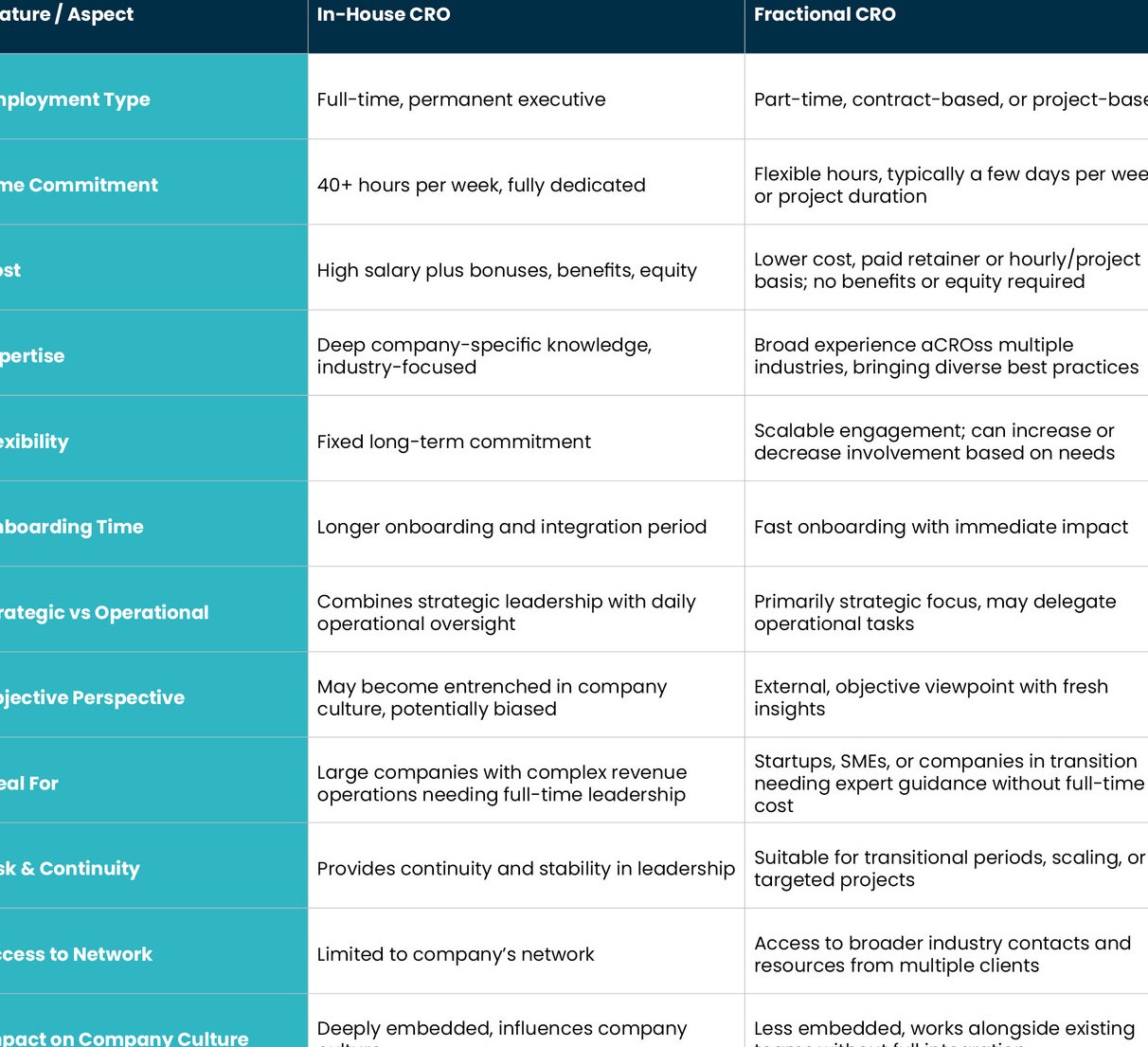
A full-time CRO is the obvious comparison and usually the wrong one below $5M ARR. You are paying base plus equity plus benefits for a person who ramps over roughly six months before producing much, and at your stage the role may not yet be full-time work. The fractional version is expected to produce inside thirty days precisely because they've done the diagnosis twenty times.

A sales consultant delivers a report and departs. That is genuinely useful when your question is narrow and analytical — pricing research, a competitive teardown, a compensation plan redesign. It is not useful when the problem is that nobody is holding the team to a new process. The distinction that matters: a consultant is accountable for the recommendation, a fractional executive is accountable for the implementation.
An advisor at two to four hours a month is the cheapest option and appropriate when you have a competent operator who just needs a sounding board. It cannot substitute for someone in your weekly cadence.
A RevOps contractor fixes the machinery — CRM architecture, reporting, routing, attribution, the plumbing that makes everything else legible. Frequently the correct first hire, and frequently mistaken for the revenue leadership hire because both get described as "RevOps." They solve different problems in a specific order: instrument first, then lead.
Promoting internally is underrated and worth an honest look. Your best AE who understands the product deeply may become a strong sales leader with a fractional executive coaching them for six months. That combination — internal promotion plus fractional oversight — costs less than either a full-time CRO or a heavy fractional engagement and builds durable capability instead of renting it. It fails when the internal candidate doesn't actually want to manage, which is worth establishing before you restructure around them.
What the Boulder market specifically means for your search
Boulder's density is real but narrow. The ecosystem clusters around SaaS, climate and energy tech, and outdoor and wellness brands, which means local candidates often bring genuinely relevant domain context — a fractional leader who has sold climate software understands a procurement cycle that runs through a utility or a municipality, and that knowledge is not transferable from a generic SaaS background.

The constraint is supply. The pool of experienced fractional revenue leaders living in Boulder proper is small, and the strong ones are usually already carrying two or three clients. Insisting on Boulder residency is the most common self-inflicted delay in this search. The practical shape most companies land on: a remote or Denver-based fractional executive who runs the weekly cadence over video and flies in quarterly for on-sites, board meetings, and team offsites. Price the travel, put the on-site dates in the SOW, and treat it as normal — because it is.
The tight-knit quality of the community cuts both ways. Reference checks are unusually easy here; two calls will typically surface someone who has worked directly with your candidate. Reputations are durable and word travels. That is a meaningful advantage in a market where credential-checking is otherwise hard. Use it aggressively — call people who weren't on the provided reference list.
On networks: the Pavilion Boulder chapter runs an active Slack and regular in-person events, which is where most of the local revenue-leadership conversation happens. RevOps Co-op has strong Colorado participation and skews toward the operations and systems side. Techstars Boulder and Boomtown program directors have watched cohort after cohort make this hire and will tell you plainly who worked out. The Boulder Chamber is less startup-native but occasionally surfaces experienced executives from the larger local employers who are stepping into portfolio work.
One structural note about timing. Boulder's founder community is small enough that the same handful of fractional executives get recommended repeatedly, which creates availability crunches — particularly at the start of a fiscal year when several companies start looking simultaneously. Beginning your search a month before you think you need someone is worth more here than in a deeper market.
Related questions
Should I hire a fractional CRO or a fractional VP of Sales?
Depends on your org chart. No sales leader and reps needing direction means a player-coach VP at 10–15 days. An existing competent sales lead who needs strategic partnership and systems design means a CRO at 5–10 days. Hiring the wrong one creates either a vacuum or a collision.
What ARR range makes a fractional revenue hire worth it?
Roughly $500K to $5M ARR is the sweet spot. Below that, a sales consultant or founder coach is usually more cost-effective. Above it, the workload typically justifies a full-time executive, and a fractional arrangement starts leaving value on the table.
Can a fractional head of revenue help me hire my full-time CRO?
Yes, and it is one of the better uses. They can write the role definition, build the scorecard, run the interview loop, and onboard the eventual hire. State that goal upfront so they optimize for documentation and handoff rather than long-term entrenchment.
Do I need RevOps in place before hiring a revenue leader?
Not necessarily, but if your CRM data is untrustworthy, a four-week RevOps engagement first often saves money. Otherwise your executive spends six weeks on data archaeology at executive rates. Instrument first, then lead — the sequence usually matters more than the total spend.
How long should a fractional engagement run?
Three to six months is typical, renewable monthly. Some convert to ongoing advisory at two to four days a month once the system is stable. Anything past twelve months at heavy day counts is a signal you should be evaluating a full-time hire.
FAQ
How is a fractional CRO different from a consultant?
A consultant delivers a report or a recommendation and moves on — accountable for the analysis. A fractional executive stays embedded for months, sits in your operating cadence, and is accountable for whether the change actually takes hold in the team. If you need a decision informed, hire a consultant. If you need behavior to change, hire an executive.
What should I put in the statement of work?
Named deliverables with dates, days per month, communication cadence, the two or three metrics you will judge success against, notice period for both sides, and an explicit documentation requirement stating that playbooks live in your systems. Avoid any language that scopes "availability" rather than output — that clause is how retainers quietly become expensive Slack subscriptions.
Do fractional revenue leaders require specific tools?
Most expect a functioning CRM — Salesforce or HubSpot are the common assumptions — and appreciate call recording and revenue intelligence tooling, but they will not usually demand enterprise-tier software your team size doesn't justify. A candidate who leads with a mandatory tool purchase before understanding your funnel is prioritizing their familiar setup over your situation.
How do I measure success without using ARR growth?
Pick two or three process metrics you control: forecast accuracy within a defined band, sales cycle length by segment, stage conversion variance narrowing across reps, or pipeline coverage against a defensible quota. ARR is influenced by market conditions, product releases, and seasonality — attributing it to one executive over ninety days is not a fair measurement.
What if the pilot doesn't work out?
You part cleanly. That is the entire purpose of the 30-day structure with a mutual opt-out on 7–14 days notice. Collect whatever documentation was produced, take the diagnostic findings — those usually retain value regardless of fit — and restart the search with a much sharper brief than you had the first time.
Should I look outside Boulder?
Almost always yes. Widening to Denver, the Front Range, and fully remote candidates multiplies your pool substantially and shortens the search by weeks. Structure quarterly on-sites into the agreement so you still get in-person time for board meetings, offsites, and team sessions where physical presence genuinely matters.
Sources
- Pavilion
- RevOps Co-op
- Harvard Business Review
- First Round Review
- SaaStr
- Techstars
- a16z
- Bessemer Venture Partners Atlas
Related on PULSE
- How to structure a 30-60-90 day plan for a new revenue leader
- When to hire your first full-time VP of Sales
- RevOps foundations: what to instrument before you scale
- Forecast accuracy: building a weekly cadence your team trusts
- Segmentation discipline for sub-$5M ARR companies
- Fractional executive SOWs: scoping outputs instead of availability
This page will be disappearing soon. Save it to your device for $1 — or read it free while it is here.
@Kory-White- · if Venmo asks, the last 4 of my number are 2012
This page is gone.
This one is off the shelf now. $1 keeps it on your phone for good — the whole page, pictures and diagrams included.
 pulse-toolsShould I Hire a Fractional CRO If I Am Scaling From 10 to 50 Reps in 2027?
 pulse-toolsHow do I hire a fractional revenue leader for a medical device company in 2027?
 pulse-toolsShould I Hire a Fractional CRO If I Need to Build a Partner Channel in 2027?
 pulse-toolsShould I Hire a Fractional CRO If I Need to Rebuild Trust After a Failed CRO in 2027?
 pulse-toolsShould I Hire a Fractional CRO If I Need to Build My First Sales Playbook in 2027?
 pulse-toolsWhere do I find a fractional VP of Sales in Birmingham in 2027?
 pulse-toolsHow do I hire a fractional CRO in McLean in 2027?
 pulse-toolsWhere do I find a fractional VP of Sales in Memphis in 2027?
 pulse-toolsWhere do I find a fractional VP of Sales in Brooklyn in 2027?
 pulse-toolsHow do I hire an outsourced CRO for a clean energy company in 2027?