


How do I hire a part-time CRO for a B2B SaaS company in 2027?
Quality
Certified

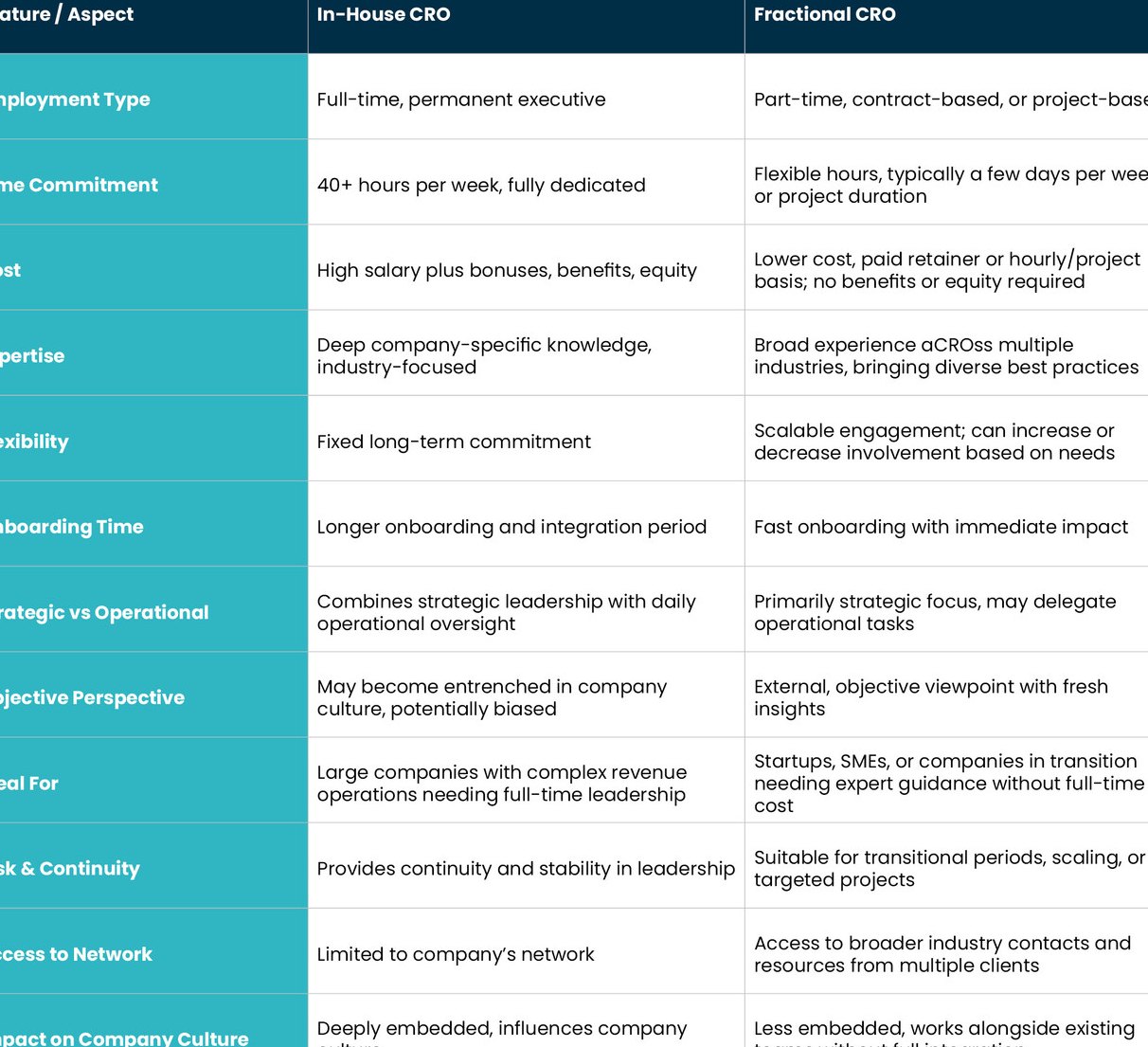
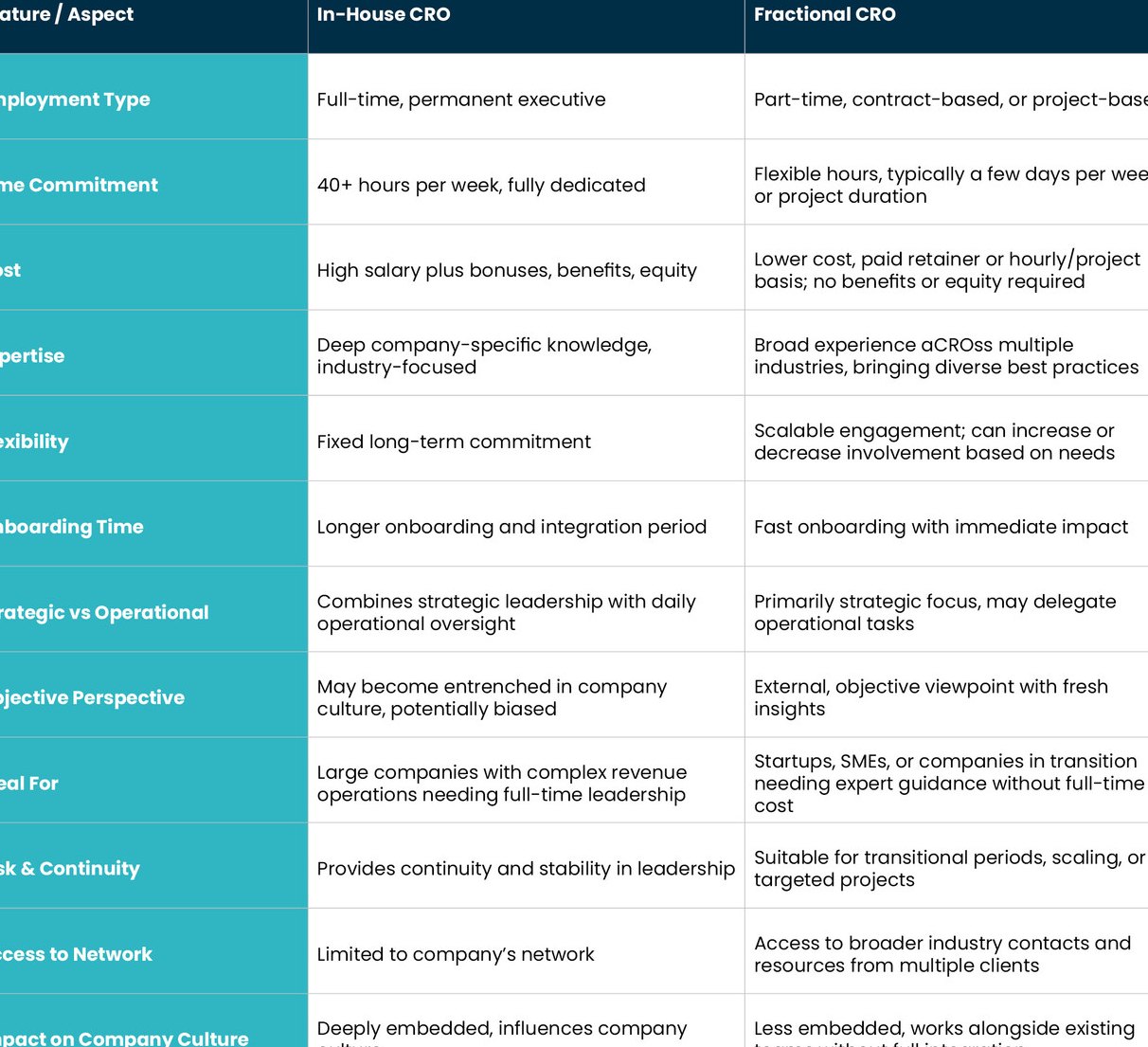
Hire a part-time (fractional) CRO by writing a one-page scope brief, sourcing through revenue-leader networks and referrals, screening three to five candidates on forecasting rigor and buyer-persona fit, checking two past clients, then signing a three-to-six-month agreement for a fixed number of days per month with a 30-day exit clause.
The job a fractional CRO is actually hired to do
The single biggest reason part-time CRO engagements fail in B2B SaaS is that the founder and the operator never agreed on what job the person was hired for. "CRO" is one of the loosest titles in software. At a 40-person company it can mean a systems architect who never touches a deal. At a 12-person company it can mean the person who runs the weekly pipeline call, rewrites the discovery script, and personally negotiates the two contracts that decide whether the quarter lands. Those are different hires with different day rates, different candidate pools, and different definitions of success.
Start by naming the failure you are trying to stop. In practice, founders reach for a part-time revenue leader for one of about five reasons, and the reason dictates the profile. First: founder-led sales has hit its ceiling, the founder is the only person who closes, and the company needs the motion documented and transferred to reps. Second: reps exist but produce inconsistently, and nobody can explain why — a qualification and coaching problem. Third: the forecast is fiction, the board has stopped believing it, and the company needs a defensible number. Fourth: pipeline generation has stalled and the top of funnel needs rebuilding across outbound, partner, and inbound. Fifth: the company is preparing for a raise or a sale and needs the revenue story, the metrics, and the operating cadence to withstand diligence. A candidate who is excellent at the third job may be mediocre at the fourth.
Write the scope as one page and be blunt in it. Include the current ARR and the target ARR at the end of the engagement. Include the number of quota-carrying reps and whether any of them are new. Include the average sales cycle in days, the average contract value, and net revenue retention if you track it. Include the stack — CRM, engagement platform, conversation intelligence, data enrichment — and whether the data in it is trustworthy. Include the political reality: whether there is a co-founder who considers sales their territory, whether a long-tenured rep will resent an outsider, whether the board is already pushing for a full-time hire. Then state, in plain language, what "this worked" looks like at day 90 and at day 180.

What a part-time CRO should own is the revenue system: the pipeline generation process and its accountability, the qualification criteria and stage definitions, the forecasting methodology and its inspection cadence, the compensation plan and its incentives, the hiring scorecard for future sellers, and the coaching rhythm that turns one good rep's instincts into a repeatable practice. Roughly two-thirds of their time goes to strategy, process, and people. The remaining third goes to direct deal support — joining the calls that matter, pressure-testing the ones that are stuck, negotiating the terms that set precedent for every deal after them.
What they should not own is execution capacity. A fractional CRO is not a part-time SDR, not a CRM administrator, and not a customer support escalation path. If your actual problem is that nobody is sending emails or booking meetings, a part-time executive is an expensive way to buy activity you could buy directly. If your actual problem is that the CRM is a swamp and nobody can pull a clean report, you need a RevOps contractor first — three weeks of data hygiene and reporting work makes the CRO engagement worth three times more, because the leader arrives to a system they can actually read. Sequencing those two hires correctly is one of the cheapest decisions available to a founder, and one of the most commonly botched.
There is a useful test for scope creep before it starts. Ask the candidate what they will stop doing if the engagement gets busy. A senior operator will tell you immediately: they will drop the individual deal work before they drop the forecast discipline, because the forecast is the artifact the company keeps after they leave. Someone who says they will "do whatever it takes" is describing a schedule they cannot honor across three other clients.
How the role fits into the RevOps stack

A part-time CRO does not sit above the RevOps function — they sit alongside it, and the relationship between the two determines how fast anything actually changes. RevOps owns the plumbing: CRM object model, field hygiene, stage definitions as they are enforced in software, routing rules, territory and quota administration, reporting, and the integrations that keep the engagement platform, the conversation intelligence tool, and the billing system speaking to each other. The CRO owns the decisions those systems are built to enforce. When the CRO says a deal cannot enter Stage 3 without a documented business case and an economic buyer on a call, RevOps is the function that makes the CRM refuse to let it happen.
Most early-stage B2B SaaS companies do not have a RevOps person. They have a founder with admin rights, a sales lead who edits fields directly, and an operations-minded AE who built the dashboards. That works until it doesn't. If you are hiring a part-time CRO into that situation, budget for one of two things: either the CRO brings a RevOps contractor they have worked with before, or you allocate a portion of the engagement's early days to system cleanup that the CRO will supervise rather than perform. Do not let a senior revenue leader spend their first month rebuilding reports at an executive day rate — that is the most expensive data-entry work in the industry.
The diagram below shows how the pieces sit relative to each other in a typical engagement.
The downstream effects matter as much as the org chart. When a part-time CRO tightens qualification, three things happen in sequence, and founders are frequently unprepared for the first one. Pipeline value drops — sometimes by a third — because deals that were never real get removed. Conversion rates rise, because the remaining deals are genuinely qualified. And the forecast becomes boring, which is the point. If you have told your board that pipeline coverage is the health metric, warn them before the cleanup lands, or you will spend a board meeting defending a number that got better by getting smaller.

Adjacent functions feel it too. Customer success inherits better-fit customers roughly two sales cycles later, which shows up in retention rather than in the CRO's own scorecard. Marketing gets pushback on lead definitions and may need to change what it optimizes for — MQL volume gives way to qualified opportunity creation, and the marketing budget defends itself differently after that. Product hears sharper loss reasons, because a disciplined loss-reason taxonomy is one of the first artifacts a good revenue leader installs. Finance gets a forecast it can actually build a cash plan against. None of these show up in a 90-day revenue number, which is exactly why the engagement scorecard needs leading indicators alongside the lagging one.
Pricing, engagement models, and what actually moves the range
Fractional CRO pricing in B2B SaaS is structured one of four ways, and the structure matters more than the headline rate.
Day-rate retainer. The most common model. You buy a fixed number of days per month — commonly five to fifteen — at a negotiated day rate, billed monthly. Five days a month is oversight: a weekly pipeline call, a monthly forecast review, ad hoc coaching, and asynchronous availability. Ten days is oversight plus hands-on program work — rebuilding a comp plan, running a hiring loop, sitting in on key deals. Fifteen days is close to an interim leader, appropriate when there is no sales manager at all and the CRO is functionally running the team. Day rates scale with track record and with the complexity of your motion; a leader who has repeatedly built enterprise land-and-expand motions from nothing commands more than one who has managed an existing SMB team.
Flat monthly retainer with a scope statement. Instead of counting days, you agree on deliverables and cadence — a weekly pipeline review, a monthly forecast, a quarterly business review, defined program work — and pay a flat fee. This avoids petty timesheet arguments and works well when both sides trust each other. It fails when scope drifts and nobody has a mechanism to name it. If you use this model, put a "material change in scope triggers a renegotiation" clause in writing.
Project or sprint pricing. A defined piece of work with a defined end: rebuild the forecasting methodology, design and roll out the comp plan for next fiscal year, run diligence prep for a Series B. Often six to twelve weeks. Useful as a paid trial before a longer retainer, and a good way to see whether someone actually delivers rather than presents.

Retainer plus variable. A reduced cash retainer with a bonus tied to a specific, measurable outcome — net new ARR above a baseline, a defined improvement in win rate, or the successful hire and ramp of two AEs. This is the structure that separates operators from consultants, and it is worth proposing to every candidate purely as a diagnostic. A real fractional CRO will negotiate the metric, argue about the baseline, and ask what happens if the product roadmap slips. Someone who refuses any performance component while claiming to own the revenue number is telling you something.
Several factors move the price meaningfully. Days per month is the obvious one — it is close to linear until you get near full-time, where rates typically compress. Company stage matters in a counterintuitive way: a very early company often pays a lower day rate but needs more days, because there is no infrastructure to lean on, while a later-stage company pays more per day for less time because the systems and people already exist. Sales motion complexity is a real multiplier — a self-serve-plus-sales-assist motion is a different discipline from a six-figure enterprise deal with procurement, security review, and a legal redline cycle, and few leaders are genuinely excellent at both. Geography still influences rates for remote work, though less than it did; the more important geographic question is time-zone overlap, because a part-time leader who is awake for two hours of your team's day cannot coach anyone.
Equity. Typical grants for a part-time revenue leader run in the range of a tenth of a percent up to about one percent, on standard four-year vesting with a one-year cliff, and the number tracks the days committed, the stage of the company, and whether cash is being discounted in exchange. Treat equity as compensation, not as a discount coupon. Two practical cautions. First, a one-year cliff on a six-month engagement is a broken instrument — either shorten the cliff, use a monthly vesting schedule with a short cliff, or skip equity and pay cash. Second, if you plan to convert the person to full-time later, negotiate that conversion path up front, including whether the fractional grant counts toward the eventual package. Renegotiating equity with someone who has already proven themselves is a worse position than negotiating it with a stranger.
Budget beyond the retainer as well. Expect to spend on tooling the CRO will insist on, on a RevOps contractor if you do not have one, and on recruiting fees if part of the mandate is hiring. A part-time CRO who identifies that you need two AEs has not solved the problem — they have named it, and hiring two AEs is a separate line item with a separate timeline.
How to source, evaluate, and shortlist candidates

Sourcing runs through three channels, and the order matters. Referrals from other founders at a similar stage produce the highest hit rate, because the referrer has watched the person work rather than watched them present. Revenue-leader communities and professional networks produce volume and let you filter by motion and segment. Fractional-executive networks and boutique firms produce pre-vetted candidates and handle some of the contracting friction, at the cost of a placement premium. Run at least two channels in parallel — a single-source shortlist gives you nothing to compare against, and the first plausible candidate always looks better than they should.
Screen on three dimensions, in this order.
Domain fit. Have they sold what you sell, to who you sell it to, at roughly your deal size? Selling a technical infrastructure product to platform engineers is not the same job as selling a compliance workflow tool to a general counsel. Ask for a specific example of adapting a sales process to an unfamiliar vertical, and listen for whether they changed the process or just changed the pitch. Deal-size fit is the most-skipped filter and one of the most predictive: a leader whose entire career ran on six-figure enterprise contracts often struggles to build a velocity motion, and the reverse is equally true.
Operational rigor. Ask them to walk through how they forecast. You want to hear specifics — how they define each stage, what evidence moves a deal forward, whether they weight by stage or by rep-committed judgment or both, how they handle a rep who is chronically optimistic, and what they do when the number is going to miss. Two minutes of clear explanation means they have a real method. Vague talk about "pipeline hygiene" and "inspection" without mechanics means they have absorbed vocabulary from a previous employer's system without ever building one. Then ask what they did when a forecast was badly wrong. Everyone has one. The answer tells you how they behave under pressure and whether they will tell you bad news early.

Communication and availability. You are sharing this person with two or three other companies. Ask, directly, how many clients they currently serve and what their total committed days per month across all of them add up to. Do the arithmetic in front of them. Ask what their written update looks like and request a redacted sample. Ask how they handle a conflict — your board meeting and another client's crisis in the same week. A part-time leader who goes quiet for ten days is genuinely worse than no leader, because the team stops raising issues they have learned won't be answered.
Structure the process as a working session, not an interview. The most informative ninety minutes you can spend is handing a shortlisted candidate a redacted export of your last two quarters of closed-won and closed-lost deals plus your current open pipeline, and asking them to come back with observations. The strong ones find things you did not know: a stage where everything stalls, a segment where win rates are half the average, a rep whose deals slip a month every month, a discount pattern that is quietly destroying your average contract value. The weak ones return generic advice about discovery and multi-threading. Pay for that session if it takes real work — a few hundred dollars for a paid diagnostic is the cheapest information you will buy in this process.
Reference checks are not a formality here. Speak to at least two past clients and push past the pleasantries. Did they deliver the days they committed? What did they actually change, and did it survive after they left? How did they behave when results were behind? Would you hire them again, and if not, why not? Ask the reference who else you should talk to — the second-degree reference is often more candid than the one the candidate handed you.
Common failure patterns worth naming out loud: the big-logo executive who ran a large team inside a company with heavy support infrastructure and has never built a process from a blank page; the consultant in fractional clothing who delivers a deck and a diagnosis but never owns an outcome; the overcommitted operator carrying five clients on paper; and the specialist mismatch — a brilliant enterprise leader hired into a product-led motion, or a velocity expert hired to build an enterprise land-and-expand play. None of these are bad operators. They are bad for your particular job.
A decision framework: fractional, interim, full-time, or something else

Before you run any process, make sure a part-time CRO is the right shape of hire. The alternatives are real and frequently better.
A fractional CRO fits when you are roughly in the early-to-mid revenue range with a small selling team, founder-led sales is straining, and you need system design more than daily management. The bet is that a senior brain applied a few days a month beats a junior body applied every day.
An interim CRO is a different animal: near-full-time, for a defined window, usually to bridge a departure or carry a company through a transition. Higher cost, deeper involvement, explicit end date. If your VP of Sales just left mid-quarter, this is often the right call rather than a five-day-a-month arrangement.
A full-time VP of Sales becomes correct once you have roughly five or more quota-carrying reps, a repeatable motion, and enough deal volume that coaching, one-on-ones, and real-time deal support fill a week. Past that threshold, part-time leadership starts to cost you in response latency — deals need decisions on Tuesday, not at the next scheduled sync.
A RevOps contractor or a sales-ops hire is the right first move when the underlying problem is data, reporting, or process enforcement rather than strategy. Cheaper, faster, and it makes any later leadership hire more effective.
A sales coach or an advisor fits when the founder wants to keep owning sales and needs sharpening rather than replacing. A few hours a month, no ownership of the number, much lower cost.

Contract terms deserve the same care as the choice itself. Three to six months initial term with a 30-day notice on both sides is the market norm, and two to three months is genuinely the minimum for anything to take hold — a revenue system change does not show up inside one sales cycle. Specify days per month and what happens to unused days: do they roll over, expire, or get credited? Specify IP ownership of the playbooks, scorecards, comp plans, and frameworks the CRO builds — these should belong to your company, and reasonable operators expect that while retaining their generic methodology. Include a non-solicitation clause covering your team, and check for conflicts: ask directly whether any current client competes with you, and put an ongoing disclosure obligation in the agreement. Define the exit deliverable up front — a written handover of processes, open deals, and recommendations — so the engagement ends with an artifact rather than a gap.
Onboarding decides the outcome more than the contract does. Give full CRM access with no restrictions on day one, including closed-lost history and activity data. Hand over the last three quarters of forecasts with actuals and commentary, so they can see where the estimates break. Introduce them to every revenue-adjacent stakeholder — co-founders, customer success, product, finance, and your two best sellers — in the first week. Set a concrete 30-day goal that is a system deliverable, not a revenue number; expecting a revenue jump in thirty days is how good engagements get killed early. Lock a weekly 45-minute sync that never gets moved. And tell the team what this person's authority actually is, in writing, before they arrive — ambiguity about whether the fractional leader can make decisions is the fastest way to neutralize them.
Track leading indicators from week one: forecast accuracy against actuals, stage conversion rates, average sales cycle length, pipeline coverage against the qualified definition, rep ramp time, and win rate by segment. These move well before ARR does, and they are what tells you at day 60 whether the engagement is working or whether you are three months from an uncomfortable conversation.
Related questions
How long should a fractional CRO engagement last?
Three to six months initially, with a 30-day exit clause on both sides. Below three months nothing structural takes hold. Many engagements extend month-to-month afterward, taper to a lighter advisory cadence, or convert to full-time if the company crosses the team-size threshold where daily leadership is required.
Should a fractional CRO get equity or just cash?

Cash-only is cleanest for short engagements. Offer equity when the operator is taking a discounted rate, when you want multi-year alignment, or when you expect a full-time conversion. If you do grant it, match the vesting schedule to the engagement — a one-year cliff on a six-month contract is meaningless to both sides.
Do I need RevOps in place before hiring a part-time CRO?
Not required, but strongly advisable. If your CRM data is unreliable, a senior leader will spend expensive early days cleaning it. Three to six weeks of RevOps contractor work beforehand — stage definitions, field hygiene, working reports — materially raises the return on every day the CRO bills.
What does a fractional CRO cost compared to a full-time hire?
A part-time engagement is a monthly retainer for a fixed number of days, with no benefits, severance exposure, or ramp period. A full-time revenue leader is a full salary plus benefits plus meaningful equity, plus two to three months of ramp. The fractional route is far cheaper and far easier to unwind.
How do I verify a fractional CRO is working the days they committed?
Require a weekly written update covering activities, deals influenced, decisions made, and days consumed against the monthly allocation. Most professional operators supply this without being asked. Resistance to any transparency about time worked is a legitimate reason to end the conversation.
FAQ
How do I know whether I need a fractional CRO or a full-time VP of Sales?
Count reps and count your own hours. If you have fewer than five quota-carrying sellers and you as the founder are still the primary closer, a part-time leader can build the system while you keep selling. If you have five or more reps, or you are spending more than twenty hours a week on sales management, the response latency of a part-time arrangement will start costing you deals — hire full-time.
How long does the hiring process take from first outreach to start date?

Three to six weeks is realistic. Roughly one week to write the scope brief and open sourcing channels, one to two weeks of screening and deep-dive conversations across three to five candidates, a few days for a paid diagnostic session with your finalists, several days for reference checks, and a week for contracting. Compressing below three weeks usually means skipping references, which is the step most predictive of failure.
What red flags should end a conversation with a fractional CRO candidate?
Refusing any performance-linked component while claiming to own the revenue number. Being unable to explain their forecasting method in two minutes. Carrying so many concurrent clients that the committed days do not arithmetically fit. Declining to provide two past-client references. Delivering only a diagnosis and a deck with no implementation. And discomfort with reporting days worked.
How many days per month should I actually buy?
Five days covers oversight — weekly pipeline review, monthly forecast, coaching, asynchronous availability. Ten days adds hands-on program work like comp plan redesign, hiring loops, and direct deal involvement. Fifteen days approaches interim leadership and suits a team with no sales manager at all. Start at the lower end with a scope-change clause; scaling up mid-engagement is easier than scaling down.
What should I expect in the first 30 days, realistically?
Diagnosis and system deliverables, not a revenue jump. Expect a pipeline audit, a rebuilt forecast with an honest baseline, documented stage and qualification criteria, findings from stakeholder interviews, and a prioritized plan. Expect reported pipeline value to fall as unreal deals get removed. Revenue impact typically appears one to two full sales cycles later, which is why the initial term needs to be at least three months.
Can a part-time CRO work if my sales cycle is nine months or longer?
It is difficult. Long enterprise cycles require sustained relationship depth with buying committees, procurement, and legal — the kind of continuity a leader present eight days a month cannot reliably provide. In those environments a part-time leader is better used for system design, hiring, and forecast discipline while a full-time seller or leader carries the relationships.
Sources
- SaaStr — B2B SaaS operating and go-to-market benchmarks
- Pavilion — community and resources for revenue leaders
- RevOps Co-op — revenue operations community and resources
- Harvard Business Review — sales management and leadership research
- First Round Review — startup leadership and hiring guidance
- OpenView Partners — SaaS benchmarks and go-to-market research
- Bessemer Venture Partners — cloud and SaaS metrics research
- a16z — enterprise and SaaS go-to-market writing
Related on PULSE
- How do I find a fractional CRO in Millsboro in 2027?
- How do I hire a fractional CRO in Tulsa in 2027?
- How do I find a fractional CRO in Oakton in 2027?
- Where do I find an interim CRO in Durham in 2027?
- How do I find a fractional CRO in Montgomery Village in 2027?
- How do I hire a fractional CRO in Charlotte in 2027?
This page will be disappearing soon. Save it to your device for $1 — or read it free while it is here.
@Kory-White- · if Venmo asks, the last 4 of my number are 2012
This page is gone.
This one is off the shelf now. $1 keeps it on your phone for good — the whole page, pictures and diagrams included.
 pulse-toolsShould I Hire a Fractional CRO If I Need a 30-60-90 Plan Before a Board Meeting in 2027?
 pulse-toolsHow do I evaluate a fractional Chief Revenue Officer in Wisconsin in 2027?
 pulse-toolsHow do I evaluate a fractional Chief Revenue Officer in Utah in 2027?
 pulse-toolsHow do I hire a fractional CRO in San Jose in 2027?
 pulse-toolsHow do I hire a fractional VP of Sales in Ogden in 2027?
 pulse-toolsShould I Hire a Fractional CRO If I Am Consolidating Regional Sales Teams in 2027?
 pulse-toolsIs there a fractional Chief Revenue Officer available near me in Houston in 2027?
 pulse-toolsWhat should I look for in a fractional CRO in South Dakota in 2027?
 pulse-toolsHow do I hire a fractional CRO in Denver in 2027?
 pulse-toolsWho is the best fractional CRO in Selbyville in 2027?