
Where do I find a directory of fractional CROs who track their own KPI benchmarks in 2027?
 Curated byKory White · Fractional CRO · Maryland
 PULSEKNOWLEDGE LIBRARY
There is no single canonical directory of fractional CROs who publish their own KPI benchmarks. In practice you assemble one from four sources: curated fractional-marketplace rosters, boutique revenue-leadership firms, RevOps communities and Slack groups, and individual operators who publish benchmark data on LinkedIn or a personal site. Always verify that a candidate tracks their own benchmarks before shortlisting.
The job this role is hired to do
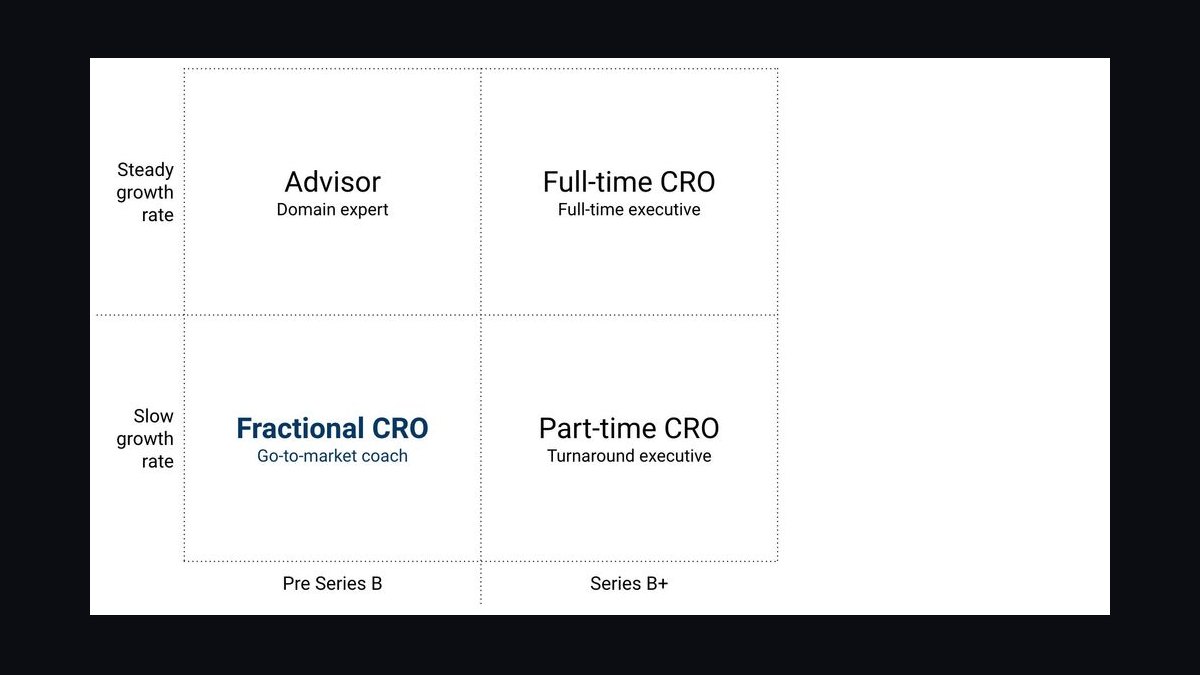
A fractional Chief Revenue Officer is a part-time executive who owns the revenue number across sales, marketing, customer success, and often partnerships. The "fractional" label matters because it changes the economics of the engagement: instead of a $300,000–$450,000 base plus equity for a full-time CRO, a company typically pays for 10–40 hours a month at a blended rate, retaining senior judgment without the full-time load. The role is hired when a company has product-market fit but no repeatable revenue engine, when the current VP of Sales has plateaued, when a founder is still acting as the de facto CRO and needs to hand off, or when a PE-backed business needs a revenue operator to install a system before a sale process.
The distinguishing trait you are searching for — a fractional CRO who tracks their own KPI benchmarks — is not cosmetic. Most revenue leaders quote industry benchmarks they read in a report. A smaller subset maintains their own instrumented dataset: a rolling record of pipeline conversion rates, sales-cycle length, quota attainment distribution, CAC payback, net revenue retention, and win/loss ratios drawn from the accounts they have actually run. That distinction matters because borrowed benchmarks are usually wrong for your stage, segment, and motion. A benchmark from a 500-rep public company tells you almost nothing about a 12-rep Series A business selling a $30,000 ACV product. An operator who tracks their own benchmarks can tell you what their median sales cycle was at a comparable ACV, how their pipeline coverage ratio behaved in a down quarter, and where their forecast accuracy broke down.
The practical implication for your search is that you are not just looking for a name and a rate card. You are looking for evidence of a measurement habit. That evidence lives in different places than a standard executive résumé, which is why a purpose-built directory is hard to find and why you have to build your own shortlist from several overlapping sources.

How it fits the RevOps stack
RevOps sits at the intersection of the systems that generate revenue data and the humans who make decisions from it. A fractional CRO who tracks their own benchmarks is effectively a portable RevOps function: they arrive with a measurement framework, instrument your CRM and adjacent tools to produce the same metrics, and then compare your numbers against their own historical baseline. That is a very different engagement from a fractional CRO who arrives with a slide deck of generic industry statistics.
Think about where the data actually lives. Your CRM (Salesforce, HubSpot, Pipedrive) holds opportunity stages, close dates, and amounts. Your marketing automation platform holds lead source and campaign attribution. Your billing system holds expansion, contraction, and churn. Your conversation-intelligence tool holds objection and competitor mentions. A benchmark-tracking fractional CRO will want read access to all of these, will define the metric set before touching anything, and will build a weekly or monthly cadence that produces the same numbers every period so trends are comparable. If a candidate cannot describe their metric definitions precisely — for example, whether "sales cycle" is measured from first meeting or from opportunity creation — they are not tracking their own benchmarks in any rigorous sense.
The diagram above shows the practical flow. The benchmark layer in the middle is the differentiator. Without it, the fractional CRO is extrapolating from memory and public reports. With it, they are comparing your business to a dataset they personally maintained across prior engagements. When you interview candidates, ask them to walk through this flow for their last two roles: what tools, what metric definitions, what cadence, what they found. The specificity of the answer is the single best signal you will get.

One caveat worth stating plainly: benchmark portability has limits. A fractional CRO who tracked benchmarks in enterprise software may have baselines that do not transfer to a PLG self-serve motion, and vice versa. The value is not that their numbers are universal — it is that they know how to build the measurement system and can tell you honestly when their baseline does not apply to you. That honesty is itself a qualification.
Pricing, engagement models, and typical ranges
Fractional CRO pricing varies widely by stage, geography, and scope, but the ranges below reflect what the market generally bears. Treat them as orientation, not quotation, and always confirm current rates directly with the operator or firm.
Retainer models. The most common structure is a monthly retainer for a defined number of hours or days. Typical ranges run from roughly $5,000 to $15,000 per month for 20–40 hours, with higher figures for operators who carry board-level responsibilities or manage a team. Some fractional CROs price by the day instead, commonly in the $1,500–$3,500 per-day range depending on seniority and market.
Project or sprint models. When the scope is bounded — build a forecast model, redesign the comp plan, run a pipeline audit — operators sometimes quote a fixed fee. A four-to-eight-week diagnostic sprint might land in the $15,000–$40,000 range. This model suits companies that want a deliverable rather than an ongoing presence.
Hybrid and performance models. Some fractional CROs blend a lower retainer with a bonus tied to revenue outcomes, pipeline coverage, or forecast accuracy. These are harder to administer and can create perverse incentives if the metric is poorly chosen, but they align interests when the scope is genuinely revenue-driving.
Equity. Early-stage companies sometimes offer a small equity grant in addition to a reduced cash retainer. This is common below Series A and rare at later stages.

What drives the price up or down. Scope (one function versus all of revenue), team size managed, board exposure, travel, segment complexity, and whether the operator is expected to hire and manage reps. A fractional CRO who also runs your RevOps function and owns the forecast will cost more than one who only coaches the sales team.
What to expect at each stage. Pre-seed and seed companies typically engage fractional CROs at the lower end of the retainer range, often for 10–20 hours a month, focused on building the first repeatable playbook. Series A and B companies usually need 20–40 hours, a full metric framework, and help hiring. Growth-stage and PE-backed businesses often want a heavier engagement with board reporting and may pay at the top of the range.
The benchmark angle affects pricing indirectly. An operator who can show you their own tracked benchmarks — median cycle length at your ACV, quota attainment distribution, pipeline coverage norms — is delivering a form of proprietary insight that a generic advisor cannot. That is a legitimate reason to pay at the higher end, provided you verify the data is real and relevant.
How to evaluate and shortlist
Because no single directory exists, shortlisting is a research process. Work through these sources in order and keep a running spreadsheet with columns for source, name, segment fit, benchmark evidence, rate, and availability.
Step 1: Curated fractional marketplaces. Several platforms and networks list vetted fractional executives, including fractional CROs. These are the closest thing to a directory. Search them by function ("revenue," "sales," "CRO") and by segment. Expect rosters of dozens to a few hundred operators. The vetting bar varies, so treat inclusion as a starting filter, not an endorsement.
Step 2: Boutique revenue-leadership firms. Many small consultancies are built around a founder who is themselves a fractional CRO, plus a bench of associates. These firms often publish case studies with real numbers, which is exactly the benchmark evidence you want. Ask for two references at your stage and segment.
Step 3: RevOps and revenue communities. Slack groups, LinkedIn groups, and community forums for RevOps and revenue leaders are where operators talk shop. Search the archives for people who post their own data — conversion rates, cycle times, coverage ratios. The people who publish numbers publicly are disproportionately likely to track them privately.
Step 4: Individual operators who publish benchmarks. Some fractional CROs write newsletters, post benchmark threads, or maintain a public metrics page. These are the highest-signal candidates because you can evaluate their thinking before you ever speak to them. Build a list of 10–20 such operators and read their last six months of output.
Step 5: Referrals from peers. Ask other founders and revenue leaders at your stage who they used and whether that person brought their own data. Referrals remain the highest-conversion channel for this role.
Once you have a list of 15–25 names, narrow to 5–8 for interviews using these filters:
- Segment match. Have they run revenue at your ACV, deal complexity, and motion (sales-led, PLG, channel)?
- Benchmark evidence. Can they show a metric framework and historical baselines, not just cite reports?
- Stage match. Have they operated at your headcount and funding stage?
- Scope clarity. Do they know what they will and will not own?
- References. Two references at your stage, contacted directly.
In the interview, ask them to walk through their benchmark framework in detail. Ask what their median sales cycle was at a comparable ACV, how they defined it, and what the distribution looked like. Ask how their forecast accuracy trended over their tenure. Ask what metric surprised them most and why. Candidates who track their own benchmarks answer these questions with specifics and caveats. Candidates who do not will pivot to generalities.

The framework above is deliberately sequential. The most common mistake is to skip the sourcing breadth and jump to interviews with the first three names a marketplace sends you. That produces a shortlist that reflects the marketplace's roster rather than the market. Spend the extra week on sourcing; it pays back in the quality of the final choice.
Buyer decision framework
Use the following decision logic to choose between candidates once you have a shortlist. The framework weights benchmark evidence heavily because that is the specific thing you set out to find.
First, decide whether you need a fractional CRO at all. If your problem is a broken forecast or messy CRM data, a RevOps consultant may be cheaper and faster. If your problem is that no one owns the revenue number across functions, you need the CRO seat filled, fractionally or otherwise.
Second, decide the scope. Full revenue ownership, sales-only leadership, or a diagnostic sprint? Scope determines the engagement model and the price band.
Third, score candidates on four axes. Benchmark evidence (do they track their own data and can they show it?), segment fit (have they run your motion at your ACV?), stage fit (have they operated at your size?), and chemistry (will your team follow them?). Weight benchmark evidence and segment fit highest.
Fourth, run a paid diagnostic. Before committing to a long retainer, hire the finalist for a two-to-four-week paid diagnostic. Ask them to produce a metric baseline for your business and compare it to their own historical benchmarks. This de-risks the engagement and gives you a concrete work sample.
Fifth, set the exit criteria up front. Define what success looks like at 90 and 180 days: a forecast you trust, a hiring plan, a comp plan, a pipeline coverage target. A fractional CRO who tracks their own benchmarks will welcome this because it is the same discipline they apply to their own work.
Trade-offs to weigh. A highly experienced operator with deep benchmark data may be expensive and in high demand, limiting availability. A less expensive operator may lack the dataset you want. A marketplace listing is convenient but may not surface the specific benchmark-tracking operators you need. Building your own directory takes time but produces a better fit. In most cases the right answer is a blend: use marketplaces for breadth, communities and individual publishers for signal, and referrals for confidence.
One final caution: be skeptical of anyone who claims benchmarks without showing their work. Ask for the metric definition, the sample size, the time period, and the segment. Real benchmark trackers answer these questions easily. If the answer is vague, move on.
Related questions
Is there a single official directory of fractional CROs?
No. There is no official registry. Curated marketplaces and networks come closest, but they list fractional executives broadly rather than CROs who specifically track their own KPI benchmarks. Plan to combine several sources.
How can I tell if a fractional CRO actually tracks their own benchmarks?
Ask them to define their metrics precisely and walk through historical baselines from a prior role. Real trackers cite definitions, sample sizes, time periods, and segment caveats. Vague answers that pivot to public reports are a red flag.
What should a fractional CRO benchmark first?
Start with pipeline coverage ratio, stage conversion rates, sales-cycle length, quota attainment distribution, CAC payback, and net revenue retention. These six give you a usable picture of the revenue engine and are comparable across engagements.
How long should a fractional CRO engagement run?
Most engagements run six to twelve months. A diagnostic sprint can be two to four weeks. Plan a 90-day checkpoint with defined success criteria so you can extend, adjust, or exit based on evidence.
Do fractional CROs work with RevOps teams?
Yes, and the best ones effectively act as a senior RevOps partner. They define the metric framework, instrument the systems, and run the cadence. If you already have a RevOps lead, the fractional CRO sets direction and the RevOps lead executes.
FAQ
Where do I actually find a directory of fractional CROs who track their own KPI benchmarks?
There is no single directory. Build one from four sources: curated fractional-executive marketplaces, boutique revenue-leadership firms, RevOps and revenue communities, and individual operators who publish benchmark data publicly. Combine all four, then verify benchmark evidence in interviews before shortlisting.
Why does it matter whether a fractional CRO tracks their own benchmarks?
Borrowed benchmarks are usually wrong for your stage and segment. An operator who maintains their own dataset can compare your pipeline conversion, cycle length, and coverage ratios to baselines they personally measured at comparable companies. That produces more accurate forecasts and better decisions.
What does a fractional CRO cost in 2027?
Retainers commonly run from roughly $5,000 to $15,000 per month for 20–40 hours, with day rates around $1,500–$3,500. Fixed-fee diagnostic sprints often land between $15,000 and $40,000. Scope, segment, and board exposure drive the variation.
How do I verify a candidate's benchmark claims?
Ask for metric definitions, sample sizes, time periods, and segment context. Request a paid diagnostic where they build a baseline for your business and compare it to their own historical data. Contact two references at your stage and segment.
Should I hire a fractional CRO or a RevOps consultant?
If the problem is data hygiene, tooling, or reporting, a RevOps consultant is often cheaper and faster. If no one owns the cross-functional revenue number, you need the CRO seat filled. Many companies eventually need both, with the CRO setting direction and RevOps executing.
How many fractional CROs should I interview?
Shortlist five to eight from a longlist of fifteen to twenty-five. Interview all of the shortlist with the same structured metric walkthrough, then run reference calls on the top two. A paid diagnostic with the finalist de-risks the final decision.
Sources
- Harvard Business Review — executive leadership and revenue strategy
- McKinsey & Company — go-to-market and revenue growth insights
- Bain & Company — commercial excellence and sales effectiveness
- Gartner — sales and revenue operations research
- Forrester — revenue operations and B2B buying research
- Salesforce — State of Sales research
- HubSpot — sales and marketing benchmark research
- Pavilion — revenue leadership community and benchmarking
- RevOps Co-op — revenue operations community
- LinkedIn — fractional executive and revenue leader search
Related on PULSE
- How to build a KPI benchmark framework for a fractional revenue leader
- What to ask a fractional CRO in the first interview
- Fractional CRO versus full-time CRO: cost and scope trade-offs
- How RevOps and a fractional CRO divide responsibilities
- Pipeline coverage ratios: definitions and realistic targets
- Where to find vetted fractional executives beyond CRO roles
This page will be disappearing soon. Save it to your device for $1 — or read it free while it is here.
@Kory-White- · if Venmo asks, the last 4 of my number are 2012
 pulse-recentWhat is the best KPI dashboard tool for a fractional CRO to use in 2027?
 pulse-toolsHow do I hire a fractional head of revenue in Naples in 2027?
 pulse-toolsHow do I hire a fractional head of revenue in Charleston in 2027?
 pulse-toolsWhat does a fractional CRO cost in Fulton in 2027?
 pulse-toolsHow do I hire a fractional CRO in Leipsic in 2027?
 pulse-toolsHow do I hire a fractional VP of Sales in Charleston in 2027?
 pulse-toolsWhere do I find a fractional VP of Sales in Pennsylvania?
 pulse-recentWhere do I find a directory of fractional CFOs I can compare against a fractional CRO before hiring in 2027?
 pulse-toolsWhere do I find a fractional head of revenue in Louisiana?
 pulse-toolsHow do I hire a fractional CRO in Columbia in 2027?