What does a fractional CRO do for a adtech business?
Direct Answer
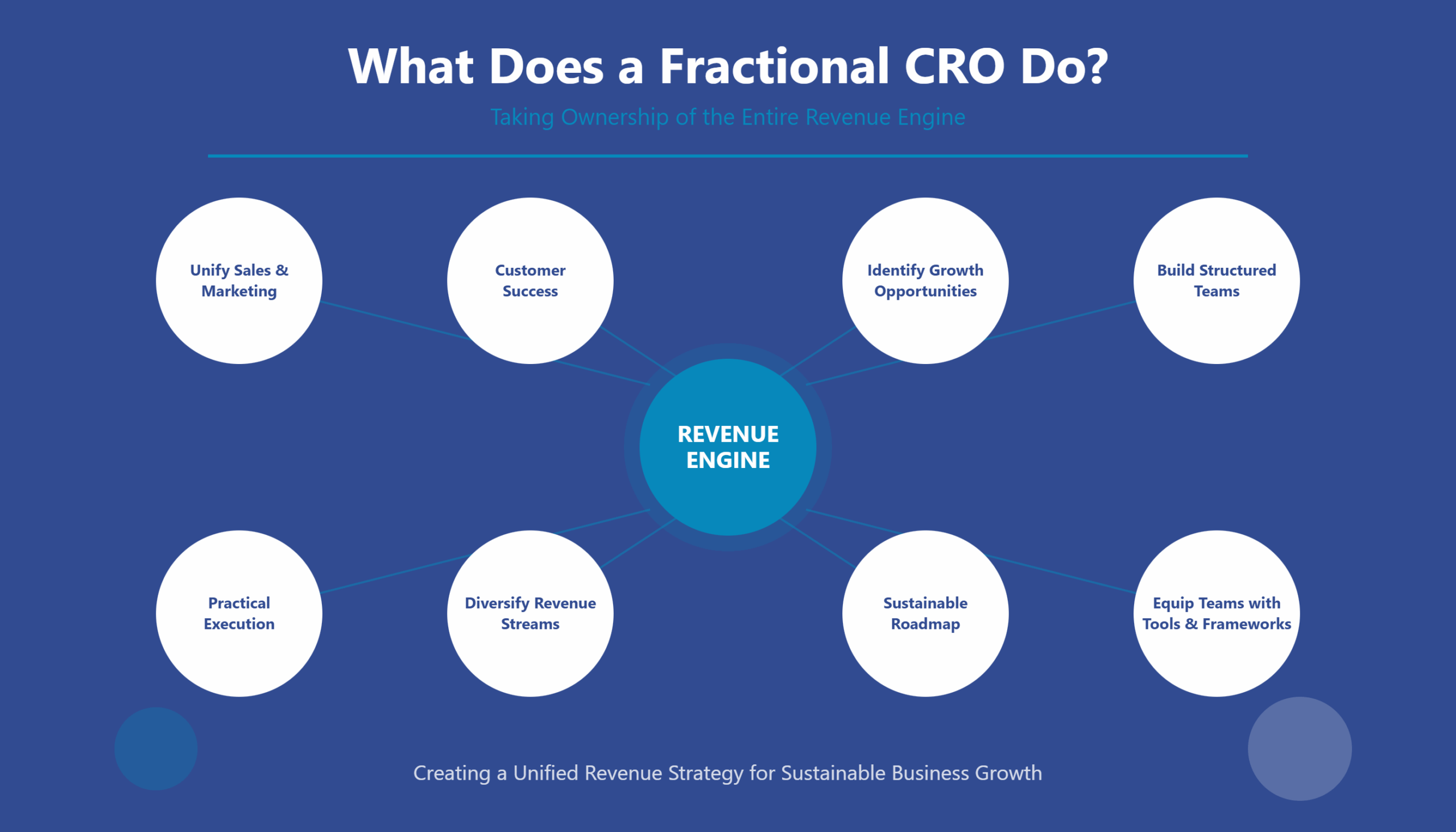
A fractional CRO (Chief Revenue Officer) for an adtech business is an executive-level consultant who owns the full revenue engine—sales, marketing, customer success, and partnerships—on a part-time or interim basis, typically for 12–24 months. In the 2027 RevOps reality, they specialize in aligning AI-driven demand generation with long, committee-heavy B2B buying cycles, while consolidating a bloated martech stack down to 3–5 core platforms. For adtech, this means replacing the old "spray and pray" media-buying pitch with a consultative, data-verified selling motion that proves ROAS to procurement teams and CFOs.
Why Adtech Needs a Fractional CRO in 2027
Adtech faces a unique triple squeeze: cookie deprecation is forcing a shift to contextual and identity-based targeting, AI agents are automating campaign optimization (reducing the need for human sales demos), and buying committees now include legal, data privacy, and procurement—not just media buyers. A fractional CRO brings a playbook from companies like HubSpot and Salesforce that have already navigated similar transitions, but without the $400K–$600K annual cost of a full-time CRO. They focus on three levers:
- Revenue architecture—mapping the adtech product (DSP, SSP, CDP, or measurement tool) to the buyer's journey, which now includes an AI evaluation phase where the buyer's AI agent tests your API against competitors.
- Vendor consolidation—cutting from 15+ tools (e.g., Outreach, Clari, Gong, Salesloft, HubSpot, plus ad-specific platforms) down to a core stack of 4–5 that share data via a single CRM like Salesforce.
- Compensation redesign—shifting from pure commission on booked deals to net revenue retention (NRR) and expansion revenue, because adtech churn rates of 20–30% destroy LTV.
The 2027 Adtech Buyer Journey
This decision tree shows why a fractional CRO is critical: they must train the sales team to handle AI-to-human handoffs (e.g., using Gong to analyze AI-generated call transcripts) and build a proof-of-concept playbook that mirrors how adtech buyers actually test—by running $10K–$50K in real ad spend, not by watching a slide deck.
The Fractional CRO’s Core Responsibilities
1. Diagnosing the Revenue Engine
The first 30 days are an audit. The fractional CRO runs a MEDDPICC analysis on the last 20 won/lost deals, looking for patterns:
- Metrics—Are deals stalling at "Decision" (procurement) or "Evaluation" (AI agent)? In 2027, 60–70% of adtech deals involve an AI agent that auto-rejects if the API latency exceeds 200ms or if the data schema doesn't match.
- Tools—Are reps using Salesloft for sequences but Clari for forecasting, with no data sync? The CRO mandates a single source of truth in Salesforce, with Gong for call coaching and Outreach for outbound.
- People—Is the VP of Sales incentivized on bookings while Customer Success is on retention? The CRO aligns comp plans so that both teams share a common NRR target (e.g., 110%+).
2. Rebuilding the Go-to-Market Motion
Adtech in 2027 can’t sell "reach" or "impressions" anymore—AI agents buy based on predicted ROAS and cost per incremental conversion. The fractional CRO shifts the pitch to:
- "We reduce your CPA by 15–25% vs. the DSP you're using now" —backed by a Challenger Sale approach that surfaces a hidden risk (e.g., "Your current vendor is double-counting viewability").
- Proof-of-Value (POV) automation—using a tool like Demandbase to run a 14-day test on a subset of the buyer’s audience, with results fed directly into the CRM.
- Buying committee maps—identifying the 6–8 stakeholders (media buyer, data scientist, legal, procurement, CFO, CEO for enterprise) and scripting specific talking points for each, using Gong’s "Deal Board" feature to track engagement.
3. AI-First Revenue Operations
This loop shows how a fractional CRO automates the repetitive parts of the funnel, freeing the sales team to focus on the 3–4 high-stakes conversations per week. The CRO’s job is to select and enforce these tools—not to let the VP of Sales keep using 12 different spreadsheets.

Reach Kory White, Fractional CRO: 📅 Book a Quick Call · 💼 Kory on LinkedIn · 🏢 CRO Syndicate
The 2027 Vendor Consolidation Playbook
Adtech companies often have 15–20 revenue tools (e.g., HubSpot for marketing, Salesforce for CRM, Outreach for sales, Clari for forecasting, Gong for coaching, Chorus for transcripts, ZoomInfo for data, Drift for chat, etc.). A fractional CRO cuts this to:
- CRM: Salesforce (non-negotiable for enterprise adtech)
- Engagement: Outreach (for outbound) + Gong (for coaching and deal intelligence)
- Forecasting: Clari (replaces spreadsheets)
- Data enrichment: ZoomInfo or Lusha (one only)
- AI agent: 6sense or Demandbase for lead scoring and intent data
The savings? $150K–$250K per year in tooling costs, plus a 20–30% reduction in admin time for reps. The CRO also negotiates multi-year contracts with these vendors, locking in 15–20% discounts.
Compensation and Metrics in 2027
Adtech fractional CROs redesign comp plans to match the new buying reality:
- Base salary: 60% of total comp (up from 50% in 2023) to reduce risk for reps facing longer cycles
- Variable: 40% tied to NRR (not just new bookings) and expansion revenue from existing accounts
- SPIFs: Quarterly bonuses for POVs that convert to paid pilots (e.g., $2K per POV that leads to a $50K+ contract)
- Team-level bonus: 10% of comp for hitting buying committee coverage (e.g., 100% of deals have contact with all 6 stakeholders)
The CRO tracks two leading indicators:
- AI agent engagement rate—what % of inbound leads come from AI agents vs. humans? In 2027, this is 40–60% for adtech.
- Time-to-POV—how fast can the sales team set up a test campaign? Best-in-class is <5 business days; average is 14.
FAQ
How does a fractional CRO differ from a full-time CRO? A fractional CRO works 10–20 hours per week, typically on a 6–12 month contract, and focuses on fixing specific revenue bottlenecks (e.g., tool consolidation, comp redesign, buying committee mapping). A full-time CRO owns culture, hiring, and long-term strategy. Fractional is ideal for adtech companies with $5M–$50M ARR that can't afford a $400K+ executive.
What tools does a fractional CRO use to audit an adtech revenue engine? They start with a Gong "Deal Board" analysis to see where deals stall, a Clari "Forecast Accuracy" report to check pipeline hygiene, and a Salesforce "Lead Source" report to see if marketing is generating real pipeline. Then they run a MEDDPICC scorecard on the last 20 deals.
Can a fractional CRO help with AI agent buying behavior? Yes—this is their primary value in 2027. They train the SDR team to detect AI agent signals (e.g., a lead that visits the API docs page 10 times in 2 hours is likely an AI bot, not a human). They also build API-first demo flows that let AI agents self-serve a sandbox environment, reducing human touchpoints by 30%.
How long does a fractional CRO engagement typically last? Most engagements run 6–12 months, with a monthly retainer of $15K–$30K (vs. $40K–$50K for a full-time CRO). The first 3 months are diagnostic and tool consolidation; months 4–8 focus on comp redesign and buyer journey mapping; months 9–12 are handoff to a permanent VP of Revenue.
What's the biggest mistake adtech companies make when hiring a fractional CRO? Hiring a generalist who doesn't understand adtech-specific metrics like eCPM, fill rate, and bid density. The CRO must know how to sell to programmatic buyers who think in terms of latency and API reliability, not "brand awareness." Look for someone who has held a CRO role at a DSP, SSP, or measurement company.
How does a fractional CRO handle data privacy and compliance in adtech? They mandate that the CRM and all revenue tools are GDPR and CCPA compliant (e.g., Salesforce Data Cloud, not a custom Snowflake setup). They also work with legal to build "privacy-by-design" buyer journeys where the AI agent only sees anonymized data until a DPA is signed.
Sources
- Gong Labs: "The 2027 Buying Committee Report"
- Gartner: "How to Consolidate Your Martech Stack"
- Forrester: "The Future of B2B Buying: AI Agents and Procurement"
- SaaStr: "Fractional CROs: When to Hire and What to Expect"
- Bessemer Venture Partners: "Adtech in the Post-Cookie Era"
- McKinsey: "Revenue Operations in the Age of AI"
- HubSpot Blog: "How to Build a Modern Revenue Engine"
- Salesforce: "The State of Revenue Operations 2027"
Bottom Line
A fractional CRO for adtech in 2027 is not a luxury—it's a necessity to survive longer buying cycles, AI-driven evaluation, and vendor bloat. They deliver a 3–5x ROI within 12 months by cutting tooling costs, aligning comp to NRR, and building a buyer journey that works for both humans and AI agents. If your adtech company has stalled at $10M–$50M ARR, this is the single highest-leverage hire you can make.
*Fractional CRO adtech 2027 revenue operations AI buying committees vendor consolidation*
People also search for: fractional cro adtech business · hire a fractional cro for adtech business · adtech business fractional cro · fractional cro near me