
Where do you find standards-aligned lesson plans when you're assigned to teach a subject outside your certification in 2027
 Curated byKory White · Fractional CRO · Maryland
 PULSEKNOWLEDGE LIBRARY
When you're assigned to teach outside your certification in 2027, find standards-aligned lesson plans through your state education agency's standards portal, OER Commons, state-vetted curriculum hubs, and district curriculum offices. Cross-check every plan against your state's adopted standards for that subject, then adapt pacing and scaffolds. Never assume a plan is aligned just because it's free or popular.
The two (or more) options compared
When a principal hands you a section of, say, seventh-grade life science and your certification reads elementary education, you have four realistic pipelines for finding standards-aligned lesson plans. Each has a different cost in time, money, and risk.
Option one: state education agency (SEA) portals and state-vetted curriculum lists. Nearly every state department of education publishes either a full model curriculum, a vetted materials list, or both. Examples that have existed for years include EngageNY (now housed at NYSED and mirrored by Louisiana's Guidebooks and others), the Texas Education Agency's TEKS-aligned instructional materials, and Louisiana's Guidebooks. These are built directly against the state's adopted standards, which is the whole point. The catch: coverage is uneven. A state may have deep math and ELA materials and thin science or world languages. Cost is zero. Alignment confidence is high where materials exist.
Option two: national OER repositories. OER Commons, the Council of the Great City Schools, and subject-specific hubs like the National Science Teaching Association's lesson archives or the National Council of Teachers of Mathematics' Illuminations. These aggregate tens of thousands of lessons tagged to standards. Quality varies enormously because anyone can upload. You must read the standard tag and verify it yourself. Cost is zero.
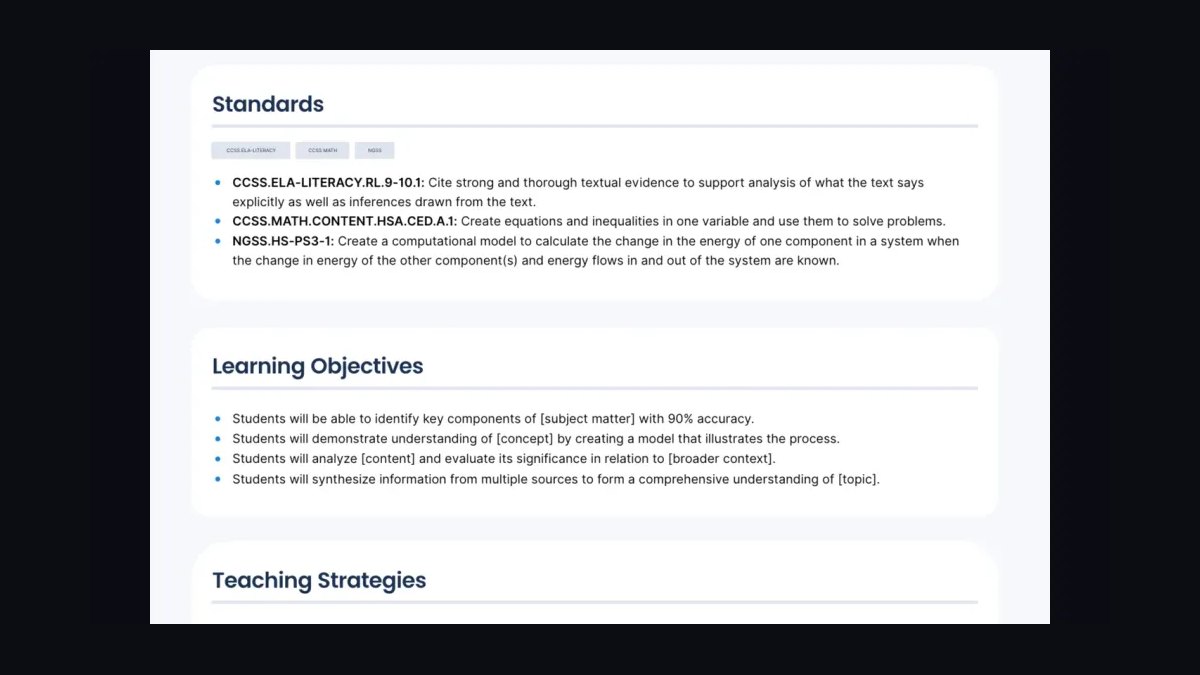
Option three: commercial curriculum with a standards correlation document. Publishers like Amplify, Savvas, McGraw Hill, and HMH ship "standards alignment" or "correlation" guides that map every lesson to state standards. If your district already owns a license, this is often the fastest legitimate route. Cost is zero to you but real to the district, and the correlation document is your evidence trail.
Option four: district curriculum office and department colleagues. Your district may already own a scope-and-sequence for the subject you're covering. Ask the curriculum coordinator or the department chair for the pacing guide and the adopted materials list. This is the most underused option and usually the most accurate, because it reflects what students will actually be tested on.
The trade-off is consistent across all four: free and fast usually means you verify alignment yourself, while pre-verified usually means money or a phone call. For a single out-of-field assignment, the district office plus a state portal is the highest-yield combination.
How to decide between them
The decision is not about which source is "best" in the abstract. It's about which source matches your constraint: how much lead time you have, whether your district owns materials, and how high-stakes the assessment is.
The logic: exhaust the sources that carry institutional verification first, because they save you the alignment work. A district correlation guide or a state model unit has already been checked by people whose job is standards alignment. Only fall through to open repositories when the verified sources have a coverage gap, and when you do, treat every lesson as unverified until you've read the standard yourself.

One more decision input: timeline. If you have six weeks before the course starts, you can afford to build from OER. If you have six days, you need the district's adopted materials and a colleague's pacing guide, full stop.
Concrete numbers behind each option
Numbers make the trade-offs concrete. These are typical ranges, not guarantees, and they vary by state and district.
State portal coverage. A well-developed state model curriculum might cover 80-100% of tested standards in math and ELA, but only 40-60% in subjects like health, world languages, or career and technical education. That gap is exactly where out-of-field teachers get stranded. Budget your search time accordingly: assume you'll need to fill one to three units per semester from other sources.
Time to verify a single lesson. Reading a lesson plan and checking its claimed standard against your state's actual standard text takes 10-20 minutes if the lesson includes a clear standard code and a visible student task. If the lesson only says "aligned to state standards" with no code, verification takes 30-45 minutes because you have to infer the intended standard from the activities. A 180-day course with one lesson per day is 180 lessons. At 15 minutes each, that's 45 hours of verification alone. This is why pre-correlated materials are worth so much.
OER repository scale. OER Commons has hosted tens of thousands of resources organized by subject and grade band. The National Science Teaching Association's lesson collections and NCTM's resources are similarly large. The volume is an advantage and a trap: with thousands of options, the search cost dominates. Use the standard code as your search term, not the topic name. Searching "MS-LS1-1" returns far more relevant results than searching "cells."

Commercial correlation documents. A publisher's correlation guide typically maps 100% of a program's lessons to 100% of a state's standards in that subject, often in a spreadsheet with lesson number, standard code, and depth-of-knowledge rating. If your district owns the program, this document is free to you and eliminates most verification work. Ask for it by name: "standards correlation" or "alignment guide."
Cost of getting it wrong. If you teach off-standard for a semester, students can enter the next course missing prerequisite skills. In tested grades, that shows up in proficiency data a year later. The remediation cost is measured in weeks of reteaching, not hours. This is the argument for spending the extra 10 hours upfront on verified sources.
A realistic budget for one out-of-field course. Expect 20-40 hours of curriculum assembly before day one: 8-12 hours locating and verifying sources, 8-15 hours adapting lessons to your students and pacing, and 4-8 hours building assessments that match the standards. If you have less than 20 hours, lean entirely on district-adopted materials and a mentor teacher's existing plans.

Implementation details and sequencing
Finding standards-aligned lesson plans is a sequence, not a search. Do it in this order and you avoid redoing work.
Step 1: Get the standard itself. Before you look at a single lesson plan, download your state's adopted standards for the subject and grade. This is the reference document everything else gets checked against. Save it locally. You will open it dozens of times.

Step 2: Ask the district for what it already owns. Email the curriculum coordinator and the department chair with three specific asks: the pacing guide or scope-and-sequence for this course, the list of adopted instructional materials, and any existing lesson plans from prior teachers of the course. Prior teachers' plans are gold because they're already calibrated to your students.
Step 3: Pull the state model curriculum if it exists. If your state publishes model units, download the units that map to your course. Note which standards each unit covers and which are missing.
Step 4: Fill gaps from OER and subject associations. For each uncovered standard, search OER Commons or the relevant subject association using the standard code. Collect two to three candidate lessons per standard so you have options.

Step 5: Verify and tag. For every candidate lesson, open the state standard text and confirm the lesson's student task actually addresses it. Tag each lesson with the standard code in your own planning document. This tag becomes your alignment evidence and your substitute-teacher guide.
Step 6: Sequence into the calendar. Lay the verified lessons into the district calendar, front-loading the standards that later units depend on. Leave two to three flex days per quarter for reteaching.
Step 7: Build or borrow assessments that match. A lesson aligned to a standard is only half the loop. Your quizzes and unit tests should sample the same standard codes. If the district has a common assessment, use it. If not, pull released items from your state's practice tests where available.

Step 8: Document your alignment. Keep a simple spreadsheet: lesson title, source, standard code, date taught, notes. If an administrator or parent asks why you're teaching something, this is your answer. It also makes next year dramatically easier.
Sequencing pitfalls to avoid. Don't build the whole semester before you've verified the first unit, because verification often reveals that a source you trusted is misaligned. Don't sequence by textbook chapter order if the standards don't follow that order. Don't skip the district ask in step 2 because you assume nothing exists; districts frequently have more than teachers realize.

Working with a mentor. If your district has a teacher certified in the subject, ask for 30 minutes to walk through their pacing and their favorite aligned resources. One conversation with a certified colleague can replace 10 hours of solo searching. Offer to share your planning document back so the exchange is reciprocal.
When nothing aligns. Occasionally a standard has no good published lesson. In that case, build from the standard text itself: identify the verb (analyze, model, explain), identify the content, and design a task that requires that verb on that content. Then have a certified colleague or the curriculum office review it. This is slower but produces a defensible, standards-aligned lesson.
Timeline for a mid-year assignment. If you're assigned mid-year, compress the sequence: day one, get the standards and the prior teacher's plans; day two, verify the next four weeks of lessons only; day three, teach. Verify forward one unit at a time rather than trying to build the whole year before you start.
Related questions
What if my state has no model curriculum for this subject?
Use OER Commons and the relevant national subject association, then verify each lesson against your state's adopted standards yourself. Ask your district curriculum office for any adopted materials and prior teachers' plans. Document your alignment in a spreadsheet so you have an evidence trail.
Can I teach outside my certification legally while using another source's plans?
Legality depends on your state's rules for out-of-field or emergency assignments, not on the lesson plans. Check with your district human resources office about the terms of your assignment. Using vetted, standards-aligned plans strengthens your position but does not change certification requirements.
How do I know a free lesson plan is actually aligned?
Look for an explicit standard code and a student task that requires the standard's verb on the standard's content. If there's no code, infer the intended standard and compare it to your state's text. If you can't connect the task to a specific standard, treat it as unaligned.
Should I tell parents I'm teaching outside my certification?
Follow district policy on notification, which many states require. Focus communication on what students will learn and how you're ensuring alignment. Being direct about your preparation and your use of vetted materials builds more trust than silence.
How long does it take to assemble a full course this way?
Expect 20-40 hours before day one for a single course: roughly 8-12 hours locating and verifying sources, 8-15 hours adapting to your students and pacing, and 4-8 hours on assessments. Mid-year assignments compress this to verifying one unit ahead at a time.
FAQ
Where exactly do I find standards-aligned lesson plans when I'm assigned outside my certification?
Start with your district curriculum office for the pacing guide, adopted materials, and prior teachers' plans. Then pull your state education agency's model curriculum or vetted materials list. Fill remaining gaps from OER Commons and national subject associations, and verify every lesson against your state's adopted standards before teaching it.
What does "standards-aligned" actually mean for a lesson plan?
It means the lesson's student task requires the specific verb and content named in an adopted standard, and the lesson cites that standard's code. A plan that mentions a topic without tying the student work to the standard's cognitive demand is topic-matched, not standards-aligned. Verify by reading the standard text side by side with the lesson.
Are free OER lesson plans reliable enough to use?
They can be, but only after you verify them. OER repositories host excellent and poor materials side by side because uploads are open. Use the standard code as your search term, collect two or three candidates per standard, and check each against your state's standard text. Treat the repository as a candidate pool, not a vetted list.
How do I handle a subject where my state has almost no materials?
Build from the standard text itself. Identify the verb and content of each standard, design a task that requires that verb on that content, and have a certified colleague or the curriculum office review it. Supplement with national subject association resources, which often cover subjects state portals neglect, such as world languages and career and technical education.
What should I document to protect myself?
Keep a spreadsheet listing each lesson, its source, the standard code it addresses, the date taught, and notes. Save the correlation guide or state model unit you drew from. If questions arise about alignment, this document shows a deliberate, standards-based process rather than improvised coverage.
Does it matter which source I use if the students pass the test?
Yes, because tests sample standards, and misaligned instruction leaves gaps that surface later. A lesson that's engaging but off-standard can produce good short-term engagement and poor long-term proficiency. Aligning to the adopted standards is the most reliable path to durable results, and it's the defensible professional choice.
Sources
- OER Commons: https://www.oercommons.org
- EngageNY / New York State Education Department: https://www.nysed.gov
- Louisiana Department of Education Guidebooks: https://www.louisianabelieves.com
- Texas Education Agency instructional materials: https://tea.texas.gov
- National Science Teaching Association: https://www.nsta.org
- National Council of Teachers of Mathematics: https://www.nctm.org
- Council of the Great City Schools: https://www.cgcs.org
- U.S. Department of Education: https://www.ed.gov
- Common Core State Standards Initiative: https://www.corestandards.org
- Learning Forward professional learning standards: https://learningforward.org
Related on PULSE
- How to read a standards correlation document before you trust it
- Building a pacing guide when you inherit a course mid-year
- Emergency certification vs. out-of-field assignment: what changes for your planning
- Verifying OER lesson quality in under 20 minutes
- Working with a mentor teacher when you're the only one teaching your subject
- Documenting curriculum alignment for administrators and parents
This page will be disappearing soon. Save it to your device for $1 — or read it free while it is here.
@Kory-White- · if Venmo asks, the last 4 of my number are 2012
 pulse-teacher-resourcesWhat are the top 10 ways to create a differentiated homework policy that respects all learners in 2027
 pulse-teacher-resourcesHow do you handle a student who refuses to work without triggering a power struggle
 pulse-teacher-resourcesHow do you build a weekly parent update email template that takes less than five minutes to personalize in 2027
 pulse-teacher-resourcesWhat are the top 10 ways to manage classroom transitions without losing instructional time in 2027
 pulse-teacher-resourcesHow do you structure a math block to include direct instruction, guided practice, and independent work
 pulse-teacher-resourcesHow do you build a daily morning routine that sets a calm tone for the entire class in 2027
 pulse-teacher-resourcesWhat are the best strategies for managing grading when you have over 150 students in 2027
 pulse-teacher-resourcesWhat are the best ways to reduce teacher burnout while maintaining high standards in 2027
 pulse-teacher-resourcesWhat are the top 10 ways to create a classroom management plan that works for a new teacher in 2027
 pulse-teacher-resourcesWhat are the top 10 ways to create a guided reading schedule that reaches every student in 2027