 Pulse Reviews and Analysis
How much time should a sales manager spend coaching each week?
 Curated by Kory White · Fractional CRO, CRO Syndicate
Direct Answer
A sales manager should spend 3 to 5 hours per week on direct, one-to-one coaching — roughly 30 to 45 minutes per rep, every week, for a team of 6 to 8. That is the band where research from Gong Labs, CSO Insights, and the Sales Management Association consistently shows win-rate and quota-attainment lift; below ~2 hours a month per rep the effect disappears, and above ~6 hours a week per rep you usually have a hiring or system problem masquerading as a coaching problem.
The core move is to protect the time as a recurring, non-negotiable calendar block and spend it on *skills and behaviors observed in real calls and deals* — not pipeline interrogation. For most managers in 2027, that means a weekly 1:1 anchored to one Gong or Chorus call clip, plus a short deal-coaching pass on the top two or three opportunities.
Why This Happens — Diagnose Before You Coach
The "how much time?" question almost always hides a different problem. Managers who say they "have no time to coach" usually have plenty of *meeting* time — it is just being consumed by deal status updates, forecast scrubbing, and firefighting. Before you add hours, diagnose where the hours are going and whether the rep in front of you actually needs skill, will, knowledge, or a system/territory fix.
- Skill gap — the rep wants to improve and knows *what* good looks like, but can't execute it (e.g., can't run discovery, can't handle a price objection). This is the only bucket that responds to coaching time. Spend here.
- Will gap — motivation, buy-in, or accountability. More coaching minutes won't fix a will problem; a candid expectations conversation will.
- Knowledge gap — they don't know the product, the MEDDIC qualification criteria, or the buyer. That's an enablement/training fix, not 1:1 coaching.
- System/territory gap — a bad territory, broken comp plan, or thin pipeline. No amount of role-play overcomes a structural problem.
Only the skill branch earns your coaching hours. If you spend 5 hours a week coaching a will problem or a comp problem, you will burn the time and the relationship and the number still won't move.
The Coaching Conversation
Run the weekly 1:1 on the GROW model — Goal, Reality, Options, Will. The discipline is to ask, don't tell: the rep should be talking 70% of the time and leave owning the next action. Here are the verbatim scripts.
Open by setting the frame (30 seconds): "This isn't a pipeline review — we'll do that Friday. This half hour is just about making *you* better at one thing. Sound good?"
Goal: "What's the one skill you want to get sharper at this month?" If they're vague, anchor it: "When I listened to your Acme call, the moment you lost control was right after pricing. Want to make objection-handling the focus?"
Reality: Play the clip. "Walk me through what you were thinking right here — what was the prospect actually telling you?" Then: "On a scale of 1 to 10, how did that land?" Reps almost always score themselves honestly when they hear the recording.
Options: Resist the urge to fix it. Ask: "What are two or three other ways you could have responded there?" If they stall, offer a menu, not an order: "Some reps would've reframed to value, some would've asked a calibrated question, some would've gone silent. Which feels like you?"
Will: "What's the one thing you'll do differently on your next three calls, and how will I know you did it?" Then lock it: "Great — I'll pull a clip next week so we can see it in the wild."
For a tougher behavior problem, the Sandler "reverse" technique works: instead of pushing, you ask, "Help me understand — what's getting in the way of prospecting in the mornings?" Let the silence sit. For deal coaching specifically, run a Challenger / Command of the Message pass: "**Whose status quo are we threatening, and what does this cost the buyer to *not* solve?**"
The Coaching Plan / Cadence
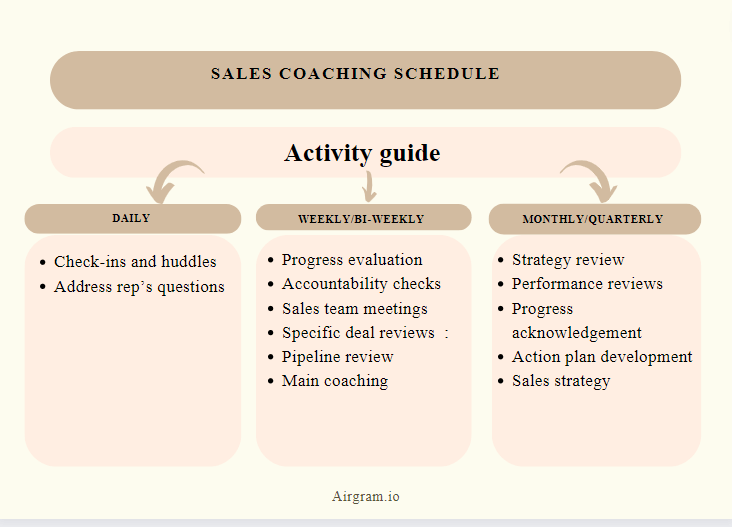
Build the week so coaching is a fixed block, not a residual. A workable cadence for a frontline manager with 7 reps:
- Weekly (per rep): 30 min skills 1:1. One observed call clip, GROW conversation, one committed action. ~3.5 hrs/week total.
- Weekly (team): 45 min call review. The whole team dissects one anonymized Gong clip together. Multiplies coaching across the team for a fraction of the time.
- Bi-weekly: 20 min deal-coaching on each rep's top 1–2 opportunities, scored against MEDDPICC.
- Monthly: 60 min growth/career 1:1 — separate from skills, so the weekly stays tactical.
That's roughly 4–5 hours of pure coaching a week, sustainable, and it scales by adjusting clip frequency, not by skipping people.
For a new SDR or AE, front-load it — daily 10-minute coaching for the first 30 days, tapering to weekly by day 60 — because ramp speed is the single highest-ROI place to spend coaching minutes.
Drills & Role-Play
Coaching time is wasted if it's all conversation and no reps. Build muscle memory with deliberate practice:
- Call-clip review (the staple): Use Gong or Chorus to clip a 90-second moment. The rep re-runs the moment live, out loud, the way they'd do it next time.
- Objection gauntlet: You play a difficult buyer and fire the three objections the rep fears most. Run it three times until the response is automatic.
- Discovery role-play scored on a card: A simple scorecard — Did they uncover the metric? The decision process? The champion? — turns a fuzzy skill into a measurable one.
- "Cold-open" cold-call drill: 60 seconds, no warmup, you pick up as a hostile prospect.
- AI role-play (2027): Tools like Hyperbound or Gong's practice features let reps rehearse against an AI buyer between your sessions, so your live time goes to the hardest 10%.
What to Measure
Don't measure coaching by quota — that's a lagging indicator polluted by territory and luck. Track leading indicators of behavior change:
- Coaching coverage: % of reps who got a real skills 1:1 this week (target: 100%).
- Behavior adoption: Did the committed action actually show up on the next 3 calls? (Verify in Gong, don't take their word.)
- Talk-track metrics: talk-to-listen ratio, longest monologue, patience after questions — all auto-scored by Gong/Chorus.
- Stage conversion: discovery→demo, demo→proposal — coaching a skill should bend the specific stage it targets.
- Ramp time for new hires and win-rate on coached deals vs. Uncoached.
If the leading indicators move and the number doesn't, your problem is upstream (pipeline, pricing, fit) — exactly what the diagnosis tree warned you about.
Common Mistakes Managers Make
- Rescuing the rep. Jumping on the call and closing it for them feels helpful and teaches nothing. Coach the rep, don't run the deal.
- Coaching the deal, not the skill. Deal reviews are necessary but they're forecasting, not coaching. If every 1:1 is "where's Acme at?", you're not building anyone.
- No follow-through. Coaching that doesn't verify the committed behavior on the *next* calls is just talking. The loop only works if you close it.
- Coaching everyone the same. Your top rep needs stretch, your ramping rep needs reps, your struggling rep needs a diagnosis. Same 30 minutes, very different agenda.
- Skipping when it's busy. The weeks you most want to skip coaching are the weeks it matters most. Protect the block.
- Confusing volume with quality. Five hours of pipeline interrogation isn't five hours of coaching. Minutes on observed skills are the only ones that count.
FAQ
How much coaching time per rep is the right amount? Aim for 30–45 minutes of skills coaching per rep per week, which lands you at 3–5 hours a week for a typical team of 6–8. CSO Insights and the Sales Management Association have long pegged ~3 hours per rep per month as the threshold where attainment lifts meaningfully; weekly cadence keeps you safely above it.
Should I count deal reviews and forecast calls as coaching? No. Forecasting and pipeline scrubs are management, not coaching. They're important, but keep them in a separate block so the coaching time stays focused on observed skills and behaviors.
What if I manage 15+ reps and can't give everyone 30 minutes? Lean on leverage: run weekly team call-reviews on a shared Gong clip, use AI role-play between sessions, and prioritize 1:1 minutes toward ramping reps and the middle 60% where coaching moves the needle most. Your top performers can run on bi-weekly.
How do I coach remote or hybrid reps without ride-alongs? Conversation-intelligence platforms — Gong, Chorus, Salesloft, Outreach — replace the windshield time. Clip a real call, review it together over video, and verify the behavior on recorded calls afterward. Distance is no longer an excuse.
When is the answer "less coaching," not more? When the diagnosis points to will, comp, or territory. More coaching minutes can't fix a motivation problem or a broken plan — those need a direct expectations talk, a comp/territory fix, or, for a true wrong-fit hire, a performance plan instead of more hours.
Bottom Line
Block 3–5 hours a week — about 30–45 minutes per rep — for coaching, and treat it as untouchable. Spend those minutes on observed skills from real calls using the GROW conversation, close the loop by verifying the behavior on the next three calls, and first diagnose whether the rep even has a skill gap — because coaching time is the wrong tool for a will, comp, or territory problem.
Sources
- Gong Labs — What separates top-performing sales managers
- Harvard Business Review — The Right Way to Coach Salespeople
- RAIN Group — Sales Coaching Best Practices
- Sandler — The GROW Coaching Model
- Sales Management Association — Sales Manager Coaching Research
- Salesforce Blog — How to Coach Your Sales Team
- Challenger — Coaching to the Challenger Selling Model
*Sales coaching for sales managers — how much time should a sales manager spend coaching, weekly sales coaching cadence, rep coaching framework, GROW model 1:1 guide, and a sales manager coaching playbook for 2027.*