 Pulse Reviews and Analysis
How do you give sales reps feedback they'll actually act on?
 Curated by Kory White · Fractional CRO, CRO Syndicate
Direct Answer
Reps act on feedback when it is specific, behavioral, and owned by them — not when it's a vague "great job" or a generic "you need to close harder." The move is to use the SBI model (Situation–Behavior–Impact): name the exact moment, describe the observable behavior (no labels, no character judgments), then connect it to the impact on the deal, the rep, or the customer — and stop talking so the rep can respond.
Deliver it fast (within 24–48 hours of the observed call), make it a two-way conversation rather than a verdict, agree on ONE change the rep will own, and then follow up so the feedback has teeth. Feedback only "sticks" when it's tied to a behavior the rep can repeat tomorrow and when the manager closes the loop.
In 2027, with Gong and Chorus auto-transcribing every call, the bottleneck isn't finding moments to coach — it's delivering them in a way reps will actually run with.
Why This Happens — Diagnose Before You Coach
Most feedback dies on arrival for one of four reasons, and they each need a different fix. Before you open your mouth, figure out which one you're dealing with — coaching the wrong cause is why managers repeat themselves for months with nothing changing.
- It wasn't specific. "Be more consultative" is not feedback; it's a wish. The rep can't act on an abstraction. Fix: anchor to a timestamped moment.
- It felt like a verdict, not a conversation. If the rep is defending instead of thinking, you triggered the threat response. Fix: ask before you tell.
- It wasn't owned. You prescribed the fix instead of letting the rep design it. People execute their own ideas; they resist yours. Fix: co-create the next step.
- There was no follow-through. You said it once, never circled back, so the rep correctly read it as low-priority. Fix: schedule the loop.
There's also a deeper split worth diagnosing: is this a skill gap (they don't know how), a will gap (they're not motivated), a knowledge gap (they lack product/market context), or a system problem (bad territory, broken comp, garbage leads)? Feedback fixes skill and knowledge.
It rarely fixes a will or system problem — those need a different conversation, and sometimes a PIP or a comp fix, not more coaching.
The Coaching Conversation
Run the conversation on the GROW model (Goal, Reality, Options, Will) and deliver the feedback itself with SBI. The goal is for the rep to do most of the talking and leave owning a change. Here is copy-pasteable language for a 1:1 after you've watched a call recording together.
Open by setting it as a partnership, not a performance review:
"I listened to the Brightway demo from Tuesday. I want to dig into one moment with you — not to grade it, but because I think there's a quick win that'll help you on the next three deals. Cool if we pull it up?"
Deliver the SBI — Situation, Behavior, Impact — with zero labels:
"Situation: about 22 minutes into the Brightway call, right after the VP asked about pricing. Behavior: you gave the number and then immediately started justifying it for about 40 seconds before they responded. Impact: you talked past the silence, so we never heard their actual reaction, and they ended the call 'needing to think about it.'"
Notice what's missing: no "you got nervous," no "you're not confident on price." Those are interpretations and they trigger defensiveness. Stick to what a camera would have recorded.
Then stop and ask — this is the most important step:
"When you hit that moment, what was going through your head?"
Let the silence sit. The rep's answer tells you whether it's skill or will. Then move through GROW:
- Goal: "What do you want to be true on the next pricing conversation?"
- Reality: "What actually happens for you right after you say the number?"
- Options: "What are two or three things you could try instead?" (Make them generate the options — don't hand them yours first.)
- Will: "Which one will you commit to on your next call, and how will I know you did it?"
Close by locking ONE behavior, not five:
"So the one thing: you say the price, then you go silent and count to five in your head. We'll listen to your next priced call together Thursday. Deal?"
One change, owned by the rep, with a follow-up already on the calendar. That's the difference between feedback that's heard and feedback that's acted on.
The Coaching Plan / Cadence
Feedback isn't an event; it's a loop. The managers whose reps actually improve run a predictable rhythm so coaching never gets crowded out by the pipeline review. A workable weekly cadence:
- Weekly: one 30-minute coaching 1:1 per rep (separate from deal review). Review ONE call together, deliver one piece of SBI feedback, agree on one behavior.
- Mid-week micro-loop: a 2-line async note in Slack or Gong when you catch the rep doing the new behavior well — positive reinforcement is feedback too, and it's the fastest way to make a behavior stick.
- Monthly: zoom out — look at the trend across four calls and the leading indicators, not a single moment.
- 30/60/90 for newer reps: 30 days = onboarding-skill feedback (talk tracks, discovery), 60 days = deal-execution feedback (multithreading, next steps), 90 days = independent-rep feedback (you observe and refine, they drive).
Drills & Role-Play
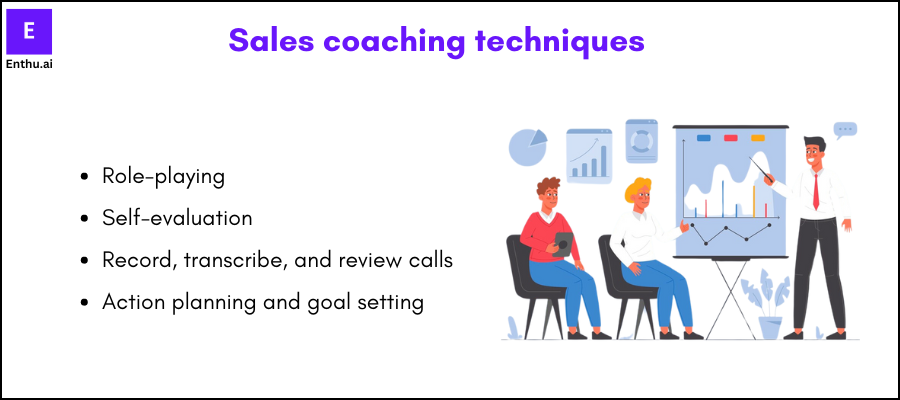
Telling a rep what to do better isn't enough — they have to rep the new behavior somewhere safe before they do it on a live deal. Build the muscle with deliberate practice:
- Call review on the actual recording. Pull the moment up in Gong or Chorus, watch it together, pause, and ask "what would you do differently here?" Self-discovery beats your verdict.
- Role-play the redo. You play the prospect; the rep re-runs the exact moment with the new behavior. Run it three times — clumsy, better, clean. Reps need reps.
- Objection gauntlet. Five rapid-fire objections back-to-back so the new response becomes reflexive, not something they have to think about.
- Scorecard a call against a rubric. Use a simple MEDDIC or Command of the Message scorecard so the rep grades their own call before you do — alignment on the standard makes future feedback frictionless.
- Peer review. Have two reps swap a call recording and SBI each other. Teaching the skill is how they internalize it.
What to Measure
Quota is a lagging indicator — by the time it moves, the quarter is over. To know whether your feedback is landing, watch leading indicators of behavior change:
- Did the specific behavior change on the next observed call? This is the single best signal. If you coached "go silent after stating price" and the next priced call has a 5-second pause, the feedback worked.
- Discovery quality: questions asked per call, talk-to-listen ratio (Gong reports this natively — target the rep moving toward ~45/55 talk/listen).
- Stage conversion: is the rep's discovery-to-demo or demo-to-proposal rate improving where you've been coaching?
- Next-step rate: percentage of calls that end with a scheduled, calendar-confirmed next step.
- Ramp time for new reps to first closed deal.
- Coaching follow-through: what percent of agreed behaviors actually showed up in the next call. If this is low, the problem is your loop, not the rep.
Common Mistakes Managers Make
- Rescuing the rep. You jump on the call and save the deal yourself. The deal closes; the rep learns nothing. Coach the skill, lose the occasional deal, win the quarter after.
- Coaching to the deal, not the skill. "Send them the case study" fixes one deal. "Here's how you handle a stalled champion" fixes fifty. Always abstract up to the repeatable skill.
- The feedback sandwich. Praise–criticism–praise buries the message and trains reps to brace for the "but." Be direct and kind; SBI is already non-judgmental.
- No follow-through. Saying it once and never circling back tells the rep it didn't matter.
- Coaching everyone the same. Your top rep needs stretch goals; your struggling rep needs one fundamental. Same script for both helps neither.
- Coaching a will/system problem with skill feedback. If the territory is dead or comp is broken, more role-play won't help — fix the system or have the harder conversation.
FAQ
How soon after a call should I give feedback? Within 24–48 hours while the call is fresh in both your heads. Waiting a week turns specific, actionable feedback into a vague memory. With Gong auto-transcribing calls, you can often deliver a short async note same-day and save the deeper conversation for the weekly 1:1.
What's the difference between SBI and the feedback sandwich? The sandwich (praise–critique–praise) hides the real message and makes reps distrust your praise. SBI (Situation–Behavior–Impact) is direct, factual, and non-judgmental — it describes observable behavior without softening or labeling, which is why reps don't get defensive and can actually act on it.
How do I give feedback to a defensive rep? Defensiveness usually means they felt judged. Strip every interpretation out of your feedback and stick to camera-observable behavior, then ask before you tell: "What was going through your head in that moment?" Letting them diagnose it first turns a verdict into a partnership.
Should positive feedback follow the same model? Yes — and it's underused. Use SBI for praise too: name the situation, the specific behavior, and the positive impact. "Good job" doesn't tell the rep what to repeat; "when the CFO pushed back, you reframed to business outcome and they re-engaged" does.
What if the rep keeps agreeing but never changes? That's a follow-through gap or a will/system problem, not a feedback-delivery problem. Re-observe the same behavior on the next call and make the commitment concrete and measurable. If they still don't change after repeated, specific, owned coaching, it's a motivation or fit issue — move to a different conversation, and if needed a PIP, not more of the same coaching.
Can AI tools replace manager feedback in 2027? No, but they make it far better. Gong, Chorus, and Clari surface the moments, the talk ratios, and the patterns automatically, so you spend your time on the human part — the conversation, the ownership, the follow-up — instead of hunting for what to coach.
Bottom Line
Reps act on feedback that is specific, behavioral, two-way, and followed up. Use SBI to describe exactly what happened without judgment, run the conversation on GROW so the rep owns the fix, lock in ONE behavior, and close the loop by re-observing it. The one move that matters: stop delivering verdicts and start co-creating the next behavior the rep will run tomorrow.
Sources
- The Right Way to Give Negative Feedback (Harvard Business Review)
- SBI Feedback Model (Center for Creative Leadership)
- Sales Coaching: How to Coach Reps (Gong Labs Research)
- The GROW Model of Coaching (MindTools)
- How to Build a Sales Coaching Program (RAIN Group)
- Sales Coaching Best Practices (Sales Hacker)
- Why Sales Coaching Matters (CSO Insights / Korn Ferry)
*Sales coaching for giving reps feedback they'll act on — how to coach sales reps with the SBI feedback model, sales manager coaching guide, rep feedback framework, and a sales feedback coaching playbook for 2027.*