 Pulse Reviews and Analysis
How do you coach reps to remove dead deals from the pipeline?
 Curated by Kory White · Fractional CRO, CRO Syndicate
Direct Answer
Coach reps to remove dead deals by making pipeline pruning a normal, scheduled habit instead of a confession. The core move is a recurring "deal age + last real action" review where you and the rep look at every open opportunity, ask one disqualifying question — *"What did the buyer do, not say, in the last 14 days?"* — and re-stage or close-lost anything that fails.
You coach the emotional attachment, not just the math: reps hold zombie deals because closing one feels like admitting failure and shrinks their number. The manager's job is to reframe a clean close-lost as a win for forecast accuracy and to build the muscle through a weekly cadence so deleting dead deals stops feeling like a loss and starts feeling like professional hygiene.
This matters more in 2027, where longer cycles and larger buying committees create more stalls that masquerade as live deals.
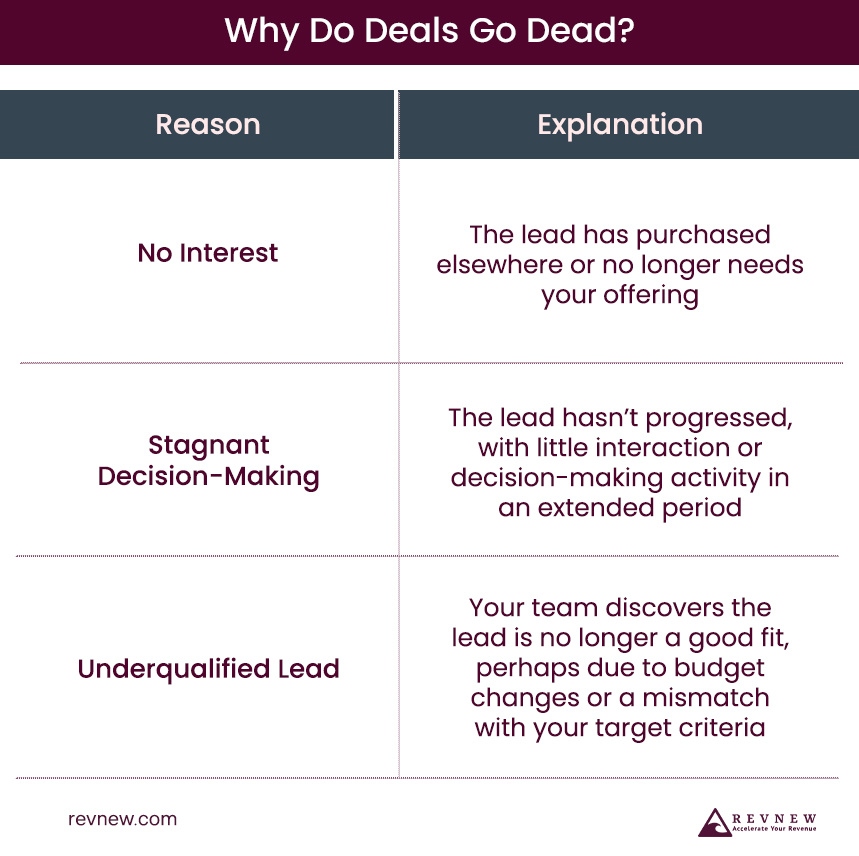
Why This Happens — Diagnose Before You Coach
A bloated pipeline full of dead deals is rarely one problem. Before you push a rep to close-lost anything, root-cause why they are hoarding. Diagnose across four lanes: skill, will, knowledge, and system/territory.
- Skill — The rep cannot tell a stalled deal from a dead one. They lack a qualification framework (MEDDIC, MEDDPICC, or SPIN), so every quiet deal looks recoverable.
- Will — The rep knows it is dead but won't close it. Closing it shrinks their pipeline coverage ratio, threatens their forecast story, or feels like a personal failure. This is the emotional attachment problem.
- Knowledge — The rep doesn't know your re-engagement or close-lost rules, or how stage age and slipped deals are supposed to be handled in your CRM.
- System/territory — The pipeline is genuinely thin, so the rep clings to scraps because there is nothing behind them. That is a demand and territory problem disguised as a discipline problem — and more coaching on pruning will make it worse, not better.
Naming the lane changes the whole conversation. A will problem needs reframing and safety; a system problem needs you to fix top-of-funnel before you ever mention pruning.
The Coaching Conversation
Run this in a 1:1 using the GROW model — Goal, Reality, Options, Will. Do not lecture. Ask, then shut up. Here are the verbatim scripts.
Goal — set the frame.
"I want us to walk your pipeline together, and my goal isn't to cut your number — it's to make your forecast something we can both trust. A clean pipeline is a stronger pipeline. Sound fair?"
Reality — surface the zombies. Pull up their board sorted by stage age and pick the three oldest open deals.
"This one's been in Negotiation for 71 days. Walk me through it. What did the buyer actually *do* — not say — in the last 14 days? An email back, a meeting they showed up to, a doc they shared?"
If the honest answer is "nothing," name it gently:
"So we've got a deal that's been sitting longer than our entire average cycle, and the buyer hasn't taken a single action in two weeks. What would have to be true for this to be real?"
Coach the emotional attachment directly when you hear "I just have a good feeling" or "I've put so much work in":
"I hear that you've invested a lot here, and that's exactly why it's hard. But the work you already did is gone whether we keep this open or not — that's a sunk cost. The real question is: if a brand-new rep inherited this deal today with zero history, would they call it live?
If not, keeping it open is costing you the time you'd spend on a deal that *can* close."
For pruning the zombie deal, give them the close-lost as a clean, low-shame act:
"Let's do this together right now. We'll mark it Closed-Lost — No Decision, tag the reason 'went dark / no buyer action,' and set a 90-day re-engagement task. You're not deleting it forever. You're moving it out of the forecast so it stops lying to us. Ready? Hit close-lost."
Options & Will — install the habit.
"Going forward, here's the rule we'll both use: any deal with no buyer action in 14 days gets a single 'breakup' email; no reply in 7 more, it's close-lost. I'll review it with you every Monday. What time works?"
Bold the disqualification standard so it sticks: no buyer action in 14 days is a re-engage; no action in 21 is a close-lost.
The Coaching Plan / Cadence
Make pruning a loop, not an event. The cadence below combines a weekly rhythm with a 30/60/90 build so the habit becomes self-sustaining.
- Days 1–30 — Manager-led. You co-pilot every Monday pipeline review. Together you re-stage or close-lost aged deals using the 14/21-day rule. You model the breakup email and the close-lost reason coding.
- Days 31–60 — Rep-led, manager-audited. The rep prunes before the 1:1 and presents what they cut and why. You audit for honesty (look for slipped deals that keep moving their close date right) and reinforce the reframe.
- Days 61–90 — Self-sustaining. Pruning is the rep's standing habit. You spot-check monthly and only intervene when stage age or close-date slippage spikes.
Drills & Role-Play
Build the skill with reps, not just rules.
- The Zombie Walk. Each week, the rep brings their five oldest deals. They get 60 seconds per deal to justify it stays open using MEDDIC criteria. No justification, it's pruned on the spot.
- Breakup-email role-play. You play the gone-dark buyer. The rep delivers the breakup line — *"Should I close your file, or is this still a priority for this quarter?"* — and you react with realistic silence or a real reply. Score tone and clarity.
- Sunk-cost rebuttal drill. You voice the rep's own excuse ("but I've worked this for months") and the rep practices the sunk-cost reframe out loud until it's automatic.
- Call-review with AI. Use Gong or Chorus to pull the last call on a stalled deal. Listen for the missing next step and the unanswered "what happens if you do nothing" question — the tell that a deal was never really qualified.
- Forecast-accuracy scorecard. Rep self-scores each committed deal against last week's prediction; chronic misses point straight at the deals they should have pruned.
What to Measure
Track leading indicators of behavior change, not just lagging quota.
- Pipeline accuracy / forecast call accuracy — does committed pipeline actually close near the predicted date? Improving accuracy is the real goal of pruning.
- Average stage age — should fall and stabilize as zombies leave.
- Slipped-deal rate — the percentage of deals whose close date moved right this month. Falling slippage means fewer dead deals are hiding.
- Close-lost discipline — count of deals closed-lost with a coded reason. Counterintuitively, you *want* this number healthy; zero close-losts means hoarding.
- Conversion by stage — cleaner pipelines show truer stage-to-stage conversion, which makes coaching the rest of the funnel possible.
- Time reallocated — hours moved off dead deals into live pipeline or prospecting.
Common Mistakes Managers Make
- Punishing the close-lost. If reps get grilled every time they close a deal lost, they will hide zombies forever. Reward the honesty.
- Coaching the deal, not the skill. Telling a rep which specific deal to cut fixes one deal; teaching the 14/21-day rule fixes the pipeline.
- No follow-through. A one-time cleanup with no weekly cadence rebuilds the swamp within a quarter.
- Mistaking a system problem for a will problem. If you force pruning on a rep with a starving territory, you set them up to miss. Fix demand first.
- Coaching everyone the same. A skill gap needs frameworks; a will gap needs the emotional reframe. Same script, wrong rep, no result.
- Letting "I have a good feeling" stand as evidence. Feelings are not buyer actions. Hold the standard.
FAQ
How do I know if a deal is truly dead versus just slow? Use the last-buyer-action test, not the rep's optimism. If the buyer has taken no real action — replied, met, shared a document, signed an order form — in 14 days, it's stalled; in 21, it's dead. A slow deal still has a mutual action plan and a live champion.
A dead deal has only the rep's hope and a stage age longer than your average cycle.
Won't aggressive pruning hurt our pipeline coverage ratio? It corrects it. A coverage ratio built on dead deals is a lie that feels like safety. You are better off knowing you have 2x of *real* pipeline than believing you have 4x of fiction.
Coach reps that accurate coverage drives better territory and lead decisions from leadership — inflated coverage gets the help cut off.
A rep is emotionally attached to a deal they admit is dead. What do I say? Name the sunk cost out loud: *"The work you did is gone whether we keep this open or not. Would a brand-new rep inheriting it today call it live?"* Then make the close-lost a shared, low-shame act you do together in the moment, with a 90-day re-engagement task so it feels like parking, not deleting.
Should close-lost be tied to comp or activity targets? Never penalize a coded close-lost. If you must, set a positive target — every rep codes a reason on every closed-lost deal — so the behavior you reward is honesty and clean data, not the lost outcome itself.
How often should we prune the pipeline? Weekly, in the 1:1, using a board sorted by stage age and last action. Monthly is too slow — zombies multiply and the forecast drifts. Daily is overkill and creates churn. A standing weekly Zombie Walk is the sweet spot.
What if pruning leaves a rep with almost no pipeline? That's the diagnosis you needed. The problem was never discipline — it's a system/territory or prospecting gap. Stop coaching pruning and pivot to top-of-funnel: lead flow, outbound cadence, and territory design. Pruning an empty pipeline just exposes the real issue faster.
Bottom Line
Dead deals don't leave a pipeline because reps decide to delete them — they leave because the manager makes pruning a safe, scheduled, low-shame habit built on a single objective rule: no buyer action, no place in the forecast. Coach the emotional attachment with the sunk-cost reframe, run a weekly Zombie Walk on stage age, and reward close-lost discipline so honesty beats hoarding.
Sources
- Gong Labs: What separates top closers from the rest
- HBR: Stop Losing Sales to Customer Indecision
- RAIN Group: Sales Pipeline Management Best Practices
- MEDDIC Academy: The MEDDIC Sales Qualification Methodology
- Sales Hacker: How to Clean Up Your Sales Pipeline
- Sandler: Why Salespeople Hold On to Dead Deals
- Winning by Design: The SaaS Sales Method on Pipeline Health
- Clari: What Is Pipeline Inspection and Why It Matters
*Sales coaching for removing dead deals — how to coach reps to prune zombie deals from the pipeline, a sales manager coaching guide for close-lost discipline, stage age and slipped deals, and a rep pipeline-hygiene coaching playbook for 2027.*