 Pulse Reviews and Analysis
How do you coach reps on their talk-to-listen ratio?
 Curated by Kory White · Fractional CRO, CRO Syndicate
Direct Answer
Coach talk-to-listen ratio by treating it as a diagnostic signal, not a target to hit. The number tells you *where* a rep is dominating the conversation; your job is to find the moment they should have shut up and asked a question instead. Pull the ratio from Gong or Chorus, set the benchmark by call stage (discovery should be rep-heavy on *listening*, not talking; demos and negotiations flip), and coach to the specific behavior behind the number — not the number itself.
A rep who talks 70% of a discovery call doesn't need a quota; they need to learn to ask a question and then stay silent for four seconds. The move: review one call together, find the missed listening moment, role-play the better version, and re-measure next week.
Why This Happens — Diagnose Before You Coach
Talk-to-listen ratio is a downstream symptom. Reps over-talk for very different reasons, and the coaching is different for each. Before you say a word about the metric, figure out which root cause you're looking at:
- Skill gap: The rep doesn't know how to ask open-ended questions or how to use silence. They fill space because they were never taught the alternative.
- Will / anxiety: The rep talks to feel in control. Silence feels like losing the deal, so they pitch over the buyer.
- Knowledge gap: The rep doesn't know the product or the buyer's world well enough to ask a sharp follow-up, so they retreat to a scripted monologue.
- System / call-type: The ratio looks "bad" but it's actually a demo or a closing call where talking more is correct. The data is fine; the benchmark was wrong.
The single most common mistake is coaching a number that was never out of range. A 65% talk ratio on a product demo is healthy; the same 65% on a first discovery call is a five-alarm fire. Diagnose the call stage first.
The Coaching Conversation
Run this inside a 1:1 with one specific call pulled up. Do not coach the ratio in the abstract — coach the moment. Lean on the GROW model (Goal, Reality, Options, Will) so the rep owns the fix instead of being told.
Goal — set the frame:
"I want to spend fifteen minutes on the Henderson discovery call. My goal today isn't to grade you — it's to find the one place where asking a question instead of talking would have changed the outcome. Sound good?"
Reality — make them hear it: Play the timeline. Then ask the question that does the work:
"At the 6-minute mark, the buyer said 'we've tried tools like this before.' Walk me through what you did next."
Let them answer. They'll usually realize they pitched instead of asking. If they don't, play the clip. Then:
"What do you think the buyer meant by 'we've tried tools like this'? What would you give to know the real story there?"
This is the pivot. You're showing them that the missed listening moment cost them information they needed.
Options — let them generate the fix:
"If you could rerun that thirty seconds, what would you say instead?"
Coach toward a question stack plus silence: "Tell me about that — what didn't work last time?" followed by a full four-second pause. If they can't generate it, offer two options and let them pick. Never hand them the only answer.
Will — lock the commitment:
"On your next three discovery calls, after every answer the buyer gives, I want you to count to four in your head before you respond. That's it. We'll listen to one of them Friday."
Notice what you did *not* do: you never said "your talk ratio is 68%." The number got you to the call; the coaching happened on the behavior.
The Coaching Plan / Cadence
One conversation changes nothing. Behavior change on talk-to-listen runs on a weekly loop tied to fresh call data.
- Week 1 — Baseline + awareness: Show the rep their ratio by call stage in Gong or Chorus. Agree on one stage to fix (almost always discovery). Run the 1:1 above.
- Week 2 — One micro-skill: Drill the four-second pause and one question stack. Review one real call. Look for the pause showing up, even imperfectly.
- Week 3 — Compounding: Add a second skill (labeling: "It sounds like X is the real concern"). Re-pull the ratio; celebrate movement even if it's only 5 points.
- Week 4 — Self-coaching: Rep reviews their own call first and brings *you* the missed moment. This is the goal state — they own the metric.
The loop matters more than any single session. Reps who get weekly call reviews change behavior; reps who get a quarterly score do not.
Drills & Role-Play
- The four-second drill: Role-play a discovery call. Every time the rep finishes a question, you (as buyer) answer, then the rep must stay silent until you visibly count four fingers. It feels excruciating; that's the point.
- Question-stack ladders: Give the rep an objection ("It's too expensive"). They must respond with three questions in a row before making any statement. Builds the reflex to dig before pitching.
- Mute-the-pitch review: Pull a recorded call and have the rep watch only the buyer's talk segments. What did the buyer reveal that the rep talked over? Trains the ear.
- Label-and-pause: Drill the Chris Voss-style label ("It seems like timing is the real issue") followed by silence. Labels invite the buyer to keep talking — the cheapest way to drop your own ratio.
- Scorecard self-review: Give a one-page rubric — open-ended questions asked, longest buyer monologue, number of four-second pauses — and have the rep score their own latest call before the 1:1.
What to Measure
Talk-to-listen ratio is itself a leading indicator, but coach the inputs behind it, not the headline number:
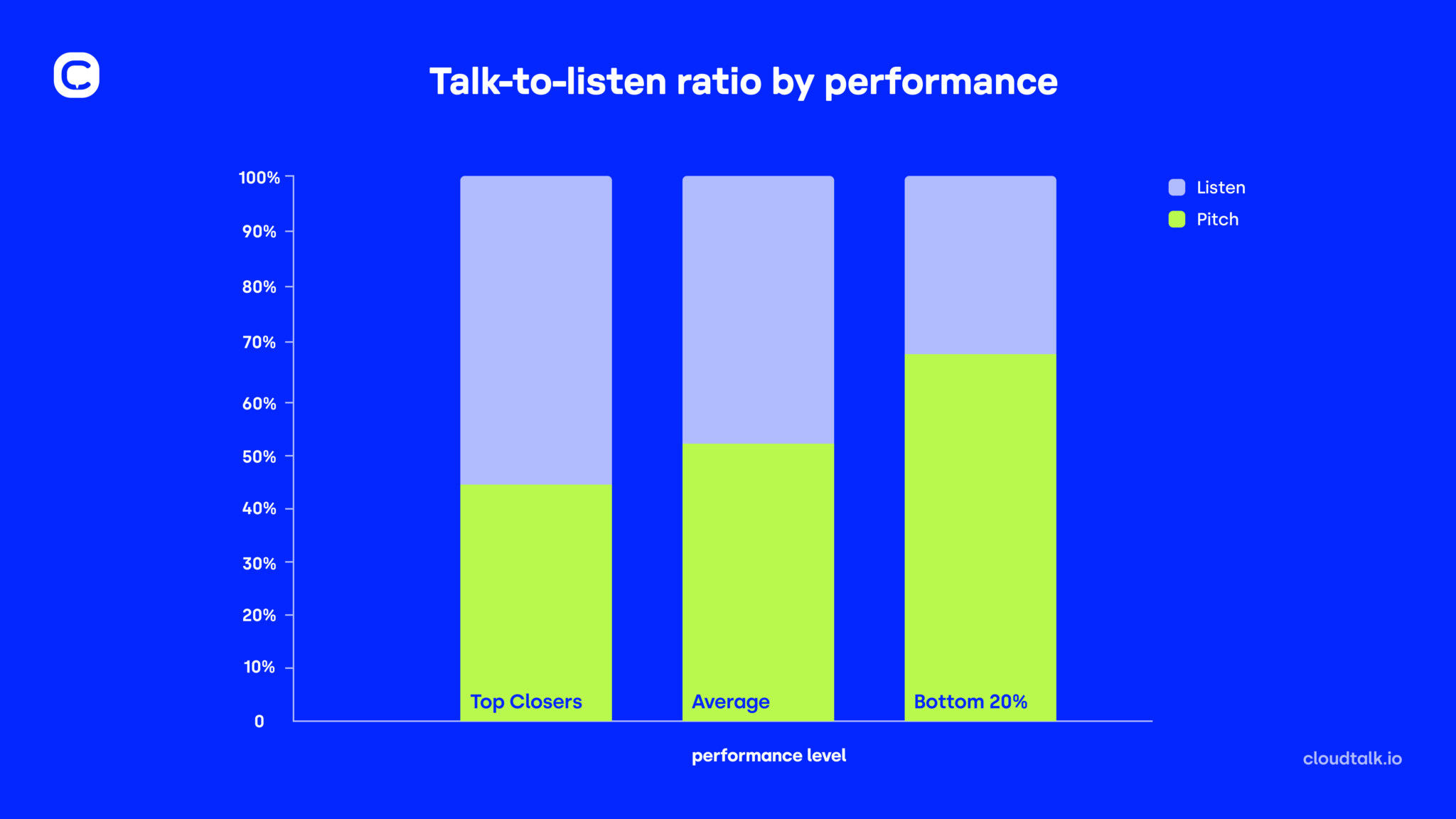
- Ratio by call stage, not blended. Track discovery separately from demo. Gong Labs research has long pointed to roughly a 43/57 talk-to-listen split on the best discovery calls — the rep listening more than half the time.
- Longest buyer monologue: A great discovery call has at least one stretch where the buyer talks for 90+ seconds uninterrupted. That's a better signal than the average ratio.
- Open-ended questions per call: Rising question count usually drags the ratio into range on its own.
- Patience / pause frequency: Some platforms surface "patience" or interruption metrics; rising pauses mean the skill is landing.
- Behavior-to-outcome link: Does the rep's discovery-to-next-step conversion climb as their listening climbs? That's the proof the coaching is worth the time.
- Win-rate as the lagging check only — never the weekly dial.
If the ratio improves but conversion doesn't, you fixed the metric and missed the skill. Go back to the call and find out whether the questions were actually *better* or just *more numerous.*
Common Mistakes Managers Make
- Coaching the number instead of the moment. "Get your ratio under 55%" is a target, not coaching. Reps will game it by going quiet and learning nothing.
- Ignoring call stage. Demanding low talk on a pricing call or a technical demo makes you look like you don't understand selling.
- Rescuing the rep. Handing them the perfect question every time means they never build the reflex. Make them generate options.
- No follow-through. One review, no re-measure. The loop dies and the behavior snaps back within two weeks.
- Same coaching for everyone. An anxious over-talker and a knowledge-thin over-talker need opposite interventions. Diagnose individually.
- Treating a will problem as a skill problem. If the rep knows exactly what to do and still pitches over buyers, that's confidence or control — coach the mindset, or in a true performance case, move to a structured plan rather than another call review.
FAQ
What is a good talk-to-listen ratio for a sales call? There's no single good number — it depends on stage. On discovery, the rep should listen more than they talk; Gong-style research points to roughly 43% rep talk / 57% listen on top discovery calls. On demos and negotiations, rep talk legitimately rises to 60–70% because they're presenting and structuring.
Always benchmark by call type, never blended.
Should I just tell reps to talk less? No. "Talk less" produces awkward silence and reps who quit asking good questions out of fear. Coach the *replacement* behavior — ask an open-ended question, then pause four seconds — so the lower ratio is a byproduct of better listening, not forced quiet.
How do I measure talk-to-listen ratio? Conversation-intelligence tools like Gong, Chorus (now part of ZoomInfo), and Salesloft auto-calculate it from recorded calls and break it down by speaker and by call stage. Without a tool, a manager can rough-estimate from a recording, but per-stage automation is what makes weekly coaching practical.
What if a rep's ratio looks bad but they're closing fine? Leave it alone, or coach lightly for upside. The metric is a means to better discovery and bigger deals, not an end. If results are strong, the most you'd do is help them find untapped expansion or risk they're talking past. Never break what's working to satisfy a dashboard.
How long until coaching changes the ratio? With weekly call reviews and a single focused micro-skill, most reps show measurable movement within three to four weeks. Durable change — where the rep self-corrects without you — typically takes one to two quarters of consistent loops.
Is a low talk ratio always better? No. A rep who barely talks may be passive, failing to challenge the buyer, or skipping the framing a complex 2027 buying committee needs. The goal is the *right* talking at the right time, anchored to the call's purpose — not the lowest possible number.
Bottom Line
Talk-to-listen ratio is a flashlight, not a finish line. Use it to find the exact moment a rep should have asked instead of pitched, benchmark it by call stage, and coach the missed listening moment with a real call open in a weekly loop. Fix the behavior — open questions plus a four-second pause — and the number follows on its own.
Sources
- Gong Labs: What's the Ideal Talk-to-Listen Ratio in Sales Calls
- Harvard Business Review: The Surprising Power of Questions
- RAIN Group: Sales Discovery Questions Research
- Sales Hacker: How to Run a Sales Call That Buyers Actually Want
- Chorus / ZoomInfo: Conversation Intelligence for Sales Coaching
- Winning by Design: SPICED and Effective Discovery
- Salesloft: Using Conversation Intelligence to Coach Reps
- The GROW Model — MindTools Coaching Framework
*Sales coaching for talk-to-listen ratio — how to coach reps on talk-to-listen ratio, sales manager coaching guide, rep coaching framework, ideal talk-to-listen ratio by call stage, and a coaching playbook for 2027.*