 Pulse Reviews and Analysis
Sales-led top-down enterprise GTM motion in 2027
 Curated by Kory White · Fractional CRO, CRO Syndicate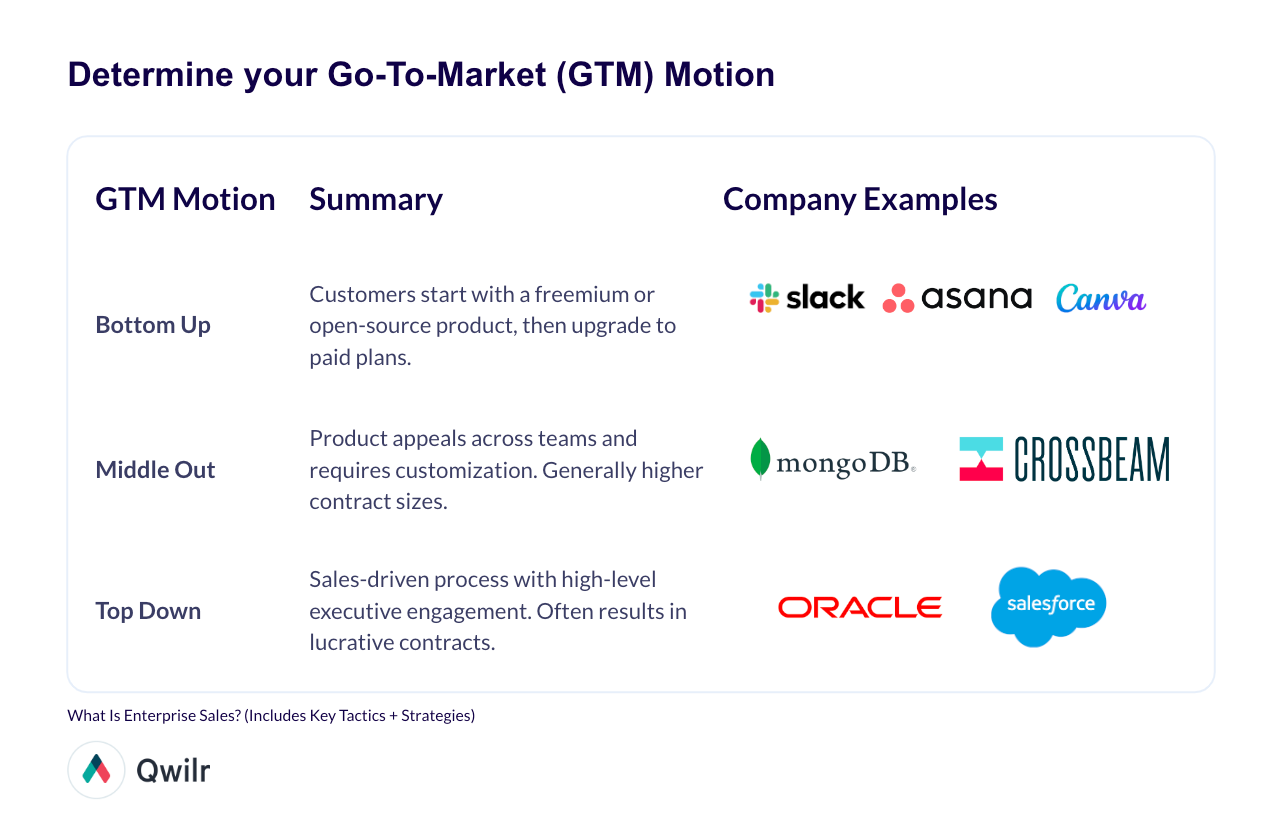
Direct Answer
A sales-led top-down enterprise GTM motion wins large accounts by selling to executive economic buyers first, then driving adoption downward through the organization. The motion centers on a named-account list, multi-threaded outbound, and quarterbacked deal teams (AE, SE, exec sponsor) running a documented qualification framework such as MEDDPICC.
Revenue concentrates in fewer, larger contracts with 6-to-12-month sales cycles, $100K+ average contract value (ACV), and procurement, security, and legal gates that smaller motions never touch. The 2027 version of this motion uses signal-based account prioritization (intent from Bombora, hiring signals, 10-K language) to decide *which* executives to approach and *when*, then orchestrates the deal in Salesforce with conversation intelligence from Gong or Clari.
Success is measured by pipeline coverage (3x+ of quota), win rate on qualified opportunities (25-35%), and average contract value growth, not raw lead volume.
When a Top-Down Enterprise Motion Is the Right Choice
A top-down motion fits when the product requires executive sponsorship to deploy, carries a price point that needs budget approval, or changes how a function operates company-wide. Platforms like Workday (HR/finance), ServiceNow (IT workflows), and Salesforce itself were built on this motion because no individual contributor can swipe a credit card and roll the tool out to 5,000 employees.
Use this motion when:
- ACV exceeds the discretionary-spend threshold (typically $25K+), forcing a formal buying committee.
- The buying committee has 6-10 stakeholders — a 2025-2027 norm for enterprise software per multiple analyst observations of committee growth.
- Switching costs are high, so the buyer wants a vendor relationship, references, and a roadmap conversation, not a free trial.
Avoid it when a self-serve or product-led motion would convert faster and cheaper — a $40/month tool does not justify a six-month enterprise cycle.
Building the Named-Account List and Territory Model
The motion starts with a finite, ranked target list, not an open territory. Build it in three passes:
- Total addressable market (TAM) definition — filter your CRM and a data source like ZoomInfo or Apollo by firmographics (industry, headcount, revenue) that match your ideal customer profile (ICP).
- Tiering — split accounts into Tier 1 (1:1, full deal team), Tier 2 (1:few), and Tier 3 (1:many nurture). A common ratio is 50 Tier-1 accounts per AE, low enough to allow genuine research.
- Account scoring — layer intent data from Bombora or 6sense, technographics, and trigger events (new CRO hire, funding round, earnings-call priorities) to rank within each tier.
Territories are then balanced by potential, not geography alone, so each AE carries comparable pipeline-creation capacity.
Multi-Threading the Buying Committee
Top-down does not mean single-threaded to the CEO. It means entering high, then widening. The economic buyer (CFO, CRO, CIO) authorizes budget; the champion builds the internal case; technical evaluators validate; procurement negotiates; legal and security clear the path.
Practical multi-threading rules:
- Map the committee explicitly in your CRM using a stakeholder field, and flag any deal with only one contact as single-threaded risk.
- Tailor the message per role — the CFO hears payback period and return on investment (ROI); the technical evaluator hears architecture and integration with existing systems; the champion hears career-making outcomes.
- Use executive sponsors from your own company to mirror seniority. An enterprise CRO expects to talk to a VP, not only a rep.
Conversation intelligence from Gong surfaces which stakeholders have actually engaged, exposing ghost deals where the champion claims broad support that does not exist.
The Qualification and Deal-Execution Framework
Enterprise deals fail from poor qualification, not poor pitching. Adopt MEDDPICC (Metrics, Economic buyer, Decision criteria, Decision process, Paper process, Identify pain, Champion, Competition) as the shared language of the deal team. Each letter maps to a CRM field, and a deal cannot advance stages until the prior letter is filled.
A disciplined cadence looks like:
- Discovery — quantify the pain in dollars, confirm the economic buyer, document decision criteria.
- Validation — technical proof via a scoped pilot or proof of concept (POC) with exit criteria agreed *before* it starts.
- Business case — a written mutual action plan (MAP) co-owned with the champion, listing every step to signature with dates and owners.
- Negotiation — engage procurement early, hold price discipline, trade concessions for term length or expansion commitments.
The Tech Stack That Runs the Motion
The enterprise sales stack in 2027 has four layers:
- System of record — Salesforce Sales Cloud holds accounts, opportunities, and MEDDPICC fields.
- Account intelligence — 6sense or Demandbase for intent and account prioritization; ZoomInfo for contact data.
- Revenue intelligence — Gong or Clari for call capture, deal risk scoring, and forecast accuracy.
- Deal collaboration — digital sales rooms and mutual action plans via tools such as DealHub or native Salesforce features, plus Slack deal channels for the internal team.
Configuration in 2027 increasingly leans on AI agents inside these platforms to draft account research, summarize calls, and flag stalled deals, but the human deal team still owns judgment on strategy and concessions.
Metrics, Comp, and Forecasting
Measure the motion on pipeline-centric metrics:
- Pipeline coverage of 3x quota in early stages, tightening to 1.5x late.
- Stage conversion rates to find where deals stall (often Validation → Business case).
- Win rate on qualified opportunities of 25-35% for healthy enterprise teams.
- Sales cycle length and average contract value (ACV) trend.
Compensation rewards closed revenue and multi-year terms, with accelerators above quota and clawbacks on early churn so reps sell to fit, not just to sign. Forecasting blends rep commit, manager judgment, and Clari's AI-projected number, reconciled in a weekly deal review.
FAQ
What is a sales-led top-down enterprise GTM motion? It is a go-to-market approach that sells first to senior executive economic buyers, then expands adoption downward through the organization, typically for high-ACV products requiring budget approval and a formal buying committee.
How is top-down different from product-led growth? Product-led growth lets individual users adopt a free or low-cost product bottom-up, while top-down enters through executives, uses a deal team, and closes larger contracts through procurement and legal — slower but with higher contract values.
What qualification framework should an enterprise team use? MEDDPICC is the most widely adopted enterprise framework; each element maps to a CRM field and gates stage progression so deals are qualified on metrics, economic buyer, decision process, and a real champion.
How many target accounts should one enterprise AE carry? A common 2027 norm is roughly 50 Tier-1 named accounts per account executive, low enough to allow genuine research and multi-threading rather than spray-and-pray outreach.
Which tools run a top-down enterprise motion? Salesforce as the system of record, 6sense or Demandbase for account intelligence, ZoomInfo for contacts, and Gong or Clari for revenue intelligence and forecasting.
Related on PULSE
- GTM playbook for B2B SaaS in 2027
- What is the go-to-market playbook for account-based marketing (ABM) in 2027?
- What is the go-to-market playbook for a land-and-expand motion in 2027?