


Fanatical Prospecting by Jeb Blount — Cliff Notes Summary & Key Takeaways
Quality
Certified

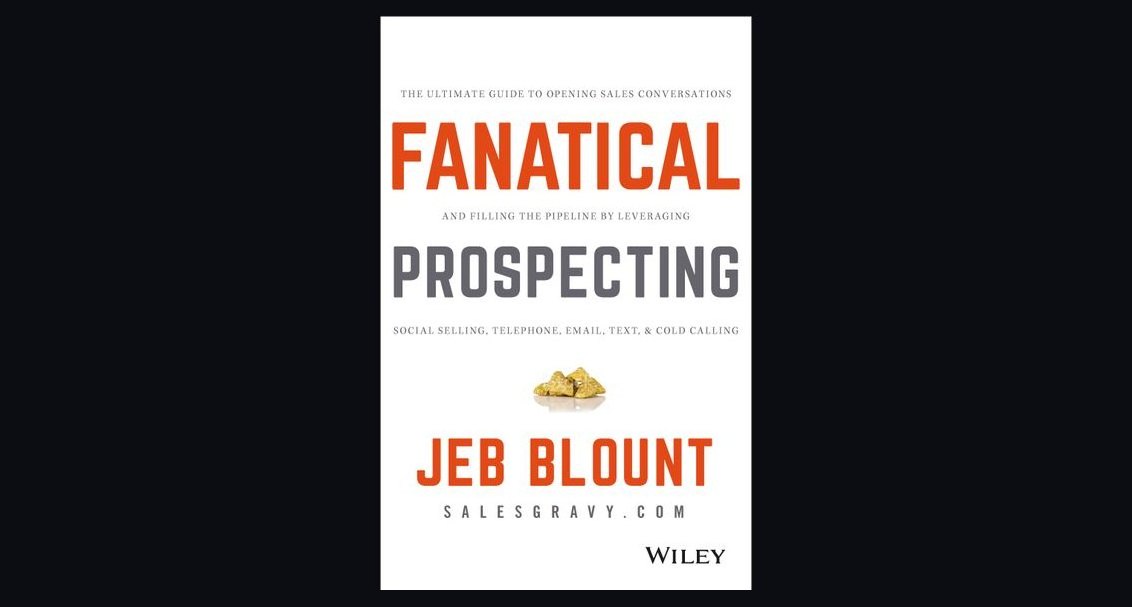
Fanatical Prospecting (Jeb Blount, Wiley, 2015) argues that pipeline collapse is always a prospecting-discipline failure, not a market failure. Its core claims: the 30-Day Rule — today's outreach pays off roughly 90 days out; the Universal Law of Need — desperation destroys leverage; and balanced multi-channel outreach across phone, email, social, referral, and in-person.
The quarter that was already lost in January
Picture a mid-market AE with a $900,000 annual quota, a 60-day average sales cycle, and a 22% close rate on qualified opportunities. December closes strong. January arrives with three big deals in late-stage, so the rep spends the month shepherding paperwork, running security reviews, and chasing procurement signatures. Those three deals close. February looks fine — commissions land, the manager is happy, the forecast is green.
Then March happens. The late-stage bench is empty because nothing was added in January. The rep starts dialing in a panic, but the sales cycle math is unforgiving: a call placed March 3rd does not become closed-won revenue until roughly May at the earliest. Q1 is already gone, and Q2 is compromised before it starts. This is precisely the pattern Blount describes, and it is why the book opens with the phrase that became its unofficial mantra — the pipe is life.
The diagnostic value here is that the failure is invisible at the moment it occurs. Nothing goes wrong in January. The rep does real work, closes real business, and receives real praise. The damage is a *non-event* — the calls that were not made, the emails that were not sent, the referral asks skipped after three successful implementations. There is no alert in the CRM for "you added zero net-new opportunities this month." Most forecast reviews scrutinize the deals that exist and never ask about the deals that should have been created. A pipeline-coverage report shows 4x coverage in January and 0.9x coverage in March, and by the time anyone reads the second number, the recovery window has closed.

This is also why the book resonates far outside enterprise software. The same shape appears in a staffing agency where recruiters stop sourcing candidates during a placement surge, in a commercial insurance brokerage during renewal season, in an agency that lets business development lapse while delivering a big project, and in a freelance consultancy that goes quiet on outreach for the eight weeks of a large engagement. Anywhere revenue arrives on a lag, the lag itself becomes the trap. Blount's contribution was making that lag legible and attaching a number to it.
How the 30-Day Rule and the Law of Replacement actually work
The mechanism has three interlocking parts, and understanding them as a system rather than as slogans is where the practical value lives.
The 30-Day Rule. The prospecting you perform in any given 30-day window primarily produces results in the following 90 days. It is a statement about lag, not about magic. If your average sales cycle is 60 days and your average first-touch-to-first-meeting delay is another 15 to 20 days, then the total distance between a cold dial and a closed deal is routinely 75 to 90 days. A prospecting drought therefore does not show up as a revenue problem for a full quarter — and the recovery takes another full cycle, because you cannot compress the buyer's timeline by working harder.

The Universal Law of Need. The more you need a specific deal, the less likely you are to get it. A rep with one live opportunity negotiates from fear: they discount without being asked, accept a demo request in place of real discovery, skip qualification because disqualifying would empty the pipeline entirely, and generally radiate what Blount memorably calls commission breath. A rep with fifteen live opportunities can walk away, hold price, and ask uncomfortable qualifying questions — because no single outcome is existential. Pipeline depth is not a reporting metric; it is a negotiating posture.
The Law of Replacement. Pipeline is a leaky bucket. Deals close, deals die, deals stall indefinitely. You must add new opportunities at the rate existing ones exit, *plus a margin* for slippage. This is where a lot of teams get the math wrong: they replace won deals but forget to replace the losses and the no-decisions, which in most B2B segments are the larger share of exits.
The loop is the point. Prospecting feeds coverage, coverage creates leverage, leverage improves win rate, and improved win rate reduces the volume of prospecting required to hit the same number. Run the loop backwards and it becomes a doom spiral: thin pipeline forces desperation, desperation lowers win rate, lower win rate demands even more pipeline, and the rep who now needs the most prospecting activity is the one with the least emotional bandwidth to do it. Blount's psychological chapters exist precisely because the math alone does not explain why intelligent people stop doing the one thing they know works.
Real numbers, coverage ratios, and the benchmarks that matter
Blount deliberately avoids prescribing one universal dial count, and that restraint is correct — the right activity number is derived, not declared. But the book does anchor several ranges, and reconstructing the arithmetic is the most useful exercise a reader can do.
Coverage ratio. The common working range is 3x to 5x qualified pipeline against quota, with the multiplier set by your actual win rate. The formula is straightforward: required coverage equals 1 divided by your historical close rate, plus a buffer for slippage. A 25% close rate implies 4x coverage as the floor; a 20% close rate implies 5x. Teams that carry 2x coverage and a 20% close rate are, arithmetically, forecasting a 60% miss and calling it optimism.
Working backwards to daily activity. Take a $1,000,000 quota with a $50,000 average deal size — that is 20 closed deals per year. At a 25% close rate, you need 80 qualified opportunities annually, or roughly 7 per month. If one in three first meetings becomes a qualified opportunity, that is 21 meetings a month. If it takes 15 to 25 conversations to set one meeting, you are looking at 300 to 500 real conversations a year at the top of the funnel. Divide across working days and the daily target becomes concrete rather than aspirational. This is the calculation most reps have never actually run, and it is the single highest-value hour you can spend with a spreadsheet.
Connect-rate erosion. The most-dated numbers in the book are the phone benchmarks. Cold-call answer rates in 2015 were meaningfully higher than they are now — mobile screening, spam-likely labeling, and carrier-level call blocking have compressed pickup rates substantially across the decade. The phone still works; the dials-per-conversation ratio simply got worse. If your historical connect rate has halved, your dial target must roughly double to hold the same conversation count, which is exactly why volume-only strategy is a losing game and why the balanced multi-channel argument aged so well.
Time blocking. The concrete prescriptions that survive: two protected hours of outreach per day, structured as 90-minute high-intensity blocks with notifications off; a 15-minute daily CRM hygiene block rather than a quarterly cleanup that never happens; and protection of core business hours for buyer-facing activity, with admin pushed to the edges of the day. The specific hours matter less than the principle — the block is defended against internal meetings, which are the primary predator of prospecting time in every organization.
Email length. Blount's prescription of short, single-ask emails — well under 100 words, with a subject line that earns the open, one sentence proving genuine research, and exactly one call to action — has been validated repeatedly by sales-engagement platform research in the years since. The three-part structure is now the default template shipped by essentially every cadence tool on the market.
Touch counts. Modern buying-group research consistently shows B2B opportunity creation requires many more touches than sellers assume, spread across multiple channels and multiple stakeholders. Blount's balanced-prospecting thesis anticipated this: the touches that create an opportunity are rarely all from one channel, and a cadence that is 100% email will underperform a cadence that mixes phone, email, social, and referral at the same total volume.
Balanced prospecting versus the alternatives
The book's central strategic claim — that no single channel wins, and that the fanatic runs several in coordination — deserves examination against its alternatives, because each alternative has real advocates and real trade-offs.
Phone-heavy. Highest information density per interaction. A three-minute conversation tells you more about fit, timing, and authority than a dozen email opens. The trade-off is brutal cost per attempt as connect rates fall, and it scales poorly against senior enterprise buyers who screen aggressively. Best fit: transactional and mid-market motions with reachable buyers.
Email-heavy. Cheapest to scale, easiest to measure, easiest to automate. The trade-off is that low marginal cost invites volume abuse, which invites deliverability collapse — domain reputation damage is slow to appear and slow to repair. Best fit: motions with strong content, clear segmentation, and disciplined volume caps.
Social and trigger-based. Highest relevance per touch. Watching for funding events, executive hires, expansion announcements, and tech-stack changes converts cold outreach into timely outreach. The trade-off is throughput — you can only work as many triggers as actually fire, and trigger monitoring is genuinely time-consuming. Blount framed social as an awareness builder rather than a closer; that framing is the part of the book that has aged most, since modern sellers do source and close pipeline directly from social signal.
Referral-led. Highest conversion rate of any channel by a wide margin, and the cheapest per closed deal. The trade-off is that it does not scale on demand — you cannot manufacture referrals in week one of a territory. Blount's key insight here is that referrals must be *asked for* with the same scripted discipline as cold calls, immediately after a moment of delivered value, with a specific name rather than a vague "know anyone?"
Inbound-only. Lowest effort per opportunity when it works. The trade-off is total loss of control over timing and account selection — you get the accounts that come to you, not the accounts you want, and the pipeline goes exactly as quiet as the marketing budget does.
The strategic argument for balance is a portfolio argument. Every individual channel decays — algorithms change, spam filters tighten, regulations shift, a platform throttles outreach. A seller whose entire pipeline depends on one channel is one policy change away from a dead quarter. A seller running five channels at moderate intensity absorbs any single decay without a pipeline event. That is a risk-management insight dressed as a sales tactic, and it is why the framework outlived its own benchmark numbers.
Worth noting the neighboring literature: Mike Weinberg's *New Sales Simplified* is the strategic companion — target account selection, the sales story, the weekly plan — while Blount supplies the tactical layer of dials, scripts, and rejection psychology. Joanne Black's *No More Cold Calling* goes deeper on referral discipline than Blount's single chapter can. Chris Voss's *Never Split the Difference* extends the objection-handling material with far more rigorous tactical-empathy mechanics. Read together, they cover the ground the single book compresses.
The pitfalls that quietly kill the discipline
Most readers finish the book energized and revert within three weeks. The failure modes are predictable enough to name and defend against.
Confusing motion with prospecting. Building lists, updating the CRM, researching accounts, and refining templates all feel like prospecting and produce no conversations. Blount names three psychological blockers — procrastination, perfectionism, and paralysis — and the middle one is the most seductive for competent people, because over-research is indistinguishable from diligence right up until the day ends with zero dials. The defense is a hard rule: during the outreach block, the only permitted actions are dialing, sending, and messaging. All list-building and research happens outside the block, ideally the afternoon before.

Letting the block be negotiable. The prospecting hour is the first thing sacrificed to a customer escalation, an internal pipeline review, or a "quick sync." Once it becomes negotiable it disappears entirely, because there is always something more urgent. The defense is calendar-blocking it as busy, treating it like a customer meeting, and — for managers — refusing to schedule internal meetings during team prospecting windows. This is the single highest-leverage thing a sales manager can do, and it costs nothing.
Prospecting only when the pipeline is thin. This is the pattern the 30-Day Rule exists to prevent, and it produces a permanent boom-bust oscillation: prospect hard in a panic, generate pipeline, stop prospecting to work the pipeline, run dry, panic again. The oscillation is worse than a lower steady rate, because every panic phase is worked from the weakest possible negotiating position. The defense is a floor — a minimum weekly activity number that holds regardless of how good the pipeline looks.
Personalizing rejection. If your appointment-set rate is 4%, then 96 no-answers per 100 attempts is the expected outcome, not a verdict on your competence. Reps who treat each no as a personal referendum burn out; reps who treat it as statistical noise keep dialing. The reframe is not motivational fluff — it is the correct interpretation of the data.
Over-automating the loop. The modern version of the trap. AI-assisted outreach tooling automates the mechanics beautifully — list building, sequencing, personalization drafts, follow-up timing. What it does not automate is the seller staying in the loop: reading the replies, catching the buying signal buried in a two-word response, making the judgment call about when to pick up the phone. The discipline question has shifted from "will the rep dial?" to "will the rep actually stay engaged with a process that runs without them?" The defense is treating automation as leverage on volume, never as a replacement for the protected human block.

Ignoring the compliance floor. Texting and calling regulations have tightened considerably since 2015. Business texting in particular now carries registration requirements in the US, and cold-texting strangers is not a viable play. Blount's own rule — text only after explicit opt-in, primarily for warm follow-up — happens to be the compliant one, but readers taking the chapter as license to add cold SMS to the cadence are creating real legal exposure. Check the current rules with your operations team before adding any new channel.
Skipping the referral ask. The cheapest pipeline in the business, routinely left on the table because asking feels like an imposition. The fix is scripted and scheduled: ask within a defined window after a successful implementation or a delivered win, by name, with a specific request rather than an open-ended one.
Related questions
Is Fanatical Prospecting still worth reading given how much has changed?
Yes, with the benchmarks read as historical. The frameworks — 30-Day Rule, Law of Replacement, Law of Need, balanced channels — describe pipeline physics that do not change. The specific connect rates and channel tactics do. Read it for the operating philosophy, not the numbers.
What should I read alongside it?
Weinberg's *New Sales Simplified* for target-account strategy, Joanne Black's *No More Cold Calling* for referral depth, and Chris Voss's *Never Split the Difference* for objection handling. Blount's own *Objections* and *Sales EQ* extend the material considerably.
How do managers operationalize the 30-Day Rule?

Track net-new opportunities created per rep per week as a leading indicator, separate from the forecast. Review it weekly. If it drops for two consecutive weeks, you have a quota problem 90 days out that no amount of deal inspection will surface.
Does the book apply to non-quota roles?
It applies anywhere revenue arrives on a lag — agencies, recruiting, professional services, insurance, real estate, independent consulting. The channel mix changes; the lag math and the leaky-bucket logic do not.
What is the fastest way to apply it this week?
Compute your required coverage ratio from your actual close rate, compare it to your current pipeline, then block two protected hours a day until the gap closes. That single exercise delivers most of the book's value.
FAQ
What is the single biggest takeaway from Fanatical Prospecting?
The 30-Day Rule: prospecting done in the current month primarily produces results over the following 90 days. The practical consequence is that a prospecting drought is invisible when it happens and unrecoverable by the time it appears in the forecast, which is why the activity floor must hold even when the pipeline looks healthy.
What does "the pipe is life" actually mean?
It means pipeline depth is the only real insurance against the Universal Law of Need. With coverage well above your close-rate requirement, you can disqualify bad fits, hold price, and run genuine discovery. At thin coverage, every call is worked from fear, and buyers reliably detect it.
How many dials per day should I actually make?
Derive it rather than copying a number. Work backwards from quota through deal size, close rate, meeting-to-opportunity conversion, and conversations-per-meeting. Full-cycle reps with larger deals dial less and research more; dedicated prospecting roles with smaller deals dial substantially more. The correct number is whichever one your own funnel math produces.
Is the book obsolete now that AI handles outreach?
No — automation changed the mechanics, not the discipline. Tooling can generate lists, draft messages, and time follow-ups, but it cannot supply the judgment to read a reply correctly or the willingness to pick up the phone at the right moment. The psychological chapters arguably matter more now, not less.
What is the RBO framework?
RBO covers reflex responses ("not interested"), brush-offs ("send me something"), and objections ("we already have a vendor"). The turnaround pattern is anchor, disrupt, ask again: acknowledge briefly, reframe in one line, then request a smaller commitment than your original ask. Practice it aloud — improvising under rejection pressure does not work.
Does the book cover email cadence sequencing?
Yes. The three-part email — subject line that earns the open, one sentence of genuine relevance, one specific ask — plus multi-touch spacing across days is the direct ancestor of the default sequence templates that modern sales-engagement platforms ship today.
Sources
- https://www.wiley.com/en-us/Fanatical+Prospecting-p-9781119144755
- https://www.salesgravy.com/
- https://www.gartner.com/en/sales
- https://blog.hubspot.com/sales
- https://www.salesforce.com/resources/research-reports/state-of-sales/
- https://www.fcc.gov/general/telemarketing-and-robocalls
- https://business.linkedin.com/sales-solutions
- https://hbr.org/topic/subject/sales
- https://www.gong.io/resources/labs/
Related on PULSE
- Objections by Jeb Blount — Cliff Notes Summary & Key Takeaways
- Sales EQ by Jeb Blount — Cliff Notes Summary & Key Takeaways
- Inked by Jeb Blount — Cliff Notes Summary & Key Takeaways
- New Sales Simplified by Mike Weinberg — Cliff Notes Summary
- Never Split the Difference by Chris Voss — Cliff Notes Summary
- Predictable Revenue by Aaron Ross — Cliff Notes Summary
This page will be disappearing soon. Save it to your device for $1 — or read it free while it is here.
@Kory-White- · if Venmo asks, the last 4 of my number are 2012
This page is gone.
This one is off the shelf now. $1 keeps it on your phone for good — the whole page, pictures and diagrams included.
 book-summaryFanatical Prospecting by Jeb Blount — Cliff Notes Summary
 book-summaryPeople Follow You by Jeb Blount — Cliff Notes Summary
 book-summaryInked by Jeb Blount — Cliff Notes Summary & Key Takeaways
 book-summaryPeople Love You by Jeb Blount — Cliff Notes Summary
 book-summaryObjections by Jeb Blount — Cliff Notes Summary & Key Takeaways
 book-summaryFanatical Prospecting by Jeb Blount: Summary, Key Lessons, and RevOps Takeaways
 book-summaryPeople Buy You by Jeb Blount — Cliff Notes Summary
 pulse-recentInsight Selling by Mike Schultz and John Doerr — Top 10 Key Takeaways for Sales Leaders in 2027
 pulse-recentSPIN Selling by Neil Rackham — Top 10 Key Takeaways for Sales Leaders in 2027
 pulse-recentHow do you implement the Sandler Rules by David Mattson in your first 30 days as a new sales manager in 2027?