


To Sell is Human by Daniel Pink — Cliff Notes Summary & Key Takeaways
Quality
Certified
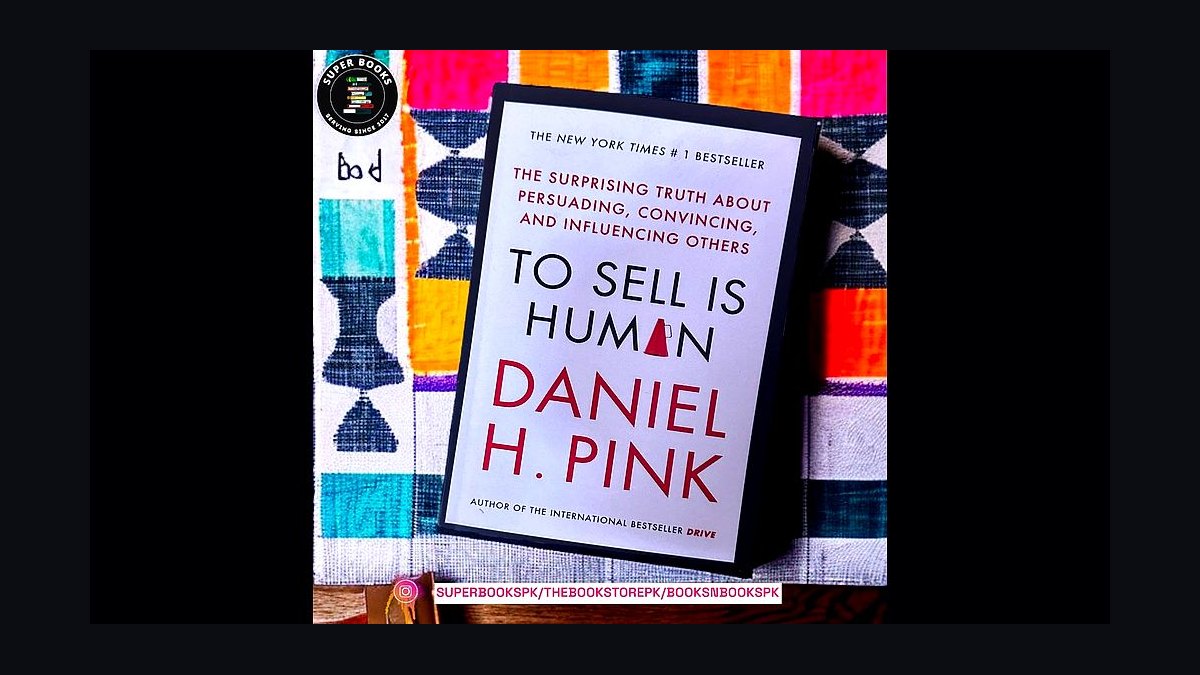
*To Sell is Human* by Daniel Pink argues everyone sells now. Only about one in nine workers holds a traditional sales job, yet Pink's survey research found the average professional spends roughly 41% of the workday moving others without money changing hands. The internet killed information asymmetry, so "Always Be Closing" gives way to Attunement, Buoyancy, and Clarity.
The outcome you should expect from reading it
Set your expectations correctly and this book pays off; set them wrong and it frustrates you. *To Sell is Human* is not a playbook. It will not give you a discovery-call script, an objection matrix, a MEDDPICC field guide, or a cadence template. What it gives you is a reframe plus about six portable tools, and the reframe is the part that actually changes behavior six months later.
The reframe: selling is not a job category, it is a fraction of your week. Pink's team, working with Harris Interactive, surveyed roughly 9,000 workers and found that people outside sales roles still spend something close to 41% of their working hours persuading, convincing, and influencing — pitching a headcount request, talking a skeptical engineer into a refactor, getting a patient to take the medication, getting a teenager to apply to college. Pink calls that non-sales selling. Once you accept the number, the question stops being "am I a salesperson?" and becomes "am I any good at the 41%?"
The concrete outputs you should expect from one reading:
- A working pitch structure you'll use within a week. The Pixar Pitch — "Once upon a time ___. Every day, ___. One day ___. Because of that, ___. Because of that, ___. Until finally ___." — is six sentences and takes about ten minutes to fill in. It is the single highest-utility artifact in the book and it transfers straight to a board slide, a fundraising email, or an internal RFC.
- A self-talk correction. Swapping "I will crush this call" for "Will I crush this call?" sounds like a party trick until you notice the question forces you to generate reasons, and the reasons are what carry you through the call. Ibrahim Senay's work at the University of Illinois is the underlying study.
- A negotiation habit. Assume you have less power than the other side. It sounds like weakness; it functions as attention. Low-power posture makes you read the room, and reading the room is the whole game.
- A vocabulary shift. Caveat emptor to caveat venditor. Problem-solving to problem-finding. Upsell to "upserve." These labels stick, and sticky labels are how frameworks survive contact with a busy quarter.

What you should *not* expect: rigor. This is a trade book built on selected studies, some of which have not survived replication. Read it as a well-argued essay with citations, not as a literature review. Practitioners who want the quantitative version should read *The Challenger Sale* — published the same year, built on a study of roughly 6,000 B2B reps — and treat Pink as the philosophy layer sitting on top of it.
One more outcome worth naming: the book is genuinely useful to people who will never carry a quota. Teachers, clinicians, nonprofit fundraisers, product managers, and internal-comms people all live in the 41%, and Pink writes for them explicitly. If you manage a team of engineers and spend your Mondays getting buy-in, this book is aimed at you as squarely as it is at an AE.
What drives that outcome
Three structural forces explain why Pink's thesis landed, and understanding them tells you which parts of the book will still be true in your context.
Entrepreneurship. The tooling collapse — Shopify, Etsy, Kickstarter, Square, Stripe, and now a long tail of no-code and AI-assisted builders — means millions of people run micro-businesses. A one-person operation has no sales department to hide behind. The founder sells or the founder starves. Pink wrote this before the creator economy matured; the trend only steepened.

Elasticity. Corporate roles got rubbery. The job description narrows and the actual work widens. An engineer pitches an architecture. A designer sells a concept to a PM who sells it to a VP. A data analyst spends more time getting a finding adopted than producing it. Elasticity is why the 41% figure is not an artifact of survey wording — it is the lived shape of knowledge work.
Ed-Med. Education and healthcare are among the fastest-growing employment sectors, and both are pure persuasion businesses. A teacher who cannot move students has not taught. A physician whose patients do not adhere to the regimen has not treated. Bureau of Labor Statistics projections at the time of writing had these sectors adding more jobs than any other; that broadly held.
Layered on top of all three is the information flip. For most of commercial history the seller knew more than the buyer — the dealer knew the invoice price, the realtor knew the comps, the broker knew the spread. Then TrueCar, Zillow, Glassdoor, Yelp, G2, and Capterra published the asymmetry away. Pink's coinage, caveat venditor, is the consequence: seller beware. Today the asymmetry runs further backward still, because the buyer often arrives having already had an AI assistant summarize your category, your competitors, and your pricing page. The seller is no longer competing with the buyer's research; they are competing with the buyer's research agent.
That is precisely why Pink's Clarity chapter is the one that aged best. When information is abundant, the scarce skill is not answering the question — it is knowing which question to ask. Pink cites the Getzels and Csikszentmihalyi study of art students at the School of the Art Institute of Chicago: the students who became successful working artists years later were the ones who spent more time finding the problem than solving a pre-set one. Map that onto B2B and you get the Challenger finding almost exactly — elite reps reframe the buyer's understanding of their own business.
The three ABCs, unpacked with the underlying research

Attunement is bringing your actions and outlook into harmony with the other person and the situation. Pink's most useful distinction here is between perspective-taking and empathy. Perspective-taking is cognitive: what does this person see, want, and fear? Empathy is affective: I feel what you feel. Adam Galinsky's research indicates perspective-taking produces better negotiated outcomes, while pure empathy can push you to concede. That is a genuinely actionable finding for anyone who has ever lost a deal by liking the buyer too much.
Three attunement rules: increase your power by reducing it (assume the low-power seat, which forces attention); use your head as much as your heart; and mimic strategically — subtle, delayed mirroring of posture and speech, not parroting. Pink also demolishes the extrovert myth. Ambiverts, people who land mid-scale on extraversion, tend to be the strongest sellers, because they talk enough to advance and listen enough to learn. If you have ever hired a room-filling extrovert who missed quota, this chapter explains why.
Buoyancy is staying afloat in an ocean of rejection. Three tools. First, interrogative self-talk — ask "Will I?" rather than declaring "I will." Second, the positivity ratio, where Pink leans on Fredrickson and Losada's claim that flourishing requires roughly three positive emotions per negative one. Third, optimistic explanatory style from Martin Seligman: read setbacks as temporary, specific, and external rather than permanent, pervasive, and personal. A lost deal was this deal, this quarter, this budget cycle — not "I can't sell."
That middle tool is the book's weakest link, and you should know it going in. The Losada mathematics was formally challenged in a 2013 *American Psychologist* paper by Nicholas Brown, Alan Sokal, and Harris Friedman, and Fredrickson partially withdrew the ratio claim. The broad principle — positive affect helps under repeated rejection — remains defensible. The specific number should be retired. Pink's book predates the challenge, so this is a dating problem rather than a dishonesty problem, but citing "3:1" in a QBR today will get you correctly challenged.

Clarity is helping others see their situation in a fresh, more revealing way. Beyond problem-finding, Pink offers five frames worth memorizing: the Less Frame (constrained choice can lift conversion — the Iyengar jam study), the Experience Frame (sell the experience, not the object), the Label Frame (labeling identity outperforms requesting behavior — "be a voter" beats "please vote"), the Blemished Frame (a small, honestly disclosed negative makes the positives more credible), and the Potential Frame (upside is more compelling than accomplishment).
The Blemished Frame deserves a special note for RevOps and enablement leaders, because it is operationally testable. Disclosing a genuine limitation early — "we don't do X well, and if X is your top priority you should look elsewhere" — tends to raise trust and disqualify faster. Faster disqualification is a pipeline hygiene win even when it costs you a logo.
Benchmarks and realistic ranges
Numbers from the book, plus honest ranges for what to expect when you apply them.
The 41% figure. This is a self-report average across roughly 9,000 surveyed workers, so treat it as an order-of-magnitude claim, not a precision instrument. In practice, the share swings hard by role: an individual-contributor engineer might land at 15–25%; a product manager, engineering manager, or account executive often exceeds 50%; a founder mid-raise is closer to 80%. Run the audit yourself — two weeks of calendar review, tagging every block as "producing" or "moving others" — and you will get a number more useful than any survey average.
The 1-in-9 ratio. Roughly 11% of the workforce in traditional sales at the time of writing. With gig work, the creator economy, and fractional consulting, the true share of people whose income depends directly on persuasion is plausibly higher today, though the precise figure depends entirely on how you draw the boundary. Do not quote a specific updated number you cannot source.

Reading time. About 250 pages, roughly 5–7 hours at typical nonfiction pace, or about 6 hours on audio. As a team read, budget two 45-minute discussion sessions: one on the ABCs, one on Pitch/Improvise/Serve.
What to expect from the Pixar Pitch. Ten minutes to draft, two or three rounds to sharpen. Realistic gain: your pitch gets shorter and gains causality. The most common failure is stuffing the two "Because of that" beats with features instead of consequences. If your version reads as a list, you have not used the structure.
Interrogative self-talk. Effect sizes in the underlying research are modest — this is a nudge, not a transformation. Expect it to help most on the calls you are dreading, which is where it matters anyway.
Where it sits in the canon. Dale Carnegie (1936) originated the "everyone sells" argument. Cialdini's *Influence* (1984) supplies the mechanism inventory. Pink (2012) supplies the modern reframe and data. Dixon and Adamson's *Challenger Sale* (2012) supplies the quantitative proof from about 6,000 reps. Adam Grant's *Give and Take* (2013) extends the serve thesis — Grant's Wharton call-center work, where fundraisers met a scholarship recipient and raised substantially more afterward, is the empirical spine under Pink's closing chapter. Chris Voss's *Never Split the Difference* (2016) picks up where Attunement leaves off with tactical empathy. Read in that sequence and each book fills a gap the previous one left open.
Risks, edge cases, and failure modes
Risk: treating trade-book citations as settled science. The Losada retraction is the headline case, but the general pattern matters more. Popular business books select studies that support a narrative, and the 2010s replication crisis hit social psychology hard. Use Pink's frameworks as hypotheses to test in your own funnel, not as findings to cite in a board deck.

Risk: the "everyone is in sales" line becoming an excuse. Some leaders read the 41% figure and conclude they can cut sales headcount because engineers can pitch. That inverts the argument. Pink says everyone needs persuasion skill; he does not say persuasion skill substitutes for a trained sales function with territory, comp design, and pipeline discipline.
Failure mode: mimicry that reads as mockery. Strategic mimicry works when it is subtle and delayed. Done fast or obviously, it is creepy and it torches trust. If you cannot do it without thinking about it, do not do it.
Failure mode: "yes, and" as capitulation. Improv's "yes, and" means accept the premise and build. It does not mean agree to a discount, a scope change, or a fictional roadmap date. The move is "yes, that timeline is real for you, and here's what we can commit to inside it." Enablement teams that teach "yes, and" without that boundary create reps who cannot say no.
Failure mode: the Blemished Frame with a fake blemish. Disclosing a trivial weakness to seem honest — "our only flaw is we care too much" — is transparent and costs you more credibility than saying nothing. The frame only works with a real limitation that a real buyer might genuinely care about.
Edge case: high-velocity transactional sales. If your motion is a $40/month self-serve product with a 15-minute sales cycle, most of this book is overhead. The Clarity and problem-finding material is built for considered purchases with multiple stakeholders. Apply it to enterprise and mid-market; apply lifecycle and onboarding thinking to PLG.
Edge case: regulated industries. In pharma, financial services, and parts of healthcare, framing choices are legally constrained. "Reframe the buyer's understanding" runs into compliance review. Run any frame-based messaging past legal before it reaches a field team.

Risk: purpose-washing the Serve chapter. Pink's two closing questions — will their life improve if they buy, and will the world be better when the interaction ends — are genuine ethical filters. They become corrosive when a company adopts the language while the comp plan still rewards the opposite. If your quota structure pays for a bad-fit close, no amount of "upserve" vocabulary changes rep behavior. Fix the incentive first, then talk about service.
Edge case: internal persuasion. The book's most underrated application is influence without authority. Getting a platform team to prioritize your ticket is a full sales cycle — discovery, champion, economic buyer, objection handling, close. Pink's tools work here and few people apply them, which is exactly why the application is valuable.
A practical rollout plan
If you want the book to change behavior rather than just decorate a shelf, run it as a short, structured program rather than a one-off read.
Week 0 — baseline. Before anyone reads a page, have each participant audit two weeks of calendar and tag time as producing versus moving others. This produces a personal 41%-equivalent and makes the book's premise concrete instead of abstract. Save the number; you will re-measure later.
Week 1 — read Parts One and Two. Discussion focuses on one question: where does our team default to Always Be Closing behavior? Get specific — a discount reflex on the second call, a "what would it take to get this done today" line, a forecast culture that punishes honest disqualification.
Week 2 — Attunement and Clarity drills. Pair up. One person plays a real open opportunity's buyer, the other runs discovery with a single constraint: no product mention for the first ten minutes. Debrief on what problem got found that was not on the original opportunity record. This is the highest-yield exercise in the whole program.

Week 3 — pitch construction. Everyone writes a Pixar Pitch for their top open deal and a one-word pitch for the company. Read them aloud. The one-word exercise is brutal and clarifying; most teams discover they cannot agree on the word, which is itself the finding.
Week 4 — improvisation and objection reframing. Take the five most common objections from actual call recordings and rewrite each as an offer to build on. "It's too expensive" is not resistance; it is information about a budget owner you have not met yet.
Week 5 — the serve filter. Apply Pink's two questions to every deal in the current forecast. Any deal where the honest answer is no gets flagged. Expect discomfort — that discomfort is the point, and it usually surfaces one or two deals that should have been disqualified a month ago.
Week 6 — re-measure and operationalize. Re-run the calendar audit. Then pick exactly two things to embed permanently: usually the Pixar Pitch as a required field on new opportunities, and the serve questions as a stage-gate criterion. Two changes stick; ten do not.
A note on sequencing across your enablement calendar. Do not run this program at the same time as a methodology rollout. If you are implementing MEDDPICC or Command of the Message, finish that first — Pink layers well on top of a methodology but competes badly with one. The natural slot is the quarter after a methodology lands, when reps have the mechanics and need the mindset.
Related questions
Is To Sell is Human worth reading if I'm not in sales?
Yes — arguably more so. Pink wrote it for the eight in nine who are not in sales but still spend roughly 41% of the workday moving others. Teachers, clinicians, PMs, and engineering leads get the most novel value, since nobody ever trained them to persuade.
Should I read this or The Challenger Sale first?

If you carry a quota, read *Challenger* first for the mechanics, then Pink for the philosophy and the Pixar Pitch. If you do not carry a quota, read Pink first — *Challenger* assumes a B2B sales context you may not have.
What is the single most useful takeaway?
The Pixar Pitch. Six sentences, ten minutes to draft, and it works for a sales pitch, an internal proposal, a fundraise, or a conference talk. Everything else in the book is a mindset; this is a template you can use tomorrow.
Which parts of the book have not aged well?
The Losada 3:1 positivity ratio, challenged in a 2013 *American Psychologist* paper and partially withdrawn by Fredrickson. The 1-in-9 sales statistic is also dated. The caveat venditor thesis, by contrast, aged better than Pink could have expected.
How does Attunement differ from active listening?
Active listening is a technique for demonstrating attention. Attunement is a cognitive stance — deliberately modeling what the other party sees, wants, and fears, including from a deliberately low-power position. You can listen actively and still misread the room; attunement is aimed at not misreading it.
FAQ
What is the core argument of To Sell is Human?
That selling is not a niche occupation but a universal human activity. Only about one in nine workers is in traditional sales, yet Pink's survey work found the average professional spends around 41% of the workday in "non-sales selling" — persuading, convincing, and influencing without money changing hands. The skill therefore belongs in everyone's toolkit.
What are the new ABCs of selling?

Attunement, Buoyancy, and Clarity — replacing Always Be Closing. Attunement is cognitive perspective-taking and strategic power-reduction. Buoyancy is surviving repeated rejection through interrogative self-talk and optimistic explanatory style. Clarity is problem-finding and framing: helping buyers see their situation in a way they could not reach alone.
What is the Pixar Pitch?
A six-sentence narrative structure: "Once upon a time ___. Every day, ___. One day ___. Because of that, ___. Because of that, ___. Until finally ___." The two consecutive "because of that" beats force causality, converting a list of features into a story with consequence. It is the book's most portable artifact and works equally well for a board slide or a cold email.
Is the 3:1 positivity ratio still credible?
No. The mathematics behind the Losada line of the Fredrickson–Losada positivity ratio was challenged in a 2013 *American Psychologist* paper by Brown, Sokal, and Friedman, and Fredrickson partially withdrew the claim. The general principle that positive emotion helps under sustained rejection stands; the specific ratio should not be cited.
What does caveat venditor mean and why does it matter?
Latin for "seller beware," inverting the traditional caveat emptor. Pink's point is that once buyers can research price, reputation, and alternatives instantly, the seller's information advantage disappears and dishonesty stops being profitable. Today AI research assistants push this further — the seller now meets a buyer who arrives pre-briefed on the entire category.
How should a sales team actually use the book?
As a six-week structured program, not a passive read: baseline calendar audit, discussion of Parts One and Two, discovery drills with no product mention, Pixar Pitch construction, objection-to-offer rewrites, and the two serve questions applied to the live forecast. Then embed exactly two practices permanently. Two changes stick; ten do not.
Sources
- https://www.danpink.com/books/to-sell-is-human/
- https://www.penguinrandomhouse.com/books/310187/to-sell-is-human-by-daniel-h-pink/
- https://hbr.org/2013/01/to-sell-is-human
- https://www.gallup.com/workplace/
- https://www.bls.gov/emp/
- https://www.apa.org/pubs/journals/amp
- https://www.ted.com/talks/dan_pink_the_puzzle_of_motivation
- https://www.gartner.com/en/sales
- https://www.pewresearch.org/
Related on PULSE
- Drive by Daniel Pink — Cliff Notes Summary for Sales Leaders
- The Challenger Sale — Cliff Notes Summary & Key Takeaways
- Thinking Fast and Slow by Daniel Kahneman — Cliff Notes Summary for Salespeople
- Sell or Be Sold by Grant Cardone — Cliff Notes Summary & Key Takeaways
- Never Split the Difference — Cliff Notes Summary
- Built to Sell by John Warrillow — Cliff Notes Summary for Founders
This page will be disappearing soon. Save it to your device for $1 — or read it free while it is here.
@Kory-White- · if Venmo asks, the last 4 of my number are 2012
This page is gone.
This one is off the shelf now. $1 keeps it on your phone for good — the whole page, pictures and diagrams included.
 pulse-recentThe Sales Acceleration Formula by Mark Roberge — Top 10 Key Takeaways for Sales Leaders in 2027
 pulse-booksTop 10 practical takeaways from Atomic Habits for building a new routine in 2027.
 pulse-recentConceptual Selling by Robert Miller and Stephen Heiman — Top 10 Key Takeaways for Sales Leaders in 2027
 pulse-recentWhat is the step-by-step process for Strategic Selling by Miller Heiman in 2027?
 pulse-recentSelling Above and Below the Line by Skip Miller — Top 10 Key Takeaways for Sales Leaders in 2027
 pulse-recentHow do you implement the Sandler Rules by David Mattson in your first 30 days as a new sales manager in 2027?
 pulse-recentWhat are the concrete steps to implement the Sandler Rules for Sales Leaders by David Mattson in 2027?
 pulse-recentInsight Selling by Mike Schultz and John Doerr — Top 10 Key Takeaways for Sales Leaders in 2027
 pulse-recentGetting to Yes by Roger Fisher and William Ury — Top 10 Key Takeaways for Sales Leaders in 2027
 pulse-recentSandler Rule #1: What is the first concrete step to build a prospect's trust in a sales conversation in 2027?