


The Challenger Customer by Brent Adamson — Cliff Notes Summary & Key Takeaways
Quality
Certified
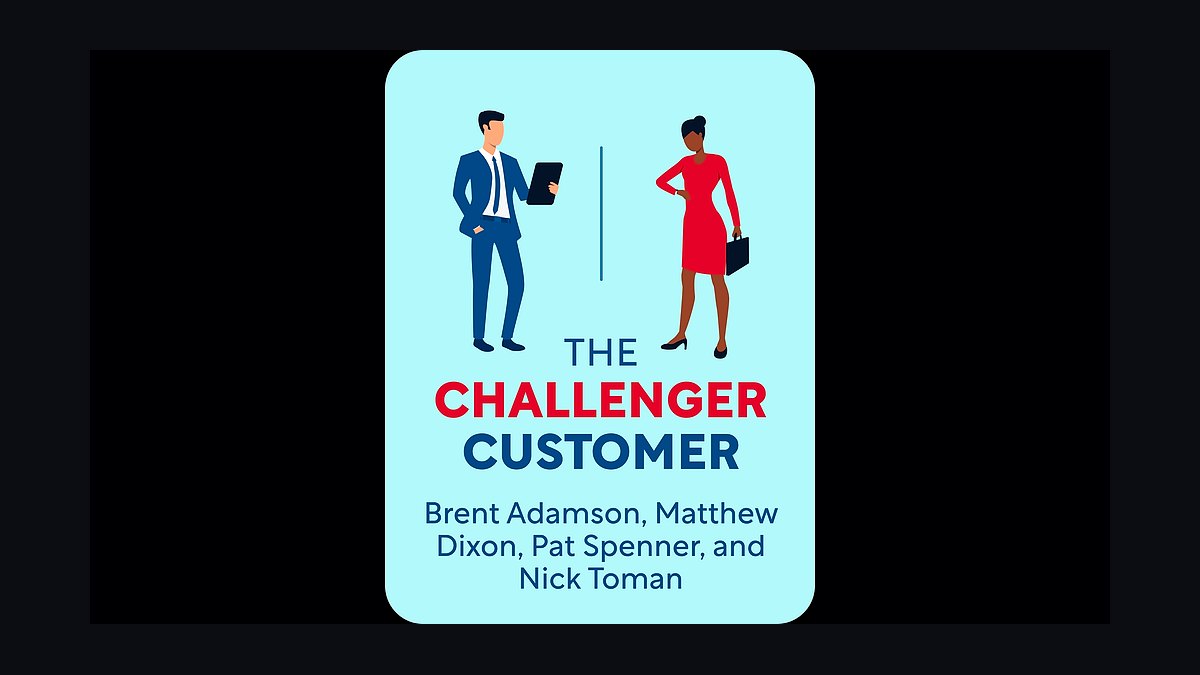
*The Challenger Customer* (2015) by Brent Adamson, Matthew Dixon, Pat Spenner, and Nick Toman argues that B2B deals die from lack of internal consensus, not lack of interest. Its core takeaway: stop hunting friendly "Champions" and find Mobilizers — Go-Getters, Teachers, and Skeptics — then arm them with Commercial Insight to sell inside their own organization.
What the book is and why it still matters
*The Challenger Customer: Selling to the Hidden Influencer Who Can Multiply Your Results* was published by Portfolio/Penguin in 2015 as the direct sequel to *The Challenger Sale* (2011). The authorship matters for how you read it. Brent Adamson and Matthew Dixon wrote the first book about the seller's behavior — teach, tailor, take control — and the sequel is a correction to their own work. Pat Spenner and Nick Toman joined for the follow-up, and the four of them essentially say: the seller-side model was incomplete because it assumed a rep talks to one buyer who owns the decision. By 2015 that assumption had collapsed.
The evidence base is CEB research (CEB was acquired by Gartner in 2017; Adamson later worked at Gartner). The headline number from a study of more than 3,000 B2B buyers across 100+ companies: the average purchase decision involved 5.4 stakeholders, and consensus among those stakeholders was the single biggest reason deals stalled. The more damning finding is the slope. As the buying group grows from one person to six, the likelihood of a high-quality purchase drops from roughly 81% to 31%. Adding people to a deal does not add advocates. It adds veto points.
That reframe is why the book has outlived a lot of 2015-era sales literature. If the constraint is one buyer's conviction, the answer is a better pitch. If the constraint is six people who each optimize for a different function — IT for security posture, Finance for payback period, Ops for uptime, Marketing for speed, Legal for indemnification, Procurement for discount — then a better pitch is irrelevant. The group's lowest common denominator is almost always "do nothing," because doing nothing is the only option everyone can agree to without spending political capital. Adamson's line is that customer consensus is the new sales reality, and the default outcome of consensus is paralysis.
The second half of the reframe is the one people quote. The seller cannot be in the room where consensus gets built. Those conversations happen in hallways, Slack threads, and 20-minute internal meetings the rep will never see. So the seller's real job is to find the one person inside the account who is both willing and able to run that internal campaign — and to make that person unreasonably effective at it. The customer, not the rep, has to become the Challenger. The book's practical Takeaways flow from that single structural fact.

It's worth placing the book in the canon, because reading it in isolation makes it feel more novel than it is and less useful than it should be. Upstream sits Rackham's *SPIN Selling* (1988), which established the research-driven, question-led approach the Challenger series inherits. Beside it sits MEDDPICC, whose Champion criteria — power, influence, and a personal win — were sharpened in exactly the direction this book pushes. Downstream sit Anthony Iannarino's *The Lost Art of Closing* (2017), which turns consensus-building into a sequence of commitments, and Dixon's own *The JOLT Effect* (2022), which argues the real enemy isn't the competitor but customer indecision. Read as a set, the through-line is clear: the field spent thirty years moving from persuading a person to de-risking a group.
The seven stakeholder profiles, and the trap inside them
The taxonomy is the book's most reproduced artifact. Seven profiles, three buckets.
Mobilizers — the only profiles the research found capable of driving organizational change:
- The Go-Getter. Action-oriented, motivated by continuous improvement. Spots a good idea, builds the business case, and pushes. The rarest and most valuable.
- The Teacher. Persuasive, respected, spreads ideas. May not own budget, but shapes how peers frame the problem. Influence comes from credibility, not authority.
- The Skeptic. Cautious, risk-aware, demanding of proof. Pushes back hard on everything — including your pitch. Counter-intuitively an asset, because when a known Skeptic finally endorses something, the room believes it. The authors' framing is that Skeptics close more deals than Friends, because Skeptics earn cross-functional trust.
Talkers — pleasant, responsive, and structurally unable to move money:

- The Friend. Likable, returns your calls, enjoys the relationship. Agrees with everything. Advocates for nothing.
- The Climber. Will advocate — but only for what advances the Climber's career. Useful right up until the internal politics shift, at which point they're gone.
- The Guide. Shares information freely, often more than they should. Feels like an inside track. Provides intelligence, not momentum.
And the seventh: the Blocker, who has a structural reason to oppose you. An incumbent vendor relationship they own. A competing internal project they staffed. A career risk if your approach works and theirs didn't.
The uncomfortable finding is that when CEB scored the "Champions" reps had named against actual deal-progression behavior, roughly 80% of them were Talkers. Not because reps are bad at their jobs, but because the selection mechanism is broken by design. Reps gravitate toward whoever responds fastest, takes the meeting, and is pleasant to talk to. Responsiveness feels like buy-in. It correlates with almost nothing that matters.
The tell is what happens between meetings. A Friend consumes: they read your deck, thank you, and wait for the next call. A Teacher transmits: they forward the deck, re-explain your reframe to their VP in their own words, and convene a follow-up you didn't ask for. Same warmth in the meeting, completely different behavior outside it. That between-meetings behavior is the only reliable signal, and it's the one most CRM fields don't capture.
On Blockers the book is unsentimental. You do not relationship your way past someone whose incentives require your failure. You isolate them — build enough cross-functional consensus through Mobilizers that the Blocker's "no" becomes politically expensive to hold. That's a different play from objection-handling, and it takes months, not one meeting.
The step-by-step process the book actually prescribes

Strip out the case studies and the operating model is a sequence. Each step has a failure mode, and skipping one doesn't speed things up — it just moves the stall later.
Step one: map the group, not the contact. Before the second meeting, list every named stakeholder and score each against the seven profiles. Not by title — the book is emphatic that Mobilizers exist at every level, and a director can be a Go-Getter while the SVP is a Friend.
Step two: build Commercial Insight. This is the raw material you'll hand your Mobilizer, and it has to pass three tests: it disrupts the buyer's current thinking, it is unique to your point of view, and it leads back to your differentiation. A whitepaper on industry trends that ends with "contact us" fails all three.
Step three: deliver the reframe using the Disrupting the Deal teaching tool. Five moves — the Warmer (open with an insight that earns attention), the Reframe (surface the hidden cost or unconsidered need), the Rational Drowning (quantify it with data), the Emotional Impact (make it personal to this room), and the New Way, which is where your differentiation finally appears.
Step four: identify who reacted like a Mobilizer. The reframe is also a diagnostic. Whoever pushes back substantively, asks who else needs to hear this, or starts doing arithmetic out loud is your candidate. Whoever nods enthusiastically and says "great deck" is not.
Step five: arm them. Language, data, a short internal deck, and pre-written answers to the objections you know Finance and Security will raise. The Mobilizer is running a sales process with no training and no time.

Step six: engineer collective learning. Get the group in one room — a working session, a benchmarking review, a structured workshop — so disagreements surface and resolve together rather than metastasizing in private.
Step seven: isolate the Blocker and close on the group's consensus, not the individual's enthusiasm.
Two notes on running this in practice. First, step four is where most teams cheat — they decide who the Mobilizer is before the reframe, based on who booked the meeting. Second, step six is the step with real leverage and the one most reps skip, because convening a workshop feels like a favor you're asking rather than value you're delivering. It isn't. It's the only mechanism in the whole sequence that produces shared understanding instead of six private ones.
Effort, timelines, and what the numbers actually look like
The book is a research summary, not an implementation manual, so it's light on operational cost. But the numbers it does contain, combined with what the framework demands, give you a usable picture.
The deal-level math. The 81%-to-31% slope is the number to internalize. If your average deal touches five or six stakeholders, your structural close-rate ceiling on a consensus-blind approach is roughly a third. That's not a rep-skill problem. Deal cycles lengthen in proportion, too — every additional stakeholder adds review time, and enterprise deals in the six-figure range routinely run six to twelve months largely because of internal serialization, not vendor evaluation.
Building Commercial Insight is a program, not a task. It requires customer research, data you own that competitors don't, and a genuine unconsidered need. Realistically that's a multi-month cross-functional effort involving product marketing, sales leadership, and often a customer-research vendor. Companies that do it well — Grainger's classic case is the standout — build it once per solution line and refresh it annually. Grainger's insight wasn't about part pricing at all: it was that maintenance buyers' real cost was unplanned downtime caused by stocking the wrong part, which reframed the entire conversation and led directly to a differentiated inventory-management service. That reframe took real research to find. You cannot brainstorm it in a Tuesday offsite.

Enablement time. Teaching reps the seven profiles is a half-day. Teaching them to reliably distinguish a Teacher from a Friend under deal pressure takes a quarter of reinforced deal reviews. The book's finding that fewer than 10% of reps could correctly identify a Mobilizer in their own live pipeline when tested is the relevant benchmark — assume most of your team gets this wrong initially, including the ones who read the book.
The manager's cost. The highest-leverage change is also the cheapest: replace "who's your Champion?" in deal reviews with "who is your Mobilizer, and what specifically did they do to advance consensus this week?" That's a script change, free to implement, and it produces immediate discomfort — which is the point. The old question rewards confident answers. The new one requires evidence of behavior.
Where cost actually bites. Collective-learning workshops cost real hours: a half-day session with six customer stakeholders means prep, facilitation, and follow-up materials, plus your own SEs and often an executive sponsor. Teams should reserve those for deals above whatever threshold makes the math work — for most enterprise motions, somewhere in the mid-five-figures-and-up range per deal. Below that, you're spending consensus-engineering effort on transactions that don't need it.
Where teams get this wrong
Mistaking the loudest advocate for a Mobilizer. The Climber is enthusiastic, well-connected, and will absolutely push your deal — until a reorg makes it inconvenient. Enthusiasm plus visible self-interest is a Climber, not a Go-Getter. Check whether their stated win survives a change in their own reporting line.

Treating the Skeptic as an obstacle. This is the most expensive error in the book. Reps route around the security architect or the finance scrutinizer because those conversations are unpleasant, then lose the deal in legal review three months later. Every modern committee has a security skeptic, a procurement challenger, and a finance analyst who will model your payback period whether you help or not. Arming them early converts the deal's biggest risk into its most credible internal endorsement.
Publishing thought leadership and calling it Commercial Insight. If a competitor could publish the same piece and swap the logo, it isn't Commercial Insight. It teaches something true but doesn't lead anywhere only you can go. The test is uncomfortable to apply honestly to your own content library, which is why most teams don't.
Running the five-step teach as a script. In 2015 you could deliver the Warmer-through-New-Way sequence as a set piece and it landed. Today buyers have seen the pattern, and a rep who visibly executes a five-step teaching tool reads as a rep executing a five-step teaching tool. The moves are still right; delivering them as one scripted meeting is not. Blend the reframe into discovery over several conversations.
Arming the Mobilizer with your sales deck. Your deck is built to persuade an external audience of your merits. What the Mobilizer needs is a three-slide internal case in their company's language, with the two objections their CFO always raises already answered. Different artifact, different author, and if you don't build it they'll rebuild your deck badly.
Skipping the group session because scheduling is hard. Six one-on-ones do not equal one workshop. They produce six private understandings that diverge, and the divergence surfaces at the worst possible time.
Applying the full framework to every deal. Not every purchase needs consensus engineering. A single-owner tool renewal under a manager's discretionary budget doesn't need a Mobilizer campaign — it needs a fast, clean commercial process. Overapplying the framework burns cycles and slows down deals that were already closing.
Choosing your play: when this framework fits and when it doesn't

The honest strategy question isn't whether *The Challenger Customer* is right. It's which motion you're running, because the answer changes the play entirely.
Enterprise, multi-stakeholder, status-quo competitor. This is the book's home turf, and it applies almost unmodified. Consensus is the constraint, the Mobilizer is the mechanism, and Commercial Insight is the fuel.
Enterprise, but competing against a named vendor rather than inaction. Here the reframe matters less and differentiation matters more. Commercial Insight still helps, but you're in a comparison, not a status-quo fight. Weight your effort toward the evaluation criteria the committee is actually using.
Product-led growth expansion. PLG genuinely changed the entry path. Figma, Notion, Linear, Datadog, and Slack all grew bottom-up because the product itself generated internal momentum before any rep appeared — the product became the Mobilizer. But watch what happens at the org-wide contract: security review, SSO requirements, procurement, finance, and a legal redline. That's a consensus problem, and it's precisely why PLG companies hire enterprise AEs. The framework applies to the expansion, not the land.
Transactional or single-owner deals. Skip it. A one-buyer decision under discretionary budget wants speed and clarity, not a teaching tool.
Deals stalling with no competitor in sight. If you're losing to "no decision" with an engaged, enthusiastic buyer, you may have an indecision problem rather than a consensus problem — Dixon's later *JOLT Effect* work is the better lens there. Consensus-building addresses group disagreement; it doesn't address an individual's fear of choosing wrong.

What has held up and what hasn't. Held up: the Mobilizer/Talker distinction, which got more important, not less — Gartner's later B2B buying research put typical committee sizes well above the original 5.4. Held up: the Skeptic-as-asset insight, now obviously correct in a world of mandatory security review. Held up: MEDDPICC's Champion definition, refined in exactly the direction this book pushed. Aged: the scripted five-step teach. Aged: the manual deal-review diagnosis, now partly automated by conversation-intelligence platforms like Gong, Chorus, Clari, and Tethr that classify stakeholder signals from meeting transcripts. Aged: the implicit assumption that a rep is present at the start of every buying journey.
The Monday-morning move is small and slightly painful. Open your top five deals. List every stakeholder. Score each as Go-Getter, Teacher, Skeptic, Friend, Climber, Guide, or Blocker — honestly, based on what they did between meetings, not how the meetings felt. If your named Champion lands in the Friend, Climber, or Guide column, you don't have a deal. You have a Talker, and a forecast that's wrong.
Related questions
What is the single biggest takeaway from The Challenger Customer?
That most self-identified "Champions" are Talkers who cannot drive consensus. The research found roughly 80% fell into that category. Deals advance only when a Mobilizer — a Go-Getter, Teacher, or Skeptic — runs the internal campaign the seller can't be present for.
Do I need to read The Challenger Sale first?
Not strictly. *The Challenger Sale* covers seller behavior; *The Challenger Customer* covers buyer-group dynamics and stands alone. Reading the first adds context for the teach-tailor-take-control language, but the sequel restates what it needs. If you can only read one, read the sequel.
How is Commercial Insight different from a value proposition?
A value proposition explains why you're better. Commercial Insight explains why the buyer's current thinking is wrong — surfacing an unconsidered need — and then leads to your differentiation as the only reasonable response. Value props answer "why you." Insight answers "why change at all."
Is the 5.4 stakeholder figure still accurate?

It reflected CEB research circa 2015. Gartner's later work found committees substantially larger, often in the double digits for enterprise purchases. The direction of travel makes the book's argument stronger, not weaker — more stakeholders means more veto points and a harder consensus problem.
Can conversation-intelligence tools identify Mobilizers automatically?
Partially. Platforms like Gong and Clari surface signals — who talks, who pushes back, who convenes follow-ups — that correlate with Mobilizer behavior. They flag candidates well. They don't reliably distinguish a Teacher from a persuasive Climber, because that depends on motive, which transcripts don't capture.
FAQ
What is the difference between a Mobilizer and a MEDDPICC Champion?
A MEDDPICC Champion requires three things: power, influence, and a personal win from your success. A Mobilizer is the broader category — anyone capable of driving cross-functional consensus, regardless of formal authority. Practically, every good Champion is a Mobilizer, but a Mobilizer without a personal stake isn't yet a Champion. The book's contribution was giving sellers behavioral tells for spotting the broader category early, before a Champion relationship has formed. MEDDPICC's Champion criteria were later tightened partly to exclude exactly the Talkers this research identified.
Why is the Skeptic classified as a Mobilizer rather than a Blocker?
A Skeptic challenges ideas on the merits; a Blocker opposes them for structural reasons. The Skeptic wants proof and will do the work to evaluate it. When they endorse something, colleagues weight that endorsement heavily precisely because the Skeptic is known for not endorsing things. A Blocker — someone with an incumbent vendor relationship, a competing project, or career exposure to your success — has no evidentiary threshold you can meet, because their objection isn't evidentiary.
How do I tell a Friend from a Teacher during early discovery?

Watch behavior between meetings, not inside them. Friends agree, thank you, and wait. Teachers push back with substance, then go re-explain your reframe to peers in their own words. Concrete tells: Did they forward your material unprompted? Did they convene a meeting you didn't request? Did they use your framing in a follow-up email to someone else? Friends consume information. Teachers transmit it, translated.
Is Commercial Insight just a rebranding of content marketing?
No, though most companies produce the latter while claiming the former. Content marketing teaches buyers something true. Commercial Insight teaches buyers something true that only your solution lets them act on. The diagnostic is blunt: if a direct competitor could publish the identical piece and swap in their logo, you've written content marketing. It may still be useful, but it won't disrupt anyone's thinking in a way that leads to you.
Does this framework apply to product-led growth companies?
To the expansion motion, yes; to the initial land, less so. PLG bypasses early consensus because individual users adopt without approval, and the product generates its own momentum. But converting scattered team usage into an org-wide contract triggers security review, procurement, finance, and legal simultaneously — a textbook consensus problem. That transition is why PLG companies hire enterprise sellers, and it's where Mobilizer identification earns its keep.
How does this compare to Iannarino's The Lost Art of Closing?
Anthony Iannarino's *The Lost Art of Closing* (2017) is the operational complement. Where Adamson and colleagues describe the structural problem and the profiles involved, Iannarino sequences it into ten specific commitments a seller earns across the cycle — commitment to explore, to change, to collaborate, and so on. Read the Challenger sequel for the diagnosis and Iannarino for the meeting-by-meeting mechanics of advancing a group toward a decision.
Sources
- https://www.penguinrandomhouse.com/books/533286/the-challenger-customer-by-brent-adamson-matthew-dixon-pat-spenner-and-nick-toman/
- https://hbr.org/2013/11/dismantling-the-sales-machine
- https://www.gartner.com/en/sales/insights/b2b-buying-journey
- https://www.gartner.com/en/newsroom/press-releases/2017-04-05-gartner-completes-acquisition-of-ceb
- https://www.penguinrandomhouse.com/books/205457/the-challenger-sale-by-matthew-dixon-and-brent-adamson/
- https://www.penguinrandomhouse.com/books/670458/the-jolt-effect-by-matthew-dixon-and-ted-mckenna/
- https://www.grainger.com/
- https://www.gong.io/
- https://hbr.org/2017/03/the-new-sales-imperative
Related on PULSE
- The Challenger Sale by Matthew Dixon & Brent Adamson — Cliff Notes & Chapter Summary
- The Challenger Customer by Adamson, Dixon, Spenner & Toman — Cliff Notes Summary
- The Challenger Customer — Cliff Notes Summary
- Sales 2.0 by Anneke Seley and Brent Holloway — Cliff Notes Summary
- Never Lose a Customer Again by Joey Coleman — Cliff Notes Summary for Sellers
- The Challenger Sale — Cliff Notes Summary
This page will be disappearing soon. Save it to your device for $1 — or read it free while it is here.
@Kory-White- · if Venmo asks, the last 4 of my number are 2012
This page is gone.
This one is off the shelf now. $1 keeps it on your phone for good — the whole page, pictures and diagrams included.
 pulse-recentWhat are the concrete steps in Sandler Rule #7 for handling a prospect's budget objection in 2027?
 pulse-booksWhat are the most common mistakes in Book Summaries in 2027?
 pulse-recentFanatical Prospecting by Jeb Blount — Top 10 Key Takeaways for Sales Leaders in 2027
 pulse-recentWhat are the seven concrete steps to implement the Sandler Submarine technique from The Sandler Rules in 2027?
 pulse-recentHigh-Profit Prospecting by Mark Hunter — Top 10 Key Takeaways for Sales Leaders in 2027
 pulse-recentWhat is the first concrete step in The Sandler Rules by David Mattson for building a sales plan in 2027?
 pulse-recentSell or Be Sold by Grant Cardone — Top 10 Key Takeaways for Sales Leaders in 2027
 pulse-recentStrategic Selling by Robert Miller and Stephen Heiman — Top 10 Key Takeaways for Sales Leaders in 2027
 pulse-recentWhat is the Blue Sheet from Strategic Selling by Miller Heiman and how do you fill it out in 2027?
 pulse-recentThe Customer Success Professional’s Handbook by Ashvin Vaidyanathan — Top 10 Key Takeaways for Sales Leaders in 2027