


Made to Stick by Chip and Dan Heath — Cliff Notes Summary for Salespeople
Quality
Certified
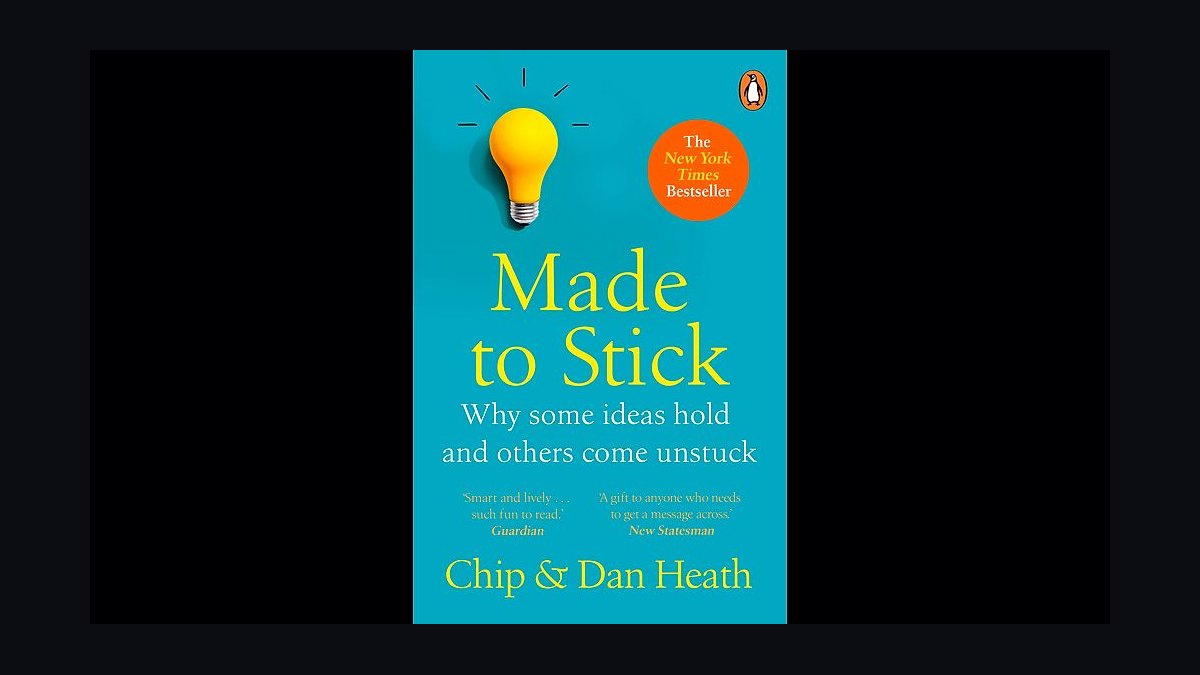
Made to Stick: Why Some Ideas Survive and Others Die by Chip Heath and Dan Heath (Random House, 2007) argues that sticky ideas — the ones that get remembered, repeated, and acted on — share six traits captured in the SUCCESs acronym: Simple, Unexpected, Concrete, Credible, Emotional, Stories. The Heath brothers built the framework by reverse-engineering urban legends, JFK's moon-shot speech, Subway's Jared Fogle campaign, and Aesop's fables, then showing the same traits make business pitches, product launches, and case studies stick. For salespeople, Made to Stick is the canonical text on message design: the rep who pitches in SUCCESs language out-sells the rep who pitches a feature list, because the first message survives the trip from the buyer's ears to the buyer's boss and the second one doesn't. It sits beside Cialdini's Influence, Pink's To Sell Is Human, and Andy Raskin's "Greatest Sales Pitch I've Ever Seen" as required reading for anyone whose job is to move an idea from their own head into a buyer's head and have it arrive intact.
1The Setup — Why Most Ideas Die

1.1 The Opening Case: Subway vs. "Eat Healthy"
The book opens with a comparison that has become a sales-training staple. Subway's marketing team had two options: pitch the chain as "the healthy fast-food alternative" (abstract, generic, forgettable) or tell the story of Jared Fogle, the college student who lost 245 pounds eating two Subway sandwiches a day. The Jared campaign ran for over a decade and is widely credited with helping move Subway from a regional player to one of the largest restaurant chains in the world. The Heaths use Jared to introduce their core claim: concrete-plus-story beats abstract-plus-claim. Same product, same nutrition facts, completely different stickiness.
1.2 The Curse of Knowledge
The book's villain is introduced early and stalks every chapter: the Curse of Knowledge. Once you know something deeply, you cannot un-know it, which means you can no longer remember what it was like to not know it. Experts pitch to novices in expert language and wonder why nobody buys. The Heaths cite a Stanford study by Elizabeth Newton in which "tappers" tapped out well-known songs on a table while "listeners" tried to name them. Tappers predicted listeners would guess correctly 50% of the time. The actual rate was 2.5%. The tapper hears a symphony in their head; the listener hears Morse code. Every sales deck and every pitch suffers from the same gap — and SUCCESs is the antidote.
2S — Simple
2.1 Find the Core
Simple does not mean dumbed down — it means stripped to the one essential truth a listener must walk away with. The chapter's hero example is Southwest Airlines and its founding mantra: "We are THE low-fare airline." Every decision — should we add a chicken Caesar salad to the menu? — runs through that filter. (Answer: no, unless it keeps fares the lowest.) Sales analog: the rep who can complete "We are THE _____ for _____" in a dozen words wins discovery calls. The rep who needs a 47-slide deck loses them.
2.2 Commander's Intent
The military borrows the same idea. U.S. Army orders open with Commander's Intent — a one-sentence statement of the mission's purpose that survives even when every detailed plan falls apart. "Seize the bridge by dawn" survives ambush, weather, and casualties in a way that "execute Phase 3a of Annex C" does not. For sales leaders, Commander's Intent is the one-line account strategy you can hand a junior AE before they walk into a meeting alone. If they can't repeat it back to you, you haven't found the core yet.
2.3 Use Schemas — Borrow Existing Mental Models
Simple ideas piggyback on what people already know. The Heaths cite "Jaws on a spaceship" — the one-line pitch that sold the movie Alien. The pitch didn't have to explain anything; it handed Hollywood a schema they already owned. Sales analog: "We're the Salesforce for veterinary clinics," or "We're the Stripe for accounts payable." A borrowed schema compresses thirty minutes of category education into six words.
3U — Unexpected
3.1 Break the Pattern

Attention is captured by violations of expectation. The Heaths' favorite case is the Nordstrom tire-return legend: a customer walks into Nordstrom — which does not sell tires — with tires bought from a previous tenant of the building, and Nordstrom refunds him anyway. True or apocryphal, the story is sticky because it violates how returns are supposed to work. Sales analog: open the discovery call with the fact the buyer does NOT already expect. Gong's analysis of sales calls finds that strong cold calls tend to open with a pattern-interrupt rather than autopilot small talk — not "How are you today?" but a permission-based opener like "This is a cold call — do you want to hang up, or give me thirty seconds?" The interrupt earns the next thirty seconds; the autopilot opener gets you hung up on.
3.2 Sustain with Curiosity Gaps
Attention grabbed is not attention held. The Heaths borrow from George Loewenstein's "information-gap theory": curiosity is the discomfort of the gap between what you know and what you want to know. Great mystery novels open by widening that gap. Great sales pitches do the same — tease the answer, then make the buyer earn it through the discovery conversation. Andy Raskin's "Greatest Sales Pitch I've Ever Seen" framework opens with a "name the enemy" beat designed to create exactly this kind of gap.
4C — Concrete
4.1 Sensory Detail Beats Abstraction
Concrete sticks; abstract evaporates. The Heaths' clearest illustration: a dog-food maker found that "high-fiber, nutritionally complete formula" lost to "We put 8 oz of beef in every can." Same product, far more memorable. For sales the lesson is blunt — every abstract benefit ("improves productivity," "drives efficiency") should be replaced with a concrete, countable proof point. "Cuts your monthly close from 11 days to 4" beats "streamlines financial operations" in every test ever run.
4.2 The Velcro Theory of Memory
The Heaths describe memory as Velcro: the more concrete hooks an idea has, the more places it can snag in a listener's brain. Abstract ideas have no hooks; they slide off. Concrete ideas — an Aesop fable, a Jared, a Nordstrom tire return — catch in dozens of places. Sales analog: every case study should read like an Aesop fable, with a named protagonist, specific stakes, and a measurable outcome. "Acme Manufacturing cut DSO from 62 days to 28 in a single quarter" is a sticky case study. "Customers see significant improvements in working capital" is not.
5C — Credible
5.1 Sources of Authority
Credible ideas borrow credibility from a trusted source. The Heaths describe several: external authority (an expert or institution endorses you), anti-authority (the recovering smoker who tells you not to smoke can be more persuasive than the Surgeon General), statistics used sparingly and concretely, and specific testable examples. The chapter's anti-smoking case study features a dying former smoker rather than an official spokesperson — lived experience that outperforms institutional warnings.
5.2 The Sinatra Test
A claim passes the Sinatra Test if a single reference — *"If you can make it there, you can make it anywhere"* — proves the entire case. The Heaths cite a small security firm that won a contract to guard a famously secure site; once you've secured that, you don't need three more references. Sales analog: lead with your Sinatra reference — the one logo in the buyer's own industry that ends the credibility debate in a sentence. "We run accounts payable for three of the top ten construction GCs in the country." Conversation over.
5.3 Make Statistics Human-Scale
Numbers are credible only if a human brain can feel them. A raw figure like "$5 trillion in losses" is invisible; the same figure translated into "enough to write every American household a five-figure check" is felt. The Heaths' classic demonstration drops a single BB into a bucket for one early atomic bomb, then pours in thousands more for a modern arsenal — the visceral clatter does what the number cannot. Sales analog: never quote ROI without translating it, e.g. "the equivalent of hiring four full-time controllers — for free."
6E — Emotional
6.1 Make People Feel, Not Just Think
The chapter draws on research by Paul Slovic on what's often called the identifiable-victim effect: donations to "Rokia, a 7-year-old girl in Mali" substantially out-raised donations framed as statistics about millions facing famine. One identifiable person out-pulls a statistical mass. Sales analog: customer stories must center on a single human protagonist — the controller, the CFO, the RevOps lead — not the abstract company. "Sarah, the CFO at Acme, used to spend her Sundays reconciling spreadsheets. She doesn't anymore." That is the case study that closes deals.
6.2 Identity-Based Appeals Over Self-Interest
The Heaths cite decision-making research (drawing on James March) showing that people often ask not "What's in it for me?" but "What would a person like me do here?" The classic example is the Don't Mess with Texas anti-litter campaign, which worked by appealing to Texan identity rather than spelling out the cost of litter. Sales analog: stop pitching ROI to a CFO whose self-image is "the operator who modernizes the back office," and pitch that identity instead. "This is what modern finance leaders are running." Identity often beats interest in close rates.
7S — Stories
7.1 Why Narrative Beats Argument
The final S — Stories — binds the other five. Stories are how human brains have stored and transmitted information for millennia; bare argument is something brains tolerate but rarely retain. The Heaths return to Jared, the Nordstrom tires, and a park-and-recreation safety case in which an officer realized he could teach caution not with statistics but with the story of a single ranger. Stories run on the brain's native operating system; a slide full of bullet points runs on emulation.
7.2 The Three Plots
The Heaths identify three story plots that consistently stick: Challenge (David versus Goliath — the underdog who beats the giant), Connection (two worlds bridged — the executive and the line worker, the founder and the customer), and Creativity (the MacGyver problem-solver who fixes the impossible). Sales analog: every case study should fit one of the three. "We helped a regional bank beat the national giants" is Challenge. "Engineering and Finance finally speak the same language" is Connection. "The team rebuilt the close process in 60 days with no new headcount" is Creativity. If a case study fits no plot, rewrite it.
7.3 Stories as Mental Flight Simulators
The Heaths' closing move: stories work as mental flight simulators. Hearing a sales story rehearses the buyer for action the way a simulator rehearses a pilot — when the real moment comes, the response is already grooved in. It's why peer testimonials out-convert vendor case studies: peers narrate in flight-simulator mode. "Here is exactly what I did. Here is exactly what happened next."
Frameworks at a Glance
- SUCCESs — Simple, Unexpected, Concrete, Credible, Emotional, Stories. The six traits of a sticky idea, in order.
- Curse of Knowledge — the trap where experts can't remember what it was like not to know, and so can't pitch to novices. SUCCESs is the antidote.
- Commander's Intent — a one-sentence statement of mission purpose that survives the fog of war. The sales version is the one-line account strategy.
- Schemas — pre-existing mental models the listener already owns ("Jaws on a spaceship," "Stripe for AP"). Borrowing one compresses thirty minutes of explanation into six words.
- Three Plots — Challenge (David vs. Goliath), Connection (two worlds bridged), Creativity (MacGyver problem-solving). Every great case study fits one.
- Concrete-is-Sticky — vivid sensory detail outperforms abstract claims in recall and conversion. "8 oz of beef" beats "high-fiber formula."
- Identity-Based Appeals — buyers ask "What would a person like me do?" as often as "What's in it for me?" Pitch the identity, not just the ROI.
- Sinatra Test — one reference so strong it ends the credibility debate. ("We do AP for three of the top ten construction GCs.")
- Identifiable-Victim Effect — one named person out-raises a statistical mass. One human protagonist per case study, always.
What Holds Up, What Has Aged
What holds up — stronger than ever. The SUCCESs framework is the spine of nearly every modern sales-message rubric. Andy Raskin's "Greatest Sales Pitch I've Ever Seen" is essentially SUCCESs in B2B SaaS clothing — name the enemy (Unexpected), show the promised land (Concrete + Emotional), prove it with evidence (Credible), tell the customer story (Stories). Donald Miller's StoryBrand is SUCCESs with a tighter focus on the customer-as-hero plot. The rise of the storyteller-in-residence role (popularized by Andrew Mason at Groupon, now common at growth-stage SaaS companies) is the Heaths' thesis institutionalized. AI writing tools default to enforcing Simple and Concrete because those are the two traits easiest to grade algorithmically — which is precisely why Emotional and Stories are where human reps still beat AI-generated outreach decisively.
What has aged. Some 2007 case studies feel dated — pre-smartphone examples and references to print journalism — and the book's thread on viral spread has been partly extended by Jonah Berger's Contagious (2013) and its STEPPS framework (Social currency, Triggers, Emotion, Public, Practical value, Stories). The credibility chapter predates the social-media trust collapse: the Sinatra Test still works, but borrowed authority from celebrities or media outlets is worth less than it was in 2007. The book also somewhat undersells identity-based appeals, which later work on tribalism and motivated reasoning would expand considerably.
FAQ
Is Made to Stick still worth reading in 2026, or has it been superseded? Read it first, before anything else. It's the foundational text. Pink's To Sell Is Human, Berger's Contagious, Raskin's pitch framework, and Miller's StoryBrand all assume you've already internalized SUCCESs.
What is the single most useful chapter for a working salesperson? Concrete. The "8 oz of beef" chapter rewrites every case study in your CRM. Read it, then audit your three best logos and rewrite them in concrete, countable language.
How does SUCCESs map to a modern cold email? Subject line = Unexpected (pattern-interrupt). First line = Concrete (a number the buyer recognizes). Middle = Credible (a Sinatra reference). Close = Story (one customer, one before, one after). The whole thing = Simple (under 90 words).
What's the difference between SUCCESs and StoryBrand? SUCCESs is a six-trait audit you run on any message. StoryBrand is a single template (customer-as-hero, with a guide, a plan, and a call to action) that always leads with Story. StoryBrand is narrower; SUCCESs is broader.
Is the Curse of Knowledge really that important? It's one of the biggest reasons senior reps lose deals to junior reps. Senior reps know too much and forget what the buyer doesn't. Junior reps still remember being confused recently, and that empathy converts.
Which companies are known for institutionalizing SUCCESs-style messaging? Southwest Airlines (the original Simple case), Apple (Concrete + Emotional — "1,000 songs in your pocket"), Stripe (schema borrowing — "payments for developers"), Salesforce (an early storytelling-led marketing machine), and HubSpot (an inbound playbook built on clarity and concrete proof).
Bottom Line
Made to Stick is the message-design book every salesperson should read before any other sales book — because the Challenger Sale, MEDDPICC, and Voss's tactical empathy all assume you can build a pitch the buyer will actually remember and repeat to their boss. Monday morning: pick your single best customer story, audit it against the six SUCCESs traits, and rewrite anything that fails. The version that survives the audit is the one your AEs should be running in every discovery call this quarter. The Curse of Knowledge is quietly eroding your win rate; SUCCESs is the only reliable antidote.
Related on PULSE
- Switch by Chip and Dan Heath — Cliff Notes Summary for Salespeople
- Decisive by Chip and Dan Heath — Cliff Notes Summary for Sales Leaders
- The Power of Moments by Chip and Dan Heath — Cliff Notes Summary
- Sam Walton Made in America — Cliff Notes Summary for Sellers
- Stories That Stick by Kindra Hall — Cliff Notes Summary
- The Lean Product Playbook by Dan Olsen — Cliff Notes Summary
Sources
- Chip Heath and Dan Heath — *Made to Stick: Why Some Ideas Survive and Others Die* (Random House, 2007)
- Chip Heath and Dan Heath — *Switch: How to Change Things When Change Is Hard* (Crown Business, 2010)
- Chip Heath and Dan Heath — *Decisive: How to Make Better Choices in Life and Work* (Crown Business, 2013)
- Chip Heath and Dan Heath — *The Power of Moments: Why Certain Experiences Have Extraordinary Impact* (Simon & Schuster, 2017)
- Daniel H. Pink — *To Sell Is Human: The Surprising Truth About Moving Others* (Riverhead Books, 2012)
- Robert B. Cialdini — *Influence: The Psychology of Persuasion* (Harper Business, revised edition, 2006)
- Jonah Berger — *Contagious: Why Things Catch On* (Simon & Schuster, 2013)
- Donald Miller — *Building a StoryBrand* (HarperCollins Leadership, 2017)
- Andy Raskin — "The Greatest Sales Pitch I've Ever Seen" (Medium, 2016) — SUCCESs applied to B2B SaaS pitch design
- George Loewenstein — "The Psychology of Curiosity: A Review and Reinterpretation" (Psychological Bulletin, 1994) — the information-gap foundation of Unexpected
- Paul Slovic — "Psychic Numbing and Genocide" (American Psychological Association, 2007) — research underpinning the identifiable-victim effect behind Emotional
- Elizabeth Newton — "The Rocky Road from Actions to Intentions" (Stanford University doctoral dissertation, 1990) — the tappers-and-listeners study that demonstrates the Curse of Knowledge
This page will be disappearing soon. Save it to your device for $1 — or read it free while it is here.
@Kory-White- · if Venmo asks, the last 4 of my number are 2012
This page is gone.
This one is off the shelf now. $1 keeps it on your phone for good — the whole page, pictures and diagrams included.
 pulse-booksRework by Jason Fried and David Heinemeier Hansson — Cliff Notes Summary
 pulse-recentThe Transparency Sale by Todd Caponi — Top 10 Key Takeaways for Sales Leaders in 2027
 pulse-recentThe Greatest Salesman in the World by Og Mandino — Top 10 Key Takeaways for Sales Leaders in 2027
 pulse-recentObviously Awesome by April Dunford — Top 10 Key Takeaways for Sales Leaders in 2027
 pulse-recentHow I Raised Myself from Failure to Success in Selling by Frank Bettger — Top 10 Key Takeaways for Sales Leaders in 2027
 pulse-recentThe Customer Success Professional’s Handbook by Ashvin Vaidyanathan — Top 10 Key Takeaways for Sales Leaders in 2027
 pulse-recentWhat is the first concrete step in SPIN Selling by Neil Rackham for structuring a discovery call in 2027?
 pulse-recentStrategic Selling by Robert Miller and Stephen Heiman — Top 10 Key Takeaways for Sales Leaders in 2027
 pulse-recentFanatical Prospecting by Jeb Blount — Top 10 Key Takeaways for Sales Leaders in 2027
 pulse-recentHow do you implement the Sandler Rules by David Mattson in your first 30 days as a new sales manager in 2027?