


Influence (New and Expanded) by Robert Cialdini — Cliff Notes Summary
Quality
Certified
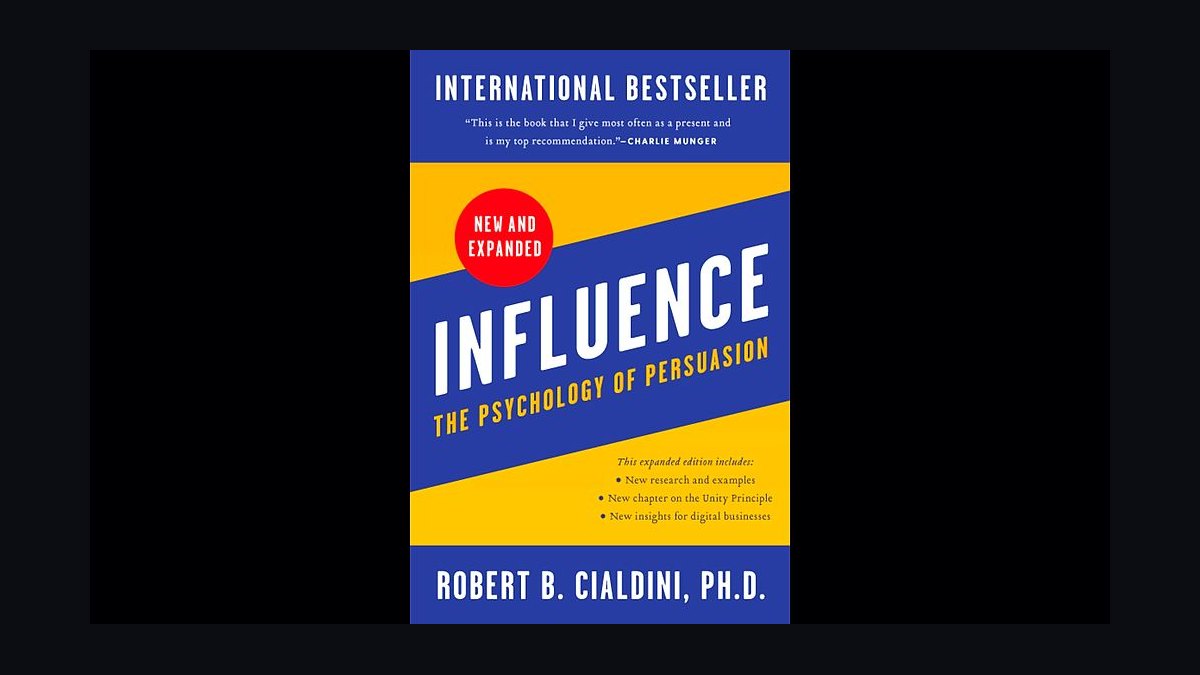
Influence: The Psychology of Persuasion (New and Expanded) by Robert Cialdini (Harper Business, 2021) is the update to the 1984 original that built the field of applied persuasion science. The expanded edition does three concrete things: it promotes a seventh principle — Unity — to stand alongside the original six (Reciprocity, Liking, Social Proof, Authority, Scarcity, Commitment & Consistency); it refreshes the case studies with digital-era examples (Amazon reviews, LinkedIn, online scarcity banners, creator marketing); and it openly addresses which older cited studies survived the 2010s replication crisis and which did not. Cialdini spent decades observing persuasion inside boiler rooms, car lots, fundraising calls, and boardrooms, and the 2021 edition is the synthesis. For a salesperson, the practical value is this: every modern methodology — **SPIN, Challenger, MEDDPICC, Sandler, Voss's *Never Split the Difference*** — is at root an application of Cialdini's seven principles to a specific deal motion. Learn the seven, and the rest read like dialects of one language.
1Why a New Edition in 2021

1.1 The Original Was Already a Classic

The 1984 Influence sold more than 5 million copies and was translated into dozens of languages before the expanded edition shipped. That success was also the problem: many of its case studies referenced Hare Krishnas at airports, door-to-door Tupperware parties, and the Kitty Genovese story — vivid in 1984, mostly historical curiosities decades later. Cialdini notes in the new preface that he resisted updating for years because the principles themselves had not changed; what changed was the terrain on which they get applied.
1.2 What's Genuinely New in 2021

Three additions justify the rewrite. First, Unity is promoted from a thread in the 2016 *Pre-Suasion* to a full seventh principle with its own extended treatment. Second, every original chapter gets digital-era case studies — Amazon review dynamics, LinkedIn endorsement loops, "only 2 rooms left" scarcity banners, creator authority signals. Third, Cialdini addresses the replication crisis directly: some older cited studies failed to replicate in the 2010s, and he says so. The core seven held up under meta-analysis, but that intellectual honesty is what makes the 2021 edition worth buying even if you already own the original.
2Reciprocity — The Obligation Engine

2.1 The Rule of Repayment

Humans are wired to repay what another person provides — even an unbought, uninvited gift triggers a felt obligation. Cialdini's classic example: Hare Krishnas at airports handed travelers a flower, and donation rates rose even when travelers immediately discarded the flower. The mechanism is pre-obligation — you didn't ask for the gift, but you feel you owe anyway.
2.2 The 2021 Digital Update

Modern reciprocity runs through content marketing and free tools. HubSpot's free utilities (Website Grader, Email Signature Generator) create exactly this felt obligation before any sales conversation. Calendly's free tier, Notion's free personal plan, and Grammarly's free Chrome extension all use the same lever, dressed as product-led growth. The B2B rep equivalent: send a personalized Loom teardown of the prospect's website before the first call — it tends to outperform cold outreach precisely because the prospect now feels they owe you a reply.
3Liking — We Say Yes to Friends

3.1 The Three Drivers

People comply with those they like, and liking flows from three sources: similarity, compliments, and cooperation toward shared goals. Cialdini cites the Tupperware home party — the host is a friend, the friend earns a cut, and the obligation cascades through the room. Joe Girard, the *Guinness*-record car salesman, mailed every customer a holiday card that simply read *"I like you"* — and sold 13,001 cars over his career.
3.2 LinkedIn and Zoom Rapport in 2021

The modern rep builds genuine liking on LinkedIn before the first touch: engage with a few of the prospect's posts, comment substantively on one, surface a shared connection or alma mater. But it is worth flagging what the data does *not* support. Gong's analysis of sales calls found that rapport-building time barely correlates with outcomes — and on late-stage closing calls, *more* time spent on small talk actually tracked with slightly *lower* win rates. So the lesson is not "open with 90 seconds of rapport"; it is that padded, manufactured rapport is no substitute for real similarity and shared ground. The Zoom era killed the in-person handshake but elevated short video intros and dressing one notch above the prospect's culture (Cialdini's "similarity at the right altitude").
4Social Proof — Peers Do It, So Should You

4.1 Pluralistic Ignorance
When uncertain, humans look to what others are doing. Cialdini's dark example was the Kitty Genovese 1964 stabbing — bystanders who, the story went, failed to call police because no one else was. The 2021 edition acknowledges that the Genovese account was partly mythologized in the original *New York Times* reporting, but defends the underlying bystander effect, which has replicated across many follow-on studies.
4.2 G2, Capterra, and the Review-Site Industrial Complex
In the modern market, social proof at scale runs through review aggregators. G2, Capterra, TrustRadius, and Gartner Peer Insights are checked by buyers before they ever take a demo. Cialdini also notes the shadow side: Amazon's 5-star system spawned an entire counterfeit-review economy, and the FTC's updated 2023 endorsement guides cracked down on fake and undisclosed reviews. The ethical version for a rep: send the prospect three reference customers in the same vertical at a similar revenue size — peer-matched social proof lands far harder than a row of generic logos on a slide.
5Authority — Titles, Trappings, Expertise
5.1 Milgram and the White Coat
Cialdini retells Stanley Milgram's obedience experiments, in which about 65% of subjects administered what they believed were dangerous shocks because a man in a lab coat instructed them to. The takeaway is unsettling: authority symbols — titles, uniforms, credentials — trigger compliance even when the underlying authority is hollow.
5.2 Digital Authority Signals in 2021
The modern equivalents are **LinkedIn endorsements, podcast guest spots, conference keynotes, and bylines in outlets like *Harvard Business Review* or *Forbes***. Cialdini recommends leading early with a credential the prospect actually respects — *"I spent six years scaling RevOps at a company like yours before joining here"* beats a generic intro. The 2021-era dark side is that fake authority is cheaper than ever: bought followers, ghostwritten thought leadership, paid placements. The buyer's defense, which Cialdini explicitly teaches, is to ask: "Is this authority relevant to the decision at hand, and is it real?"
6Scarcity — Losses Loom Larger Than Gains
6.1 The Loss-Aversion Foundation
Drawing on Daniel Kahneman and Amos Tversky's prospect theory, Cialdini notes that people are roughly twice as motivated to avoid a loss as to acquire an equivalent gain. His classic case is a study of beef wholesalers: those told an import shortage was likely roughly doubled their orders, and those *also* told the shortage news came from an exclusive source ordered dramatically more still — scarcity stacked on exclusivity.
6.2 Modern Digital Scarcity
Booking.com's *"Only 2 rooms left at this price!"*, Amazon's *"Order in the next 4 hours,"* Shopify countdown timers, early-bird conference pricing, and *"beta access limited to 100 customers"* are all Cialdini scarcity at industrial scale. The 2021 edition warns that manufactured scarcity is now among the most-regulated dark patterns in persuasion: EU dark-pattern rules under the Digital Services Act (2022) and the FTC's negative-option / click-to-cancel push (2023) target fake countdown timers and false "low stock" claims. The ethical B2B version: *"Our Q4 implementation calendar has three slots left before we cut over to January"* — true scarcity, no manipulation.
7Commitment & Consistency — Small Yeses Lead to Big Yeses
7.1 Foot-in-the-Door
Cialdini cites the Freedman and Fraser (1966) lawn-sign study: homeowners who first agreed to display a small *"Be a safe driver"* window sticker were far more likely — roughly four times — to later agree to a large, unattractive *"DRIVE CAREFULLY"* sign on their lawn. Small initial commitments rewire self-perception, and people work to stay consistent with that self-image.
7.2 Modern Email Sequences
Every Outreach, Salesloft, and Apollo cadence is built on foot-in-the-door: ask for a 15-minute call, then a 30-minute demo, then a technical deep-dive, then a procurement intro. The familiar *"Are you the right person to talk to about [X]?"* email is a sharp micro-commitment — saying yes to the identity question ("I am the right person") nudges the prospect toward the larger motion. PLG funnels use the same logic: free signup → first workflow created → invite a teammate → upgrade to paid. Each click is a consistency lever.
8Unity — The NEW Seventh Principle
8.1 Unity Is Not Liking
This is the 2021 edition's headline addition, and Cialdini is careful to separate it from Liking. Liking says *"this person reminds me of me."* Unity says *"this person is part of the same 'we' as me."* Family, tribe, ethnicity, alma mater, religious community, professional guild, fandom. People are most persuaded, he argues, by those they regard as "one of us."
8.2 Identity-Based Marketing in B2B
The B2B applications multiplied in recent years. Pavilion (formerly Revenue Collective) grew quickly by branding itself as "the community for revenue leaders" — Unity, not networking. RevGenius, Sales Hacker, and Wynter's product-marketing community work the same way. A rep who opens with *"Fellow Pavilion member here — saw you in the #cro channel"* gets a reply far more often than a cold-outbound peer. Cialdini also documents the heavier ethical territory: identity-based political microtargeting (Cambridge Analytica's 2016 use of Facebook lookalike audiences), affinity fraud (Bernie Madoff exploiting shared community trust), and MLM recruitment mechanics — all Unity gone dark.
8.3 Why Cialdini Promoted Unity
Two reasons. First, decades of cross-cultural work suggested Unity effects were larger and more durable than Liking across both collectivist and individualist cultures. Second, the internet made shared-identity communities scalable in ways the 1984 edition could not anticipate — every Slack community, Discord server, subreddit, and LinkedIn group is a Unity factory. Treating Unity as a mere subset of Liking, Cialdini concluded, no longer matched the evidence.
9Frameworks at a Glance — What's New in 2021
- Reciprocity — unbought obligations create yes. 2021 update: product-led growth, free Chrome extensions, content marketing as obligation engines (HubSpot, Calendly, Notion).
- Liking — similar + complimentary + cooperative. 2021 update: LinkedIn rapport mechanics, Zoom video intros — tempered by Gong's finding that rapport time barely correlates with win rates.
- Social Proof — peers do it, you should too. 2021 update: G2, Capterra, TrustRadius as buyer defaults; FTC 2023 fake-review crackdown.
- Authority — credentials, titles, deference. 2021 update: LinkedIn endorsements, podcast guest slots, and HBR/Forbes bylines as modern white coats.
- Scarcity — losses loom larger than gains. 2021 update: Booking.com countdown timers, EU Digital Services Act dark-pattern rules.
- Commitment & Consistency — small yeses lead to big yeses. 2021 update: Outreach/Salesloft micro-commitment cadences, PLG signup-to-upgrade funnels.
- Unity (NEW 7th) — shared identity beats mere liking. 2021 update: Pavilion, RevGenius, identity-based communities, Cambridge Analytica as the dark-pattern warning.
10What Holds Up, What Has Aged
What holds up rock-solid today: the core seven principles survived the major meta-analyses and replicate across cultures, age cohorts, and B2B/B2C contexts. Unity is the most significant addition to applied persuasion in a generation. The book's central ethical frame — persuasion isn't manipulation when the principle is true and the recipient genuinely benefits — has become standard material in business-school marketing and negotiation courses.
What has aged: a number of older cited studies failed to replicate during the 2010s reproducibility crisis; Cialdini names the weakest and removes or qualifies them in the 2021 preface. Some of the 2018–2020 digital case studies (Twitter activism, viral Facebook campaigns) already feel dated after the platform upheavals that followed. And the regulatory ground has shifted hard: the EU AI Act (2024), the FTC's negative-option / click-to-cancel rule (2023), California's automatic-renewal law, and UK CMA dark-pattern guidance all restrict the manipulative deployment of Scarcity and Social Proof in ways that were legal when the edition shipped. The book is honest about Unity's dark side (Cambridge Analytica, Madoff), but a reader today should add deepfake authority, AI-generated review bots, and algorithmic community manipulation to the threat list.
FAQ
What is the main difference between the original 1984 edition and the 2021 expanded edition? The expanded edition adds a seventh principle—Unity—to the original six, updates case studies with digital-era examples like Amazon reviews and online scarcity banners, and addresses which older studies survived the replication crisis. It’s not a rewrite but a refresh for modern persuasion contexts.
Does the book provide step-by-step scripts for sales calls? No, it doesn’t give scripts. Instead, it teaches the underlying psychological principles (Reciprocity, Liking, Social Proof, etc.) that you can adapt to any situation. Sales methodologies like SPIN or Challenger are essentially applications of these principles.
Is the Unity principle just about teamwork or shared identity? Yes, but more precisely it’s about creating a sense of “we” between persuader and target—shared identities, co-creation, or joint goals. Cialdini argues this is distinct from Liking because it goes beyond personal affinity to a sense of mutual belonging.
How does the book handle the replication crisis in psychology? Cialdini openly discusses which classic studies (like the “candle problem” or “foot-in-the-door” experiments) have been replicated and which haven’t, without dismissing the field. He updates claims with honest ranges, noting that effect sizes vary by context.
Can these principles be used unethically, and does Cialdini address that? Yes, and he does. The book includes a section on ethical persuasion, arguing that long-term relationships require genuine application—not manipulation. He warns against using principles deceptively, as they backfire when detected.
Is this book useful for someone outside sales, like a manager or parent? Absolutely. The principles apply to any situation where you need to influence behavior—negotiating with kids, motivating teams, or even convincing yourself to stick to habits. Cialdini draws examples from fundraising, marketing, and everyday life, not just sales.
Bottom Line
If you read one persuasion book in your career, read this one — the 2021 expanded edition, not the 1984. The seven principles (Reciprocity, Liking, Social Proof, Authority, Scarcity, Commitment & Consistency, Unity) are the operating system beneath every sales methodology written since: SPIN, Challenger, MEDDPICC, Sandler, Force Management, and Voss are all applications of Cialdini to a specific deal motion. A concrete Monday-morning move: audit your last five lost deals against the seven, find the one principle you under-deployed, and rebuild that single motion. For most B2B teams, that under-deployed principle is Unity — start there.
Related on PULSE
- Influence: The Psychology of Persuasion by Robert Cialdini — Cliff Notes & Chapter-by-Chapter Summary
- Pre-Suasion by Robert Cialdini — Cliff Notes Summary & Key Takeaways
- How to Win Friends and Influence People — Cliff Notes Summary
- Influence — Cliff Notes Summary
- How to Win Friends and Influence People by Dale Carnegie — Cliff Notes & Chapter-by-Chapter Summary
- The New Strategic Selling — Cliff Notes Summary
Sources
- Robert Cialdini — *Influence: The Psychology of Persuasion, New and Expanded* (Harper Business, 2021)
- Robert Cialdini — *Pre-Suasion: A Revolutionary Way to Influence and Persuade* (Simon & Schuster, 2016)
- Influence at Work — Cialdini's training company, ethical-persuasion certification curriculum (influenceatwork.com)
- Daniel Kahneman — *Thinking, Fast and Slow* (Farrar, Straus and Giroux, 2011) — prospect theory foundation for Scarcity
- Chris Voss — *Never Split the Difference* (HarperBusiness, 2016) — Cialdini applied to negotiation
- Jeb Blount — *Sales EQ* (Wiley, 2017) — emotional intelligence in sales as a Liking + Unity application
- Jonah Berger — *Contagious: Why Things Catch On* (Simon & Schuster, 2013) — Social Proof at viral scale
- Dale Carnegie — *How to Win Friends and Influence People* (Simon & Schuster, 1936) — the proto-Cialdini lineage
- Open Science Collaboration — *Estimating the Reproducibility of Psychological Science* (Science, 2015) — the replication-crisis literature Cialdini addresses
- Center for Open Science — replication and reproducibility projects (2014–2020), context for which older studies survived
- FTC Endorsement Guides (2023 update) — regulatory response to weaponized Social Proof
- EU Digital Services Act (2022) — dark-pattern provisions affecting manufactured Scarcity
Recently Added — Related
This page will be disappearing soon. Save it to your device for $1 — or read it free while it is here.
@Kory-White- · if Venmo asks, the last 4 of my number are 2012
This page is gone.
This one is off the shelf now. $1 keeps it on your phone for good — the whole page, pictures and diagrams included.
 pulse-recentHow I Raised Myself from Failure to Success in Selling by Frank Bettger — Top 10 Key Takeaways for Sales Leaders in 2027
 pulse-recentNever Split the Difference by Chris Voss — Top 10 Key Takeaways for Sales Leaders in 2027
 pulse-recentStart with No by Jim Camp — Top 10 Key Takeaways for Sales Leaders in 2027
 pulse-booksTop 10 practical takeaways from Atomic Habits for building a new routine in 2027.
 pulse-recentWhat is the second concrete step in Strategic Selling by Miller Heiman for identifying a sales coach in 2027?
 pulse-recentWhat are the first three concrete steps in Sandler Rule #1 for a new sales rep in 2027?
 book-summaryWhat factors drive the price of Book Summaries up or down in 2027?
 pulse-recentThe Transparency Sale by Todd Caponi — Top 10 Key Takeaways for Sales Leaders in 2027
 pulse-recentWhat is the first concrete step in the Sandler Selling System for handling a prospect's initial brush-off in 2027?
 pulse-recentThe Sales Manager’s Guide to Greatness by Kevin Davis — Top 10 Key Takeaways for Sales Leaders in 2027