


Getting to Yes by Fisher, Ury & Patton — Cliff Notes Summary
Quality
Certified
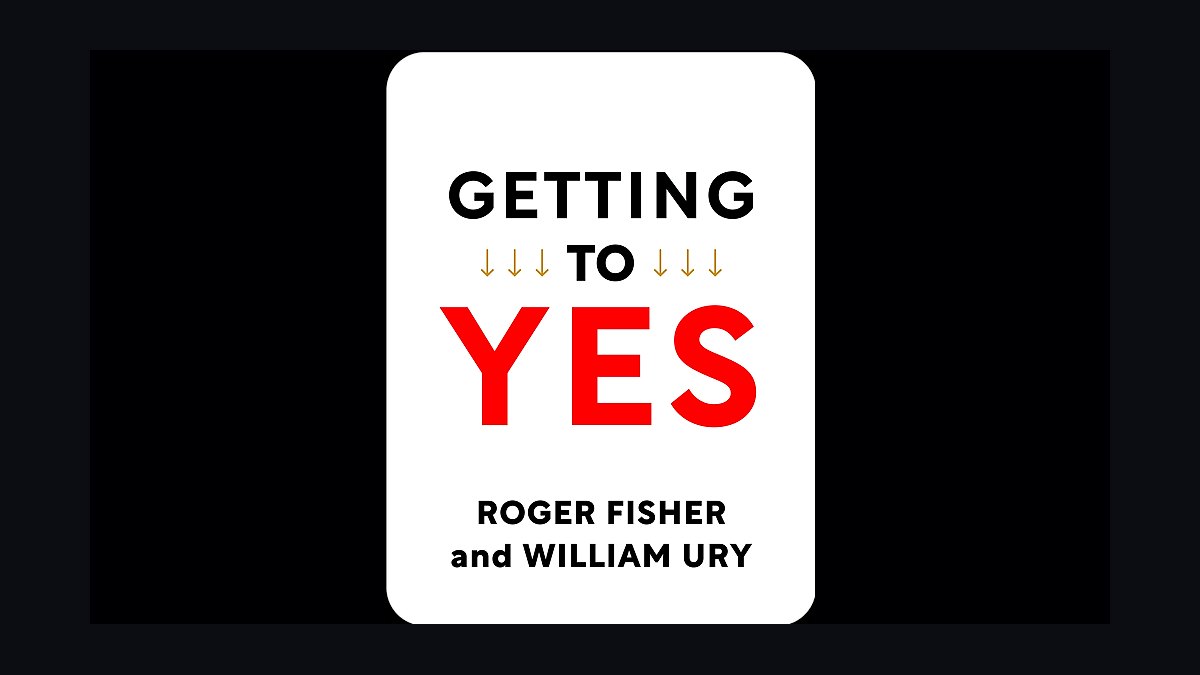
Getting to Yes: Negotiating Agreement Without Giving In by Roger Fisher, William Ury, and Bruce Patton (Penguin, 1981; revised 3rd edition 2011) is the founding text of the Harvard Negotiation Project and the most-assigned negotiation book in MBA programs worldwide. Its central thesis: positional bargaining (each side stakes a position, then grudgingly trades concessions) produces worse outcomes than principled negotiation, a four-rule method — Separate the People from the Problem, Focus on Interests, Not Positions, Invent Options for Mutual Gain, and Use Objective Criteria. The book also introduced BATNA (Best Alternative to a Negotiated Agreement), which has since become standard vocabulary in every procurement department, sales-enablement curriculum, and law-school 1L year. More than four decades after publication, every major modern negotiation book — Ury's Getting Past No, Malhotra's Negotiation Genius, Voss's Never Split the Difference, Blount's Inked — is a descendant, a refinement, or an explicit rebuttal of this 200-page paperback.
1Part One — The Problem with Positional Bargaining
1.1 Chapter 1 — Don't Bargain Over Positions
Fisher and Ury open with a single observation: positional bargaining is inefficient, unwise, and damages relationships. When a buyer says "$5,000" and the seller says "$10,000," each side digs in, defends their number, makes grudging concessions, and walks away resenting the other. The authors cite the 1961 Soviet-American test-ban talks, where both sides locked into positions on the number of on-site inspections (three vs. ten), never discussed what an inspection actually accomplished, and watched the negotiation collapse. The chapter lands the diagnosis: positions are stated demands; they are not what either party actually needs. The longer each side defends a position, the more ego gets fused to it, and the harder genuine problem-solving becomes. The fix is to change the game itself — switch from positional bargaining to principled negotiation, the four-rule method the rest of the book unpacks. This chapter is the foundation on which Chris Voss, Deepak Malhotra, and Jeb Blount all later build.
2Part Two — The Method (The Four Principles)
2.1 Chapter 2 — Separate the People from the Problem
The first principle: be soft on the people, hard on the problem. Negotiators are humans with emotions, egos, and misperceptions — and the substantive issue gets entangled with the relationship. Fisher and Ury split "people problems" into three buckets: perception (each side sees the situation differently), emotion (anger, fear, and pride hijack judgment), and communication (people talk past each other, don't listen, or speak only to constituents). The Monday-morning prescription: listen actively, acknowledge emotions explicitly, talk about yourself not them ("I feel let down" beats "You broke your word"), and face the problem together, side by side, not across the table. The chapter cites a labor dispute where a union leader opened a meeting by inviting everyone to put every grievance on the wall — within an hour the room re-organized from adversaries into a joint problem-solving team. Voss's tactical empathy in Never Split the Difference is a direct descendant of this principle.

2.2 Chapter 3 — Focus on Interests, Not Positions
The second principle is the book's most-quoted line: "Focus on interests, not positions." A position is what someone says they want ($10,000, the corner office, full custody). An interest is the underlying need driving the position (financial security, status, time with children). The breakthrough: for every interest, several positions can satisfy it, so a negotiation locked at the position level has zero solutions, while the same negotiation reframed at the interest level often has many. The canonical example: two sisters argue over one orange. Positional bargaining splits it 50/50. Interest-based negotiation reveals one sister wants the peel for baking, the other wants the juice — both can get 100% of what they need. The chapter teaches the practical tools: ask "why?" and "why not?", recognize that each side has multiple interests (not one), and that the most powerful interests are basic human needs — security, economic well-being, belonging, recognition, control. Modern discovery-call playbooks at firms like Force Management and Winning by Design descend from this chapter.
2.3 Chapter 4 — Invent Options for Mutual Gain
The third principle attacks the assumption of a fixed pie. Most negotiators believe value is finite — your gain is my loss — so they fight over slices instead of expanding the pie. Fisher and Ury identify four obstacles to inventing options: premature judgment, searching for the single answer, the assumption of a fixed pie, and thinking "solving their problem is their problem." The fix: separate inventing from deciding, brainstorm without criticism, broaden options before narrowing, and look for mutual gain by identifying shared interests, dovetailing different interests, and making their decision easy. The Camp David example reappears here — by inventing the demilitarized-zone option, the negotiators expanded a fixed-pie sovereignty fight into a creative solution that satisfied both sides' actual needs. The lineage: Malhotra's "logrolling" in Negotiation Genius (2007) and the multi-issue package offers taught at the Harvard Program on Negotiation are direct extensions of this chapter.

2.4 Chapter 5 — Insist on Using Objective Criteria
The fourth principle: when interests conflict directly, anchor the outcome to fair external standards — market value, precedent, professional standards, expert opinion, scientific judgment, court decisions — not willpower. A buyer and seller disagreeing on a used-car price stop arguing positions ("I'll pay $4,000" / "I want $6,500") and start arguing standards ("What's the Kelley Blue Book value?" / "What did three similar cars sell for last month?"). The negotiation shifts from a contest of stubbornness to a joint search for the legitimate answer. Fisher and Ury teach the moves: "On what basis?", "What's the principle behind that number?", "Help me understand the reasoning." The chapter explicitly warns: never yield to pressure, only to principle. This rule is the foundation of every procurement playbook at modern SaaS-buying platforms like Tropic, Vendr, and Sastrify, which automate "objective criteria" by surfacing benchmark pricing data.
3Part Three — Yes, But... (The Hard Cases)
3.1 Chapter 6 — What If They Are More Powerful? (Develop Your BATNA)
This is the book's other signature contribution: BATNA — Best Alternative to a Negotiated Agreement. Your BATNA is what you walk away to if the deal collapses. As the authors put it: the reason you negotiate is to produce something better than what you can obtain without negotiating, and your BATNA is the standard against which any proposed agreement should be measured. The Monday-morning prescription has three steps: (1) invent a list of actions you might take if no agreement is reached, (2) improve the most promising ideas into real alternatives, and (3) select the best one as your BATNA. A sales rep who has three other qualified opportunities in pipeline has a strong BATNA and negotiates from confidence. A rep with one make-or-break deal has a weak BATNA and concedes everything. The corollary: estimate the other side's BATNA too — if your BATNA beats their offer, walk; if their BATNA is weak, you have leverage you didn't know you had. BATNA is now standard vocabulary in every law school, every MBA negotiation class, and enterprise-sales training at companies like Salesforce, HubSpot, and Snowflake.

3.2 Chapter 7 — What If They Won't Play? (Negotiation Jujitsu)
When the other side attacks your position, attacks you personally, or refuses to engage on the merits, don't push back — that escalates positional warfare. Instead, use negotiation jujitsu: redirect their force toward the problem. The moves: "Help me understand your reasoning," "What's the principle behind that?", "What would you do in my position?" Treat their attack as an attack on the problem you both face, not an attack on you. Ask questions instead of making statements (questions don't give them a target to attack). Use silence — when they make an unreasonable proposal, say nothing; the pressure to fill the silence often makes them improve their own offer. The chapter also introduces the one-text procedure: a neutral party drafts a single document, circulates it, takes criticism, redrafts, and iterates until it satisfies everyone's interests — sidestepping the positional war entirely. Jimmy Carter used the one-text procedure at Camp David in 1978, iterating through many successive drafts before Egypt's Sadat and Israel's Begin both signed.
3.3 Chapter 8 — What If They Use Dirty Tricks? (Taming the Hard Bargainer)
Lies, threats, "good cop / bad cop," escalating demands, calculated delays, take-it-or-leave-it ultimatums — Fisher and Ury catalog the tactical tricks and prescribe one response: negotiate the negotiation itself. Name the tactic out loud ("I notice we keep doing good-cop/bad-cop — let's drop that and get back to substance"), question its legitimacy, and refuse to be a victim. The move: "Look, I may be wrong. Let's sit down and try to figure out the right answer." This chapter is the direct ancestor of Ury's Getting Past No (1991), which expanded the few pages here into an entire book on breakthrough negotiation with difficult counterparties.

4Part Four — In Conclusion
4.1 You Already Knew It / You Can Learn It / Winning
The closing chapter argues that principled negotiation is not a trick — it's how thoughtful people already negotiate when they're not under pressure. The book's job is to make the implicit explicit so you can do it deliberately, especially when the stakes are high. The final claim: "winning" in a negotiation is not beating the other side — it's getting a better outcome than your BATNA while preserving the relationship for future deals. This is the rebuttal to every "crush them" sales-bro philosophy and the moral foundation of the entire Harvard Program on Negotiation.
5The Camp David Case Study (1978)
The book's most-cited example: Egypt and Israel had incompatible positions on the Sinai Peninsula after the 1967 Six-Day War — Egypt demanded full sovereignty, Israel demanded continued control for security. Positional bargaining was deadlocked for more than a decade. President Jimmy Carter invited Sadat and Begin to Camp David and forced an interests-based reframing: Egypt's interest was sovereignty over its ancestral land; Israel's interest was security from tank invasions. The breakthrough option: return the Sinai to Egyptian sovereignty, but demilitarize it. Both interests were satisfied. The agreement has held for more than four decades. This case is taught in business schools as the proof-of-concept for interests-not-positions and inventing options for mutual gain.

6The Central Model
Frameworks at a Glance
- The 4 Principles of Principled Negotiation — (1) People: separate them from the problem; (2) Interests: focus on what each side needs, not what they say they want; (3) Options: invent multiple solutions before deciding; (4) Criteria: anchor outcomes to fair external standards.
- BATNA (Best Alternative to a Negotiated Agreement) — what you walk away to if no deal is reached. Your real source of power in any negotiation.
- WATNA (Worst Alternative to a Negotiated Agreement) — the floor of how bad things could get without a deal. Useful for estimating the other side's desperation.
- ZOPA (Zone of Possible Agreement) — the overlap between each side's reservation prices. If no ZOPA exists, no deal is possible at any price.
- Negotiation Jujitsu — when attacked, don't push back; redirect to the merits with questions like "What's the principle behind that?"
- Principled Negotiation — the umbrella term for the Fisher/Ury method; the opposite of positional bargaining.
- One-Text Procedure — a neutral party drafts and iterates a single document until it satisfies all sides' interests, bypassing positional warfare.
7The Operating Loop on a Sales Call
What Holds Up, What Has Aged
What holds up at full strength today:

- BATNA is universal sales doctrine. Enterprise reps at companies like Salesforce, Snowflake, and Databricks are trained to know their walk-away number and their next-best opportunity before entering any negotiation.
- "Interests, not positions" is the foundation of every modern discovery-call playbook — MEDDPICC's *Pain*, SPIN's *Implication*, Challenger's *Reframe*, and Sandler's *Pain Funnel* are all interest-mining tools.
- Separating people from the problem has only grown more important as remote selling, async deals, and email-first negotiations strip out the nonverbal cues that used to humanize counterparties.
What has aged or been challenged:

- Chris Voss's Never Split the Difference (2016) is the most prominent rebuttal — Voss, a former FBI hostage negotiator, argues that "win-win" can be naive in high-stakes negotiations where the other side will exploit your good faith, and that tactical empathy (labeling, mirroring) beats rational principle when the counterparty is irrational. The honest take: both/and, not either/or. Voss's tools are tactically superior in high-emotion, high-stakes, one-shot negotiations (hostage rescue, distressed M&A, divorce). Fisher/Ury's framework is strategically superior in repeated, multi-party, long-relationship deals (enterprise SaaS, partnership negotiations, labor contracts).
- Procurement automation (Tropic, Vendr, Sastrify) has industrialized "objective criteria" — modern B2B buyers come to the table with peer-benchmark pricing data and prescribed negotiation playbooks, leaving less room for the open-ended principled-negotiation choreography the book assumes.
- The interests-not-positions advice is sometimes weaponized by procurement teams: "What's your *real* interest, vendor?" becomes a discovery tactic to extract concessions. The book did not fully anticipate that buyers would read it too.
FAQ
What is the single most-quoted line from Getting to Yes? "Focus on interests, not positions." It's the entire book in five words and the foundation of every modern discovery methodology — MEDDPICC, SPIN, Challenger, and Sandler all descend from it. A position is the demand someone states out loud; an interest is the underlying need driving it. Negotiate the interest and a deadlocked deal often opens up.
What does BATNA actually mean and why does it matter? BATNA stands for Best Alternative to a Negotiated Agreement — what you walk away to if no deal is reached. It matters because your BATNA is your real source of power, not your bluster or your title. A salesperson with three live opportunities negotiates from strength; one with a single make-or-break deal concedes everything. Before any negotiation, identify your BATNA, work to improve it, and estimate the other side's so you know who actually has leverage.
Is Getting to Yes still worth reading after Never Split the Difference? Yes — read both. Fisher/Ury built the strategic frame (interests, options, criteria, BATNA). Chris Voss added the tactical layer (mirroring, labeling, tactical empathy) for high-emotion situations. They complement; they don't compete. Read Getting to Yes first for the architecture, then Never Split the Difference for the in-the-moment moves.
What is the Camp David example and why is it the book's signature case study? In 1978, Egypt and Israel had incompatible positions on the Sinai (full Egyptian sovereignty vs. continued Israeli control) but compatible interests (Egyptian sovereignty over its land, Israeli security from invasion). The breakthrough: return the Sinai to Egypt but demilitarize it — both interests satisfied, and the agreement has held for more than four decades. It's the cleanest real-world proof-of-concept for interests-not-positions and inventing options for mutual gain.
What is negotiation jujitsu and when do I use it? Use it when the other side attacks your position, attacks you personally, or refuses to engage on the merits. Instead of pushing back (which escalates), redirect their force toward the problem with questions: "Help me understand your reasoning," "What's the principle behind that?", "What would you do in my position?" Silence is also jujitsu — when they make an unreasonable proposal, say nothing and let the pressure to fill the gap push them to improve their own offer.
How does Getting to Yes fit into the modern sales canon? It's the headwater of the modern negotiation canon: Fisher/Ury Getting to Yes (1981) → Ury Getting Past No (1991) → Malhotra & Bazerman Negotiation Genius (2007) → Voss Never Split the Difference (2016) → Blount Inked (2020). Every major later book is either a refinement, a tactical layer, or an explicit rebuttal of the Harvard Negotiation Project's work. You cannot understand the modern field without reading this book first.
Bottom Line
Read Getting to Yes before you read any other negotiation book — it's the architecture every later book builds on or rebels against. Monday morning, do three things: (1) for your next deal, write down your BATNA and theirs before the call; (2) replace "What do you want?" with "What are you trying to accomplish?" in your discovery script to flip positions into interests; (3) when negotiating price, anchor to objective criteria (peer benchmarks, market comps, third-party data from G2 or Gartner) instead of willpower. The book is roughly 200 paperback pages, takes an afternoon to read, and will outlast every sales methodology of your career.
Related on PULSE
- Difficult Conversations by Stone, Patton & Heen — Cliff Notes Summary for Sales Leaders
- The Power of a Positive No by William Ury — Cliff Notes Summary
Sources
- Roger Fisher, William Ury & Bruce Patton — *Getting to Yes: Negotiating Agreement Without Giving In* (Penguin, 1981; revised 3rd edition 2011). Overview and bibliographic record: en.wikipedia.org/wiki/Getting_to_Yes
- Program on Negotiation at Harvard Law School — the research center that institutionalized the Fisher/Ury method, with ongoing articles on principled negotiation and BATNA: pon.harvard.edu
- Program on Negotiation — BATNA resources — practitioner explainers on developing and using your Best Alternative to a Negotiated Agreement: pon.harvard.edu/tag/batna
- "Best alternative to a negotiated agreement" (BATNA) — concept history and definition: en.wikipedia.org/wiki/Best_alternative_to_a_negotiated_agreement
- Camp David Accords (1978) — Encyclopædia Britannica entry on the negotiation the book uses as its signature case study: britannica.com/event/Camp-David-Accords
- William Ury — *Getting Past No: Negotiating in Difficult Situations* (Bantam, 1991) — the author's own sequel on hard-case negotiations.
- Deepak Malhotra & Max Bazerman — *Negotiation Genius: How to Overcome Obstacles and Achieve Brilliant Results at the Bargaining Table and Beyond* (Bantam, 2007).
- Chris Voss & Tahl Raz — *Never Split the Difference: Negotiating As If Your Life Depended On It* (Harper Business, 2016) — the most prominent modern complement/rebuttal.
This page will be disappearing soon. Save it to your device for $1 — or read it free while it is here.
@Kory-White- · if Venmo asks, the last 4 of my number are 2012
This page is gone.
This one is off the shelf now. $1 keeps it on your phone for good — the whole page, pictures and diagrams included.
 pulse-recentWhat is the first concrete step in SPIN Selling by Neil Rackham for structuring a discovery call in 2027?
 pulse-recentHow to Apply Strategic Selling — Step-by-Step Playbook in 2027
 pulse-recentGetting to Yes by Roger Fisher and William Ury — Top 10 Key Takeaways for Sales Leaders in 2027
 pulse-recentNever Lose a Customer Again by Joey Coleman — Top 10 Key Takeaways for Sales Leaders in 2027
 pulse-recentConceptual Selling by Robert Miller and Stephen Heiman — Top 10 Key Takeaways for Sales Leaders in 2027
 pulse-recentWhat are the first three concrete steps in Sandler Rule #1 for a new sales rep in 2027?
 pulse-recentSell or Be Sold by Grant Cardone — Top 10 Key Takeaways for Sales Leaders in 2027
 pulse-recentSales Engagement by Manny Medina — Top 10 Key Takeaways for Sales Leaders in 2027
 pulse-recentSPIN Selling by Neil Rackham — Top 10 Key Takeaways for Sales Leaders in 2027
 pulse-recentWhat is the most actionable step in The Sandler Rules for Sales Leaders by David Mattson to improve discovery in 2027?