


Selling to VITO by Anthony Parinello — Cliff Notes Summary
Quality
Certified
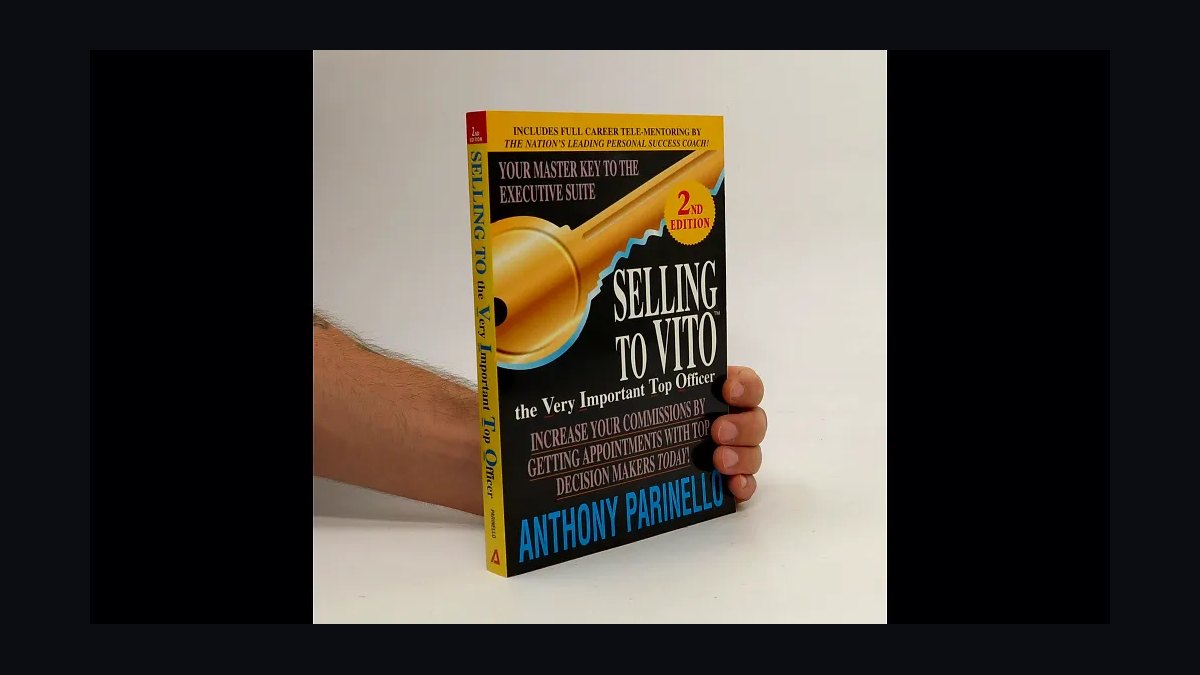
Selling to VITO (The Very Important Top Officer) by Anthony Parinello — first published by Adams Media in 1994 and substantially revised in a 3rd edition in 2010 — is the foundational manual for selling at the C-suite level. Parinello, a former IBM rep who later founded Selling To VITO Inc., argues that selling at the Top Officer level is fundamentally different from selling at the user or manager level: VITOs think in business outcomes rather than features, decide quickly rather than over weeks, and require a specific Letter → Phone → Meeting cadence to break through. The book matters because it codified — three decades before the term existed — the operating mechanics of what is now called Account-Based Marketing, and every modern executive-targeting platform (Demandbase, 6sense, Terminus, Cognism) is a scaled industrialization of Parinello's manual VITO-targeting playbook. It sits alongside Neil Rackham's SPIN Selling, The Challenger Sale, and MEDDPICC as one of the canonical references on selling to sophisticated buyers — but unlike the others, it focuses exclusively on the single person at the top of the org chart.
1The VITO Definition and Why It Matters
1.1 Chapter 1 — What a VITO Actually Is
Parinello opens by defining the Very Important Top Officer precisely: the person with budget authority + organizational power + final approval rights for your category of solution. The title varies — CEO, CFO, COO, Division President, General Manager, or a functional VP with full P&L control — but the role is constant. A VITO can say yes without anyone else's permission and can fund the purchase from a budget they personally control. Everyone else in the building can only say no.
1.2 Chapter 2 — Why You Are Probably Not Talking to One
The opening provocation of the book: most reps spend the bulk of their selling time with people who cannot say yes. Parinello calls these lookalike-authority figures Seemores — they *Seem* to be in charge, they have impressive titles, they take meetings, they ask intelligent questions, and they can absolutely kill your deal. They just can't fund it. The rep who burns six months working a Director-level champion only to hear *"my boss didn't approve the budget"* has been Seemore-trapped. Parinello's mission across the book is to teach you how to start at the top, on purpose, on the first call.

2The VITO Personality Profile
2.1 Chapter 3 — How VITOs Actually Think
This chapter is Parinello's most-cited contribution to the sales canon. He profiles the VITO across five dimensions that have held up well across thirty years and now echo in Gartner's executive-buyer research and the Corporate Executive Board's Challenger work:
- Impatient. VITOs measure in seconds. A short voicemail window. A brief elevator. A five-minute meeting that gets extended only if the first 60 seconds earn it.
- Outcome-Driven. VITOs care about revenue, cost, risk, and time — not features, not technology, not your roadmap. *"VITOs think in outcomes — not in features"* is Parinello's most-quoted line.
- Pattern-Recognizing. VITOs want to know who else in their peer set has done this. The fastest way to lose a VITO is to be the first reference they've ever heard of in their category.
- Risk-Aware. Every decision a VITO makes carries personal and political downside. They are not optimizing for upside — they are managing the asymmetry of public failure.
- Numbers-Native. VITOs speak in dollars, percentages, basis points, payback periods, and time-to-value. Show up with a feature list and you are dismissed in the first sentence.
2.2 Chapter 4 — Equal Business Stature
Parinello's deepest insight, and the philosophical spine of the entire book: you cannot sell to a VITO from a vendor stance. You must approach as a peer who happens to bring useful solutions. Voice, tone, dress, vocabulary, the way you introduce yourself, the way you handle the assistant — all signal stature. *"You sell with Equal Business Stature or you don't sell at all."* The rep who walks in apologetic, deferential, or supplicating loses before the first slide. The rep who walks in as an equal — calm, time-conscious, business-fluent, peer-credentialed — gets the second meeting.
3The VITO Letter
3.1 Chapter 5 — The One-Page Template That Built a Methodology
The VITO Letter is the single most imitated artifact in modern outbound. Parinello's template, written in 1994 and refined in 2010, still appears nearly verbatim in Stu Heinecke's *How to Get a Meeting with Anyone* (2016), in modern LinkedIn InMail best-practice guides, and in the cold-email frameworks taught by tools like Outreach, Salesloft, and Lavender. The rules:
- Single page. Never two. A second page is a confession that you couldn't edit.
- Headline addresses the VITO's biggest business pain in the VITO's own words — pulled from their 10-K, their earnings call, their LinkedIn post, or their last public interview.
- Three bullet outcomes, each with peer-company proof. *"For three other CFOs in your category, we reduced days-sales-outstanding by double digits within one quarter."*
- One specific call-to-action with a date and time. Not *"happy to chat."* Instead: *"I will call your office at 9:47 AM on Tuesday the 14th."* The oddly specific time signals discipline.
- Peer-stature signature. Signed by a Director, VP, or C-level at your own company — never an SDR. VITOs respond to peers.
3.2 Chapter 6 — Why It Works
The Letter works because it pre-qualifies you on every VITO dimension at once: it respects their time (one page), shows pattern recognition (peer proof), demonstrates outcome thinking (numbers in the bullets), and asserts equal business stature (peer signature). It removes every reason a VITO would have to delegate the response down to a Seemore.
4The VITO Phone Script
4.1 Chapter 7 — The 30-Second Opener
Parinello's phone script is engineered to clear the assistant and earn five minutes of VITO time. The opener has four required beats, delivered in under 30 seconds:
- Introduce — full name, full company name, calm pace.
- Name-drop the letter — *"I am following up on the letter I sent you on Tuesday."* This converts the cold call into a warm follow-up the assistant has likely already filed.
- Business outcome — one sentence with a number and a peer reference.
- Request for five minutes — never *"a quick chat"*; always *"five minutes to share what three of your peers did."*
4.2 Chapter 8 — Handling the Assistant
Parinello treats the executive assistant as a gatekeeper to be respected, never bypassed. He teaches reps to address the assistant by name, to be transparent about purpose, and to ask for their help routing — *"I sent your boss a letter Tuesday and promised to follow up this morning. Could you help me find the right ten minutes?"* The assistant who is treated as a peer becomes the rep's biggest internal ally. The assistant who is lied to becomes the rep's permanent blocker.
5The Seemore Trap
5.1 Chapter 9 — The Lookalike Decision-Maker
The longest and most warned-about chapter in the book. A Seemore is the person who has an impressive title (Director of Operations, VP of IT, Head of Procurement), takes your meetings, asks thoughtful questions, requests proposals, brings in colleagues, and ultimately cannot fund a single dollar of the purchase. They can say no — and they will, because a no costs them nothing and a yes carries career risk they have no authority to underwrite. Parinello's warning is blunt: *"Seemores can kill your deal — only VITOs can fund it."*
5.2 Chapter 10 — How to Escape
The escape protocol: once you realize you are with a Seemore, ask permission to brief their boss. *"This sounds like a decision your CFO will need to weigh in on. Would you be willing to introduce me, or would it be more useful if I reached out directly and copied you?"* The Seemore who refuses both options has just told you the deal is dead. The Seemore who accepts either option has just promoted you out of the trap.
6The VITO Meeting Protocol
6.1 Chapter 11 — The First Five Minutes
The VITO Meeting opens with the rep restating the business outcome from the Letter, naming the peer reference, and asking a single high-altitude question — *"What is the one initiative on your desk this quarter where a 90-day result would matter most?"* The rep then stops talking. Parinello insists that the first meeting is for the VITO to talk; the rep's job is to listen, pattern-match, and confirm fit.

6.2 Chapter 12 — The Close
The close is not a close — it is a handoff to evaluation with the VITO's explicit sponsorship. *"Based on what you've shared, the next step is for me to spend 90 minutes with your CFO and your Head of Operations. Can you make that introduction this week?"* The deal is now sponsored from the top, the Seemores below are permission-granted to engage, and the cycle compresses dramatically.
Frameworks at a Glance
- VITO Definition. Very Important Top Officer — the person with budget authority + organizational power + final approval rights for your category. Title varies; role is constant.
- VITO Personality Profile. Impatient, outcome-driven, pattern-recognizing, risk-aware, numbers-native. The five dimensions every C-suite outbound message must respect.
- VITO Letter Template. Single page, headline in the VITO's own words, three bullet outcomes with peer proof, one specific CTA with date and time, peer-stature signature.
- VITO Phone Script. 30-second opener — introduce, name-drop the letter, business outcome with a number, ask for five minutes.
- Seemore. The gatekeeper-level person (Director, Manager, VP of X) who looks like authority but isn't. Can say no, cannot say yes.
- Equal Business Stature. The unchanged operating principle — you approach the VITO as a peer who happens to bring solutions, never as a vendor.
- Sponsored Handoff. The real close — the VITO introduces you down to the evaluation team with explicit sponsorship.

What Holds Up, What Has Aged
Holds up. The VITO Personality Profile is timeless — modern Gartner executive-buyer research and CEB / Corporate Executive Board buyer studies reach almost identical conclusions about how senior executives consume information. Equal Business Stature remains the operating principle of every elite executive-targeting program at enterprise vendors. The Seemore Trap is arguably *more* relevant today than in 1994 — Gartner's B2B buying research finds the typical complex purchase now involves roughly six to ten decision-makers, the majority of whom function as Seemores.
Has aged. The physical handwritten letter has been largely replaced by personalized LinkedIn DMs, executive-targeted advertising through platforms like Demandbase, and direct-mail-plus-digital hybrids from vendors such as Sendoso and Reachdesk. The phone-script timing has compressed — modern VITOs offer even less attention than the 30-second window Parinello assumed. AI tools — Clay, Apollo, Cognism, Lavender, Regie.ai — now auto-generate VITO-quality outbound at scale, which is a double-edged sword: the median quality of cold outreach has risen, but VITO inboxes are also more crowded, making the peer-stature signature and oddly specific CTA more important than ever. The modern ABM stack (6sense, Demandbase, Terminus, RollWorks) is essentially Parinello's playbook industrialized — same logic, more channels, automated orchestration.

FAQ
Who is Anthony Parinello and why should I trust him? A former IBM sales rep who became a top performer selling to large-enterprise CFOs and CIOs, Parinello founded Selling To VITO Inc. in 1994 and built a corporate sales-training practice used by enterprise sales teams. He went on to write several follow-up books, including Think and Sell Like a CEO (2002) and Getting to VITO (2005). His VITO Letter template is still taught in Account Executive onboarding at enterprise software companies.
How is this different from MEDDPICC's Economic Buyer? MEDDPICC's Economic Buyer is essentially the same person as Parinello's VITO — but MEDDPICC is a deal-qualification scoring framework, while VITO is a how-to-get-the-meeting methodology. They are complements, not substitutes. MEDDPICC tells you the Economic Buyer must be identified and engaged; Parinello tells you exactly how to write the letter and place the call.
Does the VITO Letter still work in the era of LinkedIn and AI-generated outbound? Yes, with two updates. First, the physical letter can be replaced with a LinkedIn InMail or hand-addressed envelope — the format matters less than the content discipline. Second, the peer-stature signature matters more than ever — VITOs delete SDR-signed messages instantly but read messages that appear to come from their counterpart at your company.
What's the single biggest mistake reps make, per Parinello? Spending months with a Seemore and convincing themselves the Seemore is the VITO. Parinello's diagnostic question: *"Does this person have a budget line large enough to fund my deal without asking anyone's permission?"* If the answer is no, you are with a Seemore.
How does this book relate to The Challenger Sale? The Challenger Customer (2015) defined the Mobilizer — the internal champion who can build consensus across a buying committee. The Mobilizer is essentially a sophisticated Parinello-style ally: sometimes a VITO, sometimes a Seemore who can recruit a VITO. The Challenger work scales Parinello's logic to the multi-stakeholder buying committee that Gartner now documents as standard.
What should I do Monday morning after reading this? Pick five target accounts. Identify the actual VITO at each (use the diagnostic above). Write five one-page VITO Letters. Mail or InMail them Tuesday. Call Wednesday. Track which open and which book — then iterate the letter weekly.
Bottom Line
Read Selling to VITO if you sell anything with a meaningful price tag and you keep losing long cycles to *"my boss didn't approve the budget."* The book is short, blunt, and operationally specific — you can implement the entire methodology in a single week. Monday morning: identify five VITOs, write five letters, place five calls. The modern ABM stack will scale it for you, but the source code is here, in a 1994 book by an ex-IBM rep that quietly shaped every executive-targeting playbook in the industry.
Related on PULSE
- The Only Sales Guide You'll Ever Need by Anthony Iannarino — Cliff Notes Summary & Key Takeaways
- Eat Their Lunch by Anthony Iannarino — Cliff Notes Summary & Key Takeaways
- The Lost Art of Closing by Anthony Iannarino — Cliff Notes Summary & Key Takeaways
- Selling the Invisible by Harry Beckwith — Cliff Notes Summary
- Secrets of Question-Based Selling by Thomas Freese: Summary, Key Lessons, and RevOps Takeaways
- SPIN Selling by Neil Rackham: Summary, Key Lessons, and RevOps Takeaways
Sources
- Anthony Parinello — *Selling to VITO (The Very Important Top Officer)* (Adams Media, 1st ed. 1994; 3rd ed. 2010)
- Anthony Parinello — *Think and Sell Like a CEO* (Career Press, 2002)
- Anthony Parinello — *Getting to VITO (The Very Important Top Officer)* (Wiley, 2005)
- Selling To VITO Inc. — corporate sales-training curriculum and certification program
- Matthew Dixon and Brent Adamson — *The Challenger Sale* (Portfolio, 2011)
- Brent Adamson, Matthew Dixon, Pat Spenner, Nick Toman — *The Challenger Customer* (Portfolio, 2015) — Mobilizer concept as a sophisticated VITO descendant
- Stu Heinecke — *How to Get a Meeting with Anyone* (BenBella, 2016) — direct lineage from the VITO Letter
- Neil Rackham — *SPIN Selling* (McGraw-Hill, 1988) — parallel foundational text on consultative selling
- Darius Lahoutifard — *Always Be Qualifying (MEDDIC/MEDDPICC)* — Economic Buyer overlap with VITO
- Gartner — *The B2B Buying Journey* research — multi-stakeholder buying-committee findings
- Demandbase, 6sense, Terminus, Cognism, RollWorks — modern ABM platforms that industrialize VITO-style executive targeting at scale
Recently Added — Related
This page will be disappearing soon. Save it to your device for $1 — or read it free while it is here.
@Kory-White- · if Venmo asks, the last 4 of my number are 2012
This page is gone.
This one is off the shelf now. $1 keeps it on your phone for good — the whole page, pictures and diagrams included.
 pulse-recentThe Customer Success Professional’s Handbook by Ashvin Vaidyanathan — Top 10 Key Takeaways for Sales Leaders in 2027
 pulse-recentHigh-Profit Prospecting by Mark Hunter — Top 10 Key Takeaways for Sales Leaders in 2027
 pulse-booksWhat are the most common mistakes in Book Summaries in 2027?
 pulse-recentFanatical Prospecting by Jeb Blount — Top 10 Key Takeaways for Sales Leaders in 2027
 pulse-recentSales Engagement by Manny Medina — Top 10 Key Takeaways for Sales Leaders in 2027
 pulse-recentSell or Be Sold by Grant Cardone — Top 10 Key Takeaways for Sales Leaders in 2027
 pulse-recentSPIN Selling by Neil Rackham — Top 10 Key Takeaways for Sales Leaders in 2027
 pulse-recentSnap Selling by Jill Konrath — Top 10 Key Takeaways for Sales Leaders in 2027
 pulse-recentWhat is the first concrete step in SPIN Selling by Neil Rackham for structuring a discovery call in 2027?
 book-summaryLittle Red Book of Selling by Jeffrey Gitomer — Cliff Notes Summary