


Stop Selling and Start Leading by Kouzes, Posner & Calvert — Cliff Notes Summary
Quality
Certified
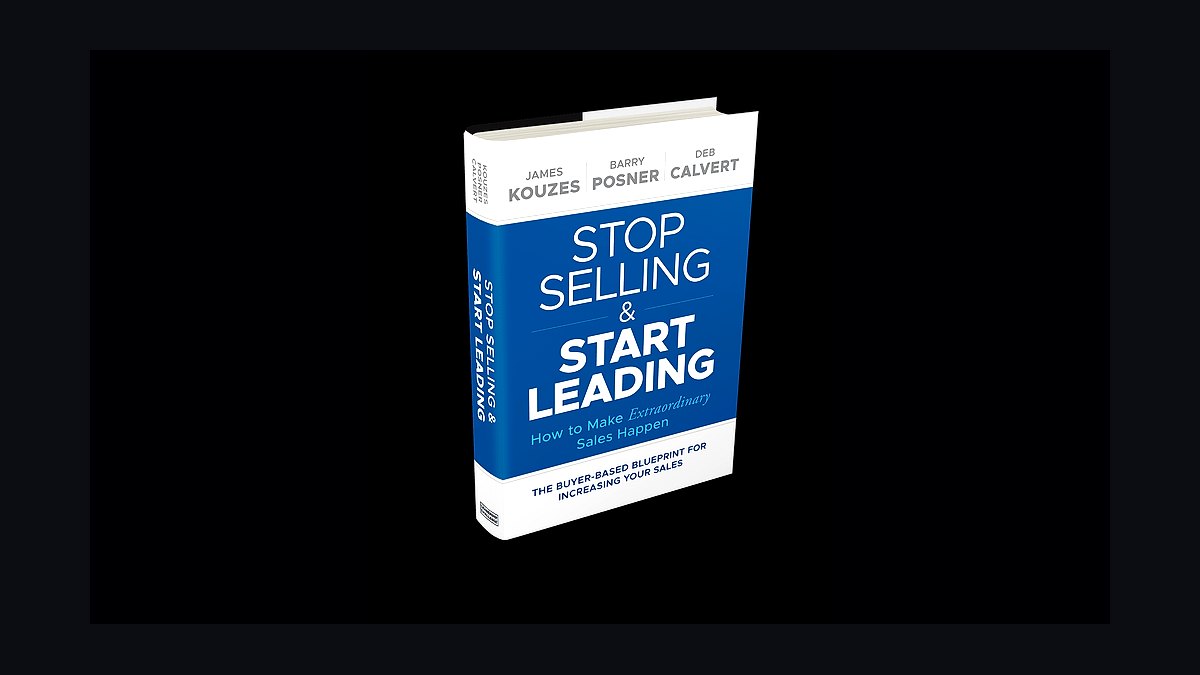
Stop Selling and Start Leading: How to Make Extraordinary Sales Happen by James M. Kouzes, Barry Z. Posner, and Deb Calvert (Wiley, 2018) makes one contrarian argument and builds an entire playbook around it: buyers don't describe their ideal salesperson using sales words — they describe a leader. The book welds Kouzes & Posner's Leadership Challenge — one of the most widely cited leadership frameworks in management, with millions of copies sold across seven editions — to the daily reality of B2B selling. Calvert, founder of People First Productivity Solutions, contributes a parallel research strand in which her team asked more than 530 B2B buyers to describe the seller they most want to work with. The buyers reached for words like trustworthy, honest, credible, knowledgeable, and responsive — and they rarely reached for the traditional sales vocabulary of *persuasive*, *persistent*, *energetic*, or *closer*. When the authors held those descriptors up against Kouzes & Posner's decades of data on what people say about leaders they admire, the two lists looked almost the same. From there the book maps the 5 Practices of Exemplary Leadership (Model the Way, Inspire a Shared Vision, Challenge the Process, Enable Others to Act, Encourage the Heart) onto concrete seller behavior and gives sellers a self-assessment to score themselves against. It belongs on the shelf next to Schultz & Doerr's Insight Selling, Bungay Stanier's Coaching Habit, and Iannarino's Eat Their Lunch as a serious answer to the question *"what do buyers actually want from a salesperson?"*
1The Research That Reframed the Question
1.1 Chapter 1 — Buyers Don't Want to Be Sold
The opening chapter lays out the founding research. Deb Calvert and her People First Productivity Solutions team surveyed more than 530 B2B buyers across industries and asked an intentionally open question: *"Describe the seller you most want to work with."* The team then looked at the language the buyers actually used. The descriptors that surfaced most often were relationship and character words — trustworthy, honest, knowledgeable, responsive, credible. What was conspicuously absent mattered just as much: the words sales training programs lionize — *persuasive*, *persistent*, *energetic*, *charismatic*, *closer* — barely appeared. The authors set those buyer descriptors next to Kouzes & Posner's long-running research on the qualities people admire in leaders, and the overlap was hard to miss. The conclusion: buyers are not asking for better sellers. They are asking for leaders who happen to sell.
1.2 Chapter 2 — Why the Old Sales Model Broke
The authors trace the breakdown to the collapse of information asymmetry. Before the internet, the seller controlled the information — they knew the product, the buyer didn't, and "selling" meant transferring that knowledge persuasively. CEB (now Gartner) research famously found that the typical B2B buyer was well past the halfway point of the purchase journey before ever engaging a sales rep, and that share has only grown as buyers self-educate online. What did not disappear is the buyer's need for someone to help them navigate the change the purchase represents. That role — guide, navigator, the person you trust at the front of the room — is leadership, not selling.

2Model the Way
2.1 Clarify Your Values
The first of the 5 Practices opens with values clarification. The authors argue that a seller who cannot say plainly what they stand for cannot build trust at the speed modern deals demand. The chapter adapts a values exercise from the Leadership Challenge workshops: list your top values, force-rank them down to a handful, and write a short personal credo in your own words. The point is not the worksheet — it is that buyers read principle versus pitch quickly, and a seller who is grounded in clear values signals the former.
2.2 Set the Example
Values without matching behavior is just talk. The authors lean on Kouzes & Posner's bedrock idea of credibility, captured in the shorthand DWYSYWD — *"Do What You Say You Will Do."* Missed callbacks, broken follow-up promises, and agenda drift are, in this framing, the fastest way to forfeit a buyer's trust. The behavior is simple and unglamorous: when you say the proposal lands Thursday, send it Wednesday. The self-assessment scores sellers on exactly this kind of follow-through.

3Inspire a Shared Vision
3.1 Envision the Future
The second Practice asks sellers to paint a future-state picture the buyer can see themselves living inside. This is not feature-benefit selling. It is the seller saying, in effect, *"Eighteen months from now, when this is fully deployed, here is what a Monday morning looks like for your team."* The book draws on Kouzes & Posner's vision research, which holds that leaders who can articulate a clear, credible future earn markedly more commitment than those who only describe the present.
3.2 Enlist Others
A vision held alone is a daydream. The seller's job is to enlist — to communicate the picture with enough genuine conviction and specificity that the buyer adopts it as their own. The authors warn against manufactured enthusiasm, the "smile-and-dial" energy buyers detect instantly, and prescribe a discipline: rehearse the vision out loud, in your own words, until it sounds like belief rather than recitation. As they put it, *you cannot enlist others in a vision you do not yourself believe.*

4Challenge the Process
4.1 Search for Opportunities
The third Practice is where the book overlaps most with Schultz & Doerr's Insight Selling (2014) and Dixon & Adamson's Challenger Sale (2011). Challenge the Process asks sellers to spot what the buyer is not yet seeing — operational waste, competitive blind spots, regulatory shifts — and bring it forward. The authors draw a careful line: this is not the confrontational "teaching" pitch of the Challenger model. It is collaborative inquiry. The seller surfaces the opportunity as a question and investigates it alongside the buyer.
4.2 Experiment and Take Risks
Sellers who play it safe — generic decks, by-the-book demos, vanilla discovery — lose to sellers who propose pilots, run small experiments, and take modest bets that show the buyer they are willing to be wrong in public. The self-assessment treats a question like *"How often do you propose something the buyer has never tried?"* as a leading indicator of engagement, on the logic that a willingness to experiment is itself a trust signal.
5Enable Others to Act
5.1 Foster Collaboration
The fourth Practice is the antidote to the "lone wolf" sales archetype. The authors point to CEB / Gartner research on buying groups, which finds that a typical complex B2B purchase now involves roughly six to ten stakeholders. A seller who wins one champion and ignores the rest tends to stall. The Practice calls for the seller to build the buying group deliberately — run multi-stakeholder conversations and create artifacts like joint roadmaps and mutual action plans that the group co-authors rather than receives.
5.2 Strengthen Others
The chapter ends with a counterintuitive directive: make your buyer look good internally. Build the slides the champion will present to their CFO. Prepare them for the objections procurement will raise. The relationship that outlasts a single deal is the one in which the seller consistently made the champion the smart person in their own organization. This maps cleanly onto Iannarino's Eat Their Lunch (2018) idea of the advisor who makes the champion the hero of the story.

6Encourage the Heart
6.1 Recognize Contributions
The fifth Practice is the one most sellers skip. Encourage the Heart asks sellers to notice and name the contributions of buyers, champions, and internal partners — not transactionally ("thanks for the order") but specifically. The instinct is well grounded: Gallup's long-running engagement research includes the item *"In the last seven days, I have received recognition or praise for doing good work"* precisely because recent, specific recognition is such a strong predictor of engagement. The same dynamic shapes buyer relationships, and a genuine handwritten note to a champion who went to bat in a procurement meeting outperforms any swag.
6.2 Celebrate the Values and the Victories
Wins are best celebrated against the values the seller and buyer set together — not just against the number. When a deployment hits a milestone, the seller marks it in a way that names what the team stood for and what they delivered. This is where the lineage of Levitin's Heart and Sell (2017) shows through: emotional connection is not the soft part of the job, it is the operating system of long-term accounts.

7The Behaviors and the Self-Assessment
The book's practical core is a self-assessment built on six observable behaviors under each of the five Practices — thirty in all — mirroring the structure of Kouzes & Posner's long-established Leadership Practices Inventory (LPI). Sellers rate themselves, and the authors urge that managers and, ideally, buyers rate them too, since the gap between self-perception and observed behavior is usually where the coaching lives. Sample items read like *"I describe the future in a way my buyer can see themselves in it,"* *"I propose something my buyer has never tried,"* and *"I recognize my buyer's contribution by name."* The authors recommend re-taking the assessment periodically and reviewing the trend with a manager, treating it as a coaching cadence rather than a one-time score.
8The Buyer-First Mindset and the Change Journey
The closing chapters reframe the seller's job entirely: the seller is not selling a product, they are leading the buyer through a change. Every purchase is a change, and every change meets resistance. The seller's role is to be the change leader the buyer needs — sometimes pushing, sometimes pulling, sometimes pausing. The authors land on the directive that gives the book its title: "Stop selling and start leading."

Frameworks at a Glance
- The 5 Practices of Exemplary Leadership — Kouzes & Posner's framework: Model the Way, Inspire a Shared Vision, Challenge the Process, Enable Others to Act, Encourage the Heart.
- The 30 Behaviors — six specific, observable behaviors under each of the five Practices, thirty in total, paralleling the Leadership Practices Inventory.
- The Research Foundation — Calvert's survey of more than 530 B2B buyers, read against Kouzes & Posner's long-running leadership research.
- The Buyer Vocabulary Gap — buyers describe ideal sellers with leadership words, not sales words; this gap is the book's central insight.
- Buyer-First Mindset — the seller leads the buyer through a change journey rather than pushing product.
- DWYSYWD — *Do What You Say You Will Do*, the credibility behavior at the heart of Model the Way.
What Holds Up, What Has Aged
What holds up. The 5 Practices rest on decades of independent research using the Leadership Practices Inventory across many countries and roles, which makes the framework's spine far sturdier than most sales-book scaffolding. The core thesis has arguably gotten *more* true since 2018: remote and hybrid selling strip away the ambient trust signals of in-person presence — body language, hallway chemistry, the feel of a room — so the seller must now demonstrate leadership through screens and text alone. Buyer-preference research from sources like LinkedIn's State of Sales reports continues to put trust and credibility at the top of what buyers want, consistent with the book's argument.

What has aged. The 2018 examples lean toward field-sales archetypes; product-led growth and high-velocity inside-sales motions get comparatively little attention. The self-assessment was designed as a manual, periodic exercise; today, conversation-intelligence tools such as Gong, Chorus, and Clari can surface much of the same behavioral signal directly from call recordings, which changes how a team might operationalize the 30 behaviors. And the book's influence outruns its readership — sales-leadership development programs have quietly absorbed the 5 Practices, often without attribution — so it remains a respected classic in the sales-leadership corner of the canon rather than a mass-market hit on the order of Challenger or SPIN Selling.
FAQ
Is this just The Leadership Challenge with sales examples bolted on? No. The 5 Practices framing is borrowed from Kouzes & Posner's earlier work, but the buyer-vocabulary research and the seller-specific behaviors and self-assessment are original to this book. The empirical claim — that buyers describe ideal sellers in leadership language — is the new contribution.
How does it compare to The Challenger Sale? Challenger says the best sellers teach, tailor, and take control. Stop Selling and Start Leading says the best sellers lead — a broader, more relational frame. The two overlap on "Challenge the Process" but differ in tone: Challenger is more confrontational, this book more collaborative. They read well together rather than against each other.
Do I have to take the self-assessment to get value from the book? No, but it is the most useful single exercise in it. Rating yourself across the five Practices — and, better, having a manager or a buyer rate you too — turns the framework from theory into a concrete list of behaviors to work on. Calvert's company, People First Productivity Solutions, is the home base for the surrounding tools and research.
Is this book for sellers or sales leaders? Both, with a slight tilt toward leaders building development programs. Individual sellers will find the behaviors immediately usable; sales leaders will find the 5 Practices a ready-made coaching curriculum.
What is the one Monday-morning takeaway? Pick the behavior you score lowest on. Practice it on your next three calls. Re-rate yourself in two weeks. That loop is the book in one sentence.
Why isn't this book more famous? It was published as a serious business title rather than marketed as a mass-market sales book, so much of its reach is secondhand — through training programs that adopted the framework. Plenty of sellers have never heard of it; plenty of sales-enablement leaders quietly run on its ideas.
Bottom Line
Read this book if you lead a sales team, build sales-development programs, or sell complex B2B deals where trust is the gating factor. The 5 Practices give you a vocabulary, the 30 behaviors give you a checklist, and the self-assessment gives you a coaching cadence. Monday morning: rate yourself across the five Practices, pick your lowest-scoring behavior, and practice it three times this week. The book's quiet superpower is that it took one of the most-validated leadership frameworks in management and made it usable on the sales floor — and the buyers in Calvert's research told us, in their own words, that leadership is what they wanted from sellers all along.
Related on PULSE
- Stop Acting Like a Seller by Jerry Acuff — Cliff Notes Summary
- DISCOVER Questions by Deb Calvert — Cliff Notes Summary
- Start with No by Jim Camp: Summary, Key Lessons, and RevOps Takeaways
- The Cold Start Problem by Andrew Chen — Cliff Notes Summary
- The Art of the Start 2.0 by Guy Kawasaki — Cliff Notes Summary
- Start with Why by Simon Sinek — Cliff Notes Summary for Salespeople
Sources
- Kouzes, James M., Posner, Barry Z. & Calvert, Deb — *Stop Selling and Start Leading: How to Make Extraordinary Sales Happen* (Wiley, 2018)
- Kouzes, James M. & Posner, Barry Z. — *The Leadership Challenge* (Jossey-Bass / Wiley, 1st edition 1987, 7th edition 2023) — origin of the 5 Practices and the Leadership Practices Inventory
- Calvert, Deb — *DISCOVER Questions Get You Connected* (People First Publishing, 2015)
- People First Productivity Solutions — Deb Calvert's firm; home of the buyer research and the seller behavior assessment (peoplefirstps.com)
- Schultz, Mike & Doerr, John E. — *Insight Selling: Surprising Research on What Sales Winners Do Differently* (Wiley / RAIN Group, 2014)
- Bungay Stanier, Michael — *The Coaching Habit* (Box of Crayons Press, 2016) — companion text on leader-as-coach behavior
- Iannarino, Anthony — *Eat Their Lunch: Winning Customers Away from Your Competition* (Portfolio, 2018)
- Levitin, Shari — *Heart and Sell: 10 Universal Truths Every Salesperson Needs to Know* (Career Press, 2017)
- Dixon, Matthew & Adamson, Brent — *The Challenger Sale* (Portfolio, 2011) — parallel research on seller archetypes
- CEB / Gartner — buyer-journey and buying-group research (buyers well past the midpoint of the journey before vendor contact; roughly six to ten stakeholders on complex B2B deals)
- Gallup — Q12 employee-engagement research, including the recognition-within-seven-days item referenced under Encourage the Heart
- LinkedIn State of Sales Report — recurring buyer-preference research showing trust and credibility as top buyer priorities
This page will be disappearing soon. Save it to your device for $1 — or read it free while it is here.
@Kory-White- · if Venmo asks, the last 4 of my number are 2012
This page is gone.
This one is off the shelf now. $1 keeps it on your phone for good — the whole page, pictures and diagrams included.
 pulse-recentThe Sandler Rules by David Sandler — Top 10 Key Takeaways for Sales Leaders in 2027
 pulse-recentHigh-Profit Prospecting by Mark Hunter — Top 10 Key Takeaways for Sales Leaders in 2027
 pulse-recentHow do you implement the Sandler Rules in your first 30 days as a new sales rep in 2027?
 pulse-recentWhat is the first concrete step in SPIN Selling by Neil Rackham for structuring a discovery call in 2027?
 pulse-recentNever Lose a Customer Again by Joey Coleman — Top 10 Key Takeaways for Sales Leaders in 2027
 pulse-recentBlue Ocean Strategy by W. Chan Kim and Renee Mauborgne — Top 10 Key Takeaways for Sales Leaders in 2027
 pulse-recentWhat is the first concrete step in the Sandler Selling System for handling a prospect's initial brush-off in 2027?
 pulse-recentProActive Selling by Skip Miller — Top 10 Key Takeaways for Sales Leaders in 2027
 pulse-recentWhat are the seven concrete steps to implement the Sandler Submarine technique from The Sandler Rules in 2027?
 pulse-recentThe Sales Manager’s Guide to Greatness by Kevin Davis — Top 10 Key Takeaways for Sales Leaders in 2027