


Selling with Noble Purpose by Lisa McLeod — Cliff Notes Summary
Quality
Certified
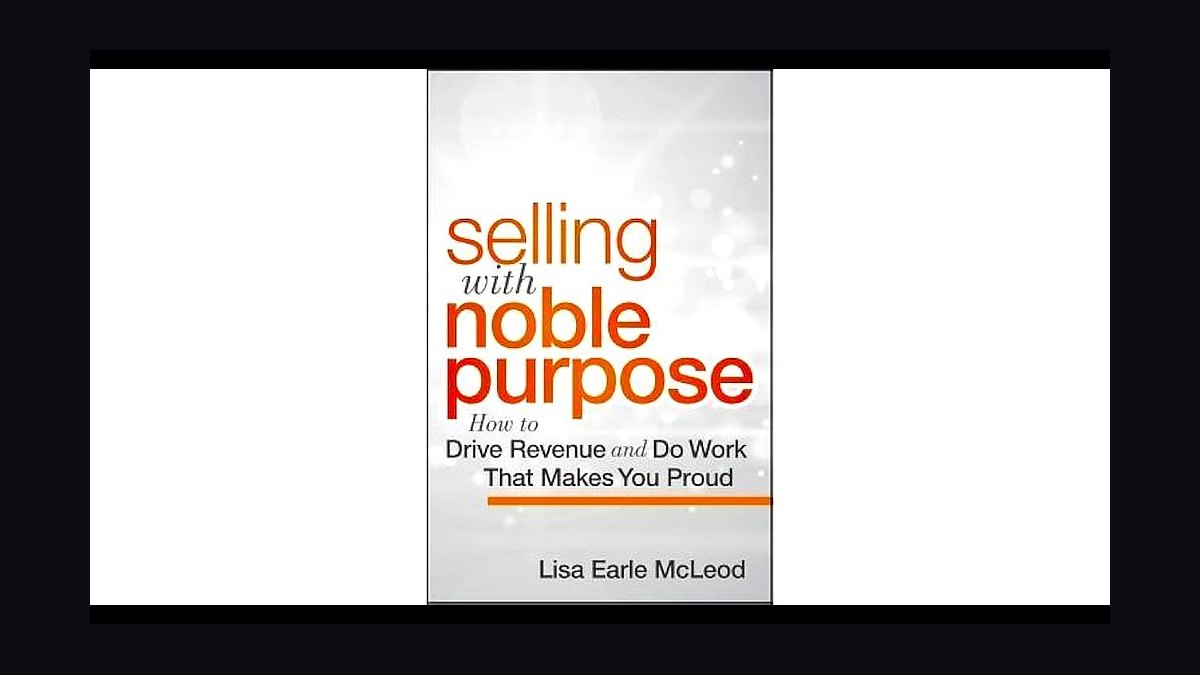
Selling with Noble Purpose: How to Drive Revenue and Do Work That Makes You Proud by Lisa Earle McLeod (Wiley, 2012; revised and updated 2nd edition, 2020) makes one central argument: salespeople who sell with a clear Noble Sales Purpose (NSP) — a genuine focus on the difference they make to their customers' lives — consistently outsell peers who are focused mainly on quotas and commissions. McLeod, founder of the sales-leadership consultancy McLeod & More, traces the idea to field research in which the strongest reps turned out to be the ones who cared most about improving their customers' situations, not the ones most fixated on hitting their numbers. The book's job is to turn that insight into an operating system: a way to define your purpose, build customer-impact stories, coach to purpose, and keep it in front of you every working day. It pairs naturally with Daniel Pink's Drive (why intrinsic motivation works) and Simon Sinek's Start With Why (purpose at the leadership and brand level), but McLeod is the one who writes it down as a day-to-day playbook for individual reps and their front-line managers. It stays relevant because commoditized SaaS, AI-generated outreach, and remote selling have eroded easy differentiation — a credible sense of purpose is one of the few edges left that a competitor cannot copy.
1Part One — Finding Your Noble Sales Purpose

1.1 Why Purpose Outperforms Money

McLeod opens with the research that gives the book its spine. Hired to study why some reps consistently outperformed others selling the same product into the same market, she found that the difference was not who was hungriest for commission. The reps who pulled ahead were the ones who genuinely wanted to make a difference for their customers — the money-motivated reps tended to land around quota, while the purpose-motivated reps tended to beat it. The mechanism is not mystical: customers can hear the difference. A rep who is privately asking "what will it take to close this quarter?" sounds different from a rep asking "what would make this team's work materially better?" McLeod's framing throughout is that purpose is not a slogan but a performance lever.
1.2 The Three Discovery Questions

McLeod's tool for surfacing a Noble Sales Purpose is a set of three questions she runs in workshops with reps and leaders:
- How do you make a difference to your customers?
- How do you do it differently than your competition?
- On your best day, what do you love about your job?
The third question is the one most teams skip, and it is the one that usually unlocks the others — the honest answer is almost never "I love hitting my number," it is some version of "I love it when a customer's situation actually gets better because of me." Reps who can only answer with feature lists or "we're a leader in the space" are typically the ones stuck at quota; reps who answer with concrete customer outcomes are the ones who run ahead of it. The questions reveal whether a rep has a Noble Sales Purpose or just a job.
2Part Two — Building Customer-Impact Stories

2.1 Specific Customers, Specific Outcomes

A Noble Sales Purpose is abstract until it is attached to a story. McLeod presses reps to collect concrete, customer-centered stories — not testimonials, not case-study PDFs, but first-person narratives a rep can tell in under two minutes about a real customer whose situation got measurably better. The discipline is specificity: a named customer, a real before-and-after, and the human stakes underneath the metric. Generic "we helped a client improve efficiency" stories do nothing; specific ones change how a prospect listens.
2.2 The Shape of a Good Impact Story

Effective impact stories tend to follow the same arc: the customer's situation before (the pain, named), what actually changed (the specific intervention, not the feature list), and the outcome after (in concrete terms, ideally in the customer's own words). McLeod is firm that secondhand, abstracted impact stories die in the prospect's ear, while specific, human ones land — because they let the prospect picture themselves on the other side of the change.
2.3 Keeping Stories Fresh

Stories go stale, and reps drift back to pitching features under pressure. McLeod's remedy is to make impact stories a routine team practice rather than a one-time exercise: reps surface new ones regularly, leaders make room to share them, and the best stories get circulated so the whole team can use them. The point is to keep customer impact — not the product spec sheet — as the team's default vocabulary.
3Part Three — Living Purpose Day to Day

3.1 The Daily Purpose Practice

McLeod's most practical contribution is turning purpose into a daily habit rather than an annual offsite theme. The practice is simple: start the day by deciding how you intend to make a difference for a customer, and end it by honestly checking whether you did. Done consistently, this reorders the day — reps stop opening calls with their agenda and start opening with the customer's situation, and prospects notice the shift early in the conversation. The habit is the mechanism; the NSP statement on the wall does nothing on its own.
3.2 Coaching Managers to Purpose

Front-line managers are the leverage point, and McLeod argues the standard pipeline review actively trains purpose out of reps. When every conversation is "what's the close date, what's the next step, what's the deal size?", reps learn that the company only cares about the number. Her fix is to add purpose questions to the same review — what difference would this deal make for the customer, why do they care, and what story have you told them — so the rep is rehearsing customer impact, not just forecasting.
3.3 Hiring for Purpose
NSP is also a hiring signal. McLeod suggests asking candidates to describe a time they made a real difference for a customer. A candidate who can only reach for a money story tells you one thing; a candidate who reaches naturally for an impact story tells you something else. The second instinct, she argues, is the one that correlates with sustained performance — and it is hard to coach into someone who does not already have it.
4Part Four — Purpose at the Org Level
4.1 Noble Purpose vs the Mission Statement
McLeod is sharp on the difference. Most company mission statements are about the company — "to be the leading provider of…" A Noble Sales Purpose is about the customer — what changes in their world because you exist. The grammatical subject of the sentence is the whole point: the company's success is the byproduct of customer impact, not the headline. A purpose that survives this test reads as something a customer would actually care about, not something only a shareholder would.
4.2 Operationalizing Purpose
Purpose dies without operational hooks. McLeod's prescription is to weave it into the places where attention actually goes: lead pipeline reviews and QBRs with customer impact, open team meetings with an impact story, and tie customer-outcome language to how performance is discussed and rewarded. Organizations that build these hooks tend to see purpose stick; the ones that print the statement on a poster and walk away see nothing change.
5Part Five — Common Objections and Failure Modes
5.1 "But My Product Isn't Saving Lives"
The most common objection McLeod hears. Her counter: nearly every B2B product makes someone's working life materially better, and the rep's job is to find that thread. A commercial-insurance rep's purpose isn't "selling policies" — it's helping a family business survive one bad event. A payroll-software rep's purpose isn't "automating payroll" — it's making sure people get paid correctly and on time. Every product has a thread to the human on the other end; weak reps simply haven't pulled on it yet.
5.2 When Purpose Becomes Cynical Marketing
This is the book's honest chapter. McLeod warns that a Noble Sales Purpose done badly — purpose-washing, a statement no one in the building actually believes — is worse than none at all, because reps know when leadership doesn't mean it and quietly tune out. The fix is genuine commitment from the top, paired with real customer-outcome reporting that travels alongside the revenue numbers. If senior leadership can't readily name customer-impact stories from the last quarter, the purpose is theater.
6Part Six — The Revised 2020 Update
6.1 Purpose in the Subscription Economy
The revised 2nd edition (2020) updates the thesis for a world that now runs on renewals. McLeod's point is that recurring revenue raises the stakes on purpose: a rep selling a one-time contract can fake caring about the customer, but a rep whose revenue depends on multi-year renewals cannot — the customer will see through it well before the renewal date. Subscription economics force genuine alignment between what sales promises and what the customer actually experiences after the deal closes.
6.2 Purpose-Driven Selling in a Remote World
The updated edition also addresses remote and hybrid selling, which physically removes reps from the evidence of their own impact — fewer site visits, fewer chances to watch the product change someone's day. McLeod argues this makes customer-impact stories more important, not less, because narrative becomes the main way customer impact still travels inside a sales team that rarely sees its customers in person.
Frameworks at a Glance
- NSP (Noble Sales Purpose) — a one-sentence statement of the difference you and your company exist to make for customers. It belongs at the top of pipeline reviews and team meetings, not on a poster.
- The Three Discovery Questions — (1) How do you make a difference to your customers? (2) How do you do it differently than your competition? (3) On your best day, what do you love about your job?
- Customer-Impact Stories — concrete, named-customer stories told in a before / what changed / after arc, refreshed regularly so the team's default language is customer impact rather than features.
- The Daily Purpose Practice — start the day deciding how you'll make a difference for a customer; end it honestly checking whether you did.
- The Purpose Pipeline Review — adds three questions to the standard forecast: what difference would this make, why does the customer care, and what story have you told them?
- NSP vs Mission Statement — mission statements are about the company; a Noble Sales Purpose is about the customer. The subject of the sentence is the test.
- The Hiring Signal — ask a candidate to describe a time they made a real difference for a customer, then listen for whether they reach for a money story or an impact story.
What Holds Up, What Has Aged
What holds up. The core thesis reads as stronger today than it did in 2012. The rise of ESG investing, B-Corp certification, and a wave of mission-forward SaaS companies has reinforced McLeod's claim that purpose-aligned selling outperforms purely transactional selling. The Three Discovery Questions remain a clean, fast diagnostic, and the emphasis on customer-impact stories has only grown more useful as remote-first work physically separates reps from the outcomes they create — narrative is now the main carrier of impact context inside distributed teams.
What has aged. Some of the book's framing predates the current sales-tech stack. McLeod underweights call-analytics and AI coaching tools, which can now scan transcripts for whether reps actually lead with customer impact or just talk about it — a natural complement to the framework that the book doesn't address. A present-day NSP rollout should pair the practice with that kind of feedback loop. The "purpose-washing" warning, by contrast, has aged well: years of mission-statement theater inside venture-backed SaaS make McLeod's caution look prescient rather than cautious.
FAQ
Is Noble Sales Purpose just rebranded "value selling"? No. Value selling teaches reps to quantify ROI; NSP teaches them to internalize *why* that ROI matters to a specific customer. The Three Discovery Questions and the daily purpose practice are operational habits, not pep talks — a value-selling rep can still be purely money-motivated, whereas the NSP practice is built to keep customer impact in front of the rep every day.
How is this different from Simon Sinek's Start With Why? Sinek's book is mostly a leadership and branding argument aimed at executives and marketers. McLeod's is an operating manual for individual reps and front-line managers, focused on revenue. Sinek explains why purpose matters; McLeod tells you what to do with it on Monday morning.
Does NSP work in transactional SMB sales or only enterprise? McLeod argues it works in both, and the 2020 revision broadens the examples. Shorter SMB cycles actually put more weight on the customer-impact story, because a single specific story has to do more of the persuasion work inside one or two calls.
What's the single most important practice from the book? The daily purpose habit — deciding each morning how you'll make a difference for a customer and checking each evening whether you did. McLeod's claim is that this routine, more than any script, is what shifts the quality of a rep's conversations over time.
Should I read the 2012 edition or the 2020 revised edition? Read the 2020 revised and updated edition. It adds the material on subscription/renewal revenue and remote selling, and refreshes the research framing. The original is mostly of historical interest now.
Can AI tools replace customer-impact stories? No. AI can surface candidate stories from CRM notes and call transcripts, but the rep still has to internalize and actually tell them in a way the customer believes. The story library is a memory and identity tool for the rep, not just a database lookup.
Bottom Line
Read Selling with Noble Purpose if you're a rep stuck at quota, a front-line manager whose pipeline reviews feel purely transactional, or a leader puzzled by why your top reps outrun your average reps on the same product, territory, and comp plan. This week: write your one-sentence Noble Sales Purpose, answer the Three Discovery Questions honestly, draft your first few customer-impact stories with real names and outcomes, and start the morning-and-evening purpose habit. In the modern sales canon, McLeod sits between Pink's Drive (why intrinsic motivation works) and the displacement-selling literature like Iannarino's Eat Their Lunch (how to win competitive deals) — the bridge between the theory of motivation and the daily practice of selling on it. It is one of the most practical books on sales motivation written this century.
Related on PULSE
- Selling the Invisible by Harry Beckwith — Cliff Notes Summary
- Secrets of Question-Based Selling by Thomas Freese: Summary, Key Lessons, and RevOps Takeaways
- SPIN Selling by Neil Rackham: Summary, Key Lessons, and RevOps Takeaways
- Gap Selling by Keenan: Summary, Key Lessons, and RevOps Takeaways
- The SPIN Selling Fieldbook — Cliff Notes Summary
- Buyer-Centered Selling — Cliff Notes Summary
Sources
- Lisa Earle McLeod — *Selling with Noble Purpose: How to Drive Revenue and Do Work That Makes You Proud* (Wiley, 2012; revised and updated 2nd ed., 2020)
- Lisa Earle McLeod — *Leading with Noble Purpose: How to Create a Tribe of True Believers* (Wiley, 2016)
- McLeod & More, Inc. — author's consultancy site and article archive (mcleodandmore.com)
- Simon Sinek — *Start With Why: How Great Leaders Inspire Everyone to Take Action* (Portfolio, 2009)
- Simon Sinek — *Find Your Why: A Practical Guide for Discovering Purpose for You and Your Team* (Portfolio, 2017)
- Daniel H. Pink — *Drive: The Surprising Truth About What Motivates Us* (Riverhead, 2009)
- Anthony Iannarino — *Eat Their Lunch: Winning Customers Away from Your Competition* (Portfolio, 2018)
- Matthew Dixon and Brent Adamson — *The Challenger Sale: Taking Control of the Customer Conversation* (Portfolio, 2011)
This page will be disappearing soon. Save it to your device for $1 — or read it free while it is here.
@Kory-White- · if Venmo asks, the last 4 of my number are 2012
This page is gone.
This one is off the shelf now. $1 keeps it on your phone for good — the whole page, pictures and diagrams included.
 pulse-recentNever Split the Difference by Chris Voss — Top 10 Key Takeaways for Sales Leaders in 2027
 pulse-recent$100M Offers by Alex Hormozi — Top 10 Key Takeaways for Sales Leaders in 2027
 pulse-recentMonetizing Innovation by Madhavan Ramanujam — Top 10 Key Takeaways for Sales Leaders in 2027
 pulse-recentHow do you implement the Sandler Rules in your first 30 days as a new sales rep in 2027?
 pulse-recentHow I Raised Myself from Failure to Success in Selling by Frank Bettger — Top 10 Key Takeaways for Sales Leaders in 2027
 pulse-recentWhat is the first concrete step in The Sandler Rules by David Mattson for a sales leader to implement the system in 2027?
 pulse-recentThe Sales Acceleration Formula by Mark Roberge — Top 10 Key Takeaways for Sales Leaders in 2027
 pulse-recentThe Greatest Salesman in the World by Og Mandino — Top 10 Key Takeaways for Sales Leaders in 2027
 pulse-recentSales Engagement by Manny Medina — Top 10 Key Takeaways for Sales Leaders in 2027
 pulse-recentObviously Awesome by April Dunford — Top 10 Key Takeaways for Sales Leaders in 2027