


Slow Down, Sell Faster! by Kevin Davis — Cliff Notes Summary
Quality
Certified
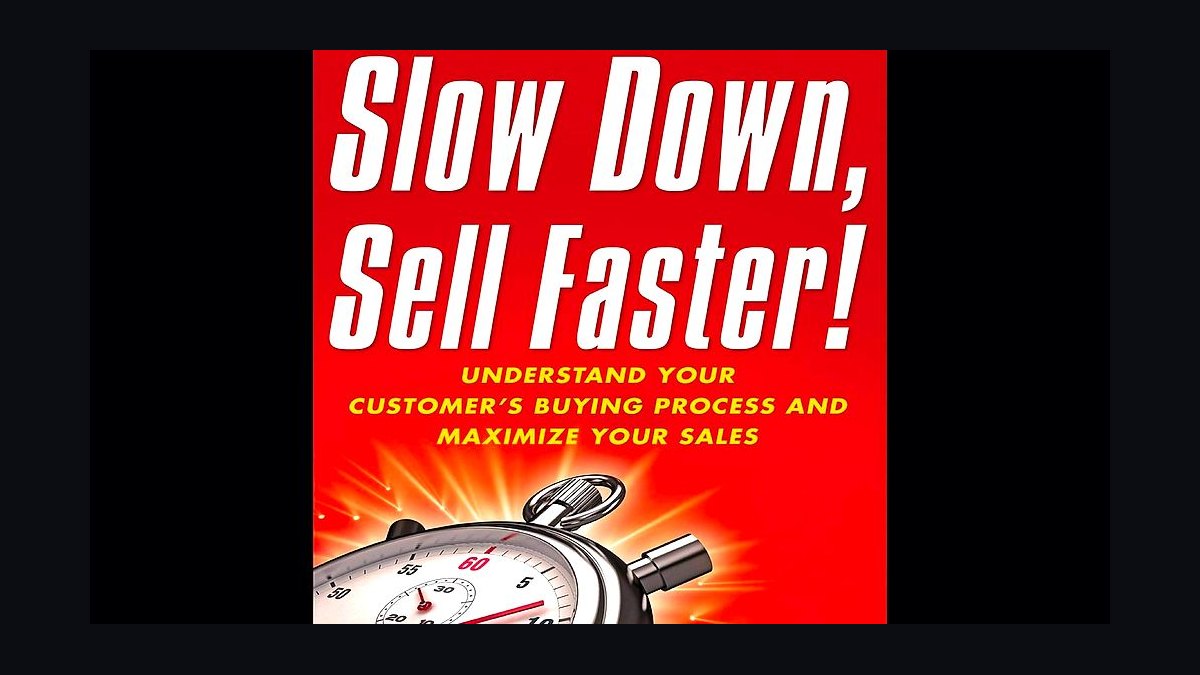
*Slow Down, Sell Faster!* (AMACOM, 2011) by Kevin Davis maps eight buyer stages — Change, Discontent, Research, Comparison, Fear, Commitment, Expectations, Satisfaction — to eight matched seller roles: Student, Doctor, Architect, Coach, Therapist, Negotiator, Teacher, Farmer. Slowing down means diagnosing the buyer's actual stage first; selling faster is the payoff when you stop pitching at stages the buyer hasn't reached.
The deal that stalls at 90 percent and nobody knows why
Picture a mid-market SaaS rep with a $180,000 opportunity that has been sitting at "Verbal Commit — 90%" for eleven weeks. The champion loved the demo. Legal cleared the MSA in nine days. Security review came back clean. Then the champion stopped replying to email. The rep's manager pushes the standard playbook: send a "breakup" email, offer a 12% end-of-quarter discount, escalate to the VP, get a mutual action plan signed. All four moves fail. The deal slips two more quarters and eventually closes at 22% off list — or dies quietly and gets re-forecast into a competitor's win column.
Kevin Davis's argument is that every one of those four moves was a stage mismatch. The rep was executing Commitment-stage behavior — price, terms, urgency — against a buyer who had regressed into what Davis calls the Fear stage. The champion was not silent because the price was too high or because the rep failed to create urgency. The champion went silent because they had finally understood what a "yes" would actually cost them personally: retraining nineteen people, migrating four years of pipeline data, owning the outcome in front of a CRO who had already lived through one failed implementation. A discount does not address any of that. It arguably makes it worse, because a sudden 12% concession signals to a nervous buyer that the seller is more motivated than the buyer is — which is exactly the wrong read for someone worried about being sold to.
The Cliff Notes version of the book's premise: the buyer's pace is the deal's pace. Urgency is a buyer attribute to be read, not a seller behavior to be applied. Davis, who founded the sales-management training firm TopLine Leadership and had published an earlier version of this thesis in *Getting Into Your Customer's Head* (1996), organizes the entire book around this diagnostic reversal. Instead of asking "what is my next step in my sales process," the rep asks "what stage is this buyer in, and what role does that stage require of me." Every chapter either defines a buyer stage, defines its matched seller role, or walks a deal where the mismatch killed the close.

What makes the framework durable is that it is falsifiable at the individual-deal level. A rep can look at a stalled opportunity, name the stage, name the role they were actually playing, and see the gap immediately. In the $180,000 example, the diagnosis is: buyer in Fear, rep playing Negotiator. The matched role is Therapist — name the change risk out loud, propose a phased rollout with a defined off-ramp, put a seller-side executive sponsor on the account. That is a completely different next call than "can we get this done by the 30th."
How the eight-stage decoder ring actually works
The mechanism is a two-column lookup. Column one is where the buyer is; column two is what the seller does. Davis's contribution is not the observation that buyers have a process — Mike Bosworth's *Solution Selling* (1994) and Neil Rackham's *SPIN Selling* (1988) both predate it — but the insistence that the seller's role changes completely at each stage, and that playing the right role at the wrong time is as damaging as playing no role at all.
Change → Student. Pre-pain. Something external has shifted: a new competitor, a regulatory deadline, a missed quarter, a CEO mandate. Nobody has named a project. Buyers here ignore cold outreach because from their seat there is no problem to solve. The Student's only job is to research the buyer's industry harder than the buyer does — read the 10-K, scan the trade press, study the two competitors keeping the CEO awake. The Student does not sell; the Student earns the meeting by knowing something the buyer's own team has not connected yet.

Discontent → Doctor. The buyer crosses from "things could be better" to "this specific thing is broken." Someone starts using the word *problem* in a staff meeting. This is where most reps wrongly start — they hear "problem" and reach for a demo. Davis treats jumping to a pitch here as one of the most expensive mistakes in B2B selling. The Doctor asks Situation, Problem, Implication, and Need-payoff questions before mentioning a product, drawing directly on Rackham. The specific goal is to make the *implication* vivid enough that the buyer wants a prescription. Skip it and you get an enthusiastic champion with no budget, because nobody upstream feels the pain.
Research → Architect. The buyer builds requirements — talks to peers, reads analyst notes, attends webinars, and frequently drafts the RFP criteria that will govern the comparison. If the rep is absent here, those criteria get written around a competitor's strengths, and the deal is effectively lost before the demo. The Architect helps design the solution so requirements reflect real evaluation discipline. A common Architect artifact is a short neutral one-pager — "criteria a system like this should meet" — that a buyer can circulate without it reading as vendor propaganda.
Comparison → Coach. Two to four vendors get scored. Demos run, proofs of concept execute, references get called. The rep's instinct is to trash the competition; Davis flags this as another top-cost mistake. The Coach helps the buyer evaluate alternatives honestly, including the seller's own weaknesses. Conceding the one or two areas where a competitor is genuinely stronger buys the credibility that survives into the next stage.
Fear → Therapist. The stage most reps do not know exists. The buyer has mentally chosen and then goes dark. Davis frames it as buyer's remorse *before* the purchase — the moment the buyer grasps the scope of organizational change a yes will trigger. The Therapist names the fear out loud, then de-risks it structurally: pilot scope, phased rollout, written success criteria with off-ramps, executive sponsorship from the seller's side.
Commitment → Negotiator. Terms, redlines, security review, procurement, signature. Davis spends the least time here, on the theory that if the first five stages went well, this is largely procedural. The Negotiator protects value already built and trades concessions rather than granting them.

Expectations → Teacher. Post-signature, pre-value. The gap between what the buyer bought and what the buyer thinks they bought. The Teacher sets realistic expectations before implementation starts and hands off to customer success with a written success plan the buyer has signed.
Satisfaction → Farmer. Renewal, expansion, referral. The Farmer runs quarterly business reviews, keeps an executive sponsor warm, and re-onboards stakeholders as the buyer's org churns.
The regression arrows matter more than the forward ones. Davis's field observation is that buyers move backward routinely — a new stakeholder joins in Comparison and drags the account back to Research because their requirements were never captured; a board memo lands during Fear and the buyer re-opens the Discontent question entirely. A rep who only tracks forward motion reads a regression as a stall and applies pressure. A rep running the decoder ring reads it as a stage change and switches roles.
The numbers a practitioner can actually work with
Davis's framework is a practitioner heuristic, not a controlled study, and the honest Cliff Notes summary says so plainly. There is no randomized trial behind the eight stages. What exists is decades of field training at TopLine Leadership plus the structural corroboration of later buyer-side research. Treat the following as operating ranges rather than published findings.
Stage count and vendor count. The Comparison stage in most mid-market and enterprise evaluations runs two to four serious vendors after an initial longer list gets cut. If a rep enters an opportunity at Comparison having never done Architect work, they are competing against criteria someone else wrote. The practical implication is a pipeline-hygiene rule: any opportunity sourced as an inbound RFP where the rep had no Research-stage contact should be scored down, because the win rate on requirements you did not help shape is structurally lower than on ones you did.

Where deals actually die. In Davis's model the two highest-loss stages are Discontent and Fear, for opposite reasons. Discontent losses are silent — the deal never opens, because the rep pitched instead of diagnosing and the buyer decided the seller did not understand the problem. Fear losses are loud — the deal appears in forecast at high probability and then slips, sometimes for two or three quarters, before dying or closing heavily discounted. A useful audit: take every opportunity that has slipped its close date twice and check whether the last three activities were price-related. If they were, the rep is running Negotiator behavior against Fear-stage buyers.
Late discounting as a diagnostic signal. Davis's claim is that a discount demanded late is usually a proxy for unresolved fear, not a genuine price objection. The operational test is cheap: before conceding anything, offer a risk concession instead — a shortened initial term, a phased rollout with a defined exit at 90 days, a documented success plan with named metrics. If the buyer takes the risk concession and drops the price ask, the objection was Fear all along. If the buyer insists on price and rejects risk relief, it was genuinely a budget or competitive-anchor problem, and the Negotiator role is correct.
Post-close revenue weighting. Stages 7 and 8 exist because in subscription and repeat-purchase businesses, the majority of an account's lifetime value lands after the first contract. Renewal plus expansion revenue typically dwarfs the initial deal over a multi-year relationship. Davis's point is behavioral rather than quantitative: reps who treat closed-won as "done" hand the larger half of the account's value to whoever picks it up next, and they lose the referral flywheel entirely. The Farmer role is not customer-success's job description accidentally printed in a sales book; it is a claim that the same relationship capital that closed the deal is the cheapest source of the next three.
Time allocation across roles. A rough working split for a rep managing a complex pipeline: the Student and Doctor roles deserve the majority of early-cycle hours, the Architect role is where the win is usually decided, the Coach and Therapist roles are where losses are prevented, and the Negotiator role should be the smallest slice of the cycle. If a rep's calendar shows the inverse — most hours in pricing conversations, almost none in industry research — that is the mismatch in aggregate rather than in a single deal.

Diagnostic cadence. The practical implementation is a weekly pipeline pass where every open opportunity gets three fields: current buyer stage, evidence for that stage (a quote, an email, an observed behavior — not a guess), and the matched role for the next action. Opportunities where the evidence field is empty are unqualified by definition. This is Davis's Buyer Decision-Process Mapping worksheet in its simplest form, and it is a clear conceptual ancestor of the Decision-Process element in MEDDIC and MEDDPICC.
Trade-offs, alternatives, and where the strategy strains
The eight-stage model is not the only buyer-centric strategy available, and choosing it means accepting specific costs.
Against MEDDIC/MEDDPICC. MEDDIC is a qualification checklist — Metrics, Economic Buyer, Decision Criteria, Decision Process, Identify Pain, Champion, plus Paper Process and Competition in MEDDPICC. It tells a rep what to verify. Davis tells a rep what to *do*. They are complements, not substitutes: MEDDIC is stronger for forecast accuracy and manager inspection, because its elements are binary and auditable. Davis is stronger for coaching the next call, because "you are playing Negotiator against a Fear-stage buyer" is a concrete behavioral instruction where "your Decision Process is weak" is not. Teams that run both usually keep MEDDIC in the CRM fields and Davis in the deal-review conversation.
Against SPIN Selling. Rackham's work is deeper and better evidenced on the questioning mechanics of a single conversation, and it is backed by observational research at a scale Davis does not claim. But SPIN is essentially a Discontent-stage technique. Davis's model absorbs it as one role out of eight and adds the seven stages SPIN does not address, particularly Fear and the two post-close stages. If a team only has bandwidth for one methodology and its problem is early-cycle discovery quality, SPIN is the better single investment. If the problem is late-stage stalls and churned renewals, Davis covers ground SPIN does not.

Against Challenger. The Challenger approach argues for teaching, tailoring, and taking control — leading with a commercial insight that reframes the buyer's thinking. That is closest to a fusion of Davis's Student and Doctor roles, executed aggressively. The tension is real: Challenger pushes the seller to create constructive tension early, while Davis pushes the seller to match the buyer's pace. A reasonable synthesis is that Challenger-style insight is the *content* of good Student-stage work, while Davis governs the *timing* of when to deploy it. Deploying a provocative insight against a buyer already deep in Comparison, who has done their own research, tends to read as condescension rather than value.
The linearity problem. This is the framework's most dated assumption. Davis wrote for a rep-led process where the seller was present from Change onward. Product-led growth scrambled the order: buyers now do Research and Comparison inside a free trial, self-serve past stages one through four, and surface to a rep already near Commitment. Under PLG the framework does not break, but it inverts — the Student and Doctor work now happens *post-trial*, and the rep's first job is forensic. Which stages did this buyer self-serve through? Which did they skip entirely? A buyer who arrives at Commitment having never passed through Discontent with a named business problem is the classic PLG trap: high product engagement, no executive sponsorship, and a Fear stage waiting at the procurement threshold.
The buying-committee problem. Davis's model tracks *the buyer* as a singular actor. In a modern enterprise deal with a committee, different members occupy different stages simultaneously — the champion is in Commitment, the CFO is in Discontent, the security lead is in Comparison, and the operations director who will absorb the change is in Fear. The framework survives this, but only if the rep runs the diagnostic per stakeholder rather than per opportunity, which multiplies the bookkeeping considerably. Gartner's buyer-enablement research, which independently arrived at a similar buyer-journey shape with six "buying jobs" — Problem Identification, Solution Exploration, Requirements Building, Supplier Selection, Validation, and Consensus Creation — explicitly handles the committee dimension through Consensus Creation, which Davis's eight stages do not name as its own stage.
The five pitfalls that make the framework fail in practice

Pitfall one: labeling the stage without evidence. The most common failure is a rep who assigns a stage from vibes — "he sounded excited, he's in Commitment." A stage assignment is only useful if it cites an observable: a quoted sentence, a document the buyer shared, a stakeholder who joined or left, a date that moved. Manager fix: in deal review, the second question after "what stage" is always "what did they say or do that tells you that." Reps who cannot answer are guessing, and a guessed stage produces a mismatched role just as reliably as no framework at all.
Pitfall two: treating the stages as a forward-only pipeline. Because the eight stages look like pipeline stages, teams map them onto CRM stages one-to-one and immediately break the model. CRM stages are seller milestones and only move forward; buyer stages move backward routinely. Keep them in separate fields. A deal at CRM stage "Proposal Sent" with buyer stage "Research" is not a data-entry error — it is the single most valuable signal in the pipeline, because it says the proposal went out before the requirements were shaped.
Pitfall three: skipping Fear because it is uncomfortable. Naming a buyer's anxiety out loud feels risky to reps, so they substitute activity — another reference call, another ROI model, another executive email. Each of those is Comparison-stage or Commitment-stage behavior. The Therapist move is to say, in effect, that most buyers at this point are quietly worried about a short list of things, name them, and work through each. Reps who will not do this default to discounting, which is why late discounting correlates with unresolved Fear rather than with genuine price sensitivity.

Pitfall four: Architect work that is actually a rigged scorecard. The Architect role invites abuse — the rep hands the buyer "evaluation criteria" that are a thinly disguised feature list only their product satisfies. Buyers recognize this instantly, and it costs the credibility the Coach stage depends on. The honest version includes at least one criterion where the seller is not the strongest option and says so. The test: would this one-pager still be useful to the buyer if they never bought from you? If not, it is propaganda.
Pitfall five: abandoning the account at signature. Stages 7 and 8 get skipped because compensation ends at closed-won. Reps who oversold during the Architect stage discover the bill arrives during Expectations, usually as an escalation they now have no incentive to handle. The structural fix is not exhortation but a written, buyer-signed success plan created before implementation begins, plus a Farmer cadence — quarterly reviews, executive-sponsor check-ins, re-onboarding when the buyer's org changes. Otherwise the renewal conversation starts from a value gap nobody documented.
A note on modern tooling. Conversation-intelligence platforms — Gong, Chorus, Tethr — now detect buyer-stage language in call recordings and can flag mismatched rep behavior at scale, which makes the Stage-Mismatch Penalty measurable in a way it was not when Davis wrote. That is a genuine advance over manual diagnosis, but it does not replace the judgment. The tool can flag that a rep discussed pricing on a call where the buyer used risk language; deciding to run a Therapist play instead of a Negotiator play is still the rep's call. Anthony Iannarino's *The Lost Art of Closing* (2017) restates much of this logic as a sequence of buyer commitments and is the most useful modern companion read.
The Monday-morning implementation. Run every open opportunity through the eight-stage diagnostic. Three columns: buyer stage, evidence, matched role for the next action. Reassign next steps by role, not by seller milestone. Expect roughly a third of the pipeline to be sitting at a stage earlier than the CRM claims, and expect the deals that have slipped twice to cluster in Fear. That single pass is the whole practical value of the book, and it takes about two hours for a forty-deal pipeline.
Related questions
Is *Slow Down, Sell Faster!* still worth reading given product-led growth?
Yes, with an adjustment. The eight stages still describe what buyers do; PLG changes only *who* they do it with. Read it as a diagnostic for which stages a self-serve buyer skipped, then run Student and Doctor work post-trial rather than pre-demo.
What is the difference between this book and Davis's earlier one?
*Getting Into Your Customer's Head* (1996) introduced the buyer-stage thesis. *Slow Down, Sell Faster!* (2011) is the refined, field-tested version with the matched eight-role system and the deal-diagnosis worksheets. If you read one, read the 2011 book.
Can a sales manager use the eight stages for coaching?
That is arguably its best use. "You are playing Negotiator against a Fear-stage buyer" is a specific, correctable instruction. Compare that with generic coaching like "create more urgency," which tells a rep nothing actionable about the next call.
Does the framework work for transactional or short-cycle sales?
Partially. Short-cycle deals compress or skip stages entirely — Research and Comparison may collapse into a single call, and Fear rarely appears when switching costs are low. The Doctor and Farmer roles still apply; the full eight-stage bookkeeping is overkill.
How do I map the eight stages to my CRM?
Do not overwrite CRM stages with them. Add a separate buyer-stage field alongside the seller-milestone stage. The gap between the two fields is the diagnostic signal — a proposal sent to a buyer still in Research is the flag worth acting on.
FAQ
Is this book just another "slow down to speed up" cliché?
No. Davis gives the phrase a specific, testable meaning: slow down long enough to diagnose which of the eight buying stages the prospect occupies, then sell in the matched role. The speed comes from eliminating wasted cycles — no demos to buyers still defining their problem, no ROI decks to buyers paralyzed by change risk.

How does this compare to MEDDIC or MEDDPICC?
MEDDIC is a qualification checklist that tells you what to verify; Davis maps the buyer's decision journey and tells you what behavior to adopt next. They complement each other cleanly. Most teams keep MEDDIC elements as inspectable CRM fields and use the Davis stage-role diagnosis in live deal reviews and one-on-one coaching.
Is there research or data backing the eight stages?
Not in the controlled-study sense. Davis draws on decades of field training at TopLine Leadership and observation across thousands of reps. Treat it as a practitioner heuristic. The independent corroboration comes later, from Gartner's buyer-enablement research, which arrived at a similarly shaped buyer journey with different labels and a different count.
Can this help if I sell to consumers rather than businesses?
Partly. The model is built for B2B evaluations with multiple stakeholders and real switching costs. Consumer purchases usually skip consensus-building entirely. The Discontent and Fear stages have rough analogues in high-consideration consumer purchases — homes, vehicles, major services — but the full eight-stage strategy is designed for committees.
What is the single biggest mistake the book fixes?
Mismatching the seller role to the buyer's actual stage — most expensively, running Negotiator behavior against a Fear-stage buyer by discounting when the real objection is change risk. The fix is to offer a risk concession before a price concession and see which one the buyer takes.
How long does it take to implement across a team?
The diagnostic pass itself is fast — roughly two hours for a forty-deal pipeline. Behavioral change takes a quarter or more, because the hard part is not learning eight labels; it is getting reps to stop defaulting to demo-and-discount when a deal goes quiet. Manager-led deal reviews that demand stage evidence are the mechanism that makes it stick.
Sources
- https://www.amazon.com/Slow-Down-Sell-Faster-Understand/dp/0814414664
- https://toplineleadership.com/
- https://www.gartner.com/en/sales/insights/b2b-buying-journey
- https://www.mheducation.com/highered/product/spin-selling-rackham/M9780070511132.html
- https://hbr.org/2012/07/the-end-of-solution-sales
- https://www.gong.io/resources/labs/
- https://www.penguinrandomhouse.com/books/551571/the-lost-art-of-closing-by-anthony-iannarino/
- https://www.meddic.academy/
- https://www.zoominfo.com/products/conversation-intelligence
Related on PULSE
- Smarter Faster Better by Charles Duhigg — Cliff Notes Summary
- Thinking Fast and Slow by Daniel Kahneman — Cliff Notes Summary for Salespeople
- Sell or Be Sold — Cliff Notes Summary
- To Sell Is Human — Cliff Notes Summary
- Built to Sell by John Warrillow — Cliff Notes Summary for Founders
- Conversations That Sell by Nancy Bleeke — Cliff Notes Summary
This page will be disappearing soon. Save it to your device for $1 — or read it free while it is here.
@Kory-White- · if Venmo asks, the last 4 of my number are 2012
This page is gone.
This one is off the shelf now. $1 keeps it on your phone for good — the whole page, pictures and diagrams included.
 pulse-recentThe Customer Success Professional’s Handbook by Ashvin Vaidyanathan — Top 10 Key Takeaways for Sales Leaders in 2027
 pulse-recentSPIN Selling by Neil Rackham — Top 10 Key Takeaways for Sales Leaders in 2027
 pulse-recentWhat are the seven concrete steps to implement the Sandler Submarine technique from The Sandler Rules in 2027?
 pulse-recentInsight Selling by Mike Schultz and John Doerr — Top 10 Key Takeaways for Sales Leaders in 2027
 pulse-recentFanatical Prospecting by Jeb Blount — Top 10 Key Takeaways for Sales Leaders in 2027
 pulse-recentSelling Above and Below the Line by Skip Miller — Top 10 Key Takeaways for Sales Leaders in 2027
 pulse-recentSnap Selling by Jill Konrath — Top 10 Key Takeaways for Sales Leaders in 2027
 pulse-recentSell or Be Sold by Grant Cardone — Top 10 Key Takeaways for Sales Leaders in 2027
 pulse-recentHow do you implement the Sandler Rules in your first 30 days as a new sales rep in 2027?
 pulse-recentWhat is the first concrete step in Sandler Rule #4 for a sales leader to implement in 2027?