


High-Trust Selling by Todd Duncan — Cliff Notes Summary
Quality
Certified
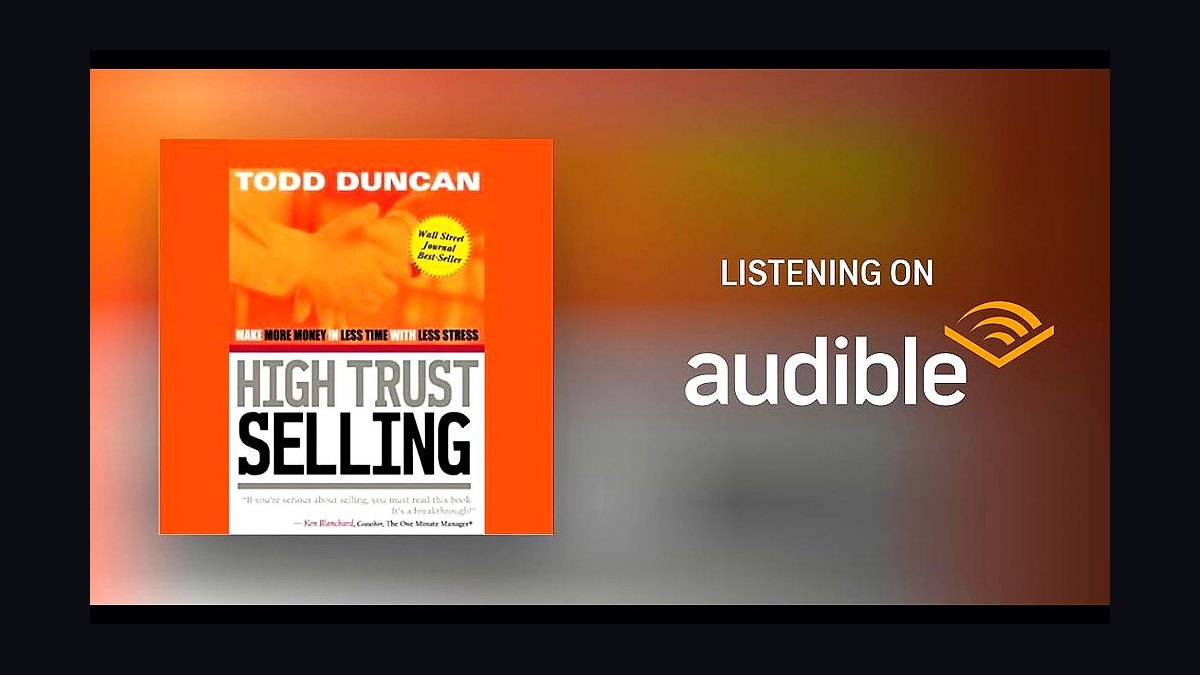
Todd Duncan's *High-Trust Selling* (Thomas Nelson, 2002; 20th anniversary edition 2022) argues trust is the only sales differentiator competitors cannot copy. Duncan organizes 14 Laws into four pillars — Identity, Service, Discipline, and Renewal — plus tools like the 6 Truth Tellers and a 5-5-5 daily cadence, promising more money in less time with less stress.
Trust-built selling versus volume selling: the two operating models Duncan puts on the table
The whole book is a comparison between two ways to run a sales career, and almost every chapter is an argument for one over the other. Duncan calls the first the transactional or volume model: the rep treats each deal as a self-contained unit, works a wide territory, and replaces every closed customer with a new stranger. Activity is the input, conversion rate is the constraint, and the pipeline resets to near-zero every quarter. The second is the trust-built model: the rep works a deliberately narrow base of relationships, invests in each one past the point where it pays for the current deal, and lets referrals replace cold sourcing as the primary pipeline input.
The trade-offs are real in both directions, and Duncan is more honest about this than most sales authors. The volume model has a fast ramp. A new rep with a phone, a list, and a script can produce revenue in weeks. It is legible to management — activity metrics go up, pipeline gets built, forecasts get made. It also survives territory changes, comp-plan resets, and company moves, because nothing the rep built is portable in the first place. What it does not do is compound. A rep in year eight of the volume model runs roughly the same day as a rep in year two, with slightly better objection handling.
The trust-built model inverts every one of those properties. The ramp is brutal. Duncan's own framing — the Law of the Mountain — is that trust is climbed in small daily steps and cannot be reached in one bound, which is a polite way of saying the first twelve to eighteen months look like underperformance to anyone reading a dashboard. Trust deposits do not appear in a CRM field. What the model produces later is a book of business where referrals arrive unsolicited, cycles compress because the buyer stops running a full evaluation, and margin holds because the buyer is not shopping the seller against three alternates. It is also portable in a way the volume book never is — the relationships follow the rep, not the logo.

Duncan's third position, which readers often miss, is that these are not equally available at every stage. He is explicit that the trust model assumes a base to work from. A rep with zero installed relationships cannot run the referral engine, because there is nobody to refer. The honest reading of the book is sequential, not binary: run enough volume activity to create a base, then convert that base into a trust book as fast as the base can support it, and stop adding volume activity only when referral flow covers quota. Reps who read the book as permission to abandon prospecting on day one are misreading it, and Duncan's Law of Daily Discipline — which keeps prospecting at roughly a third of the week permanently — makes that clear.
The comparison also plays out at the level of what the rep sells. Under the volume model, the product is whatever the buyer will sign. Duncan's Law of Identity is the direct attack on this: sellers without an identity sell anything to anyone and end up trusted by no one. The trust model requires a defined niche, a defined ideal client, and — the part almost nobody does — a written list of what the rep refuses to sell and to whom. That refusal list is the actual differentiator, because it is the only thing that makes a recommendation credible. A seller who has never said "this is not right for you" has no evidence that "this is right for you" means anything.
Where this comparison lands hardest today is in markets flooded with automated outreach. When a buyer's inbox fills with generated messages that are individually plausible and collectively worthless, the marginal value of one more well-crafted cold touch falls and the marginal value of a known, trusted human rises. Duncan wrote in 2002 and could not have anticipated the mechanism, but the structural argument survives the change in conditions: anything that can be produced at scale stops being a differentiator the moment it is produced at scale, and trust — because it is built one kept promise at a time over years — cannot be produced at scale by anyone.
Choosing your model: a decision path through Duncan's pillars

Duncan does not give a decision tree, but the book supports one, and building it is the fastest way to turn 14 laws into a choice you can actually make on a Monday. The first question is whether your market has repeat purchase. If a buyer transacts with you once and never again — a genuinely one-shot commodity sale with no referral network behind it — the trust model has nothing to compound. Duncan's own examples come from mortgage, where a loan officer sells a homeowner a mortgage every few years but sells a realtor relationship dozens of loans a year. The realtor, not the homeowner, is the trust asset. The analogous question in B2B is which counterparty recurs: often it is not the customer but the partner, the consultant, or the executive who changes companies every three years and takes you with them.
The second question is cycle length and deal size. Trust investment costs time, and time only pays back when the deal is large enough or the cycle long enough for the buyer's risk to be real. In a two-week, low-cost sale, the buyer's downside from being wrong is small, so their demand for trust is small, and they will buy on convenience. In a long, expensive, career-risking purchase, the buyer's dominant concern is not features — it is whether they will be embarrassed in six months. That is the market where the trust model dominates, and it maps to the long-cycle, relationship-heavy fields Duncan names.
The third question is your existing base. Count the people who would take your call today with no agenda. If that number is under ten, the referral engine cannot start yet and your near-term strategy is base construction — which is prospecting, done honestly, under the Law of Identity and the Law of Honesty. If the number is over fifty, you are almost certainly underworking the base and leaving referrals uncollected; Duncan's prescription there is the 5-5-5 cadence, five personal touches, five follow-ups, five introductions per day, aimed squarely at the base rather than at strangers.

The fourth question — and the one Duncan puts last in the book but that decides whether any of it works — is capacity. The Law of Renewal exists because trust cannot be built by an exhausted rep. An exhausted seller misses commitments, and under Duncan's accounting a missed commitment costs several times what a kept one earns. So the decision path loops: if you cannot sustain the daily discipline the trust model requires, the correct move is to shrink the number of relationships you are trying to serve rather than to serve all of them badly. Duncan frames this as the discipline of saying no, and it is a capacity decision, not a motivational one.
There is a fifth question worth adding for anyone in a modern named-account structure, because Duncan's cadence assumes a wide personal territory. If you carry twenty named accounts, five introductions a day is not a meaningful target — there are not enough people to introduce. The translation is to hold the ratio and change the unit: replace raw touch volume with account research depth, replace introductions with internal-champion expansion inside the same logo, and keep the discipline of a fixed daily block rather than the specific number. The law being preserved is that trust accrues from consistent small deposits; the number 5 is an artifact of Duncan's market, not the principle.
The numbers Duncan puts behind each model

Duncan is unusually willing to put arithmetic on the page, and the lifetime-value comparison is the clearest example. He walks a mortgage rep's career two ways. Path one is transactional: fifteen customers a year for thirty years, which is 450 deals over a career. Path two is trust-built: five durable referral relationships each generating roughly twenty deals a year for thirty years, which is 3,000 deals — and Duncan argues those deals close at roughly 30% higher margin, because referred buyers arrive pre-sold and do not run the transaction as a price shootout. The point of the arithmetic is not the precise figures, which are drawn from his own industry, but the shape: the trust path is not incrementally better, it is an order of magnitude different, and the difference comes entirely from the multiplier on each relationship rather than from working more hours.
The same structure shows up in his Customer-for-Life claim that one trust-based customer is worth more than fifty transactional customers over a career. Read literally that is a strong claim; read structurally it is a statement about three stacked revenue streams from one relationship — repeat business, referrals, and credibility that shortens every subsequent sale by giving the rep a named reference. A transactional customer produces the first stream once and the other two never.
On the trust account itself, Duncan's accounting is that a broken promise costs several times what a kept one earns — his framing is that it takes on the order of ten kept promises to recover from one broken one, and that some accounts never recover at all. This asymmetry is the single most actionable number in the book, because it changes what a rep should commit to. If keeping a promise is worth one unit and breaking one costs ten, the correct strategy is to make fewer, smaller, more certain commitments rather than more impressive ones. "I'll call you Thursday at 2" is a better commitment than "I'll get you a full proposal by end of week," not because it delivers more but because it is nearly impossible to miss. Duncan's related observation on diminishing trust is that repeated small failures aggregate — being fifteen minutes late three times reads to the buyer roughly the way one no-show reads.
The 6 Truth Tellers carry the most specific process claim in the book. Duncan's argument is that reps who ask all six before sending a proposal cut their proposal-to-close cycle substantially — he cites roughly a 30% reduction. The mechanism is not magic: the six questions surface the four things that actually stall deals — undisclosed concerns, unidentified decision-makers, undefined success criteria, and inaccessible budget — before the rep has spent a week writing a document premised on assumptions. The six are worth listing in full because they function as a checklist:

What is your biggest concern about working with us? Who else needs to weigh in on this decision? What would have to be true for this to be the easiest yes you have ever signed? What is your timeline, and what happens if you miss it? What is the budget, and who controls it? If we delivered exactly what we promised, would you refer us to two peers?
Duncan's diagnostic reading of each is that the answer matters less than the willingness to answer. A dodge on question one means the concern exists and the buyer does not trust you enough to name it. A vague answer on question two means you are not yet the person the buyer thinks in terms of when they think about the decision. Hesitation on question six means the trust has not been earned regardless of how warm the meetings have felt. This is why he treats them as trust instruments rather than qualification questions — they measure the relationship, not the opportunity.
On activity allocation, Duncan's 4 Quadrants of Sales Activity — Prospecting, Selling, Servicing, Skill-Building — carry a target split of roughly 30/30/30/10. His observation about the failure mode is the useful part: most reps run something closer to 70% selling, which starves prospecting, servicing, and skill work simultaneously. That allocation produces the sawtooth pipeline every sales manager recognizes, where a strong closing quarter is followed by an empty one because nothing was fed while the rep was closing. His prescribed daily template hardens the split into calendar blocks: early morning for skill work, mid-morning through late morning for prospecting, midday for selling, afternoon for servicing, and a short end-of-day review.
The Law of Mastery adds the skill number — roughly two hours a day of deliberate skill work, in the form of role-play, recorded call review, reading, and peer coaching. Two hours is more than almost any rep spends, and Duncan's justification is the athletic analogy: the performance itself is not practice. He anchors it in deliberate-practice research, which holds that improvement comes from focused repetition with feedback, not from accumulated hours of doing the job. The modern equivalents are call-recording review and structured qualification drills, and the daily number is what separates the practice from an occasional training day.

One number worth holding loosely: Duncan's claims about trust-built books closing at multiples of cold-quota rates and generating the majority of pipeline through referrals come from his own mortgage career and training population, not from independent research. The directional claim is well supported across the broader literature on relationship selling; the specific multiples are his, and should be treated as illustrations of the mechanism rather than as benchmarks to forecast against.
Sequencing the implementation: what to run in which order
The failure mode with a 14-law book is trying to run all fourteen laws on Monday. Duncan's pillars actually impose an order, and the order matters because each pillar is a prerequisite for the next. Identity comes first because it determines who you are building trust with — running a service and discipline program against the wrong accounts just builds trust efficiently in the wrong place. The Identity work is a written artifact, not a reflection: your niche, your ideal client profile, your non-negotiables, and the one-sentence answer to "who do you sell to and what do they get?" Duncan's test is that a stranger should be able to hear that sentence and immediately know whether they are your buyer. Most reps cannot produce it, and he treats that as the root cause of being ignored rather than a branding nicety.
Service comes second and is where most of the near-term revenue movement happens, because it operates on relationships you already have. The three service laws — Service-First, Authentic Listening, and Promise-Keeping — are all executable this week. Service-First means the next contact with each existing relationship carries no ask. Authentic Listening has concrete mechanics: take notes by hand, repeat the buyer's own phrasing back to them before responding, and ask one clarifying follow-up before pivoting to your own point. Duncan's claim is that accurate paraphrasing raises the buyer's assessment of the rep's competence measurably, which is counterintuitive only until you notice that most sellers demonstrate competence by talking. Promise-Keeping is the operational one: every commitment goes into a system with a date, and the system is checked daily.

Discipline comes third because it is what makes the first two survive a bad quarter. This is the 5-5-5 cadence, the 4 Quadrants allocation, the calendar template, and the daily skill block. The sequencing point is that discipline installed before identity produces a very efficient rep pointed at nothing in particular, and discipline installed before service produces high activity with no relationship depth to deposit into.
Reciprocity sits inside the Discipline pillar and has a sequencing rule of its own: give three specific pieces of value before asking for anything. Duncan's qualifier is what makes it work — the gift must be specific to that buyer. A generic whitepaper is not a gift, because it cost nothing and was not chosen for them. An introduction to a peer who has already solved the exact problem they described is a gift, because it required you to remember their problem and spend your own relationship capital. The distinction is enforceable: if the thing you sent could have been sent to a hundred people unchanged, it does not count against the three.
The Truth Tellers get installed as a gate rather than as a phase — no proposal leaves without all six answered. This is the highest-leverage single change in the book for most sellers, because it costs one conversation and removes the most common source of wasted proposal effort. The practical implementation is a required field or checklist item before proposal generation, so the discipline does not depend on the rep remembering under deadline pressure.
Renewal runs last in the book but on a quarterly cadence in practice, and its implementation is subtraction. The audit question is which commitments you are currently carrying that you cannot keep at the standard the trust account requires, and the output is a say-no list. Duncan's observation that the highest earners in his industry worked fewer total hours than the bottom half is the argument for treating this as a performance lever rather than a wellness one — compressed effort with real recovery keeps the promise-keeping rate high, and promise-keeping rate is the input the whole model runs on.

Two honest limitations on the implementation. First, Duncan's examples are drawn from mortgage, real estate, and financial services, so B2B readers translate constantly — the realtor who sends twenty loans a year has no exact SaaS analogue, and finding yours is real work the book does not do for you. Second, the book pre-dates remote-first selling. Fewer ambient touchpoints make the trust account slower to fill, but the same scarcity means a filled account differentiates more. The adaptation is to make deliberately what used to happen incidentally: scheduled no-agenda calls replace hallway conversation, and written follow-through replaces the trust that used to accrue from simply being physically present.
A last note on how the book fits its lineage, since that shapes what you should read alongside it. Duncan published in 2002, after Maister, Green, and Galford's *The Trusted Advisor* (2000) and before Stephen M.R. Covey's *The Speed of Trust* (2006). Duncan is the most tactical of the three — scripts, cadences, and daily allocations — where Covey operates at organizational scale and Maister at the professional-services engagement level. If you carry a quota, Duncan is the one to run; if you run a team, read Covey next.
Related questions
Is the 2002 original or the 2022 edition worth reading?
Read the 20th anniversary edition (2022). Duncan added a new foreword and refreshed case studies for the post-2008 market, but the 14 Laws themselves are unchanged. If you already own the original, the delta is not large enough to justify buying it twice.
Does the framework work for outbound SDRs?
Partially. SDRs cannot run 5-5-5 against a base they do not have, but the Law of Identity (know your ICP precisely), the Law of Honesty (no fabricated personalization), and the Law of Reciprocity (lead with a genuinely useful insight) all translate directly to cold outreach.
How does Duncan compare to Gap Selling or SPIN Selling?

Different layers. SPIN and Gap Selling are diagnostic methodologies for a single conversation — how to uncover and quantify a problem. Duncan operates at career scale: how to build a book that compounds. They stack rather than compete; run SPIN inside a Duncan relationship.
Is the book religious?
Duncan is openly faith-influenced and the Law of Renewal touches on spiritual practice, but the 14 Laws are operational and secular. Readers of any background can apply the complete framework — cadences, Truth Tellers, quadrant allocation — without engaging the faith content at all.
What is the single highest-leverage change from the book?
Asking all 6 Truth Tellers before sending any proposal. It costs one conversation, surfaces the four issues that stall most deals, and Duncan reports it materially shortens proposal-to-close cycles. Nothing else in the book pays back as fast.
FAQ
Who should read High-Trust Selling?
Sellers in long-cycle, relationship-heavy markets: financial services, real estate, consulting, and B2B software with meaningful deal sizes and multi-year customer relationships. The common thread is that the buyer either purchases repeatedly or sits inside a referral network. If you sell a genuine one-shot commodity where the buyer never returns and knows nobody relevant, the compounding argument does not apply and your time is better spent on conversion mechanics.
What are the four pillars?
Identity (know who you are, who you serve, and what you refuse to sell), Service (the Customer-for-Life orientation, authentic listening, and promise-keeping), Discipline (the daily cadence, activity allocation, reciprocity, and skill mastery), and Renewal (mental, physical, and spiritual recovery, plus the discipline of saying no). The 14 Laws distribute across these four, and Duncan treats them as sequential — identity precedes service, service precedes discipline.

What is the 5-5-5 cadence exactly?
Five personal touches, five follow-ups, and five introductions per day, aimed at your existing relationship base rather than at cold prospects. Duncan's point is arithmetic: a rep who does this consistently for a year has made over a thousand trust deposits, which no quarterly blitz can replicate. Modern named-account reps with small territories should preserve the daily-block discipline while translating the volume into account research and champion expansion.
Why does Duncan weight broken promises so heavily?
Because trust is asymmetric. His accounting is that recovering from one broken promise takes roughly ten kept ones, and some relationships never recover. The practical consequence is a change in commitment strategy: make fewer, smaller, more certain commitments rather than impressive ones you might miss. A precise, easily-kept promise builds more trust than an ambitious one delivered late.
How reliable are the numbers in the book?
The structural claims are well supported by the broader relationship-selling literature; the specific multiples are Duncan's own, drawn from his mortgage career and his training population rather than independent research. Treat figures like the 3,000-versus-450 career comparison as illustrations of the mechanism — relationship multipliers beat activity increases — rather than as benchmarks to build a forecast on.
What is the fastest way to start?
Pick three past customers you have not spoken to in six months. Call them with no agenda, ask what is currently difficult, and offer one specific piece of help with nothing attached. Do it again tomorrow with three more. That is the Service pillar running at minimum viable scale, and it is the only part of the framework that produces signal within a week.
Sources
- High-Trust Selling — publisher page, HarperCollins Leadership
- Todd Duncan Group — official site
- High-Trust Selling — Goodreads listing and reader reviews
- The Trusted Advisor — Maister, Green & Galford (publisher page)
- The Speed of Trust — Stephen M.R. Covey (publisher page)
- Influence: The Psychology of Persuasion — Robert Cialdini
- Peak: Secrets from the New Science of Expertise — Anders Ericsson
- Harvard Business Review — research and articles on trust in business relationships
Related on PULSE
- The Transparency Sale by Todd Caponi: Summary, Key Lessons, and RevOps Takeaways
- Selling the Invisible by Harry Beckwith — Cliff Notes Summary
- Secrets of Question-Based Selling by Thomas Freese: Summary, Key Lessons, and RevOps Takeaways
- SPIN Selling by Neil Rackham: Summary, Key Lessons, and RevOps Takeaways
- Gap Selling by Keenan: Summary, Key Lessons, and RevOps Takeaways
- The SPIN Selling Fieldbook — Cliff Notes Summary
This page will be disappearing soon. Save it to your device for $1 — or read it free while it is here.
@Kory-White- · if Venmo asks, the last 4 of my number are 2012
This page is gone.
This one is off the shelf now. $1 keeps it on your phone for good — the whole page, pictures and diagrams included.
 pulse-recentSelling Above and Below the Line by Skip Miller — Top 10 Key Takeaways for Sales Leaders in 2027
 pulse-recentThe Closer’s Survival Guide by Grant Cardone — Top 10 Key Takeaways for Sales Leaders in 2027
 pulse-recentWhat is the first concrete step in The Sandler Rules by David Mattson for building a sales plan in 2027?
 pulse-recentHow do you implement the Sandler Rules by David Mattson in your first 30 days as a new sales manager in 2027?
 pulse-recentWhat are the concrete steps in Strategic Selling for building a sales plan in 2027?
 pulse-recentThe Sales Acceleration Formula by Mark Roberge — Top 10 Key Takeaways for Sales Leaders in 2027
 pulse-recent$100M Offers by Alex Hormozi — Top 10 Key Takeaways for Sales Leaders in 2027
 pulse-recentStart with No by Jim Camp — Top 10 Key Takeaways for Sales Leaders in 2027
 pulse-recentSandler Rule #1: What is the first concrete step to build a prospect's trust in a sales conversation in 2027?
 pulse-recentHow do you implement the Sandler Rules in your first 30 days as a new sales rep in 2027?