


The Brain Audit by Sean D'Souza — Cliff Notes Summary
Quality
Certified
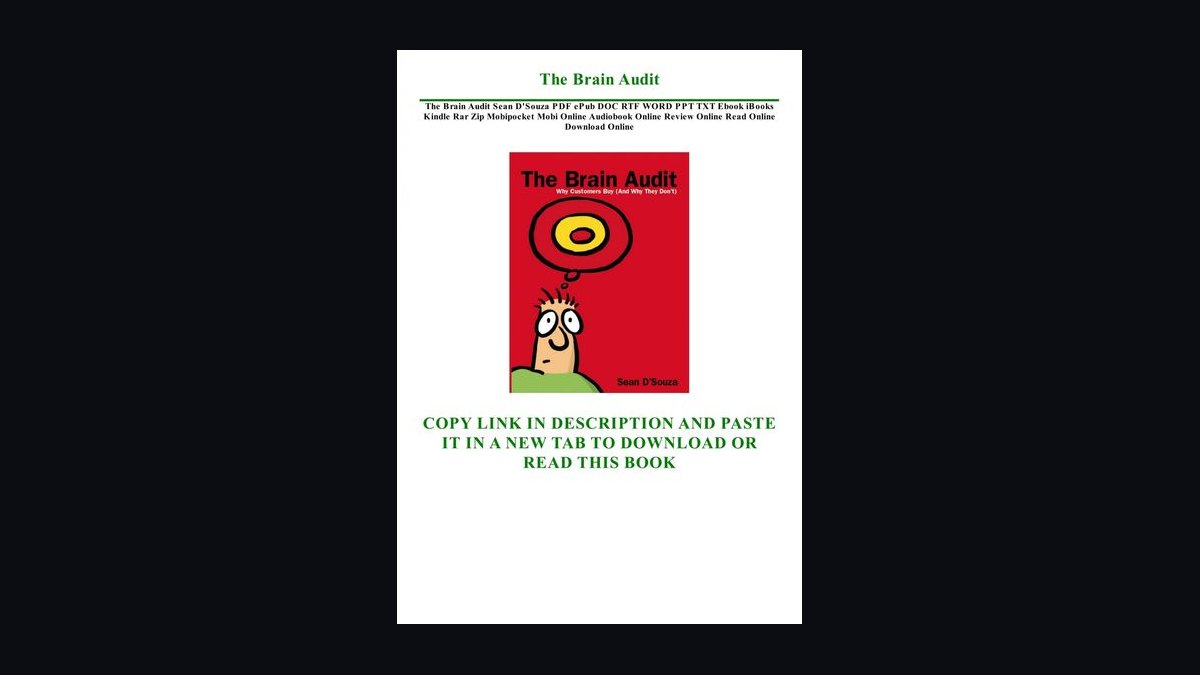
The Brain Audit: Why Customers Buy (And Why They Don't) by Sean D'Souza (PsychoTactics, 2009; later revised editions) argues that every prospect carries seven specific "bags" of objection through the purchase decision, and that sellers and copywriters who unpack all seven before asking for the order close far more reliably than those who leave even one bag still circling the carousel. D'Souza, a New Zealand-based marketing consultant who runs PsychoTactics and the 5000bc.com subscription community, frames the buyer as a traveler at an airport: even one un-claimed bag at the carousel stalls the trip, and even one un-addressed objection stalls the sale. The seven bags — Problem, Solution, Target Profile, Objections, Testimonials, Risk Reversal, Uniqueness — are taught as a fixed checklist that maps onto a sales page, a discovery call, a webinar, or an in-product onboarding flow. The book matters because it sits in the lineage from Robert Cialdini's Influence (1984) through Michael Bosworth's Solution Selling (1994) and forward into Donald Miller's StoryBrand (2017) and Joanna Wiebe's Copyhackers conversion-copy work, and because modern AI sales-copy tools like Lavender and Regie.ai now audit cold email and landing pages for the same persuasion gaps the seven bags name.
1The Airport Metaphor and the Setup

1.1 Why Customers Don't Buy
D'Souza opens with the central diagnosis: most customers don't say no — they say "let me think about it," and then disappear. He attributes this to an incomplete unpacking. The brain, he argues, runs a silent risk audit before any purchase, and it does not move forward while a single bag is still unclaimed. The seller usually thinks the deal stalled on price; D'Souza shows price is rarely the real bag.
1.2 The Seven Bags, Introduced as Luggage
The airport metaphor anchors the entire book. A traveler arrives at baggage claim with seven bags. Six bags appear on the belt; one does not. The traveler does not leave the airport. They wait, frustrated, until the missing bag arrives or is officially declared lost. Sales pages, demo calls, and pricing pages work the same way. A prospect will not "leave the airport" (sign the contract, click Buy, upgrade the plan) while any one of the seven bags is still circling unclaimed. The metaphor is sticky because it explains the most common failure mode in B2B selling: the seller did six of seven things right and cannot understand why the deal froze.
2Bag One — The Problem
2.1 Naming the Pain in the Buyer's Own Words
The first bag is the Problem, and D'Souza is rigid about how it must be unpacked: in the buyer's own language, not the seller's. A buyer who searches "my sales team can't get past the gatekeeper" should land on a page that uses the phrase "can't get past the gatekeeper" verbatim — not "improve top-of-funnel pipeline velocity." D'Souza credits the PsychoTactics 5000bc community for the practice of harvesting verbatim phrases from forum posts, support tickets, and one-to-one interviews. The Problem bag fails most often when marketing teams describe the pain in their own internal jargon.
2.2 The "Trigger Moment"
D'Souza distinguishes the trigger moment — the specific event that made the buyer start looking — from the underlying chronic pain. A CRO does not wake up one morning and decide to buy a forecasting tool; she wakes up after the board meeting where the CFO challenged her commit number. The Problem bag must land on the trigger, not the chronic condition.
3Bag Two — The Solution
3.1 Showing, Not Describing

The second bag, Solution, is the easiest to unpack and the one most sellers over-invest in. D'Souza warns that showing the solution before naming the Problem (Bag One) almost always backfires — the prospect rejects the solution because they were not yet convinced the problem was theirs. He cites the infomercial pattern as the canonical sequence: agitate the problem, then reveal the product. Demos that lead with "let me show you our dashboard" skip Bag One and lose the room.
3.2 Concrete Over Abstract

D'Souza insists on a concrete, picturable solution — not "we help you grow revenue" but "we send your reps three pre-researched prospects every morning at 7am with the trigger event already noted." The more picturable the solution, the faster the prospect's brain checks the bag off the list.
4Bag Three — The Target Profile
4.1 One Specific Person You Can Name
The third bag is where D'Souza's framework diverges sharply from standard marketing. He rejects demographic-style buyer personas outright: "Target Profile isn't a demographic — it's one specific person you can name." A real Target Profile is not "VP of Sales at a 50-200 person SaaS company"; it is "Maria Chen, VP of Sales at a Series B horizontal SaaS company who just missed Q3 and whose CRO told her to fix forecast accuracy by Q1."
4.2 Why One Person Beats a Segment
D'Souza argues the one-person target produces sharper copy than any segment definition because copy written for "VPs of Sales" tries to land with every VP of Sales and lands with none. Copy written for Maria Chen lands with Maria Chen — and, by extension, with the broader segment whose situation rhymes with hers. This is the bag most B2B teams skip; they assume "ICP" is good enough. D'Souza shows it is not.
4.3 The "Could You Pick Them Out of a Lineup?" Test
The diagnostic test D'Souza prescribes: could you pick your target out of a lineup of similar buyers? If the answer is no, the Target Profile bag is unclaimed and the copy will not convert.
5Bag Four — Objections
5.1 The Three Sources of Objections
The fourth bag is Objections, and D'Souza classifies every objection into one of three sources. Friend objections come from the buyer's trusted peers ("my CFO will never approve a six-figure contract for a tool nobody on my board has heard of"). Self objections come from internal doubts ("I tried a tool like this two years ago and the rollout failed — what makes this different?"). Comparison objections are versus alternatives ("Gong already does some of this; why pay you on top?").
5.2 Surface Them, Don't Hide Them
D'Souza's most counterintuitive teaching: the seller, not the buyer, raises the objection first. Hiding from objections lets them fester in the buyer's silent risk audit. Naming them on the sales page or in the demo — "you're probably wondering whether this overlaps with Gong, and here's exactly where it does and doesn't" — defuses them. The companion volume How to Get Testimonials That Sell treats this as the highest-leverage move in conversion copy.
5.3 The "Yes-But" Pattern
D'Souza teaches a verbatim phrasing pattern: "You may be thinking X — and here's why Y." It mirrors the Voss-style "It seems like..." label move from Never Split the Difference and the Carnegie acknowledge-before-disagree technique. The pattern is older than D'Souza, but his contribution is structuring it as a checklist item the copywriter cannot skip.
6Bag Five — Testimonials
6.1 Peer-Like Proof
The fifth bag, Testimonials, fails when the proof comes from a buyer who does not match the Target Profile. A testimonial from a Fortune 50 CIO does not unpack a startup founder's bag; the founder needs to hear from another founder. D'Souza dedicates a full companion book — How to Get Testimonials That Sell — to the mechanics of harvesting peer-like proof, and the 5000bc.com community runs ongoing workshops on the topic.
6.2 The Six-Question Testimonial Script
D'Souza's signature contribution is the six-question testimonial interview, which produces testimonials that pre-emptively unpack other bags. Sample questions: "What was the obstacle that would have prevented you from buying?" (surfaces Objections), "What did you find as a result of buying?" (surfaces Solution outcomes), "Who would you recommend this to?" (sharpens Target Profile). A well-harvested testimonial is a multi-bag unpacker, which is why D'Souza calls testimonials "the most underused asset in marketing."
7Bag Six — Risk Reversal
7.1 The Price of Admission
The sixth bag is Risk Reversal, and D'Souza is uncompromising: "Risk reversal isn't a marketing tactic — it's the price of admission." Money-back guarantees, free trials, opt-out clauses, pilot-to-production paths, and mutual exit ramps all qualify. The stronger the reversal, the faster the close. He cites direct-response legends like Joe Karbo and Gary Halbert who built reputations on long, no-questions-asked guarantees because the buyer's downside collapsed toward zero.
7.2 B2B-Specific Risk Reversal
For B2B, D'Souza prescribes tiered risk reversal: a paid pilot with a clean exit, a quarterly opt-out clause for the first year, a price-lock for the duration of the contract, and a named human accountable for the rollout (not a faceless "customer success team"). Each layer peels another worry out of the buyer's bag. Modern PLG companies — Notion, Linear, Vercel — have institutionalized this with freemium tiers and self-serve cancellation, which is risk reversal built directly into the pricing page.
8Bag Seven — Uniqueness
8.1 Why You, Not Them
The seventh bag is Uniqueness, and D'Souza is careful: uniqueness is not a feature checklist or a "we're the only ones who..." brag. It is a clean answer to "why you, not them?" that the buyer can repeat to their CFO without notes. The Uniqueness Test he prescribes: strip your company name off the sales page. If a competitor could paste their name on the page and it would still be true, you have no uniqueness. Most B2B sales pages fail this test.
8.2 Uniqueness Comes from a Wedge, Not a Wishlist
The best uniqueness statements are wedge-shaped: narrow enough to be defensible, sharp enough to be repeatable. "We are the only forecasting tool that reads your CRM and your Gong calls and reconciles the two automatically" beats "We are the most accurate forecasting platform on the market." The first is testable. The second is marketing wallpaper.
Frameworks at a Glance
- The Seven Bags — Problem, Solution, Target Profile, Objections, Testimonials, Risk Reversal, Uniqueness. Fixed order, fixed checklist, no skipping.
- Target Profile — one specific named person, not a demographic segment. The "lineup test" decides whether the bag is unpacked.
- The Three Sources of Objections — Friend, Self, Comparison. Every doubt the buyer carries belongs to one of these three sources.
- Risk-Reversal Architecture — money-back guarantees, free trials, quarterly opt-outs, named human owners, price-locks. Layered, not single-shot.
- The Uniqueness Test — strip your name off the page; if a competitor could paste theirs on and it would still be true, the bag is unclaimed.
- The Six-Question Testimonial Script — interview questions that produce testimonials which themselves unpack multiple bags.
- Conversion Lift — D'Souza's core claim is that unpacking all seven bags explicitly outperforms the typical four-or-five-bag sales page; the un-addressed bags, not the price, are where deals stall.
What Holds Up, What Has Aged
What holds up. The seven-bag framework itself is the most durable contribution. Today, many PLG companies apply seven-bag thinking inside the product itself — the pricing page unpacks Bags 1, 2, 3, and 7; the in-product onboarding unpacks Bags 4 and 6; the customer-marketing function unpacks Bag 5. Lavender and Regie.ai ship AI features that audit cold-email and landing-page copy for the same gaps the seven bags describe. The Target Profile insistence on one named person rhymes with the conclusions of modern conversion-copy practitioners — from Joanna Wiebe at Copyhackers to April Dunford's positioning work to Donald Miller's StoryBrand — all of whom land on the same advice to write for one person, not a segment.
What has aged. The book's examples lean heavily on direct-response infomercials and email lists, which feels dated against modern PLG motions and product-led adoption. D'Souza under-weights the role of the product itself as a bag-unpacker — today, a free tier that lets the buyer experience the solution before talking to sales can unpack Bags 1, 2, and 6 simultaneously, which the original book did not emphasize. AI copywriting tools can audit for missing bags but cannot source authentic testimonials, which keeps Bag 5 as the highest-leverage human work in the modern stack. And risk reversal is more important than ever, not less, because B2B SaaS buyers have been burned by failed rollouts and now expect quarterly opt-outs by default.
FAQ
Why seven bags and not five or ten? D'Souza argues the seven map onto the recurring stall points he saw in conversion work — fewer leaves gaps, more becomes unmemorable. The seven hold up across B2C, B2B, services, SaaS, and PLG without modification.
Is the airport metaphor literal or just rhetorical? Both. The airport is a memory device, but D'Souza means it operationally: the buyer does not leave the airport while a bag is missing, which means the seller's job is to monitor the carousel, not to push the buyer toward the exit.
How does this differ from Cialdini's Influence? Robert Cialdini's Influence (1984) catalogs universal compliance principles (reciprocity, scarcity, authority, consistency, liking, social proof). D'Souza's framework is operational, not psychological — it tells you what to put on the page, not why the brain reacts to it. The two are complementary: Cialdini explains why a testimonial works; D'Souza tells you which six questions to ask to harvest it.
Does the 7-Bag framework work for enterprise selling? Yes, with adaptation. In enterprise, Bag 3 (Target Profile) becomes a buying committee — every member carries their own seven bags. MEDDPICC and Force Management's Command of the Message handle the committee dynamics; D'Souza handles each individual member.
What's the single highest-leverage bag to fix first? Bag 4 (Objections), in D'Souza's experience. Most sales pages already do passable work on Problem, Solution, and Uniqueness; almost none surface objections first. A single afternoon of objection-mapping is one of the cheapest conversion gains available, precisely because so few competitors do it.
Should AI write my 7-Bag sales copy? AI can draft Bags 1, 2, 6, and 7 — they are pattern-matchable from existing material. AI cannot produce Bags 3, 4, and 5 without human input — Target Profile, Objections, and Testimonials all require real interviews with real customers. The best practice is AI-drafted first pass, human-interview-fed second pass.
Bottom Line
Read The Brain Audit if you write sales copy, run sales calls, or design a pricing page — which means every founder, every revenue leader, and every product marketer. Monday morning: print the seven bags on a card, lay it next to your top-of-funnel sales page or your demo deck, and circle every bag that is not explicitly unpacked. The unmarked bags are why your deals stall on "let me think about it." Fix the missing bags before you touch headlines, hero images, or pricing — the bag work is where the conversion lift lives.
Related on PULSE
- The 12 Week Year by Brian Moran and Michael Lennington — Cliff Notes Summary for Sellers
- Contagious by Jonah Berger — Cliff Notes Summary for Sellers
- The Advantage by Patrick Lencioni — Cliff Notes Summary for Sales Leaders
Sources
- Sean D'Souza — The Brain Audit: Why Customers Buy (And Why They Don't) (PsychoTactics, 2009; later revised editions)
- Sean D'Souza — How to Get Testimonials That Sell (PsychoTactics, companion volume)
- PsychoTactics blog and the 5000bc.com subscription community — D'Souza's ongoing workshops and case-study library
- Robert Cialdini — Influence: The Psychology of Persuasion (William Morrow, 1984; revised 2021)
- Michael Bosworth — Solution Selling (McGraw-Hill, 1994) — the lineage predecessor on consultative discovery
- Donald Miller — Building a StoryBrand (HarperCollins Leadership, 2017) — the descendant that translated D'Souza-style structure into narrative form
- Joanna Wiebe — Copyhackers blog and Copy School curriculum — modern conversion-copy practice built on the same buyer-language audits
- April Dunford — Obviously Awesome (Ambient Press, 2019) — companion text on the Uniqueness bag and positioning wedges
- Chris Voss — Never Split the Difference (HarperBusiness, 2016) — the "It seems like..." label pattern echoing D'Souza's "You may be thinking..." move
- Lavender and Regie.ai product documentation — AI sales-copy tools that audit cold email and landing pages for persuasion gaps
- Notion, Linear, Vercel pricing pages — modern PLG examples of risk reversal built into the product itself
- Gartner — The B2B Buying Journey research (2019–2024) confirming the multi-stakeholder stall pattern the 7-Bag framework predicts
This page will be disappearing soon. Save it to your device for $1 — or read it free while it is here.
@Kory-White- · if Venmo asks, the last 4 of my number are 2012
This page is gone.
This one is off the shelf now. $1 keeps it on your phone for good — the whole page, pictures and diagrams included.
 pulse-recentSandler Rule #1: What is the first concrete step to build a prospect's trust in a sales conversation in 2027?
 pulse-recentNever Lose a Customer Again by Joey Coleman — Top 10 Key Takeaways for Sales Leaders in 2027
 pulse-recentHow to Apply Strategic Selling — Step-by-Step Playbook in 2027
 pulse-recentSPIN Selling by Neil Rackham — Top 10 Key Takeaways for Sales Leaders in 2027
 pulse-recentSell or Be Sold by Grant Cardone — Top 10 Key Takeaways for Sales Leaders in 2027
 pulse-recentWhat are the concrete steps to implement the Sandler Rules for Sales Leaders by David Mattson in 2027?
 pulse-recentWhat is the first concrete step in The Sandler Rules by David Mattson for building a sales plan in 2027?
 pulse-recentThe Sales Manager’s Guide to Greatness by Kevin Davis — Top 10 Key Takeaways for Sales Leaders in 2027
 pulse-recentWhat are the concrete steps in Sandler Rule #7 for handling a prospect's budget objection in 2027?
 pulse-recentHow do you implement the Sandler Rules in your first 30 days as a new sales rep in 2027?