


Pitch Perfect by Bill McGowan — Cliff Notes Summary
Quality
Certified

*Pitch Perfect* by Bill McGowan (HarperBusiness, 2014, co-written with Alisa Bowman) teaches seven persuasion principles — Headline, Scorsese, Sound Bite, Conversational, Curiosity, Draper, No-Wind-Up — plus the ABT Bridge for redirecting hostile questions. This Summary distills a working strategy: lead with the punchline, speak concretely, kill filler preamble, and rehearse out loud before every high-stakes conversation.
What the book is and why sellers still read it
Bill McGowan is an Emmy-winning former correspondent for *Inside Edition* and the founder of Clarity Media Group, a media-training firm whose client list includes Sheryl Sandberg, Eli Manning, Kelly Clarkson, and Jack Welch, alongside executive teams at Facebook, Spotify, and Goldman Sachs. That background matters because it explains the book's angle. McGowan did not come up through sales methodology or academic rhetoric. He came up through television, where a guest gets ninety seconds, no second take, and an interviewer whose incentives are not aligned with yours. Everything in *Pitch Perfect* is built for that constraint, and the constraint turns out to describe a modern discovery call almost perfectly.
The diagnosis McGowan opens with is blunt: professionals get promoted into rooms where the stakes are existential — a multimillion-dollar deal, a board meeting, a press inquiry, a funding round — with zero formal training in how to speak in those rooms. Everyone gets coached on the deck. Nobody gets coached on the sentence. He describes working with a Fortune 100 CEO who lost a deal inside the first ninety seconds by burying the actual point under three minutes of context-setting, and the lesson generalizes: content is necessary but not sufficient. Delivery is what closes the loop. The line that anchors the whole book is that the audience remembers your headline, not your wind-up.
He then catalogs the three failure modes he sees in nearly every training session. The Wind-Up is thirty to forty seconds of preamble before the actual point arrives — "that's a great question," "let me take a step back," "so a little context first." The Data Dump is a flood of statistics with no narrative spine, where every number is individually true and collectively unmemorable. The Hedge is the qualifier stack: "I think maybe we could probably consider possibly…" McGowan uses a transcript of a tech CEO's failed cable-news appearance — the executive said "you know" forty-seven times in four minutes — to make the abstraction visceral. His fix is structural rather than stylistic. You do not solve the Wind-Up by trying to sound more confident. You solve it by front-loading the headline, pruning the qualifiers, and committing to the sentence.

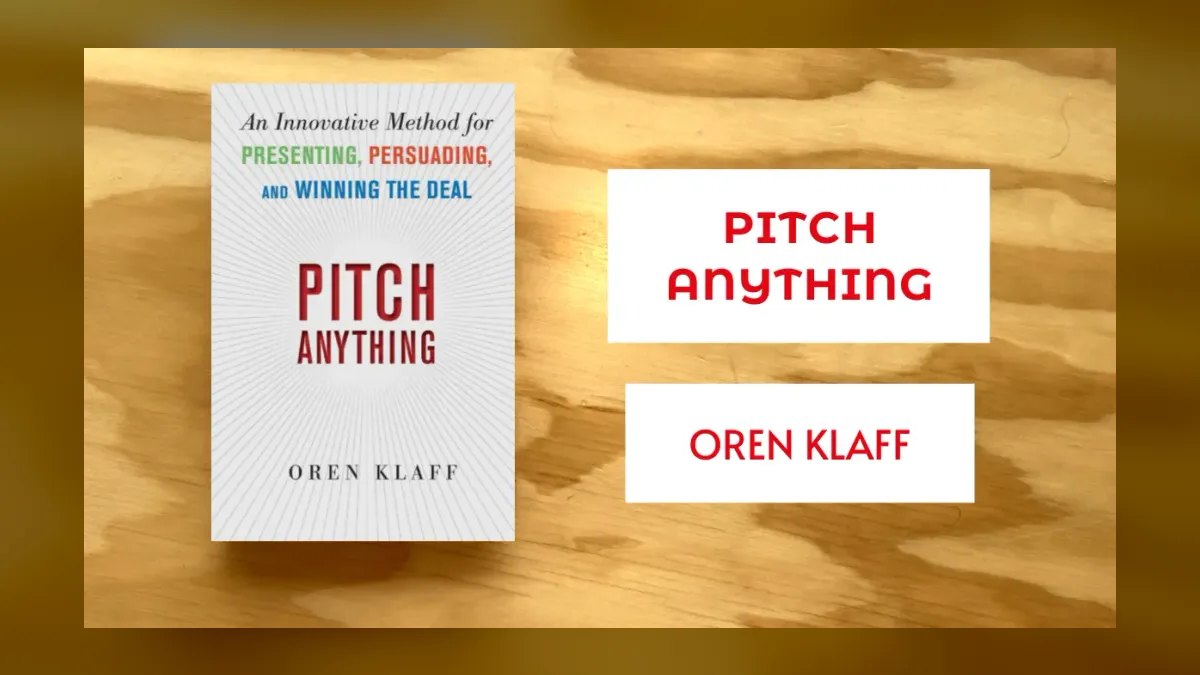
Why this lands with sellers specifically: sales training is overwhelmingly about *what* to ask and *when* to advance. MEDDPICC teaches qualification. SPIN teaches question sequencing. Challenger teaches commercial teaching and constructive tension. None of them teach the delivery layer — the actual acoustic shape of the words leaving your mouth in the moment a CFO asks why you cost more than the incumbent. *Pitch Perfect* is the operating manual for that layer, which is why it sits comfortably next to Oren Klaff's *Pitch Anything*, Carmine Gallo's *Talk Like TED*, and the Heath brothers' *Made to Stick* rather than competing with any of them.
There is a useful adjacency here worth naming. The same delivery layer governs domains most sellers touch but rarely think of as pitching: an internal QBR where you are defending forecast accuracy, a hiring loop where you are selling a candidate on the role, a vendor negotiation where you are the buyer, an all-hands where you are explaining a pricing change to a nervous CS team. The book's TV framing obscures how broad the surface actually is. If a moment involves a live human, a limited window, and a question you cannot fully control, the seven principles apply.
The seven principles, and the process for running them
The principles are not a checklist you apply in sequence during a call. They are a preparation discipline that produces a call you do not have to think your way through. Here is how each one actually behaves in practice.
Headline. Lead with your strongest point, full stop. McGowan trains clients to imagine the newspaper headline that would summarize their answer and then simply say that first. Sandberg's TED talk on women in leadership opens with the problem stated flat — no country has this figured out — and the headline lands in about eleven seconds with no thank-you-for-having-me. For a seller, the application is direct and slightly uncomfortable: the first sentence on a discovery call should be the single most important thing the prospect needs to hear, not a recap of the agenda you both already read.
Scorsese. Show, don't tell. Every abstract claim needs a visual, vivid, specific anchor. "Our software is fast" is inert. A concrete image of what fast means is portable — the prospect can repeat it to their CFO without your deck. The canonical example is Jobs describing the iPod not as five gigabytes of storage but as a thousand songs in your pocket. Same fact, radically different half-life.
Sound Bite (McGowan calls it the Pasta-Sauce Principle, after Prego's "it's in there"). Your message must be memorable, repeatable, and short. A twelve-word sound bite outlasts a twelve-minute monologue. Carville's "it's the economy, stupid" defined the 1992 Clinton campaign in four words. "Just Do It." "Think Different." "Got Milk?" The operational point for sellers is that the prospect *will* paraphrase you internally to their buying committee, whether or not you authored the paraphrase. Author it deliberately or accept whatever they invent.
Conversational. Speak like a person, not a press release. McGowan is merciless about corporate-speak — "operationalize cross-functional alignment," "leverage core competencies" — and runs a translation exercise in which stiff written copy gets rewritten into spoken English. Word counts drop sharply and comprehension climbs. He points to Buffett's shareholder letters as the standard: a billionaire writing in the voice of a friendly uncle. On video calls, warmth and rhythm outperform vocabulary every time.
Curiosity. Open loops the audience wants closed. Tease before you tell. Gladwell's *Outliers* opener — a Pennsylvania town with no heart disease, why? — is the master class. The seller's version is the pattern-interrupt cold open: noticing something specific and slightly odd in the prospect's public materials and asking about it. Curiosity buys you the next ninety seconds, which is all you were going to get anyway.
Draper. Named for the *Mad Men* character: ownership, clarity, command. No hedging, no apologizing, no undermining your own pitch before it lands. Strike the apologetic preamble — "I'm not sure if this is helpful, but…" — which signals weakness in advance of any content. McGowan pairs this with physical mechanics: posture, eye contact, and the vocal floor, meaning you drop your pitch at the end of a sentence instead of upspeaking into an implied question.
No-Wind-Up. The most quoted line in the book and the highest-leverage habit in it: never preface, just say it. The phrases to eliminate are specific — "that's a great question," "let me think about that," "to answer your question," "as I said before," "what I'd like to do is." Each steals five to ten seconds and signals stalling. McGowan holds up Eli Manning's post-game interviews as the counter-model: answer first, elaborate second, earn the elaboration.
The Bridge deserves its own treatment because it is the only piece of the book that is a live-fire technique rather than a preparation habit. ABT: Answer briefly — one sentence, acknowledge the question honestly, do not dodge. Bridge with a transition phrase — "and what's really important here is," "the bigger issue is," "let me put that in context." Talking point — pivot to the message you came to deliver. McGowan has clients prepare three bridge phrases in advance so the move feels natural rather than robotic, and he holds up Zuckerberg's 2018 Senate testimony as a clinic: answer the literal question in one sentence, bridge every time back to the remediation plan.
For sellers the application is the objection. "Yes, we price above the incumbent — and what really matters here is where the payback actually shows up. Here's how that math works for a team your size." The structure acknowledges rather than deflects, which is what separates a bridge from a dodge. Buyers can feel the difference instantly, and a detected dodge costs more trust than the objection ever would have.
Sitting behind the Bridge is the practice McGowan calls war-gaming the Q&A: before any high-stakes appearance, brainstorm the twenty worst questions you could be asked and write the bridge for each. He credits it with saving multiple Fortune 500 reputations during crisis interviews. The seller's version is an objection map — every recurring pricing, timeline, competitor, security, and procurement objection mapped to a one-sentence answer plus a bridge into the value narrative.
Time, effort, and what the prep cycle actually costs
The book's prep discipline is specific enough to schedule, which is unusual for a communication title. McGowan's cycle runs roughly twenty-four hours ahead of the event and has five components: draft your three sound bites, war-game twenty questions, rehearse out loud into a recorder, review the tape, then edit ruthlessly. His observation about compliance is the interesting part — the overwhelming majority of trainees skip the out-loud rehearsal, and that is precisely the group that freezes. Rehearsing in your head is pattern-matching. Rehearsing out loud is performance, and only performance surfaces the sentence that collapses halfway through.
Translated into hours for a seller, the honest ranges look something like this. Building a first objection map for your product — twenty questions, one-sentence answers, one bridge each — is a two-to-four-hour exercise done properly, and it is largely a one-time cost that you amend quarterly as pricing, competitors, and security posture shift. Drafting three sound bites for a specific opportunity is fifteen to thirty minutes once the map exists, because you are selecting and sharpening rather than inventing. Out-loud rehearsal with a recording is ten to twenty minutes. Reviewing that recording honestly takes about as long as the recording itself plus a pass to mark the wind-ups. The day-of routine McGowan describes — hydrate, warm up the voice, avoid the caffeine spike, check posture, scan the three sound bites — compresses to about five minutes before a call.
So the marginal cost per meaningful call is roughly thirty to forty-five minutes of prep, against a fixed setup investment of a few hours. That is the actual trade being proposed. For a routine follow-up call it is obviously too much. For a first executive briefing, a competitive bake-off, a renewal at risk, or a board-level presentation, it is trivially worth it, and the asymmetry is the whole point: you are spending a fixed, predictable amount of time to protect an outcome whose variance is enormous.
Formal media training as a purchased service is a different order of magnitude — a category typically sold as day-rate engagements to executive teams, which is why the book exists at all. Reading the book and running the drills yourself captures a large fraction of the value at the cost of a paperback and your own discipline. That is the practical arbitrage for anyone in sales who is not going to get a media-training budget line.
There is a habit-formation timeline underneath the event timeline, and McGowan is realistic about it. You cannot suddenly become a great communicator in the high-stakes moment. You build the muscle in low-stakes settings: lead with the conclusion in every internal meeting, cut the wind-up in every Slack message, write the sound bite in every email subject line. His closing argument is that there are no free reps — every internal call is practice for the customer call. Expect the headline habit to feel deliberate for a few weeks and automatic somewhere past a month of consistent use. The wind-up phrases are harder to kill because they are social lubricants and their removal initially feels rude. It is not rude. It reads as prepared.
The final chapter argues for relentless self-recording — every pitch, every demo, every internal presentation — reviewed with a coach or a peer. McGowan's blunt observation is that most professionals never watch themselves on video, which is exactly why bad habits compound undisturbed for decades. Modern conversation-intelligence tooling has automated the capture side of this for sellers, but the discipline is unchanged: watch the tape, mark the wind-ups, fix one habit a week. One habit. Not seven.
Where teams get this wrong
The most common failure is treating the seven principles as a style guide rather than a preparation system. A rep reads the book, decides to "be more Draper," and shows up to the next call with performative confidence and no sound bites. That is worse than the baseline, because unearned command reads as arrogance and buyers punish it. The principles are downstream of the prep. Skip the prep and you are just adjusting your posture.
The second failure is bridging into a dodge. ABT works because the "A" is a real answer — brief, honest, responsive. Teams that adopt bridge phrases without adopting the brief-honest-answer discipline produce reps who sound evasive on every pricing question, and buyers now have a decade of exposure to this move from vendors and politicians alike. They spot it immediately. If your answer to a pricing question never actually contains a directional answer about price, the bridge is a tell, not a technique.
Third: over-scripting. Sound bites are meant to be authored lines you can deliver naturally, not a script you recite. When a rep memorizes twelve sound bites and starts inserting them regardless of context, the call turns into a sequence of unrelated slogans. McGowan's own guidance is three per event, not twelve, and the reason is cognitive — three you can hold in working memory and place naturally, twelve you must consciously retrieve, and conscious retrieval is visible to the listener.
Fourth: enablement teams roll this out as a one-time workshop. A ninety-minute session on the seven principles produces a week of improved calls and then reversion, because nobody built the feedback loop. The version that sticks pairs the workshop with call recording, a weekly review ritual, and a single named habit per rep per week. Without the loop, you have bought awareness, not behavior change.
Fifth, and this one is subtle: applying the Headline Principle to discovery when you should be applying Curiosity. Front-loading your punchline is correct when you are *answering*. It is wrong when your job in the moment is to make the prospect talk. A rep who opens every discovery call with a compressed value headline has optimized for the demo and damaged the discovery. The principles have contexts, and the book's TV framing — where you are always the one being asked — can obscure that a seller's first call is often the reverse.
Sixth: ignoring the medium shift. The book was written before video calls were the default, and some of its physical guidance needs translation. Vocal floor still applies. Posture still applies. But eye contact on a video call means looking at the camera, not the face on screen, and the two are mutually exclusive. Framing, lighting, and the half-second of latency that makes interruption feel aggressive are all real variables the 2014 text does not address. Teams that port the advice literally end up coaching behaviors that read differently through a webcam than they did across a conference table.
Seventh: measuring the wrong thing. Filler-word counts are easy to instrument and tempting to gamify, and a rep who is consciously suppressing "um" while talking is not listening. The outcome that matters is whether the prospect can restate your value proposition accurately after the call. If you want a metric, use that one — ask the champion to repeat it back, or read it in their internal summary email. Filler count is a lagging proxy at best.
Choosing which principle to reach for
The decision is usually not "which of the seven" but "what kind of moment am I in." Most of the confusion in applying this book comes from collapsing four distinct situations into one.
If you are being *asked* something — an objection, a hostile question, a question you did not anticipate — the answer is No-Wind-Up first, then Bridge if the question is one you would rather redirect. If you are *opening* — a cold call, a first sentence, an email subject — the answer is Curiosity, because your job is to earn attention you do not yet have. If you are *explaining* — a demo, a technical walkthrough, a business case — the answer is Scorsese plus Sound Bite, because the risk is a data dump nobody can repeat. If you are *closing or committing* — a proposal review, a negotiation, a board ask — the answer is Draper plus Headline, because ambiguity at the commitment stage is read as doubt.
The same framing helps with the neighboring question of which book to reach for. McGowan and Klaff are often shelved together and they solve different problems. Klaff's *Pitch Anything* is the aggressive sibling — frame control, status dynamics, holding a room that is actively trying to take it from you. McGowan is the polished sibling — calm command, sound bites, bridges, broadcast discipline under scrutiny. If your problem is that you lose control of adversarial rooms, read Klaff. If your problem is that you sound unprepared under a question you did not expect, read McGowan. If your problem is that your ideas are forgotten within an hour, the Heath brothers' *Made to Stick* is closer to the root cause, and Gallo's *Talk Like TED* is the closest adjacent title to *Pitch Perfect* — published the same year, aimed at the stage rather than the interview chair.
What holds up in the book is nearly everything structural, because it is grounded in cognitive economics rather than fashion. Attention is scarce, working memory is bounded, and primacy and recency effects are real. If anything the Headline Principle matters more now than in 2014: meetings have compressed, buying committees evaluate several vendors in parallel, and the first thirty seconds of a demo decide whether you get the next thirty minutes.
What has aged is the frame. Most readers will never sit for a network television interview, and the broadcast examples reference a media landscape that podcasts and short-form video have substantially displaced. Video calls are barely mentioned because they were still novel when the book was written. And the whole text predates AI-assisted preparation, which has genuinely changed the economics of the prep cycle — drafting candidate sound bites and war-gaming twenty questions used to be the expensive part and is now fast. That shift makes the book *more* useful, not less, because it moves the bottleneck squarely onto delivery, which is the part McGowan actually teaches and the part no tool performs for you.
The practical strategy, if you want two things to change Monday: front-load the headline on every call, and delete every wind-up phrase from your vocabulary. Both are free, both are immediate, and both move perceived authority within a week. Then build the twenty-question objection map with a bridge for each, and rehearse it out loud before your next real deal.
Related questions
How long does it take to read *Pitch Perfect*?
It is a fast trade-nonfiction read — most people finish it in one or two sittings. The principles are short and example-driven. The real time cost is not reading but building your own sound bites and objection map afterward, which is where the value actually is.
Should I read *Pitch Perfect* or *Pitch Anything* first?

Read McGowan first if your weakness is sounding unprepared under unexpected questions. Read Klaff first if your weakness is losing control of adversarial rooms. McGowan is the easier read and the faster payoff; Klaff is more situational and more aggressive.
Does the Bridge technique work on sophisticated buyers?
Yes, provided the "answer briefly" step is a real answer. Sophisticated buyers detect dodges instantly and penalize them. The bridge works because it acknowledges honestly before redirecting — remove the honest acknowledgment and it becomes an obvious evasion.
Is this book useful for non-sales roles?
Very. The principles apply to internal presentations, hiring loops, board updates, incident communications, and job interviews. Anywhere there is a live audience, a limited window, and questions you cannot fully control, the delivery layer decides whether your content lands.
What's the fastest habit to adopt from the book?
Eliminating wind-up phrases. Cut "that's a great question," "let me think about that," and "to answer your question." It costs nothing, requires no preparation, and immediately makes you sound more prepared and more credible.
FAQ
What is the single most important takeaway from Pitch Perfect?
The No-Wind-Up Principle. Delete "that's a great question" and "let me take a step back" from your vocabulary and you instantly sound more confident and more prepared, because the words that follow a question are read as evidence of whether you knew the answer. It requires no prep, no script, and no permission — which makes it the highest-leverage habit in the book.
What exactly is the Bridge technique and when should I use it?
ABT: Answer briefly in one honest sentence, Bridge with a prepared transition phrase such as "what's really important here is," then pivot to the Talking point you came to deliver. Use it when a question is technically fair but strategically inconvenient — pricing before value is established, a competitor comparison, a timeline you cannot commit to yet.
How many sound bites should I prepare for a call?
Three. McGowan's number is deliberate — three fit in working memory and can be placed naturally as the conversation offers openings, while a dozen require conscious retrieval, and conscious retrieval is audible to the person listening. Keep each under roughly twelve words, and make them vivid enough that your champion can repeat them accurately to someone who was not on the call.
Is Pitch Perfect only for executives doing television interviews?
No. The broadcast framing is the vehicle, not the lesson. The same mechanics govern discovery calls, demos, board pitches, internal QBRs, all-hands explanations, and job interviews. McGowan chose TV examples because television makes the constraints extreme and therefore visible, but any moment with a live audience and a limited window has the same shape.
Can AI tools replace the preparation McGowan teaches?
Partially, and usefully. Modern assistants can draft candidate sound bites, war-game twenty likely objections, and critique a call transcript in minutes — work that used to consume most of the prep cycle. What they cannot do is deliver. Vocal command, pacing, posture, and the decision to answer rather than preface all remain human, and those are precisely what the book trains.
Where does this book sit in the modern sales canon?
Alongside the Heath brothers' *Made to Stick* on the foundational end and Gallo's *Talk Like TED* as its closest 2014 contemporary, with Klaff's *Pitch Anything* as the adversarial counterpart. It is not a sales methodology and does not compete with SPIN, Challenger, or MEDDPICC — it teaches the delivery layer that makes any of those methodologies actually land in the room.
Sources
- https://www.harpercollins.com/products/pitch-perfect-bill-mcgowan
- https://www.claritymediagroup.com/
- https://www.ted.com/talks/sheryl_sandberg_why_we_have_too_few_women_leaders
- https://www.berkshirehathaway.com/letters/letters.html
- https://www.mheducation.com/highered/product/pitch-anything-innovative-method-presenting-persuading-winning-deal-klaff/M9780071752855.html
- https://heathbrothers.com/books/made-to-stick/
- https://us.macmillan.com/books/9781250061539/talkliketed
- https://www.c-span.org/video/?443543-1/facebook-ceo-mark-zuckerberg-testifies-data-protection
- https://www.gong.io/blog/
- https://www.nytimes.com/2014/02/23/business/pitch-perfect-by-bill-mcgowan.html
Related on PULSE
This page will be disappearing soon. Save it to your device for $1 — or read it free while it is here.
@Kory-White- · if Venmo asks, the last 4 of my number are 2012
This page is gone.
This one is off the shelf now. $1 keeps it on your phone for good — the whole page, pictures and diagrams included.
 pulse-recentGetting to Yes by Roger Fisher and William Ury — Top 10 Key Takeaways for Sales Leaders in 2027
 pulse-recentHow to Apply Strategic Selling — Step-by-Step Playbook in 2027
 pulse-booksTop 10 practical takeaways from Atomic Habits for building a new routine in 2027.
 pulse-recentMonetizing Innovation by Madhavan Ramanujam — Top 10 Key Takeaways for Sales Leaders in 2027
 pulse-recentThe Transparency Sale by Todd Caponi — Top 10 Key Takeaways for Sales Leaders in 2027
 pulse-recentWhat is the first concrete step in the Sandler Selling System for handling a prospect's initial brush-off in 2027?
 pulse-recentHow do you implement the Sandler Rules by David Mattson in your first 30 days as a new sales manager in 2027?
 pulse-recentTraction by Gabriel Weinberg and Justin Mares — Top 10 Key Takeaways for Sales Leaders in 2027
 pulse-recentHyper Sales Growth by Jack Daly — Top 10 Key Takeaways for Sales Leaders in 2027
 pulse-recentConceptual Selling by Robert Miller and Stephen Heiman — Top 10 Key Takeaways for Sales Leaders in 2027