


Deep Work by Cal Newport — Cliff Notes Summary for Sellers
Quality
Certified
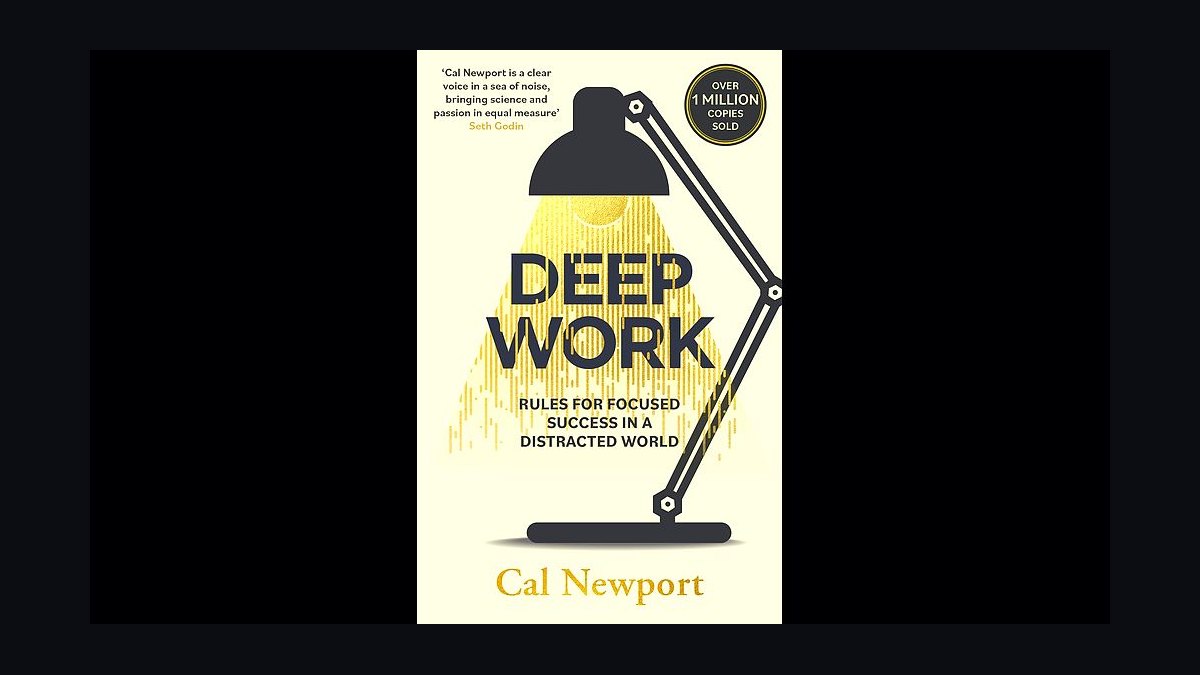
Cal Newport's *Deep Work* (2016) argues that focused, distraction-free effort on hard problems is getting rarer and more valuable at the same time. For sellers, that means the rep who protects two or three uninterrupted blocks a day for research, deal strategy, and skill drilling compounds faster than the rep living inside Slack.
The outcome you should expect
The honest promise of this book is narrower than the marketing around it. Reading *Deep Work* will not add pipeline. Installing its rules will — but on a lag, and the lag is where most sellers quit.
Here is the realistic arc. Week one is unpleasant. You block ninety minutes, close Slack, and discover you cannot hold attention for ninety minutes. Around minute eighteen your hand reaches for the phone with no conscious decision behind it. That reflex is the whole diagnosis: you have spent years training the opposite skill. Newport's point in the "Embrace Boredom" rule is that the reach is not a willpower failure, it's a conditioned response you built at every red light and every elevator ride.
Weeks two and three the block starts holding. You get maybe sixty usable minutes out of the ninety. Output quality changes before output quantity does — the pre-call research you do in a protected block is noticeably better than the research you do with three tabs open, even though it takes the same wall-clock time. You start showing up to discovery calls knowing the buyer's last two earnings calls instead of the homepage boilerplate.
Weeks four through eight is where the compounding shows up in the CRM. Not because you made more calls — you probably made fewer — but because the calls landed differently. Better research produces better questions; better questions surface the actual economic buyer instead of the friendly champion who cannot sign; better qualification means fewer zombie deals clogging the forecast. The mechanism is indirect, which is exactly why it is hard to sell to a sales manager who wants activity metrics this week.

Month three and beyond the effect is on career capital, which is Newport's term from his earlier book *So Good They Can't Ignore You*. You are now the rep who understands the vertical, who can explain the buyer's P&L, who writes the Mutual Action Plan the champion actually forwards internally. That is a hard-to-replicate skill, and hard-to-replicate skills are what the labor market pays a premium for.
The failure mode to expect: you will over-promise this to yourself. A single ninety-minute block does not fix a broken territory, a bad ICP, or a product nobody wants. Deep work is a leverage multiplier on an existing strategy. Multiply a bad strategy by two and you get a worse outcome faster. Newport is explicit that the depth is the *how*, not the *what* — the *what* comes from the qualification framework, the segmentation, and the pipeline math, and none of that is in this book.
One more expectation to set: the effect is uneven across roles. An enterprise AE running six-month cycles with complex buying committees gets enormous return from deep blocks, because the work that wins those deals is research-heavy and strategy-heavy. A high-velocity SMB rep on a fifty-dial-a-day motion gets less — their winning behavior really is volume, and the deep-work value shows up mostly in skill development and call review rather than in the daily motion itself. Know which one you are before you rebuild your calendar around it.
What drives that outcome
Four mechanisms do the work. Understanding them matters because each one has a different failure point, and if you only install the rituals without understanding the mechanism, you will drop the rituals the first week a deal goes sideways.
Attention residue. This is the load-bearing research in the book, from Sophie Leroy's work on task switching. When you switch from task A to task B without finishing A, a fragment of your attention stays on A and degrades your performance on B. The residue does not clear instantly. So the rep who checks Slack every eleven minutes during a "research block" is not doing a research block with interruptions — they are doing a research block at permanently reduced cognitive capacity, and they never see the version of themselves working at full capacity, so they have no idea what they're leaving on the table.
Deliberate practice requires undivided attention. Newport leans on Anders Ericsson's research here. Skill does not improve from repetition; it improves from repetition at the edge of your ability with immediate feedback and full concentration. That is why doing four hundred calls a month can leave a rep exactly as good as they were in month one. Listening back to six of your own recorded calls with a notepad, isolating the specific moment the conversation went sideways, and drilling the alternate response — that is deliberate practice, and it is impossible while half-watching a channel.
The principle of least resistance. In the absence of clear signal about what actually matters, workers default to whatever feels urgent. Sales floors amplify this because responsiveness is visible and pipeline strategy is not. The manager sees the green Slack dot. The manager does not see the ninety minutes you spent mapping the buying committee. Newport's institutional argument is that companies reward the visible proxy, which is why deep work stays rare — and why staying rare is what keeps it valuable.
Busyness as a proxy for productivity. The cultural companion to the above. When output is hard to measure, activity becomes the stand-in. In sales this is unusually well-disguised because there *are* real activity metrics — dials, emails, meetings booked — and they genuinely correlate with results at the top of the funnel. The trap is applying a top-of-funnel logic to bottom-of-funnel work, where the winning behavior is thinking, not doing.
Notice what the diagram implies: the two paths do not differ in hours worked. They differ in what those hours produce. The seller on the fragmented path may work longer and feel busier while producing steadily less durable value — and because both paths feel like work, the gap is invisible from the inside.
Benchmarks and realistic ranges
Newport gives some numbers, and it is worth separating his claims from what is actually reproducible.
Daily deep-work capacity. Newport's stated ceiling for a novice is roughly one hour per day of true deep work; an expert who has trained the habit for years can push toward four. Beyond four hours a day is rare even among full-time researchers and writers. This is the most useful benchmark in the book because it corrects the common mistake of blocking six hours and failing by 10:30 AM. Start at sixty to ninety minutes. Earn the second block.
Shallow work budget. Newport suggests knowledge workers negotiate an explicit ceiling with their manager, and floats 30–50% as a typical range for most roles. For a quota-carrying seller that ceiling is realistically higher — internal meetings, CRM hygiene, forecast calls, and legitimate buyer responsiveness are not optional. A workable target for an enterprise AE is roughly 60–70% shallow and 30–40% deep, which translates to two to three protected hours in an eight-hour day. If you cannot find two hours, the problem is your calendar governance, not your discipline.
Ramp curve. Expect roughly two weeks before a ninety-minute block feels sustainable, four to six weeks before it feels normal, and eight to twelve weeks before you can see it in pipeline quality. Anyone promising a faster read is selling something.
Depth test. Newport's diagnostic for classifying any task: how long would it take to train a smart recent college graduate, with no specialized training in your field, to do this? If the answer is months, the task is deep. If it's a few hours or days, it's shallow. Applied to sales, this sorts cleanly. Building a competitive differentiation matrix for a specific account? Months. Booking a meeting room and updating close dates? Hours. That single question is the most portable tool in the book — it takes ten seconds and it settles most calendar arguments.
Time-blocking granularity. Newport advocates scheduling every minute of the workday in blocks, thirty minutes as the base unit, replanning rather than abandoning when reality intervenes. In practice most people who sustain this long-term end up hybridizing: schedule roughly 50–60% of the day and leave the rest as declared buffer. A seller's day is interrupt-driven by definition — a buyer calling back is not a distraction, it's the job — so the fully-scheduled version tends to break within a week and take the whole habit down with it.
Where the numbers get soft. Be careful with the productivity multipliers that circulate in summaries of this book. Newport is a careful writer and does not claim a clean "scheduled days produce 3x output" figure; that number comes from downstream blog posts, not from the research. The defensible claim is directional and well-supported: task switching carries a real measurable cost, and consolidated attention produces higher-quality cognitive output. That is enough to act on. You do not need an inflated multiplier to justify closing Slack for ninety minutes.
A useful side benchmark from an adjacent domain. Software teams have been measuring this problem for years under the name "maker's schedule versus manager's schedule," Paul Graham's 2009 framing. Engineering orgs that consolidate meetings into two fixed days and leave three clear routinely report that developers describe the clear days as their only productive ones. Sales orgs almost never run this experiment. A team that moved all internal syncs to Monday and Thursday would be running the same experiment on the revenue side — and it is a cheaper test than any tooling purchase.
Risks, edge cases, and failure modes
This is where most summaries go soft, so here are the honest limits.
You are not a Georgetown professor. Newport writes from a tenured academic role where the output that matters is publications and the calendar is largely self-governed. A quota-carrying seller has a manager, a forecast call, a support escalation, and a buyer in a different timezone who wants a call at 7 AM. The monastic philosophy — Donald Knuth famously not doing email — is structurally unavailable to you. Applying it literally will get you managed out. The rhythmic philosophy, the same hours every day, is the only one of the four that survives contact with a sales org.
Unresponsiveness is a real cost in a relationship business. Newport's "become hard to reach" advice was aimed at academics receiving unsolicited requests. In sales, responsiveness to a buyer is a competitive weapon — the vendor who answers in twenty minutes beats the one who answers tomorrow, and buyers notice. The correct translation is to become hard to reach *internally* and stay fast *externally*. Separate those two channels explicitly: buyer email and buyer texts get fast response; internal Slack gets batched at three fixed checkpoints.
The block gets eaten by the first crisis. A deal blows up on Tuesday and the deep block dies, and it does not come back on Wednesday. The fix is to treat the block like a customer meeting — it exists in the calendar as busy, you decline conflicts against it by default, and if it must move, you move it rather than cancel it. Reps who protect it as a "nice to have" lose it within ten days. Every single time.
The schedule becomes its own anxiety. Newport's schedule-every-minute discipline has a documented failure pattern: people build a plan so tight that the first deviation feels like failure, then abandon the whole system. He addresses replanning explicitly in the book, but readers skim past it. If you find yourself feeling guilt about the schedule rather than using it, you have inverted the tool. The block is a container, not a verdict.
Team norms beat individual willpower. A single rep going dark for ninety minutes on a floor where instant Slack response is the cultural norm creates friction, and the friction lands on them. This is the single biggest predictor of whether the habit survives. If the manager has not blessed it, install the block quietly at 6:30 or 7:00 AM before anyone is online, and let results earn you the right to ask for a mid-day one.
The social media chapter is the weakest one for sellers. Newport's craftsman test — adopt a tool only if its benefits substantially outweigh its costs — is sound. His 2016 framing of social platforms as near-uniformly negative does not survive contact with modern B2B, where a rep's LinkedIn presence is a legitimate pipeline source. Split the tool by use: posting and targeted prospecting pass the craftsman test cleanly; scrolling the feed does not. The tool is not the unit of analysis. The behavior is.
Collaborative depth is underweighted. The book's frame is fundamentally solo — one person, one hard problem, one closed door. Modern enterprise deals get won in deal-strategy sessions and win-room reviews where three or four people think hard together for ninety minutes. That is genuinely deep work and Newport's framework does not really account for it. Treat a well-run strategy session as a deep block, not a meeting, and protect it accordingly.
Deep work on the wrong accounts is worse than shallow work. Ninety focused minutes researching an account that will never buy is ninety minutes destroyed with excellent form. Depth amplifies whatever direction you were already pointed. Qualification comes before focus, always — which is why the practical rollout below starts with the account list, not the calendar.
A practical rollout plan
Do not try to install four rules at once. Sequence them.
Days 1–3: measure before you change anything. Keep a rough log of where the hours actually go, sorted with Newport's depth test. Most sellers who do this find one to two hours of genuinely deep work in a week, not a day, and the shock is the motivation. Do not skip this step — you cannot negotiate a shallow-work budget with a manager without evidence.
Days 4–7: install one block, early. Ninety minutes, same time every weekday, before the internal meeting layer switches on. Phone face down in a drawer, not on the desk. One tab. Pick the highest-leverage deep task you have: pre-call research on your top three accounts, or building the account plan for your largest open opportunity. Rhythmic philosophy, no exceptions, no negotiations with yourself at 6:29 AM.
Week 2: add the shutdown ritual. At a fixed end time, review every open task, capture anything unresolved into tomorrow's plan, and close the day explicitly — Newport suggests a verbal cue, which sounds silly and works because it gives the brain a clean stopping signal. The point is to stop attention residue from following you into the evening, where it degrades both your rest and your capacity for tomorrow's block.
Week 3: train the boredom tolerance. This is the rule everyone skips and it is the one that determines whether the blocks keep working. Stop reaching for the phone in queues, elevators, and the two minutes before a call starts. Add one productive-meditation walk a week: pick a single stuck deal, walk for thirty minutes, think only about that deal, no notes, and gently return when your mind drifts. Sellers consistently report this as the tool that unsticks deals that have sat in stage three for a quarter.
Week 4: audit the tool stack against the craftsman test. List every extension, channel, notification, and subscription. For each one ask whether it substantially and demonstrably moves pipeline. Kill everything that does not. Turn off every push notification except calls and calendar. This is the highest ratio of effort to relief in the entire program — it takes forty minutes and it changes every day afterward.

Weeks 5–8: add the second block and negotiate the budget. Once the morning block is automatic, add an afternoon block for a different class of work — deal strategy, MAP construction, call review. Then take your day-one log and your week-eight log to your manager and propose an explicit shallow-work ceiling. Frame it in their language: fewer zombie deals, better forecast accuracy, more discovery depth. Managers say yes to that framing far more often than to "I need focus time."
What to measure. Track two things only: deep hours logged per week as your lead measure, and a lagging quality metric you already trust — discovery-to-qualified conversion, or average deal size, or forecast accuracy. Two numbers, one visible scoreboard, one weekly review. That is the 4DX structure Newport borrows, stripped to what a single rep can actually run.
Where to go next. If the career-capital argument is what hooked you, *So Good They Can't Ignore You* is the strategic companion — depth is the mechanism, career capital is the currency. If the habit mechanics are the hard part, James Clear's *Atomic Habits* covers the ritual layer better than Newport does. And Newport's own later books extend the thesis: *Digital Minimalism* on the personal-tech side, *A World Without Email* on the organizational side, *Slow Productivity* on pacing over the long run.
Related questions
Is Deep Work still relevant now that AI handles routine work?
More relevant, arguably. AI tooling absorbs the shallow layer — drafting, summarizing, note-taking, triage — which pushes the remaining human value toward judgment, synthesis, and customer empathy. Those are exactly the cognitively demanding activities that require protected attention. The gap between focused and fragmented workers widens rather than narrows.
Which of Newport's four philosophies works for a quota-carrying rep?

Rhythmic, nearly always. Same hours, every weekday, ideally early. Monastic is structurally impossible in a customer-facing role. Bimodal suits founders and consultants with lumpy calendars. Journalistic — switching into depth on demand — requires years of prior training and fails for almost everyone who tries it first.
Do I have to quit LinkedIn to follow this book?
No. Apply the craftsman test at the behavior level, not the platform level. Targeted prospecting and deliberate posting produce measurable pipeline and pass. Idle feed scrolling produces nothing and fails. Batch the useful uses into fixed windows and close the tab the rest of the day.
How is this different from ordinary time management advice?
Time management optimizes the arrangement of tasks. Newport argues the scarce resource is not time but sustained attention, and that attention is a trainable capacity you can degrade or build outside work hours. That reframing — attention as a muscle, not a setting — is what separates the book from a scheduling system.
What if my manager expects instant Slack replies?
Start with an early block before the floor is online, so nobody notices. Log the results for six to eight weeks, then bring the comparison to your one-on-one framed as pipeline quality rather than personal preference. Separate internal batching from external responsiveness explicitly, so nobody thinks you're going dark on buyers.
FAQ
What is the single-sentence thesis of Deep Work?
The ability to concentrate without distraction on cognitively demanding tasks is becoming simultaneously rarer and more economically valuable, which makes it one of the highest-leverage skills a knowledge worker can deliberately train. Everything else in the book is implementation detail hanging off that claim.
What are the four rules?
Work Deeply — build a philosophy and rituals that make depth automatic rather than a daily negotiation. Embrace Boredom — train attention outside work hours so it's available during them. Quit Social Media — apply the craftsman's test to every tool. Drain the Shallows — budget, schedule, and ruthlessly cut low-value work.
What is attention residue and why should a seller care?
It's the cognitive fragment left behind when you switch tasks before finishing, and it measurably degrades performance on the next task. For sellers it explains why a research block punctuated by Slack checks produces visibly worse pre-call preparation than an uninterrupted one, even when total minutes are identical.
Is the book worth reading if I already know the summary?
If you only want the frameworks, a good Cliff Notes treatment covers them. The book's real value is the first section's argument for *why* depth matters — that's the part that changes behavior, because rituals installed without conviction get abandoned during the first busy week. Skim Part One, read Rule 1 and Rule 4 properly.
How does this fit alongside a sales methodology like MEDDPICC?
They operate at different layers and don't compete. The methodology tells you what to find out about a deal; deep work is the practice that gives you enough uninterrupted cognitive room to actually do that work well. Qualification frameworks answer *what*; Newport answers *how you get the hours*.
What's the smallest version I can start tonight?
Three moves. Put one ninety-minute block on tomorrow's calendar before 9 AM and mark it busy. Turn off every push notification except calls and calendar. At the end of tomorrow, review your open tasks, plan the next day, and close the laptop deliberately. That's the minimum viable install.
Sources
- https://calnewport.com/books/deep-work/
- https://calnewport.com/blog/
- https://www.goodreads.com/book/show/25744928-deep-work
- https://www.grandcentralpublishing.com/titles/cal-newport/deep-work/9781455586691/
- https://hbr.org/2015/03/conquering-digital-distraction
- https://www.apa.org/topics/research/multitasking
- https://www.paulgraham.com/makersschedule.html
- https://www.franklincovey.com/the-4-disciplines/
- https://en.wikipedia.org/wiki/Flow_(psychology)
Related on PULSE
- The 12 Week Year by Brian Moran and Michael Lennington — Cliff Notes Summary for Sellers
- Cold Calling Techniques That Really Work by Stephan Schiffman — Cliff Notes Summary
- Exactly What to Say by Phil M. Jones — Cliff Notes Summary for Sellers
- Antifragile by Nassim Taleb — Cliff Notes Summary for Sellers
- Contagious by Jonah Berger — Cliff Notes Summary for Sellers
- The Tipping Point by Malcolm Gladwell — Cliff Notes Summary for Sellers
This page will be disappearing soon. Save it to your device for $1 — or read it free while it is here.
@Kory-White- · if Venmo asks, the last 4 of my number are 2012
This page is gone.
This one is off the shelf now. $1 keeps it on your phone for good — the whole page, pictures and diagrams included.
 pulse-booksWhat are the most common mistakes in Book Summaries in 2027?
 book-summaryWhat factors drive the price of Book Summaries up or down in 2027?
 book-summaryLittle Red Book of Selling by Jeffrey Gitomer — Cliff Notes Summary
 pulse-recentWhat is the Blue Sheet from Strategic Selling by Miller Heiman and how do you fill it out in 2027?
 pulse-recentStrategic Selling by Robert Miller and Stephen Heiman — Top 10 Key Takeaways for Sales Leaders in 2027
 pulse-recentWhat are the seven concrete steps to implement the Sandler Submarine technique from The Sandler Rules in 2027?
 pulse-recentMonetizing Innovation by Madhavan Ramanujam — Top 10 Key Takeaways for Sales Leaders in 2027
 pulse-recentThe Sales Manager’s Guide to Greatness by Kevin Davis — Top 10 Key Takeaways for Sales Leaders in 2027
 pulse-recentHow to Apply Strategic Selling — Step-by-Step Playbook in 2027
 pulse-recentBlueprints for a SaaS Sales Organization by Jacco van der Kooij — Top 10 Key Takeaways for Sales Leaders in 2027