


Essentialism by Greg McKeown — Cliff Notes Summary for Sellers
Quality
Certified
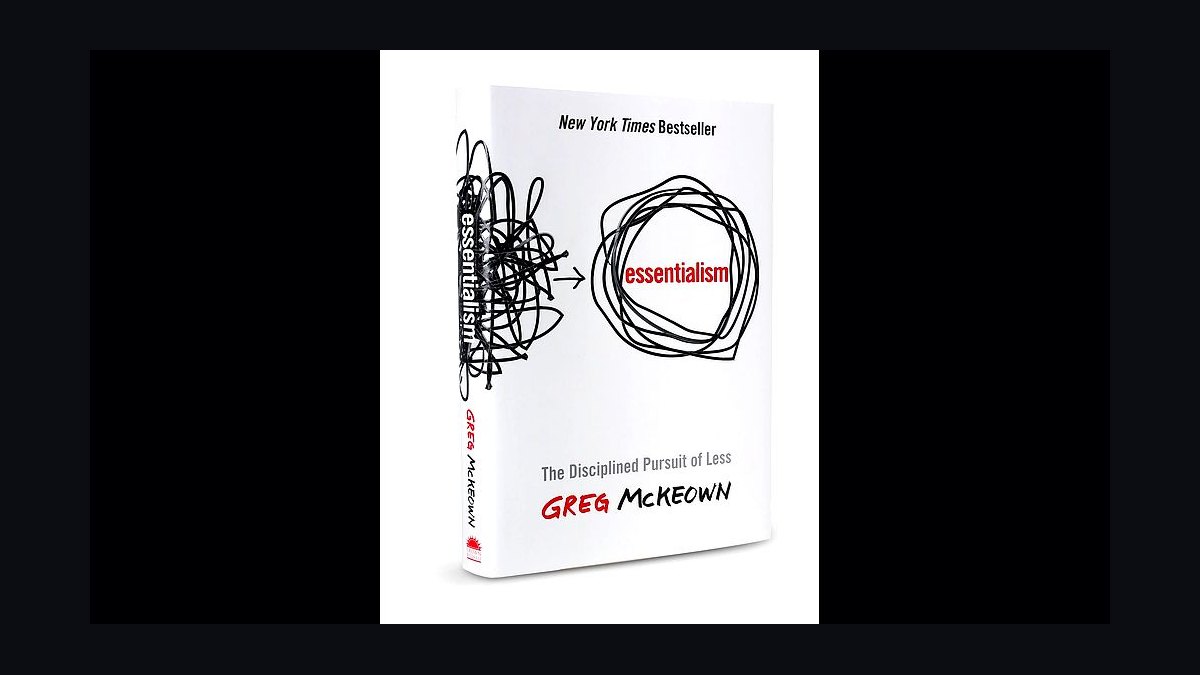
*Essentialism: The Disciplined Pursuit of Less* (Greg McKeown, Crown Business, 2014) argues that high performers fail from a lack of disciplined subtraction, not effort. The core move is replacing "How can I fit it all in?" with "Is this the right thing to do?" For sellers, that becomes a pipeline filter: reject the many, invest heavily in the few.
The Tuesday that eats every quarter
Picture a mid-market account executive on the last Tuesday of month two in a quarter. The calendar shows eleven meetings. Two are customer-facing. The other nine are a forecast call, a pipeline hygiene sync, a product-marketing enablement session on a feature nobody has asked about, a "quick 15" with a solutions engineer that will run forty minutes, a partner intro that came in over Slack, a peer-shadow session, a CRM data-cleanup block, a one-on-one, and a company all-hands. Between them, the rep fields inbound from marketing: fourteen leads scored as MQLs, of which perhaps two match the actual ideal customer profile.
By 6pm the rep has spoken to two buyers, sent nine follow-up emails they half-remember writing, and logged nothing to the CRM. The forecast did not move. The quarter did not move. And the honest post-mortem is not that this person worked too little — they worked eleven straight hours. It is that almost none of the eleven hours were aimed at the small set of things that would actually close revenue.
That is the exact scenario McKeown opens the book with, transposed. His version is Sam Elliot, a Silicon Valley executive who came out of an acquisition buried in obligations, saying yes to every request because saying yes felt like being a good colleague. Elliot's reset was a single question applied to his calendar: *is this the very most important thing I should be doing with my time and resources right now?* Most items failed the test. He cut them, and his output, energy, and influence all went up rather than down — which is the counterintuitive claim the whole book rests on.

McKeown draws a hard line between two operating modes. The Non-Essentialist thinks *I have to*, *it's all important*, and *how can I fit it all in?* — so they react to whatever is loudest, say yes under social pressure, and end up with a life other people authored. The Essentialist thinks *I choose to*, *only a few things really matter*, and *what are the trade-offs?* — so they explore widely, commit narrowly, and execute with less friction because the field of obligations is smaller.
The seller-specific translation matters here, because it is where the book stops being a self-help abstraction. Your CRM is not a to-do list handed to you. It is a set of choices you have already made about where the next 500 hours go. Every open opportunity sitting in Stage 2 with no economic buyer identified and no next step scheduled is a standing claim on your attention that you renew, silently, every week you refuse to close it out. The Tuesday above is not a scheduling failure. It is the accumulated interest on months of undisciplined yes.
How the mechanism actually works
The engine underneath Essentialism is three linked ideas, and they only work in sequence. Skip one and the system collapses back into ordinary time management.
Choice. McKeown's first claim is that choice is a capability you exercise, not an object you possess — and it atrophies. He borrows Martin Seligman's learned-helplessness research: when consequences appear disconnected from actions for long enough, the subject stops trying to escape even when escape becomes trivially available. The sales version is a rep who has been told for six quarters to "work every lead," internalizes it, and eventually cannot perceive disqualification as an available move. Ask them why they are on a call with a 40-employee prospect when their ICP starts at 500, and the answer is genuinely bewildered: *it was in my queue.*
Discernment. The empirical floor is Pareto's 80/20 observation — a small minority of causes drives most consequences. McKeown pushes it further into what he calls the unimportance of practically everything, crystallized in the line worth laminating: *you cannot overestimate the unimportance of practically everything.* This is not cynicism, it is distribution math. Enterprise sales outcomes are famously power-law, not normal. Most tabs, most threads, most meetings contribute approximately zero to booked revenue.
Trade-off. The bedrock fact is that you can do anything but not everything. Essentialists make trade-offs on purpose; Non-Essentialists have trade-offs made for them by whoever emails last. McKeown's business example is Southwest under Herb Kelleher — the airline deliberately said no to assigned seating, meals, hub-and-spoke routing, and first class in order to win on cheap, fast, point-to-point flights. The nos were not concessions. They were the strategy. When competitors tried to copy the model while keeping their existing commitments, they got the costs of both and the advantages of neither.
From there the book runs a four-part loop: Essence (the mindset above), Explore (widen the option set before narrowing), Eliminate (cut what doesn't clear the bar), Execute (make the remaining work close to frictionless).
The Explore stage is the one most sellers skip, and it is the least intuitive. McKeown insists Essentialists explore *more* options than Non-Essentialists, not fewer — they simply commit to far fewer of them. The inputs he prescribes are unglamorous: scheduled space to think (Bill Gates' twice-yearly Think Weeks are the famous example; Newton's plague-year retreat is the historical one), deliberate looking for the signal buried in the noise, protected play, and sleep. The sleep chapter is not filler. McKeown cites the Ericsson violinist study out of the Berlin Academy, where the elite performers slept roughly 8.6 hours a night — more than their less accomplished peers, not less. Sleep is an input to discernment, and discernment is the whole product.
Then the filter fires. Explore is followed by Select, which is where the 90 Percent Rule lives.
The rule itself: score the opportunity 1 to 100 against your single most important criterion. Anything below 90 is treated as a zero. Not a maybe, not a backlog item — a zero. The reason the threshold is so aggressive is crowding, not snobbery. A 70-scoring opportunity is not free; it consumes the exact hours that a 95 would have needed, and it does so quietly, because it never feels like a mistake in the moment. McKeown's verbatim test for the gray zone: *if I didn't have this opportunity, what would I be willing to do to acquire it?* If the honest answer is "not much," you have your answer.
Execute is the last stage, and it is deliberately boring. Buffer time between commitments so prep and follow-up actually happen. Subtract the constraint rather than adding effort everywhere — McKeown's "slowest hiker" framing is Goldratt's Theory of Constraints from *The Goal* wearing different clothes. Small visible progress early, per Amabile's progress-principle research at Harvard Business School. Routine defaults so the right behavior needs no willpower. And single-tasking, which McKeown supports with the University of London finding that heavy multitasking degrades effective cognitive performance measurably during the task.
Real numbers, ranges, and benchmarks
The book is philosophy with a few hard anchors. Here are the numbers that matter and how they cash out in a sales org.
The 90 threshold. One criterion, scored 1–100, cutoff at 90. In practice most teams cannot score against a single criterion honestly, so a workable adaptation is a three-factor composite: ICP fit, a confirmed economic buyer, and a compelling event with a date attached. Score each 1–10, require all three at 8+ before an opp gets weekly attention. This is a translation, not McKeown's construction — he would argue the composite is already a compromise, and he would be right. It survives contact with a comp plan.
80/20 as a pipeline audit. Pull last four quarters of closed-won by account and check whether roughly 20% of accounts produced roughly 80% of bookings. In most B2B books it skews at least that hard. Now pull *time* — meetings held, emails sent, calls logged — against those same accounts. The gap between the revenue distribution and the effort distribution is the exact size of the opportunity Essentialism is describing. If the top revenue quintile is getting 25% of your calendar instead of 60%, that gap is your quarter.
Buffer time: 10–15 minutes. Not a metaphor. Between back-to-back calls you need enough room for the follow-up email, the CRM note, and thirty seconds of prep for the next conversation. A 25/50-minute meeting default instead of 30/60 produces this automatically. McKeown's cautionary examples are institutional — the Yom Kippur War's logistical failure on one side, NASA's Apollo-era institutional buffer on the other — but the seller version is mundane and immediate: notes written same-day are worth several times notes written Friday.
Sleep: ~8.6 hours in the Ericsson elite cohort. Compare that to the grind narrative that dominates sales culture. A tired rep does not fail loudly. They ask three fewer follow-up questions on discovery, accept the first answer about budget, and lose the deal two months later in a way nobody traces back to a Tuesday night.
Disqualification velocity. Set a hard target: any inbound lead gets 90 seconds to fail an ICP check before it either advances or gets marked closed-lost-disqualified. Ninety seconds is enough to check employee count, industry, and whether the domain matches a target account. It is not enough to talk yourself into it, which is the point.
Meeting-free blocks. The common implementation is one full no-internal-meeting day per week plus a daily protected first hour for pipeline triage. Even at a conservative estimate, one protected day per week is roughly 20% of selling capacity moved from reactive to deliberate — which is exactly the magnitude Pareto predicts you need.
The honest caveat on all of this: McKeown does not run controlled trials, and neither does anyone else at the scale of "does saying no more make you sell more." The numbers above that come from the book (8.6 hours, the 90 threshold, the London multitasking work) are his citations; the pipeline ratios are arithmetic you run on your own data. Do not present the composite scoring model or the 90-second disqualification window to your team as research findings. They are operating conventions that make the philosophy executable, and they should be tuned to your own close rates.
Trade-offs and what to use instead
Essentialism is not free, and the costs land unevenly depending on where you sit.
The autonomy problem. The framework assumes you control your calendar. An AE with a book of accounts largely does. An SDR working an assigned list under an activity-based comp plan largely does not. Telling a BDR to reject 80% of their leads when their variable pay is tied to meetings booked is not advice, it is a way to get them managed out. The honest version for that role is narrower: apply Essentialism to *how* you work the list — batching, single-tasking, protected blocks, no context-switching during dial hours — while leaving *which* leads you work to the comp plan until you have the standing to change it. The book is quiet on saying no upward, and that quiet is its largest gap.
The comp-plan conflict. If your organization pays for pipeline created rather than pipeline converted, the 90 Percent Rule is directly adversarial to your paycheck. Do not pretend otherwise. The move is to run the rule on *time allocation* while keeping whatever activity floor the plan demands, and to bring the 80/20 audit above to your manager as evidence for changing the plan. Essentialism applied against your own incentives is a losing strategy, and McKeown's own trade-off logic says so.
Where the neighboring books fit better. Keller and Papasan's *The One Thing* (2013) is more tactical — the focusing question is a smaller, more portable tool and works better for individual contributors who want one habit rather than a philosophy. Newport's *Deep Work* (2016) is the stronger choice if your actual problem is attention fragmentation during work rather than too much work on the list. Covey's Quadrant 2 from *The 7 Habits* (1989) is the ancestor of all of it and remains the cleanest single diagram for explaining urgency-versus-importance to a skeptical team. Drucker's *The Effective Executive* (1967) said much of this first and more austerely. And McKeown's own sequel, *Effortless* (2021), addresses the layer Essentialism skips: once you know what matters, how do you make it structurally easier rather than relying on discipline?
The graceful no, and its limits. McKeown's refusal vocabulary — borrowed from Derek Sivers' *hell yeah or no* framing, which Sivers published on his blog before it became a book — includes the calendar-check delay, the honored-but-declining referral, the competing-commitment line, the "no, but" with an alternative, and the awkward pause. These work well laterally and downward. They work less well when the request comes from the person who writes your review, and the book does not really acknowledge the asymmetry. Use the referral and alternative variants upward; save the flat no for peers.
What has aged well. The 2014 thesis got sharper, not duller. The collaboration-tool flood that followed 2020 — chat, video, async docs, notification surfaces multiplying across a seller's day — made undisciplined yes far more expensive than it was when the book shipped. Calendar-defragmentation tooling now automates the buffer-time and routine-defaults chapters mechanically. And the graceful-no scripts have become standard material in commercial sales-leadership curricula, which is a reasonable proxy for the ideas holding up under practitioner scrutiny.
Common pitfalls and how to avoid them

Confusing subtraction with laziness. The most frequent misread. Essentialism is not doing less work; it is doing less *of the wrong* work so the right work gets a genuinely disproportionate share. A rep who cuts their pipeline from 40 opps to 12 and then works 12 opps at the same shallow intensity has not applied the book — they have just shrunk their number. The reinvestment step is mandatory: hours freed by disqualification go into deeper discovery, multi-threading, and executive access on what remains.
Cutting before exploring. The Explore stage exists precisely so that elimination has something to choose from. Sellers who narrow their target list on week one, before doing account research, are not being disciplined — they are guessing early and calling it focus. Widen first: research more accounts than you will pursue, run more discovery questions than you will need, then cut hard.
Sunk cost dressed as commitment. The reverse pilot is the antidote: *if I weren't already doing this, would I start it today?* Run it quarterly against every reopened, circled-back, we'll-revisit-next-quarter opportunity in your book. Most will fail it. The emotional resistance is real — you have months invested, you know the champion's kid's name — and that resistance is exactly the bias the tool exists to override. Sutton's work on the drag of carrying persistent low performers is the organizational analog; the individual analog is your Stage 3 zombie deals.
Boundaries announced but not defended. Declaring a no-meeting Tuesday and then accepting three exceptions in the first week teaches everyone that the boundary is decorative. McKeown's line is blunt: if you don't set boundaries, there will be none. The practical enforcement is structural rather than willful — mark the block as busy, decline programmatically, offer an alternative slot every time rather than a case-by-case judgment call. A boundary you renegotiate weekly costs more willpower than having no boundary at all.

Treating sleep and recovery as rewards. They are inputs. A rep grinding at 5.5 hours a night is degrading exactly the faculty — discernment — that the entire framework depends on. You cannot score opportunities honestly when you are too depleted to notice that the champion has gone quiet.
Essential intent that isn't measurable. "Get more done" is not an essential intent. "Land adoption at 100 of our top-300 ICP accounts by end of fiscal year" is: concrete, dated, countable, and meaningful enough to decline things over. Teams without a clear intent default to motion, and motion is what politics feeds on. If your team cannot state its essential intent in one sentence a new hire would understand, elimination has no criterion to run against.
Applying it only to the calendar. The strongest version of this reaches the deal-level and the account-level, not just the schedule. Fewer accounts worked deeper. Fewer stakeholders but the right ones. Fewer sequences with better-researched messaging. A calendar-only application produces a rep with free time and the same mediocre book.
Related questions
What is the 90 Percent Rule in one sentence?
Score an opportunity 1–100 against your single most important criterion, and treat anything below 90 as a zero — because mediocre options are not free, they consume the exact hours the exceptional ones need.
Is "hell yeah or no" McKeown's phrase?
No. Derek Sivers coined it in a blog post before publishing a book by that name; McKeown popularized it inside the Essentialism framework and built the graceful-refusal toolkit around it. Credit belongs to both.
Should an SDR read Essentialism?

Yes, with a caveat. SDRs rarely control which leads they work, so apply the method — batching, single-tasking, protected dial blocks, no context-switching — rather than the selection rule, until you have the autonomy to change what lands in your queue.
What should I read after Essentialism?
*Effortless* (McKeown, 2021) for the systems layer, *Deep Work* for the attention layer, *The One Thing* for a lighter tactical version, and Drucker's *The Effective Executive* for the intellectual origin of all of it.
Does saying no damage relationships?
Less than most people fear. McKeown's scripts are deliberately graceful — offering alternatives, referring elsewhere, naming a competing commitment. Clear declines are usually more trusted than the slow, silent non-delivery that follows a reluctant yes.
FAQ
Is Essentialism just another time-management book?
No, and the distinction is the whole point. Time-management books optimize the schedule you already have — better blocking, better tooling, tighter meetings. McKeown's argument is that most of what is on the schedule should not be there at all, and no amount of optimization fixes a wrong list. It is a prioritization framework upstream of scheduling, which is why applying it purely as a calendar tactic produces disappointing results.
What is the single most useful idea for a B2B seller?
The selection filter applied to pipeline. Score every open opportunity against ICP fit, economic-buyer engagement, and a dated compelling event; anything failing badly on any of the three gets disqualified rather than nurtured. Most reps know which of their deals are dead and keep them open anyway, because an open opp feels like hope and a closed-lost feels like failure. Reversing that instinct is where the returns are.
How long does the book take to read, and is a summary enough?
It is a short, anecdote-driven read — most people finish it in a few sittings. A Cliff Notes summary for sellers gets you the operational content faithfully: choice, discernment, trade-off, the 90 threshold, graceful no, reverse pilot, buffer, routine defaults. What a summary loses is the accumulation of stories that make the ideas stick emotionally, and that stickiness is a real part of why the book changes behavior when a framework list does not.
Can a whole sales team adopt this, or is it individual?
Both, but team adoption requires the manager to move first. If leadership keeps rewarding activity volume while asking reps to say no more, the reps will correctly ignore the request. Team-level adoption looks like a stated essential intent, a shared disqualification standard, fewer mandatory internal meetings, and a comp plan that pays for conversion rather than motion. Without those, individual Essentialism is a rep quietly protecting their own hours.
What is the reverse pilot and when should I run it?
It is the question *if I weren't already doing this, would I start it now?* Run it quarterly against every recurring meeting on your calendar and every stalled opportunity in your book. It is designed specifically to defeat sunk-cost bias, which is why it removes the history from the frame — you are evaluating the thing as if you encountered it fresh today.
Where does Essentialism sit in the broader productivity canon?
Directly downstream of Drucker's knowledge-worker writing and Covey's urgent-versus-important quadrant, alongside Keller's focusing question, and upstream of Newport's attention work. McKeown's contribution is packaging disciplined subtraction as an identity and a repeatable loop — explore widely, select ruthlessly, eliminate gracefully, execute with defaults — rather than a single tactic.
Sources
- https://gregmckeown.com/
- https://www.penguinrandomhouse.com/books/224712/essentialism-by-greg-mckeown/
- https://hbr.org/2012/08/the-disciplined-pursuit-of-less
- https://sive.rs/hellyeah
- https://hbr.org/2011/05/the-power-of-small-wins
- https://calnewport.com/books/deep-work/
- https://www.the1thing.com/
- https://ppc.sas.upenn.edu/people/martin-ep-seligman
- https://www.southwest.com/about-southwest/
- https://www.toc-goldratt.com/en/
Related on PULSE
- The 12 Week Year by Brian Moran and Michael Lennington — Cliff Notes Summary for Sellers
- Contagious by Jonah Berger — Cliff Notes Summary for Sellers
- The Tipping Point by Malcolm Gladwell — Cliff Notes Summary for Sellers
- Exactly What to Say by Phil M. Jones — Cliff Notes Summary for Sellers
- Antifragile by Nassim Taleb — Cliff Notes Summary for Sellers
- Steve Jobs by Walter Isaacson — Cliff Notes Summary for Sellers
This page will be disappearing soon. Save it to your device for $1 — or read it free while it is here.
@Kory-White- · if Venmo asks, the last 4 of my number are 2012
This page is gone.
This one is off the shelf now. $1 keeps it on your phone for good — the whole page, pictures and diagrams included.
 pulse-recentWhat is the first concrete step in The Sandler Rules by David Mattson for a sales leader to implement the system in 2027?
 pulse-recentObviously Awesome by April Dunford — Top 10 Key Takeaways for Sales Leaders in 2027
 pulse-recentWhat are the concrete steps in Strategic Selling for building a sales plan in 2027?
 pulse-recentNever Lose a Customer Again by Joey Coleman — Top 10 Key Takeaways for Sales Leaders in 2027
 pulse-recentNever Split the Difference by Chris Voss — Top 10 Key Takeaways for Sales Leaders in 2027
 pulse-booksRework by Jason Fried and David Heinemeier Hansson — Cliff Notes Summary
 book-summaryLittle Red Book of Selling by Jeffrey Gitomer — Cliff Notes Summary
 pulse-recentThe Sales Manager’s Guide to Greatness by Kevin Davis — Top 10 Key Takeaways for Sales Leaders in 2027
 pulse-recentWhat is the first concrete step in the Sandler Selling System for handling a prospect's initial brush-off in 2027?
 book-summaryWhat factors drive the price of Book Summaries up or down in 2027?