


Decisive by Chip and Dan Heath — Cliff Notes Summary for Sales Leaders
Quality
Certified
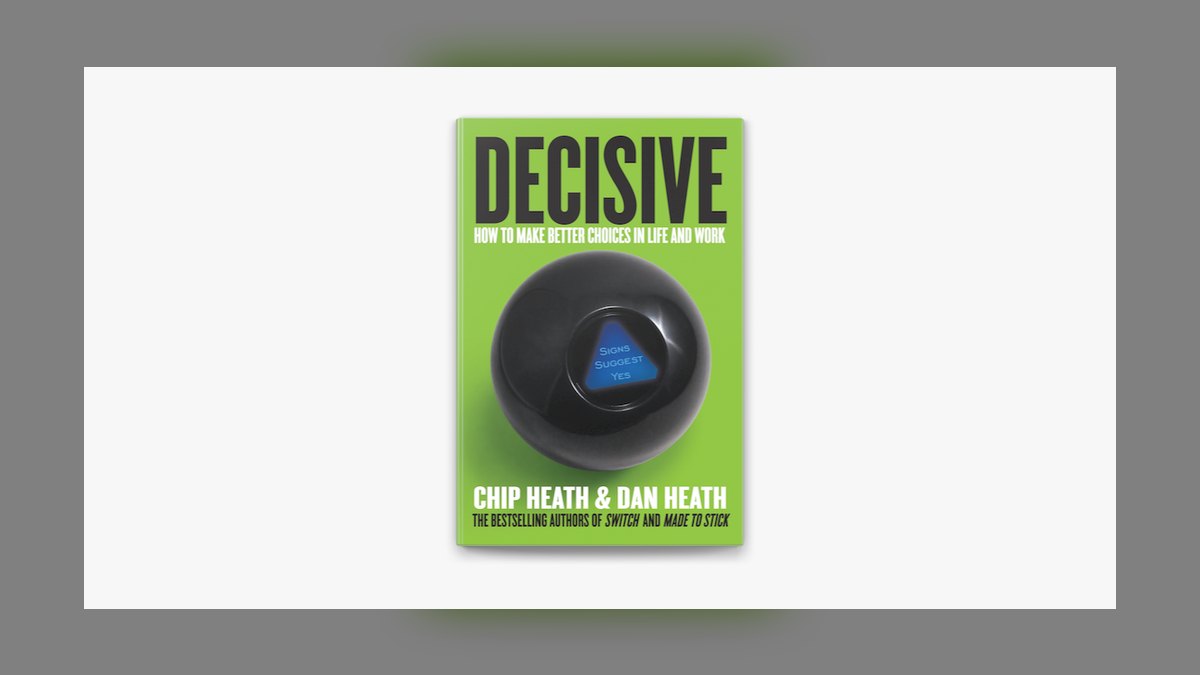
*Decisive* by Chip and Dan Heath (Crown Business, 2013) argues four villains wreck most choices — narrow framing, confirmation bias, short-term emotion, and overconfidence — and counters each with WRAP: Widen options, Reality-test assumptions, Attain distance, Prepare to be wrong. For sales leaders it is the missing operating manual for deal, hiring, and pricing calls.
The Friday deal review where nobody actually decides anything
Picture the standard Friday forecast call. Eleven reps, a shared pipeline view, ninety minutes on the calendar. A rep pulls up a $1M opportunity that has sat in "Negotiation" since the second week of the quarter. The champion has gone quiet, procurement has asked for a redlined MSA twice without returning it, and the economic buyer has never joined a call. The rep says the sentence every sales leader has heard several thousand times: "I think we need to discount to get this over the line — maybe fifteen points. Should we?"
Everyone in the room now debates that question. Some argue yes, protect the logo. Some argue no, it sets precedent. Forty minutes evaporate. The VP makes a gut call, usually the one that feels least painful in the moment, and the room moves to the next deal.
What just happened is exactly the failure mode the Heath brothers open the book with. Nobody widened the frame — the entire discussion accepted "discount: yes or no" as the universe of options. Nobody hunted for evidence that the deal was already dead; they hunted for reasons it was still alive, because the pipeline coverage number depended on it. Everybody was operating inside the emotional weather of a quarter that was three weeks from closing. And nobody stated, out loud and in advance, what would have to happen for them to conclude they'd been wrong.
The Heaths cite Paul Nutt's research at Ohio State, which studied 168 organizational decisions and found only about 29% of teams considered more than a single alternative. Their sharper finding: "whether-or-not" decisions — the binary kind — failed at roughly 52%, while decisions that weighed two or more genuine alternatives failed closer to 32%. That is a twenty-point swing available to any leader willing to change the shape of the question rather than the quality of the answer.
The adjacent point matters as much as the core one. This same failure runs through the parts of revenue work that sit upstream and downstream of the deal review. Marketing debates "should we sponsor this conference?" instead of "what are four ways to spend $80K on pipeline generation next quarter?" A CS leader debates "should we save this renewal?" instead of "what are three exit paths and two save paths, and what does each cost us in headcount hours?" RevOps debates "should we buy this tool?" instead of "what are three ways to fix this reporting gap, one of which involves no new vendor at all?" The disease is structural, not situational.
Chip Heath teaches at Stanford's Graduate School of Business; Dan Heath is at Duke's CASE center. *Decisive* is the third book in their quartet — *Made to Stick* (2007) on communication, *Switch* (2010) on change, *Decisive* (2013) on choice, *The Power of Moments* (2017) on experience design. It synthesizes Kahneman and Tversky on bias, Gary Klein on naturalistic decision-making, and Phil Tetlock on forecasting, then compresses the whole thing into a process a leader can run inside a thirty-minute block. That compression is the entire value proposition.
How WRAP actually works, villain by villain

The framework is not four nice ideas. It is four countermeasures, each reverse-engineered against a specific villain, applied in a specific order. Skipping a step leaves that villain intact.
Widen your options attacks narrow framing. The signature diagnostic is the Vanishing Options Test: assume the option you're currently debating has been removed from the table entirely, then ask what you'd do. The brain reflexively surfaces two or three alternatives it had been suppressing. Ask a rep "if discounting were illegal, what would you do to close this?" and you'll typically get: bring in an executive sponsor, restructure to a shorter term at full rate, unbundle the services component, or trade a case-study commitment for the price. None of those existed thirty seconds earlier. The book pairs this with multitracking — developing two or three options in parallel rather than eliminating them sequentially. Research the Heaths cite on ad designers shown multiple concepts simultaneously found both more creative output and better-rated final work than the sequential approach, and multitracking has a second benefit that matters politically: when no single option is the ego-attached default, killing one costs nobody status.
Reality-test your assumptions attacks confirmation bias. Wason's 2-4-6 experiment from 1960 is the canonical demonstration — subjects given a sequence and asked to deduce the rule tested only confirming cases, never a single disconfirming one, and so almost universally landed on the wrong rule. The counter is deliberate: consider the opposite. In practice, don't ask "what could go wrong with this deal?" — that generates polite hedges. Ask "assume we lose this in Q4; what killed it?" The second tactic here is *ooching* — a term the Heaths borrow from Peter Sims's work on small bets. Run a cheap experiment that produces real data instead of speculation. The book's memorable case is a professional considering a career switch into medicine who volunteered in an emergency room for a month before committing to four years of pre-med, and discovered he hated the environment. The sales-leader translation is direct: test a new pricing model on five accounts before rolling it to the field, pilot a new SDR-to-AE handoff on one pod before rewriting the whole motion.

Attain distance before deciding attacks short-term emotion. Two tools. Suzy Welch's 10/10/10: how will I feel about this in ten minutes, ten months, ten years? The three horizons deliberately dilute the dominant feeling of right now. A leader furious about a missed quota fires on the ten-minute view, coaches on the ten-month view, and on the ten-year view recognizes the rep may be one of a handful of future enterprise sellers in the org. Average the three and the answer is usually "coach, with a hard tripwire at ninety days." The second tool is the best-friend test: what would I tell a friend in exactly this position? Distance from self produces clarity that proximity destroys — which is why your advice to a peer VP is always cleaner than your advice to yourself.
Prepare to be wrong attacks overconfidence. Tetlock's long-running study of expert political forecasters (*Expert Political Judgment*, 2005) showed specialists barely beat chance and lost to simple statistical rules. Applied here: assume you are wrong about *what will happen*, not merely about *whether to act*. The tools are the premortem — Gary Klein's device, which Kahneman has praised as among the best decision tools available — and tripwires, preset conditions that force reconsideration automatically. The book's famous tripwire illustration is Van Halen's contract rider demanding a bowl of M&Ms with the brown ones removed; when the bowl was wrong, the band knew the venue hadn't read the technical safety specifications either.
The order is load-bearing. Reality-testing a single option only tells you whether that option survives — it never tells you whether a better one existed. Attaining distance from a badly framed choice just gives you a calm bad decision. Run W before R before A before P, or you are running a subset and calling it the framework.
The numbers worth knowing, and what they actually license you to claim

*Decisive* is unusually number-dense for a management book, and a sales leader who quotes it should know which figures are firm and which are directional.
Nutt's 168-decision study is the backbone: roughly 29% of the organizational decisions studied considered more than one alternative. The failure-rate contrast — about 52% for whether-or-not decisions versus about 32% for multi-option ones — is the single most useful statistic in the book for anyone trying to change how a forecast call runs, because it converts a soft process complaint into a measurable delta. Frame it that way to a skeptical CRO: "we are currently choosing in the mode with the worse documented hit rate, on every deal above a quarter million dollars."
The Lovallo and Sibony work on business decisions found that decision *process* explained substantially more outcome variance than analytical quality did — their reported multiple is roughly six-to-one. The operator translation is uncomfortable and correct: your deal-desk spreadsheet is not the bottleneck. Who is in the room, which alternatives got written down, and whether anyone was assigned to argue the other side matter more than the model's precision. Most revenue orgs have this exactly inverted, investing in ever-finer forecast analytics while the meeting that consumes those analytics remains structurally unchanged from 2015.
Klein's premortem research reports meaningfully more risk factors surfaced than conventional risk reviews produce — commonly cited around 30% more. The mechanism is social, not cognitive: a normal risk review taxes the person who raises the concern with the cost of being the pessimist, while a premortem assigns failure as a premise and makes naming causes the compliant behavior rather than the contrarian one.
Tetlock's forecasting corpus covers hundreds of experts and tens of thousands of predictions across two decades. The headline is that credentialed expertise did not confer forecasting advantage, and that confidence correlated poorly with accuracy. For a sales org this is a direct argument against the "gut-feel commit" — the rep who is most certain the deal will land is not, on this evidence, the rep you should weight most heavily.
_CoA.jpg)
Where you should stay general: any claim that adopting WRAP produces a specific forecast-accuracy improvement is not something the book establishes, and you should not present a number there. What you can defend is the mechanism — moving decisions from binary to multi-option shifts you toward the better-performing category in Nutt's data — and then measure your own delta. A reasonable internal instrumentation plan: tag every deal review decision for one quarter as binary or multi-option, tag whether a premortem was run above a value threshold, then compare slipped-versus-closed rates across the two populations. You'll have your own number in ninety days, which is worth more in an internal argument than any figure you borrowed.
One practical threshold question comes up constantly: at what deal size does full WRAP earn its overhead? The honest answer is that it's a function of your review capacity, not the book. A full pass — widen, premortem, 10/10/10, tripwire — takes fifteen to twenty-five minutes with a prepared rep. If you run a hundred open opportunities and can spend three hours a week on structured review, you can cover roughly eight deals properly. Set the threshold wherever your top eight deals begin. For most mid-market orgs that lands somewhere between $100K and $500K ACV; for enterprise teams it may be every deal in the commit category.
Trade-offs: where WRAP costs more than it returns, and what to use instead
The framework is not free, and treating it as universally applicable is the fastest way to get it rejected by a sales team.
The primary cost is time. Multitracking means genuinely developing alternatives, not listing them theatrically — a real second option requires someone to scope it. Premortems require the room, and a premortem with three people who all report to the person who wants the deal to close is a compliance exercise, not a reality test. If you cannot get one genuinely independent voice into the room, the P step degrades to ritual.

The second cost is decision latency in a fast-moving deal. There are moments in a negotiation where a same-day answer is worth more than a better answer — a competitor is in the account, the buyer's budget cycle closes Friday, an executive sponsor is available for exactly one window. Running a full WRAP pass on a deal that needs a two-hour turnaround is a strategy error dressed as rigor. The book's own escape hatch is the tripwire: decide the rule *in advance*, during a calm moment, so the fast moment only requires executing it. "Anything under 10% off list with a twelve-month term, the rep approves alone" is a pre-made WRAP output that costs zero seconds at deal time.
The third cost is credibility with reps who read process as distrust. A leader who introduces premortems only on deals they already doubt has taught the team that a premortem means "your leader thinks you're going to lose." Apply it by threshold, not by suspicion — every deal above X gets one, including the ones everybody is certain about — and the signal disappears.
Alternatives and complements matter here. WRAP is a decision process, not a qualification checklist, and it does not replace one. MEDDPICC tells you *what to gather* on an opportunity; WRAP tells you *how to choose* once you have it. Running WRAP without qualification data is deliberation over vibes. Running MEDDPICC without a decision process gives you a beautifully scored deal and still no rule for when to walk. Use MEDDPICC (or MEDDIC, or your own scorecard) as the input, WRAP as the operator.
For group and committee decisions specifically — comp plan redesign, territory carve-ups, pricing architecture — *Decisive* is thinner than it should be, and Sunstein and Hastie's *Wiser* (2014) is the better companion because it addresses information cascades and shared-information bias directly, which is exactly what goes wrong when nine people argue about territories. For pure forecasting discipline, Tetlock and Gardner's *Superforecasting* (2015) goes deeper than the P step alone does. And for the underlying psychology, Kahneman's *Thinking, Fast and Slow* (2011) is the source text the whole book stands on.
The loop at the end is the part most teams skip. WRAP compounds only if you go back and look at which decisions the process caught and which it missed, then move the thresholds accordingly.
The pitfalls that kill adoption, and how to route around each
Premortem theater. The most common failure. The team gathers, the leader says "imagine this failed," and three people offer risks everyone already knew. Fix: make it silent and written first. Everyone writes causes independently for four minutes with no discussion, then reads them aloud. This is the whole reason the technique works — it defeats the anchoring that happens the moment the first person speaks. Second fix: require at least one cause that implicates the seller's own execution, not just the buyer's behavior. "Budget froze" is a comfortable answer; "we never got the economic buyer on a call and papered over it for six weeks" is the useful one.
Fake multitracking. A rep brings three options where two are obviously non-viable — the classic pattern is full price, the discount they wanted all along, and walk away. That's one option with two decoys. Fix: require that each option have a named next action and an owner. If option A is "bring in the CRO for an executive-to-executive call," someone has to have checked the CRO's calendar. Decoys collapse the moment they need logistics.
Tripwires nobody enforces. A tripwire that fires and gets overruled is worse than no tripwire, because it teaches the org that the preset rule is negotiable and every future one gets litigated. Fix: write the tripwire with its consequence attached and make the consequence automatic and small enough to actually execute. "If procurement hasn't returned redlines by the 20th, the deal moves to best-case and the rep's next two days go to the top of the new-business list" is enforceable. "We'll reconsider" is not.
Confusing distance with delay. 10/10/10 takes ninety seconds. Some leaders use "let me get some distance on this" as cover for avoidance, and the deal, the rep, or the pricing decision rots for three weeks. Fix: run the distance tools in the meeting, out loud, and land the call before the meeting ends.
Applying it only to deals. The highest-leverage uses in a revenue org are often not opportunity decisions at all. Hire/fire is the classic: "should I fire this rep?" is textbook narrow framing, when the real option set includes a structured ninety-day plan, a territory swap, a move to a different segment, a shift to a specialist or overlay role, and a clean exit. Widen the frame there and you'll frequently discover the rep was the canary on a broken territory rather than the problem. Territory design, comp plan changes, tooling consolidation, and channel-versus-direct calls all reward the same treatment — and those decisions are usually less reversible than any single deal, which is precisely the profile where process investment pays.
Treating the book as prescription rather than process. Some of the case studies have aged — the Quaker/Snapple acquisition and the Kodak and Polaroid examples have been retold to exhaustion, and the book predates the product-led growth era entirely, so it has nothing to say about self-serve pricing, feature gating, or usage-based expansion decisions. That doesn't damage the framework, because WRAP tells you *how* to decide without dictating *what* to decide. The villains it targets are cognitive architecture, not 2013 business conditions. Modern language models happen to be very good at WRAP's mechanical labor — generating five alternative deal structures on demand, running a structured premortem prompt, pulling base rates from your own CRM history — which lowers the cost of the process without changing it. If anything, the framework is more usable now than when it shipped.
Related questions
How does WRAP compare to MEDDPICC?
They solve different problems and compose well. MEDDPICC is a qualification checklist — what information you need on an opportunity. WRAP is a decision process — how to choose once you have that information. Use MEDDPICC to score the deal, WRAP to decide commit, walk, or restructure.
What is the single fastest tool to start with?
The Vanishing Options Test. Next time a rep proposes discounting, ask: "if the discount were off the table entirely, what would you do?" You'll get two or three real alternatives in under a minute, with no training, no rollout, and no new process to introduce.
Does a premortem work with only two people?
Poorly. The technique depends on independent perspectives, and two people who share context share blind spots. Minimum viable is three to four, with at least one who has no stake in the outcome — a peer from another segment, a CS lead, or someone from RevOps.
Where does Decisive sit among the Heath brothers' books?
*Made to Stick* (2007) covers communication, *Switch* (2010) covers change management, *Decisive* (2013) covers choices, and *The Power of Moments* (2017) covers experience design. Read together they form a fairly complete operator's toolkit for a revenue leader.
Should tripwires be set by the leader or the rep?
Jointly, in advance, and written down. A tripwire the rep helped author gets honored; one imposed unilaterally gets argued at the moment it fires — which is exactly when nobody has the objectivity to relitigate it fairly.
FAQ
Why do so few sales leaders read Decisive?
It was positioned as a general-management book, so it never appears on sales reading lists next to *SPIN Selling*, *The Challenger Sale*, or *Gap Selling*. Nothing on the cover suggests deal qualification. Leaders who do find it — usually through a peer community or an executive reading list — tend to describe it as the operating manual their qualification methodology never included.
Is the four-villain model actually supported by research, or is it a packaging device?
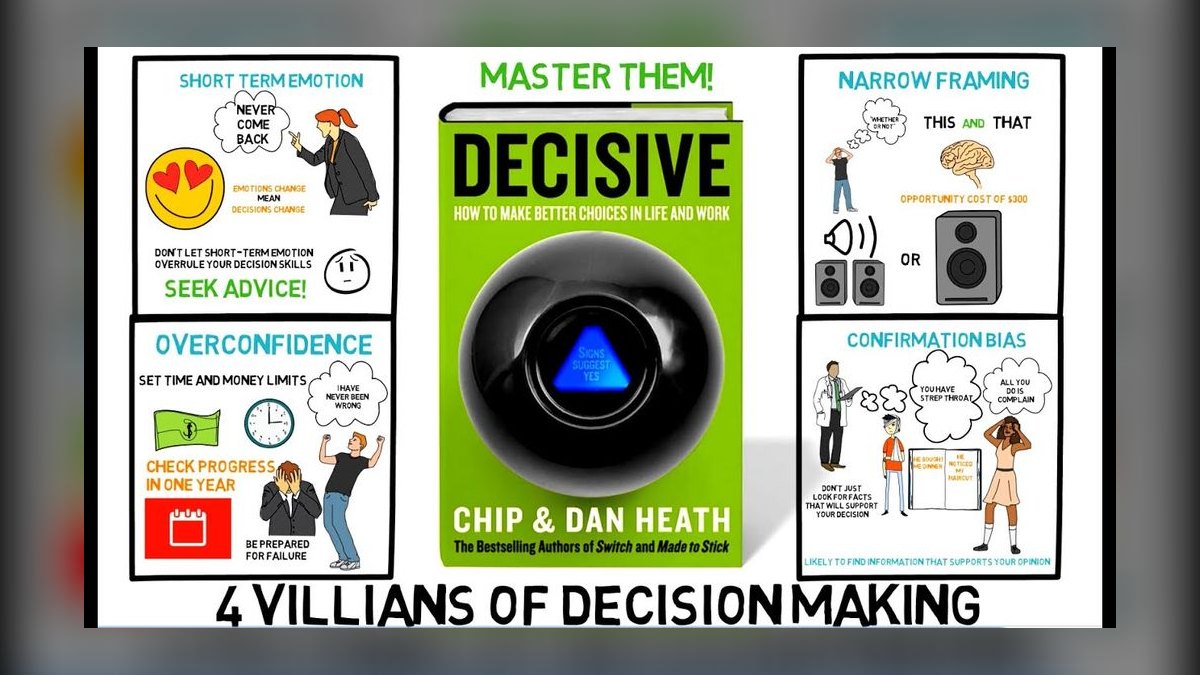
Both, honestly. Each villain maps to a well-documented body of work — narrow framing to Nutt's decision studies, confirmation bias to Wason and decades of follow-on research, present-bias and affect to the behavioral economics literature, and overconfidence to Tetlock's forecasting corpus. The grouping into exactly four with a matching four-letter acronym is a packaging choice, and a good one, but the underlying phenomena are not invented for the book.
How long does a full WRAP pass take on one deal?
With a prepared rep, roughly fifteen to twenty-five minutes: five to widen into three scoped options, seven to ten for a written silent premortem with two or three participants, two for 10/10/10, and a few minutes to write the tripwire. Unprepared, it takes twice that and produces worse options, which is why the rep should arrive with alternatives already drafted.
Can this be run asynchronously instead of in a meeting?
Yes, and often better. Written silent premortems work well in a shared doc — arguably better than live, since nobody anchors on the first speaker. The distance tools are individual anyway. The step that genuinely needs synchronous time is widening, because scoping a real alternative usually requires someone to say "actually, I could get my VP on that call Thursday."
Does this conflict with a strong sales methodology already in place?
No. Methodologies govern what you do with a buyer; WRAP governs what you decide internally. Command of the Message, Challenger, SPIN, and Sandler all leave the commit-or-walk judgment to a manager's discretion. WRAP fills that gap without touching the customer-facing motion, which is also why it introduces almost no retraining cost.
What's the minimum viable version for a team that resists process?
Two rules. First, no "should we" questions in a deal review — every proposal arrives with three options. Second, every deal above your commit threshold has a written tripwire before it enters the forecast. That's it. Both are enforceable in one meeting, and together they capture most of the value of the full framework.
Sources
- https://heathbrothers.com/books/decisive/
- https://www.penguinrandomhouse.com/books/213241/decisive-by-chip-heath-and-dan-heath/
- https://www.gsb.stanford.edu/faculty-research/faculty/chip-heath
- https://hbr.org/2011/09/before-you-make-that-big-decision
- https://hbr.org/2007/09/performing-a-project-premortem
- https://www.mckinsey.com/capabilities/strategy-and-corporate-finance/our-insights/the-case-for-behavioral-strategy
- https://press.princeton.edu/books/paperback/9780691178288/expert-political-judgment
- https://mitpress.mit.edu/9780262611466/sources-of-power/
- https://www.hbs.edu/faculty/Pages/item.aspx?num=42345
- https://www.sciencedirect.com/science/article/abs/pii/S0090261699900174
Related on PULSE
- The Power of Moments by Chip and Dan Heath — Cliff Notes Summary
- Switch by Chip and Dan Heath — Cliff Notes Summary for Salespeople
- Made to Stick by Chip and Dan Heath — Cliff Notes Summary for Salespeople
- Predictably Irrational by Dan Ariely — Cliff Notes Summary for Sellers
- The Advantage by Patrick Lencioni — Cliff Notes Summary for Sales Leaders
- The Lean Product Playbook by Dan Olsen — Cliff Notes Summary
This page will be disappearing soon. Save it to your device for $1 — or read it free while it is here.
@Kory-White- · if Venmo asks, the last 4 of my number are 2012
This page is gone.
This one is off the shelf now. $1 keeps it on your phone for good — the whole page, pictures and diagrams included.
 pulse-recentTraction by Gabriel Weinberg and Justin Mares — Top 10 Key Takeaways for Sales Leaders in 2027
 pulse-recentProActive Selling by Skip Miller — Top 10 Key Takeaways for Sales Leaders in 2027
 pulse-recentWhat are the concrete steps to implement the Sandler Rules for Sales Leaders by David Mattson in 2027?
 pulse-recentWhat is the first concrete step in The Sandler Rules by David Mattson for a sales leader to implement the system in 2027?
 pulse-recentWhat are the concrete steps in Sandler Rule #7 for handling a prospect's budget objection in 2027?
 pulse-recentNever Split the Difference by Chris Voss — Top 10 Key Takeaways for Sales Leaders in 2027
 book-summaryMajor Account Sales Strategy by Neil Rackham: Summary, Key Lessons, and RevOps Takeaways
 pulse-recentHow to Apply Strategic Selling — Step-by-Step Playbook in 2027
 pulse-recentConceptual Selling by Robert Miller and Stephen Heiman — Top 10 Key Takeaways for Sales Leaders in 2027
 pulse-recentWhat is the first concrete step in the Sandler Selling System for handling a prospect's initial brush-off in 2027?