


Scaling Up by Verne Harnish — Cliff Notes Summary for Sales Leaders
Quality
Certified
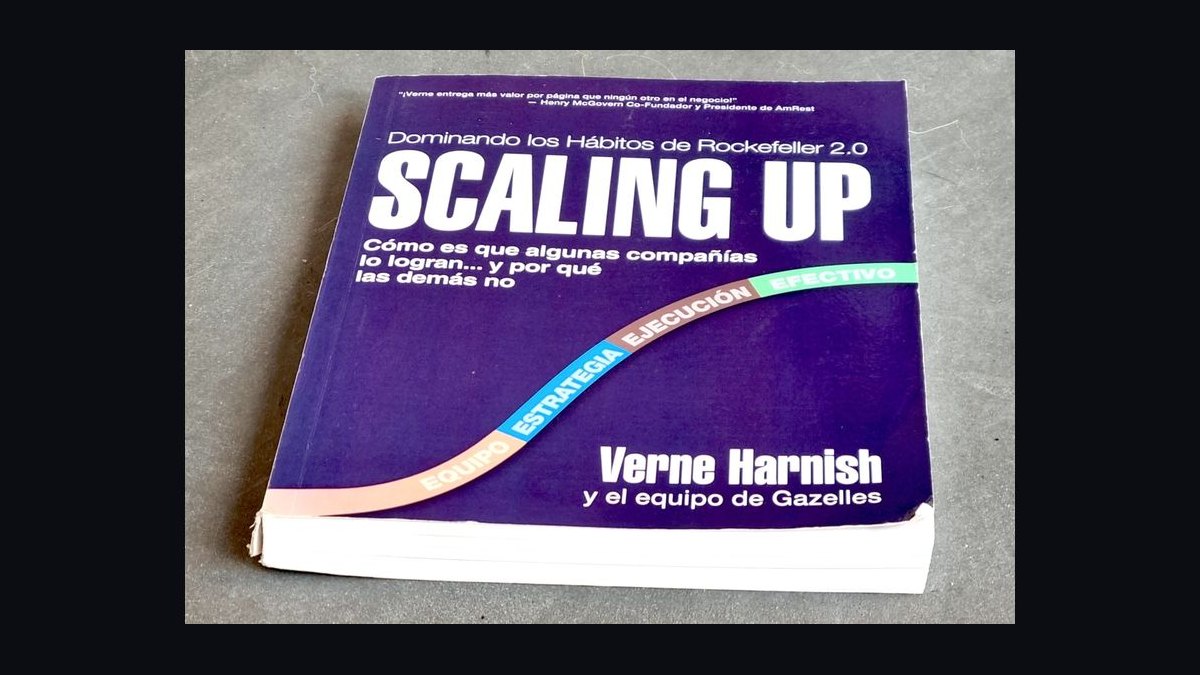
*Scaling Up* by Verne Harnish is the operating manual for companies crossing the 50-, 250-, and 500-employee thresholds. It argues that scaling depends on four decisions — People, Strategy, Execution, Cash — made consistently well. Sales leaders get the missing weekly rhythm, one-page plan, and cash discipline that turns revenue chaos into a repeatable engine.
The outcome you should expect
Read the book, install its machinery, and the outcome is not "more revenue" in any direct sense. The outcome is a revenue organization that stops depending on the heroics of three people. That distinction matters, because most sales leaders reach for *Scaling Up* when the quarter is already ugly, and the book does not fix an ugly quarter. It fixes the conditions that produce ugly quarters repeatedly.
Concretely, here is what changes in the first two quarters if you actually run the system rather than skim it. Your leadership team stops discovering problems at month-end. The daily huddle surfaces a stuck deal on Tuesday morning instead of during the forecast call three weeks later. Your quarterly priorities shrink from a list of fourteen initiatives everyone nods at to three to five that have names attached and a definition of done. Your forecast conversation shifts from "what do you think will close" to "what does the pipeline coverage ratio say, and what did we agree the ratio needed to be." And your finance partner stops being the person who tells you no, because you have finally internalized that a sales cycle is a cash cost, not just a velocity metric.
The second-order outcome is retention of your best people. Harnish's argument — drawn from three decades coaching fast-growing firms through the Entrepreneurs' Organization network and his own consulting practice — is that A-players leave chaotic growth companies before B-players do, because A-players have options and low tolerance for ambiguity about who owns what. The Function Accountability Chart exists to remove that ambiguity. When a strong AE can point at a chart and see that pipeline coverage belongs to the VP of Sales, net revenue retention belongs to the VP of Customer Success, and forecast accuracy belongs to RevOps, the political fog lifts. Fog is what drives good people out.

What you should not expect: a sales methodology. *Scaling Up* has nothing to say about discovery questions, MEDDIC, or objection handling. It sits one layer above that. If your problem is that reps cannot run a discovery call, this book is the wrong purchase — that is *SPIN Selling* or a sales enablement program. If your problem is that you have three functioning reps, eleven reps you cannot diagnose, no shared definition of a qualified opportunity, and a leadership team that meets when someone remembers to schedule it, this is the right purchase.
You should also expect friction in weeks three through six. The daily huddle feels like theater until roughly the tenth one, when someone finally says "I'm stuck on legal review for the Meridian deal" out loud and three people solve it in ninety seconds. That moment is the conversion event. Teams that quit before it conclude the book is overhead. Teams that push through it usually never go back.
What drives that outcome
The engine underneath is Harnish's Four Decisions: People, Strategy, Execution, and Cash. His framing — that most companies fail not from a bad strategy but from bad execution of a reasonable strategy — is the load-bearing claim, and it explains why three of the four decisions are operational rather than strategic.
People is Topgrading applied without sentiment. Harnish borrows Brad Smart's methodology directly: hire A-players, defined as the top tier of talent available at the compensation level you are actually paying, plus B-players with a credible path upward. C-players get coached or exited quickly, because in a scaling company a C-player does not merely underperform — they consume the manager attention that the A-players needed. The signature mechanic is the chronological interview walking through every prior role with the question set: who was your boss, what would they say about you, what is their number. The threat of the reference check does more work than the check itself. In sales hiring specifically, this catches the candidate who "built the SDR function" but actually inherited it and hired two people.
Strategy is the 7 Strata: the words you own in a customer's mind, the sandbox you will and will not play in, three measurable brand promises, a guarantee behind them, a one-phrase strategy, three to five differentiating activities, and an X-Factor — a roughly tenfold advantage in one narrow dimension. The sandbox stratum is the one sales leaders under-use. Writing down which segments you explicitly will not sell to is the fastest way to stop your team from burning a quarter on a whale that will churn in month nine.
Execution is the Rockefeller Habits Checklist, ten disciplines named for John D. Rockefeller's operating habits at Standard Oil. Aligned executive team. Shared number-one quarterly priority. Established communication rhythm. A single accountable owner for every facet. Systematic employee input. Customer feedback reported as rigorously as financials. Living core values. Employees who can state the strategy in their own words. Employees who can tell quantitatively whether they had a good day. Visible plans and performance. Harnish's own experience is that most teams pass three or four on first audit, and that getting to eight-plus is the difference between sustained growth and a single good year.
Cash is the Cash Conversion Cycle — days inventory plus days sales outstanding minus days payable outstanding — plus the Power of One, a model of what a one percent improvement in each of seven levers does to cash. Dell's famously negative cycle, collecting from customers before paying suppliers, is the canonical illustration of using working capital as a growth engine rather than a constraint.
The four decisions interlock rather than stack. Weak People discipline means your rocks have no credible owners, so Execution fails. Weak Strategy means the sandbox is undefined, so reps chase every logo and the sales cycle stretches, which directly lengthens the cash cycle. Weak Cash means you cannot fund the A-player you need in seat three. This interlock is why Harnish resists letting teams adopt only the meeting cascade — it is the most copied piece and the least sufficient one.
Benchmarks and realistic ranges
The book's own numbers, and the ones you can defensibly borrow, are mostly about time and structure rather than performance.
The meeting cascade has fixed durations, and the durations are the point. The daily huddle runs fifteen minutes, standing, at the same time every day, with a three-beat format: what is happening in the next twenty-four hours, the daily metric, and where you are stuck. Fifteen is not a soft target — a huddle that routinely runs twenty-five minutes has become a status meeting and will be abandoned within a month. The weekly meeting runs sixty to ninety minutes and covers KPIs, rock progress, customer and employee data, and exactly one strategic issue. The monthly runs about four hours with a broader leadership group and skews toward learning and one deep dive. Quarterly planning is a one-to-two-day offsite that sets rocks, a theme, and a scoreboard. Annual planning is two to three days and refreshes the one-page plan, the core values audit, the three-to-five-year picture, and the coming year.

Quarterly rocks land at three to five per team, with one designated the top rock — the thing that, if accomplished, makes the rest easier or unnecessary. The temptation for a sales org is to set eight. Eight rocks is zero rocks. A well-formed sales rock reads like "reduce average sales cycle from ninety-two days to sixty" or "close three logos in the healthcare vertical," never like "improve pipeline quality."
The cash guardrails Harnish gives are blunt and worth treating as thresholds rather than aspirations: hold roughly three months of operating expenses in reserve; do not let one customer exceed about fifteen percent of revenue; do not let one supplier or channel exceed about a quarter of your input. Concentration risk is what kills companies that look profitable on paper. A revenue org with a single channel partner driving a third of pipeline is running the same exposure, and sales leaders rarely see it that way until the partner reorganizes.
The Power of One exercise generally produces the same shape of result across businesses: a one percent price improvement contributes dramatically more cash than a one percent volume improvement, because price flows almost entirely to the bottom line while volume drags cost of sales with it. The exact multiple depends on your gross margin — run it on your own P&L rather than quoting a number you read. For most B2B software companies with high gross margins, the pricing lever dominates so heavily that it reframes where a VP of Sales should spend discretionary energy: on discount discipline and packaging rather than on adding two more reps.
For the Rockefeller Habits audit itself, use the ten-question checklist as a literal scored diagnostic each quarter. Three or four yes-answers is a normal starting point. Six is a functioning team. Eight-plus is rare and correlates with the companies that repeat rather than spike.
On sales-specific cash math, translate the conversion cycle into your own terms. Annual upfront billing collapses days sales outstanding toward zero. Monthly billing with net-45 terms does the opposite and quietly finances your customers. Sales cycle length is the largest and least-examined cash tax in a software business — every additional thirty days of average cycle is thirty days of fully loaded rep cost with no offsetting collection.
Risks, edge cases, and failure modes
The most common failure is partial adoption. A team installs the daily huddle, likes it, and stops. Six months later the huddle is a standup that reports activity and nobody remembers what the quarterly priorities were. The cascade only works because it is a cascade — the daily rolls into the weekly, the weekly into the quarterly rocks, the rocks into the one-year plan. Sever any link and the remaining meetings become ceremony.
The second failure is stage mismatch. *Scaling Up* is calibrated for roughly fifty to five hundred employees. Below fifty, the one-page strategic plan can over-formalize a company that still needs to change direction quarterly, and Gino Wickman's EOS — with a simpler vocabulary and fewer artifacts — is frequently the better first system. Many companies run EOS early and migrate to Harnish's framework as financial complexity grows and the cash discipline starts to matter. Above roughly a thousand employees, the one-page plan tends to fracture into divisional plans and the model needs adaptation rather than adoption.
The third is the Topgrading interview colliding with modern hiring velocity. A three-hour chronological interview is defensible for a VP hire and unworkable for a volume SDR funnel where your best candidates hold three offers. The practical compromise most teams land on is a compressed structured interview with a consistent question set plus rigorous asynchronous reference checks — you keep the reference-check discipline, which was always the source of the signal, and drop the duration.
Fourth, and most dangerous for sales specifically: rocks becoming a second quota. If an AE's three rocks are all revenue-shaped, you have just restated the number in a new format and added reporting overhead. Rocks should be the things that quota does not capture — territory penetration, a named-account plan, a process fix, a skill the rep is deliberately building. Mixing the two produces cynicism fast, and cynical reps kill an operating system faster than any structural flaw.
Fifth is accountability charts that become org charts. The Function Accountability Chart is supposed to expose overlaps and gaps. Filled out honestly, it is uncomfortable — two names in one box means nobody owns it, and an empty box means a function is running unattended. Filled out politically, it just reproduces the reporting hierarchy and teaches you nothing.
Sixth, the book predates the current tooling generation. Harnish assumes manual KPI dashboards, manually gathered customer feedback, and manually compiled meeting notes. Revenue intelligence platforms now capture much of the leading-indicator data automatically, and conversation analytics can surface customer feedback continuously rather than quarterly. That does not invalidate the disciplines — it means the labor cost of habits six and nine has dropped enormously, so having a poor answer to "can employees tell whether they had a good day" is now much harder to excuse.
Finally, coaching dependency. The Scaling Up coaching network exists because most leadership teams struggle to self-facilitate their first two or three quarterly planning sessions — the CEO cannot both run the room and participate honestly in it. That is a real constraint, not a sales pitch. But teams that never graduate to self-facilitation have outsourced their operating rhythm, and the system was designed to be owned internally.
A practical rollout plan

Do not roll out four decisions at once. Sequence it.
Week one — install the daily huddle. Fifteen minutes, standing, same time, three questions. Do not add agenda items. Do not let it become a pipeline review. Run it for ten consecutive business days before evaluating it, because the first eight feel useless and the tenth usually does not. This is the cheapest, highest-signal thing in the entire book and it requires no executive buy-in beyond your own team.
Weeks two and three — build a sales one-page plan. Not the company plan; yours. Core values as they apply to how your team sells, the sandbox you will play in, three brand promises your team can actually keep, your critical number for the quarter, and the accountabilities. Keep it to one page literally. If it does not fit, you have aspirations rather than a strategy, which is exactly the forcing function the format was designed to create.
Week four — set three to five quarterly rocks with named owners. One is the top rock. Each has a measurable definition of done that a skeptical outsider could verify. Put them where the team sees them daily.
Month two — run the Rockefeller Habits audit and the Power of One. Score the ten habits honestly and pick the single worst one to fix this quarter. Separately, sit with your finance partner and model the seven one-percent levers on your actual numbers. The pricing result will likely reframe your quarter.

Month three — first quarterly planning session. One day minimum, offsite, phones away. Review rock completion honestly — a rock that was seventy percent done did not get done. Set the next quarter's rocks and theme. Consider an outside facilitator for the first one or two.
Quarter two — extend to cash and people. Map your sales-side conversion cycle: average sales cycle days plus days sales outstanding. Attack whichever is longer. Simultaneously, build the Function Accountability Chart for the revenue org and fix any box with two names or none.
A note on adjacent systems, because sales leaders almost always ask. If your company already runs OKRs, you do not need to rip them out — quarterly rocks and OKRs occupy the same territory, and rocks are arguably the lighter-weight expression of the same idea. What OKRs do not give you is the meeting cascade, the accountability charts, or the cash discipline. Treat OKRs as a subset and layer the rest around them. Similarly, if the wider company runs EOS, most of the vocabulary maps cleanly — rocks are rocks, the level-ten meeting maps to the weekly, the accountability chart maps to the FACe — and you can adopt Harnish's cash chapters without a system migration.
Related questions
Should a 30-person startup adopt Scaling Up?
Probably not yet in full. Below fifty employees, the one-page plan can over-formalize a company that still pivots quarterly. Take the daily huddle and quarterly rocks now, and add the strategy and cash artifacts as complexity grows.
How does Scaling Up compare to Traction and EOS?
Substantially overlapping DNA. EOS is simpler and better suited to smaller, founder-led companies. Harnish's framework is more sophisticated, with real financial discipline through the cash conversion cycle and Power of One. Many companies start with EOS and graduate.
What is the single highest-ROI chapter for a sales leader?

The cash chapter. Most sales leaders have never modeled the seven one-percent levers on their own P&L and are genuinely surprised that discount discipline outperforms headcount growth for cash generation.
Do quarterly rocks replace quota?
No. Rocks should cover what quota does not measure — account penetration, process fixes, skill development. Making rocks a restatement of the number adds overhead without adding information and reliably breeds cynicism among reps.
Can you implement it without a certified coach?
Yes, though most teams struggle to self-facilitate the first two or three quarterly sessions, because the CEO cannot simultaneously run the room and participate candidly. Bring in a neutral facilitator early, then bring it in-house.
FAQ
What exactly are the Four Decisions?
People, Strategy, Execution, and Cash. Harnish's argument is that every scaling company must make consistently good calls in all four, and that failing any single one stalls or kills growth regardless of how well the other three are running. The book devotes one part to each, with the cash conversion cycle treated as its own extended discussion.
What is the One-Page Strategic Plan and why does it matter?
A single large sheet holding core values, core purpose, the long-range goal, the sandbox, profit per X, brand promises, three-to-five-year targets, the one-year plan, quarterly rocks, the quarterly theme, the critical number, and accountabilities. Its value is the constraint itself — anything that will not fit on one page is not yet a decision.
What are the Rockefeller Habits?
Ten operational disciplines named for John D. Rockefeller's habits at Standard Oil, framed as yes/no questions about executive alignment, quarterly priority, communication rhythm, single-owner accountability, employee input, customer feedback, living core values, strategy articulation, quantitative daily feedback, and visible performance. Score them quarterly; most teams start at three or four.
How do I adapt the meeting cascade for a distributed sales team?
Keep the durations and the format, drop the requirement to physically stand. Fifteen minutes on video with cameras on, same time daily, three questions, hard stop. The failure mode for remote huddles is drift into a status report — protect the format aggressively, and route anything longer than thirty seconds into a follow-up.
Is the 2022 update worth buying over the 2014 edition?
The core framework is unchanged; the refresh updates examples and references. If you already own the original, the frameworks you need are all there. If you are buying fresh, take the current edition. Either way, the companion volume on compensation is the more useful second purchase for a sales leader.
What is the fastest way to know if the system is working?
Ask three reps at random what the team's number-one priority is this quarter. If you get three different answers, the cascade is not reaching them, and no amount of executive-level rhythm will fix that. Consistent answers within roughly two weeks of setting rocks is the signal that the system has taken.
Sources
- https://scalingup.com/
- https://www.penguinrandomhouse.com/books/
- https://hbr.org/2013/06/how-i-did-it-dells-founder-on
- https://www.investopedia.com/terms/c/cashconversioncycle.asp
- https://www.jimcollins.com/concepts/bhag.html
- https://topgrading.com/
- https://www.eosworldwide.com/
- https://www.eonetwork.org/
- https://www.inc.com/inc5000
- https://www.tablegroup.com/books/dysfunctions/
Related on PULSE
- Amp It Up by Frank Slootman — Cliff Notes Summary
- The Advantage by Patrick Lencioni — Cliff Notes Summary for Sales Leaders
- The First 90 Days by Michael Watkins — Cliff Notes Summary for Sales Leaders
- The Sandler Rules for Sales Leaders by David Mattson — Cliff Notes Summary
- Pick Up the Phone and Sell by Alex Goldfayn — Cliff Notes Summary
- Difficult Conversations by Stone, Patton & Heen — Cliff Notes Summary for Sales Leaders
This page will be disappearing soon. Save it to your device for $1 — or read it free while it is here.
@Kory-White- · if Venmo asks, the last 4 of my number are 2012
This page is gone.
This one is off the shelf now. $1 keeps it on your phone for good — the whole page, pictures and diagrams included.
 pulse-recentObviously Awesome by April Dunford — Top 10 Key Takeaways for Sales Leaders in 2027
 pulse-recentHow do you implement the Sandler Rules by David Mattson in your first 30 days as a new sales manager in 2027?
 pulse-recentHow I Raised Myself from Failure to Success in Selling by Frank Bettger — Top 10 Key Takeaways for Sales Leaders in 2027
 pulse-recentMonetizing Innovation by Madhavan Ramanujam — Top 10 Key Takeaways for Sales Leaders in 2027
 pulse-booksWhat are the most common mistakes in Book Summaries in 2027?
 pulse-booksTop 10 practical takeaways from Atomic Habits for building a new routine in 2027.
 pulse-recentWhat is the Blue Sheet from Strategic Selling by Miller Heiman and how do you fill it out in 2027?
 pulse-recentStrategic Selling by Robert Miller and Stephen Heiman — Top 10 Key Takeaways for Sales Leaders in 2027
 pulse-recent$100M Offers by Alex Hormozi — Top 10 Key Takeaways for Sales Leaders in 2027
 pulse-recentWhat are the seven concrete steps to implement the Sandler Submarine technique from The Sandler Rules in 2027?