


Never Lose a Customer Again by Joey Coleman — Cliff Notes Summary for Sellers
Quality
Certified
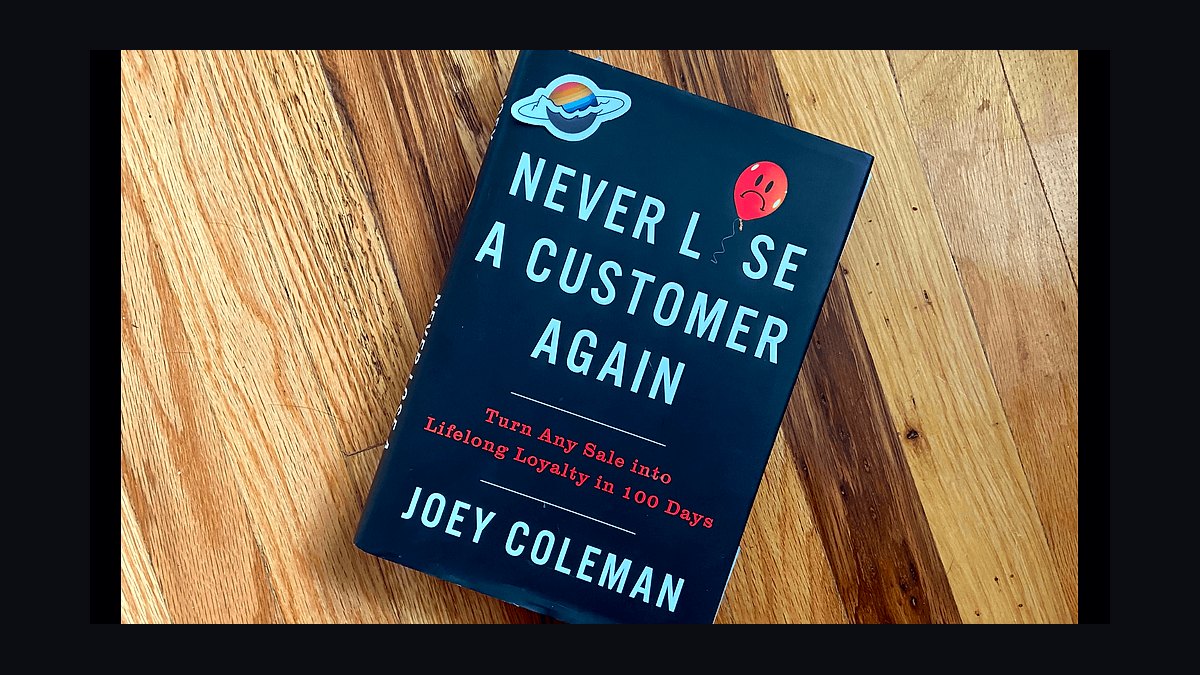
Joey Coleman's *Never Lose a Customer Again* argues that 20-70% of new customers leave within the first 100 days after purchase — a window he calls the buyer's remorse period. His antidote is the 8-Phase Customer Journey (Assess, Admit, Affirm, Activate, Acclimate, Accomplish, Adopt, Advocate) delivered through 6 Communication Tools. For Sellers, it is the definitive post-close handoff playbook.
What the book is and why it matters to Sellers
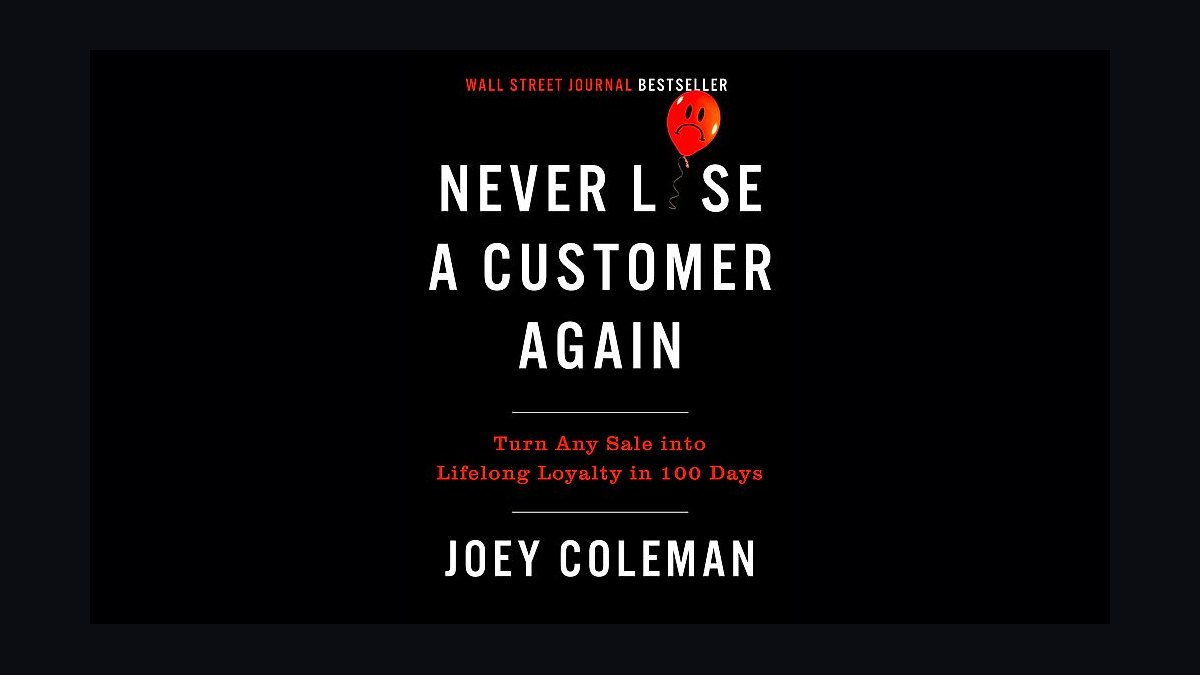
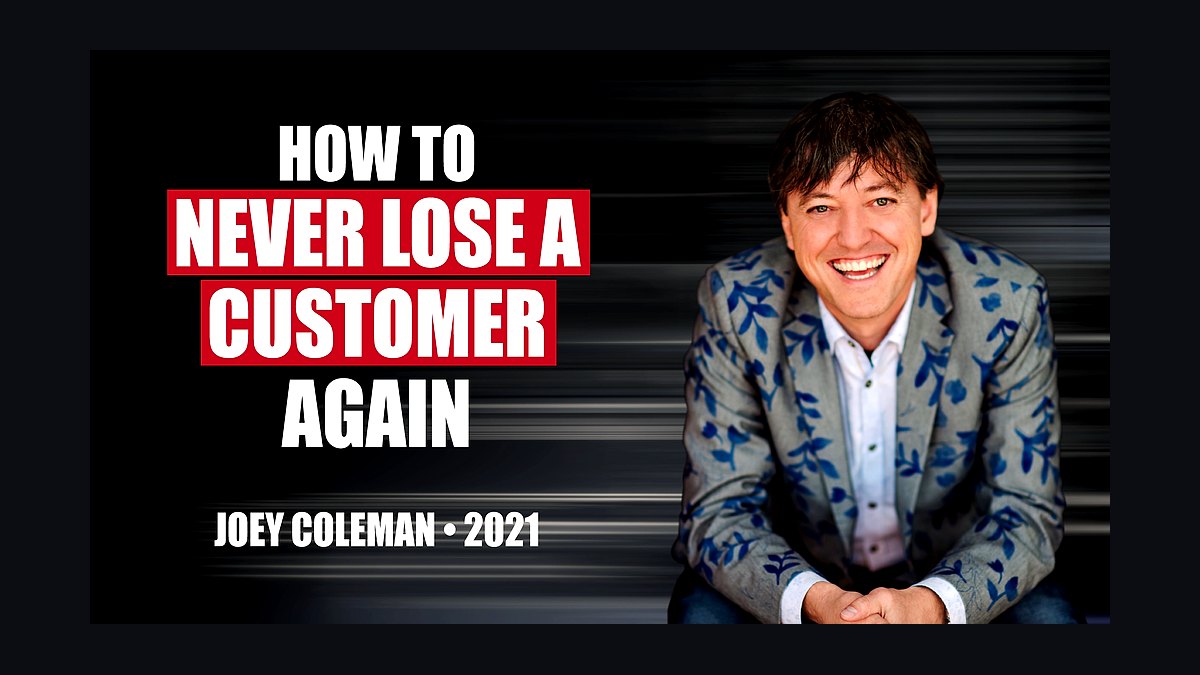
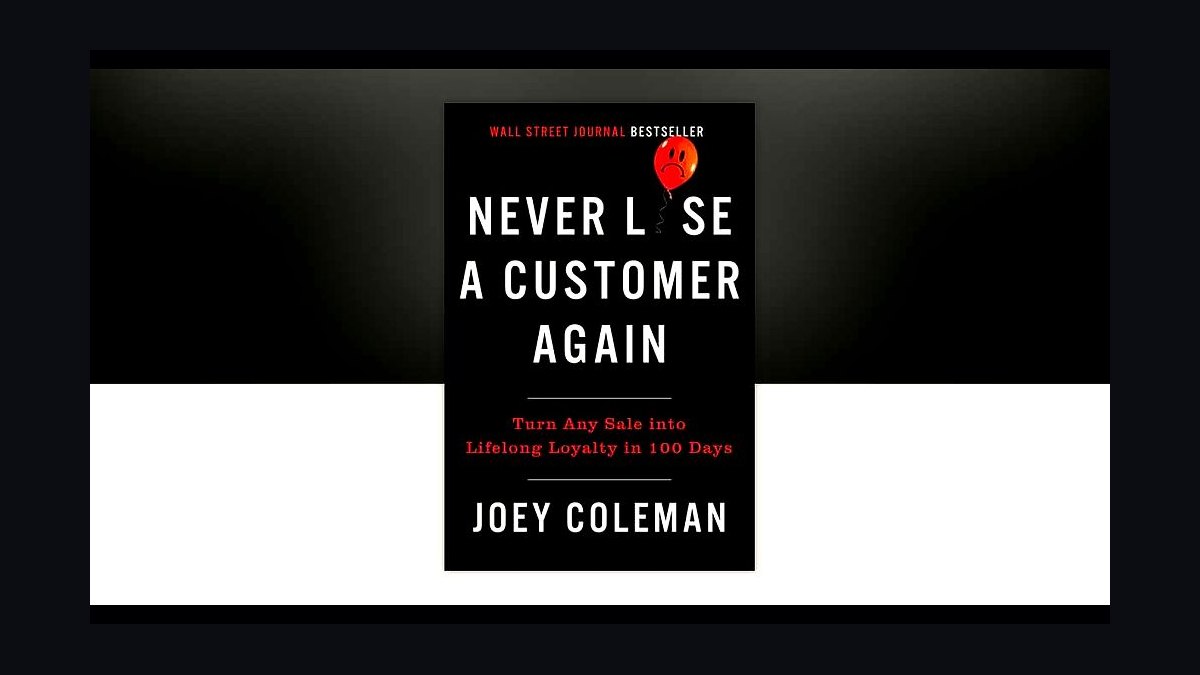
*Never Lose a Customer Again: Turn Any Sale into Lifelong Loyalty in 100 Days* was published by Portfolio/Penguin in 2018. Its author, Joey Coleman, is a former criminal defense attorney turned brand consultant and founder of Design Symphony. The book sits at the end of a long retention canon that runs from Frederick Reichheld's *The Loyalty Effect* (1996) through Matthew Dixon's *The Effortless Experience* (2013) and into the modern Customer Success platform stack. What makes it essential reading for Sellers is that it answers the question every other sales book only implies: what happens after the deal closes?
The central claim is uncomfortable. Coleman reports that between 20% and 70% of new customers leave within the first 100 days — not at renewal, but before the relationship even stabilizes. His framing is blunt: "It's not a churn problem, it's an onboarding problem." For a Seller, that reframes every closed deal as provisional for 100 days. The revenue booked in Q1 is the revenue at risk in Q2 if the post-sale experience goes silent. This is why the book functions as a sales-to-Customer Success handoff playbook rather than a pure CS text. It gives Sellers and CSMs a shared vocabulary and a shared map of where trust is won or destroyed.
Coleman's second foundational claim is that onboarding is not an afterthought — it is a product. Products have owners, KPIs, roadmaps, and release cadences. Onboarding, he argues, deserves the same operating posture. Most companies treat it as a chore handled by whoever is least busy, which means the highest-leverage retention lever in the business is owned by no one. The third claim is that customers remember Day 1 forever. Coleman calls this the Remarkable First Day, and he argues companies that engineer it generate dramatically higher lifetime value than those that deliver a standard transactional first day. He points to examples like Zappos surprise shipping upgrades, Ritz-Carlton pre-arrival touches, and Apple's Genius Bar first-visit ritual as engineered Day-1 moments.
For Sellers specifically, the book matters because it names the exact moment where most deals quietly die: the silence after signature. The Seller has moved on to the next opportunity. The buyer is left asking "Did I make the right call?" with no one answering. Coleman's entire framework is a strategy for closing that gap.
The step-by-step process
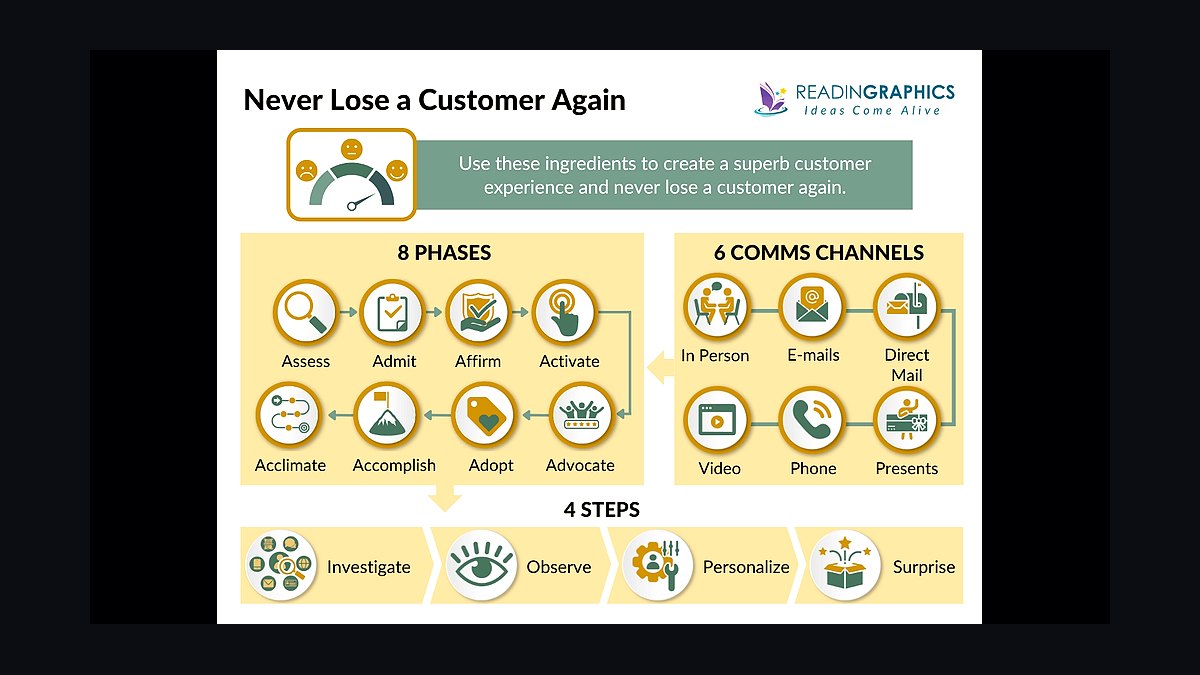
Coleman's framework has two interlocking parts: the 8 Phases of the Customer Journey and the 6 Communication Tools used to deliver touches within each phase. The phases are sequential but not strictly linear — a customer can loop back, and advocacy feeds new prospects into Assess.
Phase 1 — Assess. The pre-purchase phase. The Customer is comparing alternatives, reading reviews, evaluating fit. The failure mode is a gap between the marketing promise and the product reality. Coleman's prescription is mundane and underused: make the marketing accurate. Overselling here loads buyer's remorse into Phase 3 before the contract is even signed.
Phase 2 — Admit. The moment the buyer signs the contract or completes purchase. This is emotionally loaded — the Customer has just committed money, political capital, and reputation. The most common failure across all eight phases lives here: silence after the sale. Most companies send one auto-generated receipt and then go dark for days or weeks. The fix is structural — a planned, multi-channel touch sequence triggered within minutes of contract execution, not a single transactional email.
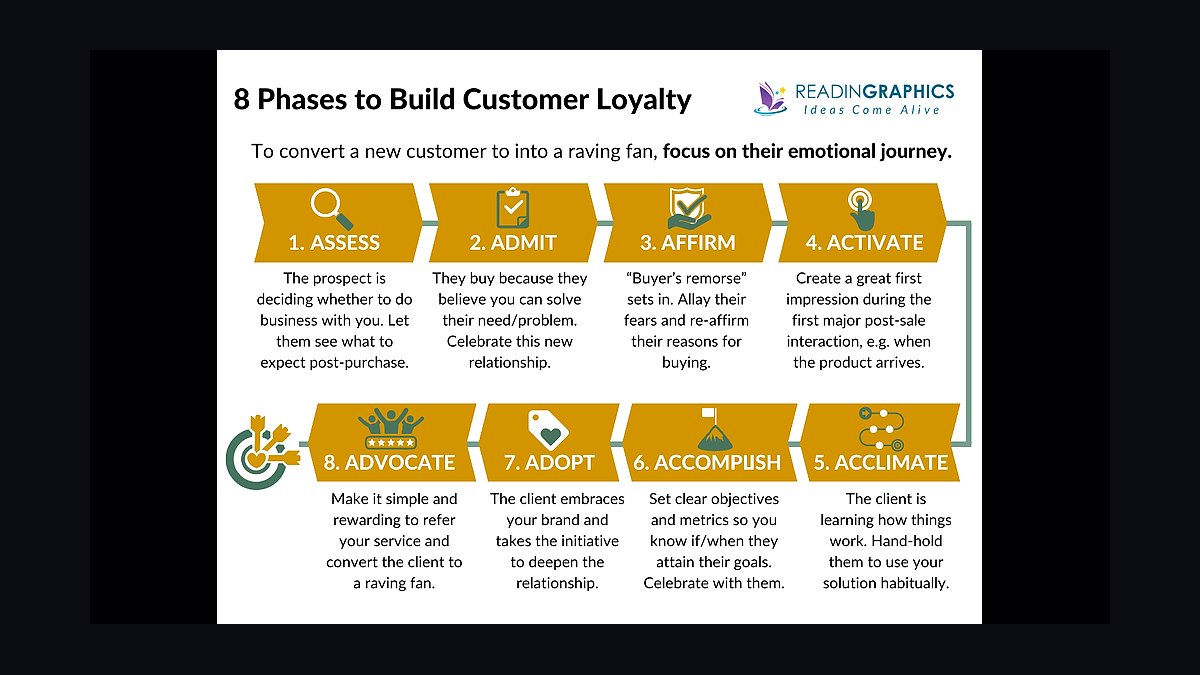
Phase 3 — Affirm. The first 24-48 hours post-purchase. Coleman calls this the acute buyer's remorse zone. The Customer is asking "Did I make the right call?" A standard "Thanks for your order" email confirms the transaction without affirming the decision. Coleman's prescription is a deliberately personal touch from a real human — ideally the Seller or an executive sponsor. A handwritten note, a two-minute personalized video from the account executive, or a phone call from the CEO for high-ACV deals. The goal is to convert "Did I make the right call?" into "These people have my back."
Phase 4 — Activate. The first real engagement — the kickoff, the implementation start, the first login. The failure mode is handoff confusion between sales and CS, where the Customer asks "now what?" and gets three conflicting answers. Coleman's fix is a defined kickoff ritual: same agenda, same artifacts, same owner, every time.
Phase 5 — Acclimate. The first 30-60 days. The Customer is learning the product, the workflow, the support channels. Unstructured onboarding leaves them overwhelmed — they paid for a product they do not yet know how to use. Coleman's prescription is a paced, milestone-driven curriculum with explicit checkpoints.
Phase 6 — Accomplish. The Customer's first major win — the moment they achieve the outcome they bought the product for. The failure mode is that the company does not surface the win, and the Customer does not notice their own success. Coleman's fix is the engineered win moment: a CSM-triggered celebration, a dashboard milestone, an email from the CEO. The win has to be named for the Customer to internalize it.
Phase 7 — Adopt. The product becomes part of the Customer's routine. They self-identify as a user. The failure mode is that the company stops engaging, assuming the Customer is safe. Coleman's warning: the silent Customer is the highest-risk Customer. Adoption is not the end of the journey — it is the start of the expansion and advocacy windows.
Phase 8 — Advocate. The Customer recommends the product to peers, leaves reviews, gives testimonials, joins case studies. The failure mode is asking at the wrong moment or asking too early. Coleman's timing rule is specific: ask for advocacy at Phase 8, not at Phase 4. Most companies invert this — they ask for a review during onboarding, when the Customer has nothing to say yet, instead of after the first major win.
The 6 Communication Tools are the channel palette for delivering touches within each phase. In-Person has the highest impact and lowest scalability — reserve it for high-ACV moments like contract signing dinners, executive QBRs, and first-major-win celebrations. Email is the most overused channel and effective only when truly personalized; generic templated email actively damages trust in Phases 2-3. Direct Mail is counterintuitive but powerful — physical mail stands out precisely because every other channel is saturated. Phone is chronically underused; Coleman's point is that a five-minute call beats a ten-email thread for resolving anxiety in Phase 3. Video, via tools like Loom or Vidyard, is the right format for "I want to feel like I know you" without the calendar friction of a meeting. Presents — physical gifts at milestone moments — signal investment when done with taste and manipulation when done sloppily. Reserve them for Phase 6 and Phase 8.
Costs, timelines, and typical ranges
The book does not prescribe a fixed budget, but the operating economics are worth mapping for any Seller or RevOps lead trying to build this into a real motion. The 100-day window is the core timeline. Within it, the highest-leverage intervention is the first 24-48 hours — Phase 3, Affirm. That is where a small investment in human touch produces outsized retention effects.
On cost, the ranges vary widely by ACV. For a low-ACV self-serve product, the Affirm touch may be a personalized video recorded in two minutes or a well-written email with a real human's name and a specific detail about the purchase. Marginal cost: near zero. For mid-market deals, a handwritten note plus a phone call from the account executive is realistic — perhaps 15-30 minutes of Seller time per deal. For enterprise deals, Coleman's prescription scales up: an executive sponsor call, a curated welcome package, an in-person kickoff. That can run into hundreds or thousands of dollars per account, which is defensible when the contract value is six or seven figures.
The Remarkable First Day is where costs concentrate. Coleman's claim is that companies engineering a remarkable first day generate 3-5x the lifetime value of companies delivering a standard one. That is a directional claim, not a precise forecast, but the trade-off is clear: spend on Day 1 or spend more later on retention and re-acquisition. The typical pattern is that teams underinvest in Phases 2-3 because those costs hit before any revenue is recognized, and overinvest in Phase 7 retention motions because by then the Customer is already at risk.
Timelines for building the full motion: most teams can map their current Customer journey against the 8 Phases in a single workshop. Designing one human, non-email touchpoint for the most neglected phase — usually Phase 3 — takes a week or two. Instrumenting the full 100-day sequence with triggers, owners, and success criteria is a quarter-long project for a mid-sized org. The touch tracker — logging every Customer touchpoint by phase and channel — is the artifact that surfaces gaps and over-engagement.
Where teams get it wrong
The most common failure is treating the handoff as a document rather than a ritual. A Seller fills out a handoff form, drops it into a Slack channel, and considers the job done. The Customer experiences a seam — a new name, a new tone, a new set of expectations — and the trust built during the sales cycle starts to erode. Coleman's framework says the Seller owns Phases 1-3, the CSM owns Phases 4-7, and both jointly own Phase 8. The Customer should never feel the transition.
The second failure is defaulting to email for high-stakes moments. Email is the most overused channel and the weakest for emotional moments. A "welcome aboard" email in Phase 3 does almost nothing to reduce buyer's remorse. A five-minute phone call does. Most Sellers have been trained out of using the phone, which is precisely why it works.
The third failure is asking for advocacy too early. Teams push for a G2 review or a case study during onboarding, when the Customer has no results to point to. Coleman's rule is to ask at Phase 8, after a celebrated win in Phase 6. The right ask, at the right moment, from the right person, generates dramatically higher response rates than the wrong one.
The fourth failure is assuming the silent Customer is safe. Adoption is not the end of the journey. A Customer who stops engaging in Phase 7 is often the one who churns at renewal without warning. The touch tracker exists to catch that silence before it becomes a cancellation.
The fifth failure is treating onboarding as a chore. If no one owns it, no one improves it. Coleman's argument that onboarding is a product means it needs a named owner, a roadmap, and a release cadence — the same operating discipline as the core product.
Decision framework: when to choose what
Not every deal justifies every touch. The framework scales by ACV, complexity, and strategic value. The decision is about matching channel intensity to deal economics.

For low-ACV self-serve, the Affirm touch is automated but still personal in tone — a real name, a specific detail, an in-product welcome. For mid-market, a personalized video plus a handwritten note plus a kickoff call is the standard. For enterprise, the full sequence applies: executive sponsor call, curated welcome package, in-person kickoff, dedicated onboarding team.
The second decision is timing. The Affirm touch must fire within 24-48 hours. The kickoff ritual should happen within the first week. The first win should be surfaced within the first 60 days. The advocacy ask should follow the celebrated win, not precede it.
The third decision is ownership. The Seller owns Assess, Admit, and Affirm. The CSM owns Activate, Acclimate, Accomplish, and Adopt. Both jointly own Advocate. Any ambiguity here is where the Customer feels the seam.
Related questions
What is the 100-day window in Coleman's framework?
It is the period after purchase during which 20-70% of new Customers leave. Coleman calls it the buyer's remorse window and argues it is the highest-leverage retention period in the entire Customer lifecycle — more important than renewal, expansion, or QBR motions.
Who owns which phase in the sales-to-CS handoff?
The Seller owns Phases 1-3 (Assess, Admit, Affirm). The CSM owns Phases 4-7 (Activate, Acclimate, Accomplish, Adopt). Both jointly own Phase 8 (Advocate). The Customer should experience no seam between the two roles.
Why is the phone the most underused tool in B2B sales?

Because most Sellers have been trained to default to email for everything. Coleman's point is that a five-minute call in Phase 3 reduces buyer's remorse more effectively than any email sequence, and the phone's scarcity makes it stand out.
When should you ask for a review or case study?
At Phase 8 (Advocate), after the Customer has experienced a celebrated win in Phase 6 (Accomplish). Asking during onboarding — Phase 4 — generates almost no usable advocacy and slightly damages trust.
FAQ
Why does Coleman say onboarding is a product, not an afterthought? Because products have owners, KPIs, roadmaps, and release cadences — and onboarding determines 20-70% of lifetime value. Treating it as a chore means the highest-leverage revenue lever is owned by no one, which is why most companies neglect Phase 3 (Affirm) entirely.
What is the single most underused communication tool in B2B sales? The phone. A five-minute call in Phase 3 (Affirm) reduces buyer's remorse more effectively than any email sequence. Most Sellers have been trained out of using it, which is precisely why it works when deployed deliberately.

How does this book apply to the sales-to-CS handoff? The 8 Phases give the handoff a shared structure. The Seller owns Phases 1-3, the CSM owns Phases 4-7, and both jointly own Phase 8. The Customer experiences no seam, which is the entire point of the framework.
Is the Remarkable First Day really worth the cost? Coleman's claim is 3-5x lifetime value versus a standard first day. The trade-off is clear: spend on Day 1 or spend more later on retention and re-acquisition. For high-ACV deals, the math almost always favors investing in the first day.
**How does this compare to Dixon's *The Effortless Experience*?** Dixon argues to reduce effort to prevent disloyalty. Coleman argues to engineer remarkable touches to build loyalty. They are complementary — Dixon owns the support-experience floor, Coleman owns the onboarding-experience ceiling. A mature strategy uses both.
What has aged since the book was published in 2018? The 8-Phase framework holds up entirely and has become de facto Customer Success vocabulary. What has aged is the example set — Coleman leans on retail and hospitality more than B2B SaaS. The 6 Communication Tools also understate the rise of in-product touchpoints, which are now often the most effective Phase 5 channel.
Sources
- Joey Coleman — *Never Lose a Customer Again: Turn Any Sale into Lifelong Loyalty in 100 Days* (Portfolio/Penguin, 2018)
- Joey Coleman — *Never Lose an Employee Again* (Portfolio/Penguin, 2023)
- Frederick Reichheld — *The Loyalty Effect* (Harvard Business Review Press, 1996)
- Matthew Dixon, Nick Toman, Rick DeLisi — *The Effortless Experience* (Portfolio, 2013)
- Lincoln Murphy — Sixteen Ventures customer success essays
- Gainsight — Customer Success Index reports
- OpenView Partners — Product-led growth benchmark reports
- Harvard Business Review — customer retention and loyalty research
- Sendoso — direct mail and gifting category research
- Pendo — product analytics and in-product guidance resources
Related on PULSE
- Never Split the Difference by Chris Voss: Summary, Key Lessons, and RevOps Takeaways
- The Challenger Customer — Cliff Notes Summary
- Never Split the Difference — Cliff Notes Summary
- The Challenger Customer by Adamson, Dixon, Spenner & Toman — Cliff Notes Summary
- Never Split the Difference by Chris Voss — Cliff Notes & Chapter-by-Chapter Summary
This page will be disappearing soon. Save it to your device for $1 — or read it free while it is here.
@Kory-White- · if Venmo asks, the last 4 of my number are 2012
This page is gone.
This one is off the shelf now. $1 keeps it on your phone for good — the whole page, pictures and diagrams included.
 pulse-recentNever Lose a Customer Again by Joey Coleman — Top 10 Key Takeaways for Sales Leaders in 2027
 pulse-recentWhat is the second concrete step in Strategic Selling by Miller Heiman for identifying a sales coach in 2027?
 pulse-recentCrossing the Chasm by Geoffrey Moore — Top 10 Key Takeaways for Sales Leaders in 2027
 pulse-recentStrategic Selling by Robert Miller and Stephen Heiman — Top 10 Key Takeaways for Sales Leaders in 2027
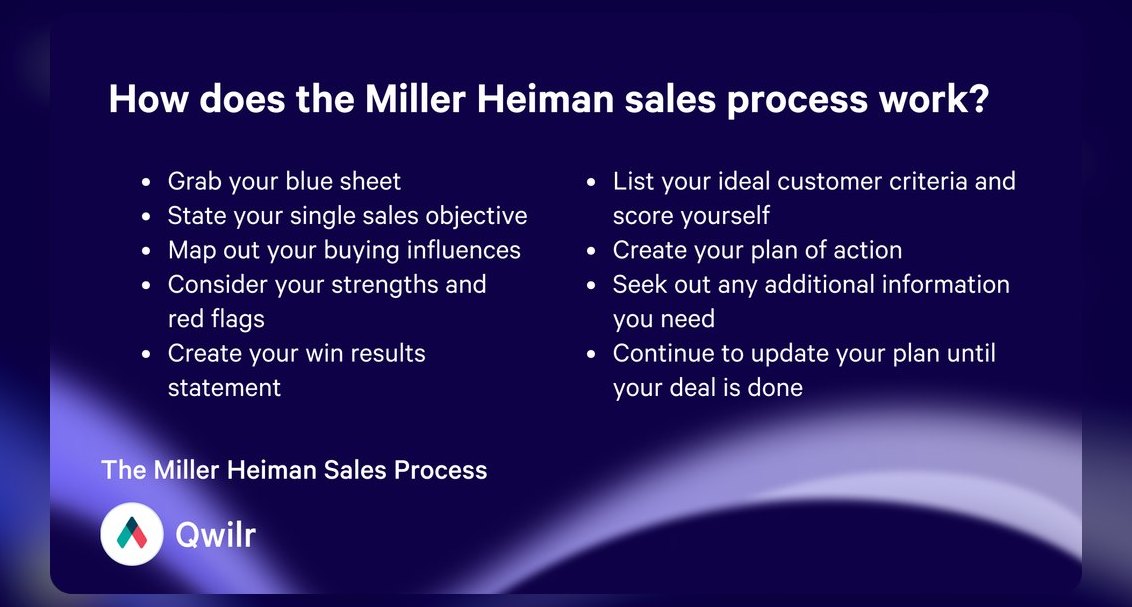 pulse-recentWhat is the step-by-step process for Strategic Selling by Miller Heiman in 2027?
 pulse-recentHyper Sales Growth by Jack Daly — Top 10 Key Takeaways for Sales Leaders in 2027
 pulse-recentThe Transparency Sale by Todd Caponi — Top 10 Key Takeaways for Sales Leaders in 2027
 pulse-booksRework by Jason Fried and David Heinemeier Hansson — Cliff Notes Summary
 pulse-recentBlueprints for a SaaS Sales Organization by Jacco van der Kooij — Top 10 Key Takeaways for Sales Leaders in 2027
 pulse-recentThe Challenger Customer by Brent Adamson — Top 10 Key Takeaways for Sales Leaders in 2027