


Action Selling by Duane Sparks — Cliff Notes Summary
Quality
Certified
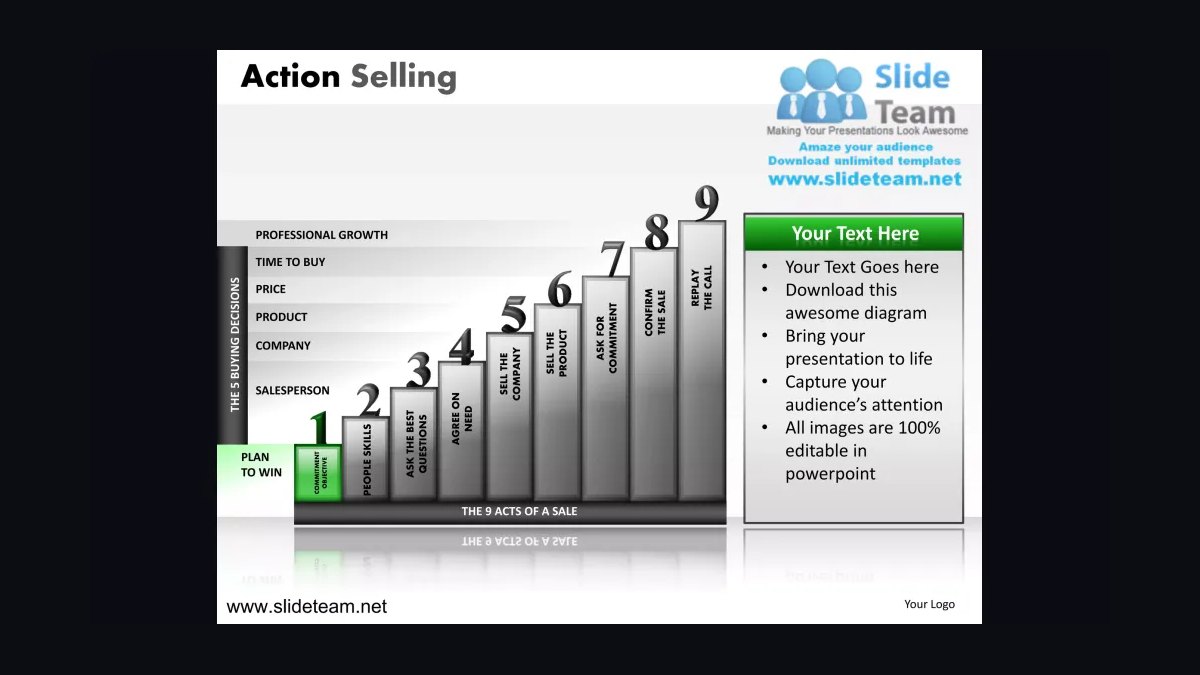
*Action Selling* by Duane Sparks is a short, prescriptive B2B sales methodology built on recorded field research. It teaches five trainable skills — setting a Commitment Objective, people skills, structured questioning, buyer-tailored presenting, and explicitly asking for commitment — and argues buyers make five trust decisions in fixed sequence that a seller cannot skip.
What the book is and why it still matters
Duane Sparks founded The Sales Board in Minneapolis and spent roughly three decades in sales training before writing *Action Selling: How to Sell Like a Professional, Even If You Think You Are One* (Action Selling Books, 2004). The book is the textbook companion to a corporate certification program that has been run at large enterprises including HP, IBM, Microsoft, Cisco, Honeywell, Pitney Bowes, and Sherwin-Williams. It is deliberately thin — around 200 pages, written partly as a business parable — because it was designed to be read once before a workshop and then referenced as a checklist forever after.
What separates it from the shelf of sales books published in the same decade is its origin. Sparks and The Sales Board built the framework from an audit of tens of thousands of recorded buyer-seller interactions across industrial distribution, manufacturing, and technology accounts. That research method — observe real calls, code what happens, find the repeatable failure — is the same method Neil Rackham used at Huthwaite to produce *SPIN Selling* (1988). Both arrived at the same uncomfortable finding: the average seller talks too early, asks too few questions, and ends the meeting without a defined next step.
The thesis is one sentence: selling is a skill, not an art — and skills are trainable. That line is doing heavier lifting than it looks. If selling is an art, then the only lever a sales leader has is hiring, and every quarter becomes a talent lottery. If selling is a skill, then the levers are curriculum, practice, coaching, and measurement — the same levers that govern any other operational function. This is precisely why *Action Selling* found a home in enterprise sales-enablement organizations rather than on airport bookshelves. It gives a VP of Sales something to standardize.
The five decisions model is the book's other durable contribution. Sparks argues a buyer decides, in this order: do I trust the salesperson, do I trust the company, do I trust the product, do I trust the price-to-value math, and do I trust that now is the right time. A seller who opens with a product pitch is arguing Decision 3 to a buyer still stuck on Decision 1 — and the buyer will rarely say so out loud. They will nod, let you finish, and go dark. David Hoffeld's *The Science of Selling* (2016) arrives at a structurally similar sequence twelve years later using cognitive-science literature rather than call recordings, which is reasonable corroboration that the sequencing instinct is real.

For a RevOps audience, the reason the book matters is not the parable. It is that every element of the framework is instrumentable. A Commitment Objective is a required field. A question count is a conversation-intelligence metric. A buying decision is a stage-exit criterion. The book predates modern revenue tooling by a decade but reads like a specification for it.
The five skills, in the order the method runs them
Skill 1 — the Commitment Objective. Before any interaction, the seller writes down the specific commitment they will ask the buyer to make: schedule the technical demo, sign the pilot agreement, introduce the CFO, return the redlined MSA. Sparks explicitly disqualifies soft objectives like "build the relationship" or "check in." The rule he is most quoted for is that every meeting must have a Commitment Objective or you are just chatting. He also insists on stating it aloud in the first two minutes — something like *"By the end of our thirty minutes I'm hoping we can agree on whether a pilot makes sense — does that work for you?"* — which converts a hidden agenda into a shared one and gives the buyer a chance to renegotiate the scope of the meeting rather than silently opting out of it.
When the ultimate commitment is too large for one conversation, Sparks teaches a ladder of Minor Commitments: agree to a second meeting with a named attendee, agree to loop in IT, agree to share last year's spend. Each rung is a measurable, loggable win, and the ladder is what produces the close. Robert Cialdini's commitment-and-consistency principle from *Influence* (1984) describes the same psychology; Sparks arrived at it from call data rather than lab studies.
Skill 2 — people skills. Sparks refuses the premise that likability is innate. He teaches named, practicable techniques: mirroring pace and posture, labeling the buyer's stated priority back to them, summarizing before transitioning, and going "three deep" — never accepting the first surface answer, always asking two follow-ups. The lineage back to Dale Carnegie (1936) is explicit, but the setting is updated for a B2B procurement contact who has already been cold-called four times that morning.
This skill also carries the DISC-derived buyer typology — Director, Influencer, Steady, Compliant, descending from William Marston's *Emotions of Normal People* (1928). Directors want the bottom line in bullets; Influencers want stories and social proof; Steadies want process, timelines, and reassurance; Compliants want data, footnotes, and a risk register. The seller's job is to read the style early and adapt delivery, not product.
Skill 3 — questioning. This is the chapter Sparks is cited for most. Discovery runs four question types in fixed order: a broad open ("walk me through how your team handles renewals today"), a focused open ("what's the single biggest friction point in that flow?"), a feeling question ("how does that land with your CFO when the number misses?"), and a commitment question ("if we could fix that, would you sponsor a pilot?"). It is a funnel — wide, then narrow, then personal, then locked. The research finding attached to it is stark: weak reps asked a handful of questions before pitching, while top performers asked several times more. Sparks's prescription is mechanical — write ten best questions per account before the call, in sequence, and do not present until most are answered.
Skill 4 — presentation. A generic deck is a confession that discovery did not happen. The presentation must reference by name the buyer's stated priority, their stated friction, their stated success metric, and their communication style. Sparks also amends the old Xerox/IBM Features-Advantages-Benefits model with a fourth beat: Reactions. After each benefit, stop and ask how it lands. Never pitch past a silent buyer.
Skill 5 — gaining commitment. The amateur's sin is the implicit close: *"let me know what you think," "shoot me an email if you want to move forward."* Sparks demands the explicit ask — name the commitment, name the timeline, name the next step, then stop talking. He catalogs the recurring stall categories (price, timing, authority, risk, and status-quo inertia) and pairs each with a handling pattern: feel-felt-found for price, time-boxing for timing, sponsor-mapping for authority, scope-reduction for risk, and cost-of-inaction for inertia. Much of that catalog was later absorbed into qualification frameworks like MEDDPICC.
The step-by-step process a rep actually runs
The five skills map one-to-one onto a five-phase call process, and the phases map onto the buyer's five decisions. That triple mapping is the whole method; everything else is elaboration.
Phase one is planning. Before the meeting, the rep writes the Commitment Objective in one sentence, drafts ten sequenced questions, and identifies which buying decision is most at risk. If it is a first meeting with a stranger at a company that has never heard of you, Decision 1 and Decision 2 are the risk, and product content is irrelevant. If it is a fourth meeting where procurement has entered, Decisions 4 and 5 are the risk, and more feature talk actively hurts.
Phase two is opening. State the Commitment Objective, confirm the time box, and read communication style in the first minute or two. A Director who opens with "so what do you have for me" has told you to cut the warm-up. A Compliant who asks about your security posture before you have introduced yourself has told you the deck needs an appendix.
Phase three is diagnosis. Run the question sequence in order and resist the pull to answer product questions early. When a buyer asks "does it integrate with our ERP" in minute six, the disciplined move is a brief yes followed by a return to the funnel — *"it does; before I go deep there, help me understand what breaks today when it doesn't."*
Phase four is the recommendation, built live from the language captured in phase three. Depth and density are tuned to style: a short deck for a Director, a long one with an appendix for a Compliant. Reaction checks are inserted after every claim.
Phase five is earning commitment. Make the explicit ask, handle the objection by category, and if the answer is no, diagnose which decision failed rather than repeating the pitch louder. A "we need to think about it" after a strong demo is almost never a product problem — it is usually Decision 4 (value math) or Decision 5 (timing).
The loop back from H to C is the part most teams drop. Sparks's argument is that a lost commitment is diagnostic information, not a dead end: it tells you exactly which trust decision is unresolved, and the remedy is more diagnosis, not more presentation.
Costs, timelines, and what adoption actually takes
The book itself is a trivial purchase — a paperback, readable in an evening. The real cost sits in the training program and, more importantly, in the reinforcement. Corporate sales methodology rollouts of this type are typically sold as instructor-led workshops of one to two days per cohort, followed by certification testing and periodic refreshers. Pricing is negotiated per engagement and varies enormously by headcount, delivery mode, and whether the customer licenses the curriculum for internal trainers, so any specific number quoted secondhand should be verified directly with the vendor rather than trusted from a summary.
What is generalizable is the shape of the timeline. Reading the book takes a few hours. Getting a rep to consistently write a Commitment Objective before every meeting takes a few weeks of manager inspection. Getting a team to shift its question-to-pitch ratio takes a quarter, because it requires unlearning a reflex under quota pressure. Getting the method embedded so that new hires absorb it from peers rather than from a class takes longer still — typically two to four quarters, and only if the CRM and the pipeline reviews are rebuilt to demand its artifacts.
That last condition is where most of the true cost hides. A methodology that is not instrumented decays fast. If your opportunity stages still advance on rep optimism, nothing in the workshop survives contact with the forecast call. The operational work looks like this: add a required next-commitment field on every open opportunity; make stage exit criteria read as buying decisions rather than internal activities; add a pre-call planning field the manager can inspect; and pull question-count or talk-ratio data from whatever conversation-intelligence tool you run. Each of those is a small change. Together they are the difference between a training event and a operating system.
Budget for reinforcement at least as heavily as for delivery. Manager coaching capacity is the binding constraint — a front-line manager with ten reps and no protected coaching time cannot enforce a methodology no matter how good the curriculum is. Practitioners who have rolled out any named methodology tend to converge on the same rule of thumb: if managers are not certified first and held to a call-coaching cadence, treat the rollout as unlikely to stick and either fix the cadence or defer the spend.
There is also a hidden cost worth naming: content rework. The buyer-tailored presentation skill is unenforceable if marketing only ships one master deck. Supporting it means maintaining at least a short-form and a long-form version of the core narrative, plus a proof appendix. That is a real content-ops workload, and it usually lands on enablement rather than on the sales team that requested the training.
Where teams get it wrong
Treating the Commitment Objective as a CRM field instead of a conversation. The most common failure mode is that reps start typing a next step into Salesforce after the call rather than negotiating one during it. The artifact appears, the behavior does not. The tell is a pipeline full of next steps like "follow up" with dates that slide weekly. The fix is inspection at the level of language: in pipeline review, ask what the buyer literally said when the rep asked for the commitment. If the rep cannot quote it, it did not happen.
Turning the DISC read into typecasting. Sparks uses the four styles as an opening heuristic — a way to decide how to spend the next ten minutes. Teams routinely inflate it into a personality system, tagging contacts in the CRM and building rigid playbooks per type. Academic psychology has been consistently skeptical of DISC-style typologies as predictive instruments, and Adam Grant among others has publicly criticized the broader family of workplace personality typing. The operational heuristic survives that criticism; the pseudo-scientific certainty does not. Read style, adapt delivery, do not build a segmentation strategy on it.
Running the question sequence as an interrogation. The four-question funnel is a structure, not a script. Reps who have just been certified often fire questions in mechanical order without reacting to the answers, and buyers feel processed. The three-deep technique from Skill 2 is the corrective — the sequence should feel like curiosity that keeps going, with each follow-up visibly built from what the buyer just said.
Skipping ahead in the buying decisions and misreading the loss. When a deal stalls, the reflex is to send more product material. Sparks's model says that is almost always wrong: if the buyer disengaged at Decision 1 or 2, more product content is answering a question nobody asked. Diagnose the decision, then choose the intervention — a reference customer for Decision 2, a risk-reduced pilot for Decision 3, a business case for Decision 4, a cost-of-inaction frame for Decision 5.
Applying the 2004 cadence literally in modern buying environments. The book's explicit-ask examples ("sign the pilot today") read from an era with shorter procurement cycles and less formalized legal review. In enterprise deals now routed through security review, privacy review, and vendor onboarding, "sign today" is not a thing a champion can do. The principle holds — name the next step and get a verbal yes — but the ask must be sized to what this specific person can actually authorize this week. Asking a champion for a commitment they lack the authority to make damages the relationship you spent Skill 2 building.
Ignoring the motion mismatch. The case material skews industrial distribution and pre-SaaS enterprise. Teams running product-led growth, self-serve, or high-velocity inbound motions cannot apply it unmodified. In a PLG motion the Commitment Objective often belongs to a product event ("get three teammates into the workspace") rather than a meeting, and discovery is partly replaced by usage telemetry. The translation is doable and worth doing, but pretending the book was written for that motion produces a curriculum reps quietly ignore.

Rolling it out on top of a competing methodology. Plenty of organizations layer *Action Selling* on a team already certified in Challenger, Sandler, or a MEDDPICC-based qualification model. The frameworks are not contradictory, but the vocabulary collides, and reps default to whichever one the forecast call uses. Pick one language for the pipeline and treat the others as supplements.
Choosing between this and the neighboring methodologies
*Action Selling* sits in a crowded field, and choosing well means matching the framework to the actual failure in your funnel rather than to the most-recommended book.
If your problem is that reps leave meetings without next steps and pipeline is full of stalled, undefinable opportunities, this book is the most direct fix in the canon. The Commitment Objective is the single most portable idea in it, and it can be adopted in a week without buying anything.
If your problem is that reps present too early and discovery is shallow, *SPIN Selling* (Rackham, 1988) or *Gap Selling* (Keenan, 2018) go deeper on diagnosis. SPIN's implication and need-payoff questions do more work on building urgency than Sparks's four-type funnel does.
If your problem is that you win on features and lose on status quo — deals dying at "we'll revisit next year" — *The Challenger Sale* (Dixon & Adamson, 2011) is aimed squarely at that, since its commercial-teaching insight is designed to unsettle the buyer's current thinking rather than respond to a stated need.
If your problem is qualification rigor and forecast accuracy rather than call execution, you want MEDDPICC or a similar qualification checklist. That is a different tool doing a different job; it tells you which deals are real, not how to run the meeting.
And if the problem is discounting, Sparks's own companion volume *Selling Your Price* (2007) is more on-point than the flagship book, as is *Masters of Loyalty* (2010) for post-sale retention motions — a reminder that the methodology extends downstream into customer success, where the same commitment discipline governs renewal conversations.
The honest summary is that these frameworks overlap heavily at the level of behavior and differ mostly in emphasis and vocabulary. Nearly all of them tell you to ask more, present less, and secure a defined next step. The choice matters less than the consistency of enforcement — a mediocre methodology inspected weekly beats an excellent one that lives in a binder.
What holds up and what has aged
The question-to-pitch discipline has aged extremely well. Modern conversation-intelligence platforms — Gong, Chorus, and similar tools — surface talk ratios and question counts as first-class metrics, which is essentially the automation of the manual call coding The Sales Board did by hand. A rep can now see the same diagnostic Sparks needed a research team to produce.
The Commitment Objective has become table stakes in pipeline hygiene. Every CRM stage gate in Salesforce or HubSpot, every forecast-inspection tool, is functionally asking the same question: what did the buyer agree to do next, and when. Sparks's framing gives that field a purpose beyond compliance.
The five buying decisions hold up as a diagnostic lens, especially the insistence that trust in the seller and the company precedes any product conversation. In a market where buyers self-educate before ever taking a meeting, Decisions 1 and 2 arguably matter more now than in 2004, because the first live conversation happens later in the process and carries more weight.
What has aged: the DISC scaffolding, as discussed; the industrial-distribution case material; the single-threaded assumption that one buyer makes the decision, which sits awkwardly against the reality of large modern buying committees; and the pacing of the explicit ask. The book also predates the entire remote-selling apparatus, so its rapport techniques assume physical presence — mirroring posture is a different exercise on a video call with cameras half off.
Read it for the operating discipline rather than the tactics. As a strategy document it is thin; as a checklist for what must be true before a meeting ends, it is one of the tightest things in the category, and at its length there is very little cost to finding out.
Related questions

Is Action Selling a good first methodology for an untrained team?
Yes — it is arguably the best starting point precisely because it is simple and prescriptive. Five skills, five phases, five buyer decisions is a small amount to memorize, and the Commitment Objective delivers visible pipeline improvement within weeks without requiring a full sales transformation.
How does the Commitment Objective differ from a CRM next step?
A next step is a record of what happened; a Commitment Objective is a plan made before the meeting and negotiated during it. The CO is stated aloud to the buyer at the top of the call. The next step is only real if it is what the buyer agreed to, in their words.
Does the method work for inside sales and short cycles?
Mostly. The Commitment Objective and explicit ask translate directly to short cycles. The four-question discovery funnel compresses to two or three questions on a fifteen-minute call, and the buyer-tailored presentation collapses into tone and pacing rather than deck depth.
Should we run Action Selling alongside MEDDPICC?
They solve different problems and can coexist, but pick one vocabulary for pipeline reviews. Use qualification checklists to decide which deals deserve investment, and use the call methodology to decide how each meeting is run. Do not force reps to speak two languages in the same forecast call.
What is the fastest thing to adopt from the book?
Write a one-sentence Commitment Objective for your next three meetings and state it aloud in the first two minutes. It requires no budget, no software, and no training, and it is the change most likely to show up in the pipeline within a month.
FAQ
What is the core argument of Action Selling?
That selling is a trainable skill rather than an innate art. Sparks contends that losing calls fail in predictable, repeatable ways, and that a seller who runs a consistent checklist — objective, rapport, questions, tailored recommendation, explicit ask — will outperform one improvising, regardless of natural charisma.
What are the five buying decisions?
In sequence: trust in the salesperson, trust in the company, trust in the product, trust in the price-to-value math, and trust in the timing of the decision. Sparks argues buyers move through these in order and a seller cannot skip ahead, which is why product pitching to a cold stranger fails.
How is it different from SPIN Selling?
Both came from large-scale analysis of recorded sales calls and both conclude that questioning beats presenting. SPIN goes deeper on question types and building implication; Action Selling covers the whole call arc, including commitment discipline and presentation tailoring, in a more prescriptive and shorter form.
Is the DISC element of the book credible?
Use it as a delivery heuristic, not a science. Personality typologies of the DISC family have been widely criticized in academic psychology for weak predictive validity. The practical instruction — notice how this person prefers to receive information and adapt accordingly — is sound regardless of the underlying taxonomy.
Does the book still apply to SaaS and remote selling?
The structure does; the examples need translation. Commitment discipline, question-first discovery, and the buying-decision sequence transfer cleanly. The physical-presence rapport tactics, single-decision-maker assumption, and same-day close cadence all need adapting to video calls, buying committees, and formal procurement.
What should a sales leader do after reading it?
Instrument it. Add a required next-commitment field, rewrite stage exit criteria as buyer decisions rather than internal milestones, certify front-line managers before reps, and protect weekly call-coaching time. Without those, the workshop is an event rather than a change in how the team operates.
Sources
- https://www.actionselling.com/
- https://www.goodreads.com/book/show/1099748.Action_Selling
- https://openlibrary.org/search?q=action+selling+duane+sparks
- https://en.wikipedia.org/wiki/SPIN_selling
- https://en.wikipedia.org/wiki/DISC_assessment
- https://www.gong.io/resources/
- https://hbr.org/2012/07/the-end-of-solution-sales
- https://www.challengerinc.com/
- https://www.mheducation.com/
- https://www.penguinrandomhouse.com/
Related on PULSE
- SPIN Selling by Neil Rackham: Summary, Key Lessons, and RevOps Takeaways
- Gap Selling by Keenan: Summary, Key Lessons, and RevOps Takeaways
- Secrets of Question-Based Selling by Thomas Freese: Summary, Key Lessons, and RevOps Takeaways
- The SPIN Selling Fieldbook — Cliff Notes Summary
- Buyer-Centered Selling — Cliff Notes Summary
- Selling the Invisible by Harry Beckwith — Cliff Notes Summary
This page will be disappearing soon. Save it to your device for $1 — or read it free while it is here.
@Kory-White- · if Venmo asks, the last 4 of my number are 2012
This page is gone.
This one is off the shelf now. $1 keeps it on your phone for good — the whole page, pictures and diagrams included.
 pulse-recentObviously Awesome by April Dunford — Top 10 Key Takeaways for Sales Leaders in 2027
 pulse-recentCoaching Salespeople into Sales Champions by Keith Rosen — Top 10 Key Takeaways for Sales Leaders in 2027
 pulse-recentThe Transparency Sale by Todd Caponi — Top 10 Key Takeaways for Sales Leaders in 2027
 pulse-recentWhat are the first three concrete steps in Sandler Rule #1 for a new sales rep in 2027?
 pulse-recentSPIN Selling by Neil Rackham — Top 10 Key Takeaways for Sales Leaders in 2027
 pulse-recent$100M Offers by Alex Hormozi — Top 10 Key Takeaways for Sales Leaders in 2027
 pulse-recentSell or Be Sold by Grant Cardone — Top 10 Key Takeaways for Sales Leaders in 2027
 pulse-recentHyper Sales Growth by Jack Daly — Top 10 Key Takeaways for Sales Leaders in 2027
 pulse-recentFanatical Prospecting by Jeb Blount — Top 10 Key Takeaways for Sales Leaders in 2027
 pulse-recentThe Sales Acceleration Formula by Mark Roberge — Top 10 Key Takeaways for Sales Leaders in 2027