


Conversations That Sell by Nancy Bleeke — Cliff Notes Summary
Quality
Certified
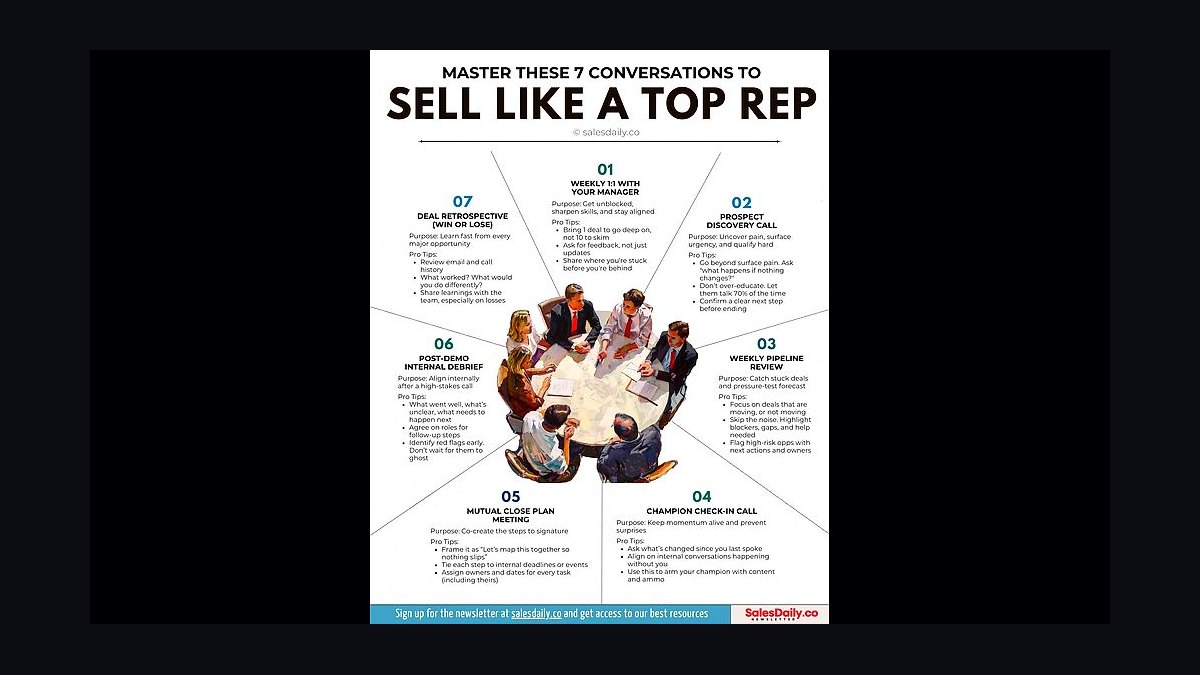
*Conversations That Sell* by Nancy Bleeke is a 2013 sales book arguing that calls fail when reps run WIIFM (What's In It For Me) instead of WIIFT (What's In It For Them). Its core method is a four-step in-call cadence — Wait, Investigate, Facilitate, Then — supported by a four-level listening hierarchy and seven distinct conversation types.
What the book actually argues, and what it competes with
Every sales book on your shelf is answering a different question. Understanding which question *Conversations That Sell* answers is the fastest way to know whether it belongs in your enablement stack or whether you already own something that does the job better.
The dominant strategy in most sales methodology is deal-shaped: it gives you a map of the buying cycle, a set of qualification criteria, and a way to forecast. MEDDIC tells you what facts must be true before a deal is real. The Challenger research tells you what posture correlates with winning complex deals. Solution Selling gives you a diagnostic sequence across a multi-month cycle. These are all *macro* frameworks — they operate at the altitude of the opportunity.
Bleeke operates one altitude down. Her unit of analysis is not the deal; it is the thirty-minute conversation. The book asks a narrow, almost stubbornly practical question: what should come out of your mouth, in what order, during a single live sales call, so that the buyer ends the call better off than they started? Everything in the book — the WIIFT mindset, the cadence, the listening levels, the openers — exists to answer that one question.

That focus is both the book's strength and its boundary. It will not help you build a territory plan, forecast a quarter, or design a compensation structure. It will help a rep who consistently walks out of calls thinking *that felt fine and I have no idea what happens next.*
The practical comparison most buyers of sales training face looks like this:
Option A — a deal-stage methodology (MEDDIC/MEDDPICC, Command of the Sale, Solution Selling). You get a shared vocabulary for pipeline reviews, cleaner CRM hygiene, and forecast discipline. The cost: it is a *scoring* system, not a *behavior* system. Reps learn to fill in the fields after the call rather than change what they do during it. Adoption typically shows up in CRM completeness and forecast accuracy first, and in win rate much later, if at all.
Option B — a conversation-level discipline (*Conversations That Sell*, and adjacent titles like *SPIN Selling*, *Let's Get Real or Let's Not Play*, *Never Split the Difference*). You get changes in live rep behavior — talk ratio, question quality, pause length, the shape of the close. The cost: it is much harder to inspect. A manager cannot see WIIFT in a pipeline report. Without call recording, you are trusting self-report.
Option C — the questioning frameworks specifically. SPIN Selling (Rackham, 1988) is the closest direct competitor to Bleeke's Investigate step. SPIN is built on observational research of a very large sample of sales calls and produces a rep-driven question sequence: Situation, Problem, Implication, Need-payoff. Bleeke's critique — stated plainly in her chapter on Investigate — is that SPIN still puts the rep in the driver's seat. The rep is walking the buyer down a predetermined path toward an implied need. WIIFT inverts that: the rep's questions exist to surface what the buyer already wants, and the rep's job is to remove friction between the buyer and that outcome. Whether that inversion is real methodology or mostly a framing difference is a fair argument, and one worth having before you buy either curriculum for a team.
Option D — buy the tooling instead of the book. Conversation-intelligence platforms (Gong, Chorus, and similar) record and score calls automatically. They will tell you your talk-to-listen ratio without anyone reading a chapter. What they will not do is tell a rep what to *say* instead. The tools measure; the book prescribes. Teams that buy only the tool end up with a dashboard full of metrics nobody knows how to move.
The honest read: these are not mutually exclusive, and the sequencing matters more than the choice. A team with no shared deal language should fix that first, because conversation quality is invisible without a pipeline you trust. A team with clean pipeline hygiene and flat win rates has a conversation problem, and that is exactly the gap Bleeke's book is built for.
How to decide which layer you actually need
The decision is not "which sales book is best." It is "which failure mode is currently costing me the most money." Diagnose that first and the choice mostly makes itself.
Start with three observable signals, all of which you can gather in a week without buying anything.
Signal one — where deals die. Pull your last two quarters of closed-lost and segment by stage. If losses cluster at the *first* stage transition — discovery to qualified, or first meeting to second meeting — you have a conversation problem. The rep is not earning the next meeting. That is the WIIFT gap: the buyer never got a reason to care in the first two minutes. If losses cluster late — proposal to close, or in procurement — you have a qualification or business-case problem, and a conversation book will not fix it. Go buy the deal-stage methodology instead.
Signal two — talk ratio. If you have call recording, pull the distribution across your team on discovery calls specifically. Bleeke's whole argument rests on the claim that reps talk too much and that the best performers talk substantially less. That directional finding has been replicated repeatedly by conversation-intelligence vendors publishing on their own call corpora. If your team's distribution is tight and already listener-heavy, the book will tell you things you already do. If it is wide — some reps at a healthy ratio, some dominating the call — you have a coachable spread and a curriculum has something to bite on.
Signal three — the no-decision rate. Deals that end in nothing, rather than in a loss to a competitor, are usually conversation failures wearing a competitive costume. The buyer never built enough internal conviction to move. Bleeke's Facilitate step — offer two or three paths, let the buyer pick — is aimed squarely at this. A buyer who chose the path defends it internally. A buyer who was pitched a path does not.
Once you know the failure mode, the sequencing question is about capacity, not preference. Rolling out a conversation discipline requires three things a deal methodology does not: call recording (or ride-alongs), manager time for weekly call review, and patience across a full sales cycle before you see anything in the numbers. If you cannot commit a manager to reviewing calls weekly, do not buy conversation training. It will decay to a laminated card in a drawer within a quarter. That is not a knock on Bleeke's material; it is true of every behavior-change curriculum ever sold.
The flowchart makes an assumption worth stating out loud: it assumes you have enough call volume to learn from. A team running four enterprise calls a month per rep cannot run this loop meaningfully — the sample is too thin and the cycle too long. Below roughly one call per rep per day, drop the statistical framing entirely and treat coaching as apprenticeship: the manager sits in, debriefs immediately, and repeats. Bleeke's material still applies, but as a shared vocabulary between manager and rep rather than as a scoring rubric.
The numbers Bleeke works with, and how to read them
This is where a careful reader should slow down. *Conversations That Sell* is a practitioner book, not a research monograph, and its quantitative claims come mostly from Bleeke's own training practice — Sales Pro Insider, which has trained sales organizations in financial services, insurance, and healthcare. That is legitimate source material, but it is a different evidentiary class than Rackham's observational research or a published academic study. Treat the numbers as directionally useful, not as benchmarks to hold your team to.
The talk-ratio claim. The book's foundational number is that average reps talk far more than they should, and that the strongest performers invert it. Different sources put the specific figures in different places, but the direction is one of the most consistently replicated findings in sales research — conversation-intelligence vendors publishing on large recorded-call corpora keep landing in the same neighborhood. The actionable version: on a discovery call, if you are talking more than you are listening, you are almost certainly in the wrong band. Do not chase a specific decimal. Chase the direction, and chase it on discovery calls specifically — the ratio should legitimately flip on a demo or a technical deep-dive, and scoring those calls against a discovery benchmark produces nonsense.
The pause claim. Bleeke's Wait step rests on the observation that reps jump back in almost immediately after a buyer stops talking — well under a second — while stronger reps let a multi-second gap sit. This is the single cheapest behavior change in the entire book. It costs nothing, requires no new content, and can be practiced on the very next call. It is also genuinely uncomfortable: three seconds of silence feels like ten when you are the one holding it. The mechanism Bleeke describes is the important part — the buyer's first answer is the rehearsed one, and the second answer, the one that arrives in the gap you left, is where the real objection lives. Whether the precise threshold is two seconds or four is not the point.
The listening-level distribution. Bleeke argues that only a small minority of reps ever reach what she calls Deep Listening on a routine call. This is her judgment from years of scoring recorded calls, not a measured population statistic, and you should read it as such. Its value is as a rubric, not as a benchmark. The four levels give a manager language for a coaching conversation that would otherwise be vague: instead of "you need to listen better," a manager can say "you were at level two for the first eleven minutes — you were hearing her, but every response was a hook back to your own point."
The practice curve. The book's claim is that WIIFT becomes automatic after roughly forty deliberately-practiced calls with self-review — not four, and not four hundred. This number matters more than it looks, because it sets expectations for the rollout. Forty deliberate calls at typical mid-market volume is somewhere between six and twelve weeks. Any enablement leader promising win-rate movement in thirty days from a conversation curriculum is promising something the underlying model does not support.
What to actually measure. Build your own baseline rather than importing hers. Before any training, pull thirty discovery calls at random and score four things: talk-to-listen ratio, number of open questions asked before the first product mention, whether the rep answered the buyer's implicit trust/relevance/urgency questions in the opening minutes, and whether the close was a request for commitment or a request for the next calendar slot. Score the same four things ninety days later on a fresh sample of thirty. That is a real before-and-after on your own population, and it is worth more than any number printed in any sales book.
The economics. Conversation curricula are typically bought as a workshop plus reinforcement. The dominant cost is not the license — it is manager time. Weekly call review at fifteen minutes per rep, for a manager with eight reps, is two hours a week of management capacity permanently reallocated. That is the real invoice. Budget it explicitly or the program dies quietly.
Rolling it out without the program dying in week six
Most conversation-training rollouts fail the same way: a two-day workshop, high energy, laminated cards, and complete decay by the end of the quarter. The material is rarely the problem. The reinforcement loop is.
Sequence the content, do not dump it. The book contains at least six distinct frameworks — the WIIFT mindset, the Wait/Investigate/Facilitate/Then cadence, the listening hierarchy, the buyer's opening questions, the layered question sequence, and the seven conversation types. Teaching all six at once guarantees none of them stick. Run them one at a time, roughly two weeks apart, in difficulty order.
Start with Wait. It is the only step in the framework a rep can execute perfectly on their next call with zero preparation, and early wins buy you credibility for the harder steps. Move to the opening — the three things a buyer is silently deciding in the first two minutes: whether to trust you, whether to care, and whether now is the moment. Then Investigate, which is genuinely hard and where most of the coaching time will go. Then Facilitate, which requires reps to stop presenting and start offering choices — the single biggest behavioral ask in the book. Then, last, the commitment step, because asking for commitment is only safe once the preceding steps are real.
Build the scorecard before the workshop, not after. Whatever rubric you use for weekly call review must exist on day one, and the reps must see it before they are scored against it. A five-line scorecard is plenty: did the rep pause after the buyer stopped; did the rep ask an open question before mentioning product; did the rep answer trust/relevance/urgency in the opening; did the rep offer options rather than a single path; did the rep ask for commitment only after a readiness signal. Binary answers. No five-point scales — they collapse into everyone scoring a three.
Use recordings, not memory. Debriefing from memory produces a debrief of the rep's self-image. If you have conversation-intelligence tooling, use its transcript search to find the moments rather than listening to full calls — search for the rep's product name and look at what happened in the ninety seconds before the first mention. That one query surfaces most of what the scorecard is trying to measure. If you have no tooling, record with consent on a laptop and review two calls per rep per week. It is slower, and it works.
Adapt the conversation types to your actual motion. Bleeke's seven types — relationship-building, discovery, presenting, closing, negotiating, objection-handling, follow-up — map to a live human conversation in a fairly traditional B2B cycle. Most modern motions do not look like that. A PLG-assisted motion may collapse discovery and presenting into a single call after the buyer has already self-served a trial. A high-velocity SMB motion may run the entire cycle in two calls. Do not force the seven; identify which conversations your motion actually contains, and write the opener and the success metric for each of those. The framework's real contribution is the insight that *different conversations need different openers and different success criteria* — reps fail mostly by running the presenting pattern everywhere. That insight survives the translation even when the specific seven do not.
Extend it past the live call. The book predates the current async-heavy reality, and this is its clearest gap. Nothing in it addresses recorded video, email sequences, LinkedIn messaging, or AI-assisted outreach. But the WIIFT test translates cleanly: read any outbound email and mark each sentence as rep-centered or buyer-centered. Most cold emails are five sentences of WIIFM with a calendar link. That single edit pass is the highest-leverage application of the book outside a live call, and it takes a rep about two minutes per email.
Include the neighboring roles. Conversation discipline is usually bought for AEs and stops there. The adjacent gains are often larger. SDRs benefit most from the opening framework, because their entire job *is* the first two minutes. Customer success benefits most from Facilitate and from the listening levels, because renewal conversations are almost entirely about surfacing unstated dissatisfaction before it hardens. Solutions engineers benefit from the pause — technical experts are the worst offenders on talk ratio, because answering thoroughly feels like doing the job well. Partner and channel teams get an unexpected payoff from the conversation types, since a partner conversation is structurally different from a direct one and most reps run it identically.
Know when to stop. If the day-90 re-score shows no movement on the four baseline behaviors, the problem is not the curriculum and adding a second workshop will not help. Two causes account for nearly all of it: managers stopped reviewing calls, or the reps do not believe the behavior is safe. The second one is more common than enablement leaders expect. A rep whose comp plan rewards activity volume will not spend three extra seconds of silence on a call, because silence is not a countable activity. Fix the incentive before blaming the training.
Where the book holds up and where it shows its age
Holds up. The WIIFM/WIIFT distinction is more useful now than when it was written, because buyers arrive at the first call with more independent research than the rep has. A pitch that would have been merely tedious in 2013 is now actively insulting to a buyer who has read the review sites, talked to two peers, and mapped the category before they took the meeting. The pause is timeless and free. The listening hierarchy remains the cleanest coaching vocabulary in the genre — four named levels beats a five-point scale for the simple reason that a manager can point at a moment in a recording and name it.
Shows its age. The book assumes a synchronous, voice-first world. It has nothing to say about async video, about buying committees that never assemble on one call, or about AI-assisted research on either side of the table. Its practice curve assumes manual self-review, which is now largely automatable — the scoring work Bleeke had to do by ear can be done by transcript search in a fraction of the time, which genuinely compresses the loop. And the seven conversation types are drawn from a fairly traditional field-sales cycle; a modern PLG or high-velocity motion needs a translation pass before the framework fits.
Where it sits in the lineage. The book is a bridge. Carnegie established the interpersonal foundation. Rackham made questioning empirical. Bleeke's contribution was packaging per-call behavior into something a manager could actually coach against on a Tuesday afternoon — and the conversation-intelligence category that followed is, in large part, the automation of exactly that scoring work. Reading it now, the strategy it describes feels less like a novel argument and more like the design spec for a product category that did not exist yet.
Related questions
Is Conversations That Sell better than SPIN Selling?

Different jobs. SPIN is empirically grounded and gives a stronger questioning sequence for complex, long-cycle sales. Bleeke's book covers the whole call — opening, listening, facilitating, closing — and is easier to coach against weekly. Teams running long enterprise cycles often use both.
Do I need call recording to use this book?
Not to read it, but yes to roll it out to a team. Nearly every behavior in the framework — pause length, talk ratio, question order — is invisible without a recording. Without inspection, a conversation curriculum decays to a laminated card within one quarter.
Does WIIFT apply to email and outbound?
Yes, and it is the highest-leverage adjacent use. Mark each sentence of a cold email as rep-centered or buyer-centered. Most cold emails are almost entirely rep-centered with a calendar link attached. The rewrite takes two minutes and changes reply rates more than subject-line testing.
How long before a team sees results?
Plan on one full sales cycle minimum. The book's own practice curve puts habit formation around forty deliberate calls, which is six to twelve weeks at typical mid-market volume. Any promise of thirty-day win-rate movement from conversation training is overselling.
Which roles benefit most besides AEs?
SDRs, because their entire job is the opening minutes. Customer success, because renewal conversations depend on surfacing unstated dissatisfaction. Solutions engineers, because technical experts are the worst talk-ratio offenders — thorough answers feel like good work.
FAQ
What is WIIFT?
WIIFT stands for What's In It For Them — the buyer's perspective. It is Bleeke's counter to WIIFM, the internal monologue about quota, commission, and pipeline that most reps unconsciously run during a call. The book's organizing claim is that every sentence a rep says lands in one bucket or the other, and buyers can tell which very quickly.
What are the four steps of the cadence?
Wait — let the buyer finish and hold the pause before responding. Investigate — ask layered open questions and listen past the first answer. Facilitate — offer two or three paths forward and let the buyer choose. Then — ask for commitment, but only after the buyer has signaled readiness through verbal or behavioral cues.
Who is the book written for?
Sellers who spend significant time on live calls: B2B account executives, financial advisors, insurance and healthcare device reps, and SDRs moving into closing roles. It has been used most heavily in regulated industries where consultative selling is the norm and scripted pitching creates compliance exposure.
Is it still relevant given AI-assisted selling?
The mindset and the cadence are, and arguably more so — buyers with more independent research punish pitching faster. What has changed is the coaching loop: the manual call scoring the book prescribes is now largely automatable through conversation-intelligence tooling, which compresses the practice curve considerably.
What is the fastest thing to implement from it?
The pause. Wait a few seconds after the buyer stops talking instead of responding immediately. It requires no preparation, no new content, and works on the very next call. Bleeke's argument is that the buyer's first answer is rehearsed and the second — the one that fills your silence — is the true one.
Should I buy this or a deal methodology like MEDDIC?
Diagnose first. If deals die late, in procurement or business case, buy the deal methodology. If deals die at the first stage transition or stall into no-decision, the gap is conversational and this book targets it directly. Most mature teams eventually run both, with pipeline discipline installed first.
Sources
- https://www.harpercollinsleadership.com/9780814431801/conversations-that-sell/
- https://www.amazon.com/Conversations-That-Sell-Collaborate-Conversation/dp/0814431801
- https://www.salesproinsider.com/
- https://www.goodreads.com/book/show/17332265-conversations-that-sell
- https://www.mheducation.com/highered/product/spin-selling-rackham/9780070511132.html
- https://hbr.org/2012/07/the-end-of-solution-sales
- https://www.gong.io/resources/labs/
- https://www.gartner.com/en/sales/insights/b2b-buying-journey
Related on PULSE
- Conversations That Win the Complex Sale by Erik Peterson and Tim Riesterer — Cliff Notes Summary
- Difficult Conversations by Stone, Patton & Heen — Cliff Notes Summary for Sales Leaders
- Crucial Conversations by Patterson, Grenny, McMillan, Switzler — Cliff Notes Summary
- Sell or Be Sold — Cliff Notes Summary
- To Sell Is Human — Cliff Notes Summary
- Built to Sell by John Warrillow — Cliff Notes Summary for Founders
This page will be disappearing soon. Save it to your device for $1 — or read it free while it is here.
@Kory-White- · if Venmo asks, the last 4 of my number are 2012
This page is gone.
This one is off the shelf now. $1 keeps it on your phone for good — the whole page, pictures and diagrams included.
 pulse-recentGetting to Yes by Roger Fisher and William Ury — Top 10 Key Takeaways for Sales Leaders in 2027
 pulse-recentHow to Apply Strategic Selling — Step-by-Step Playbook in 2027
 pulse-recentCrossing the Chasm by Geoffrey Moore — Top 10 Key Takeaways for Sales Leaders in 2027
 pulse-recentThe Collaborative Sale by Keith Eades — Top 10 Key Takeaways for Sales Leaders in 2027
 pulse-recentThe Sandler Rules by David Sandler — Top 10 Key Takeaways for Sales Leaders in 2027
 pulse-recentHow do you implement the Sandler Rules in your first 30 days as a new sales rep in 2027?
 pulse-recentNever Split the Difference by Chris Voss — Top 10 Key Takeaways for Sales Leaders in 2027
 pulse-recentWhat is the first concrete step in SPIN Selling by Neil Rackham for structuring a discovery call in 2027?
 pulse-recentNever Lose a Customer Again by Joey Coleman — Top 10 Key Takeaways for Sales Leaders in 2027
 pulse-recentTraction by Gabriel Weinberg and Justin Mares — Top 10 Key Takeaways for Sales Leaders in 2027