


The Founder's Mentality by Zook and Allen — Cliff Notes Summary
Quality
Certified
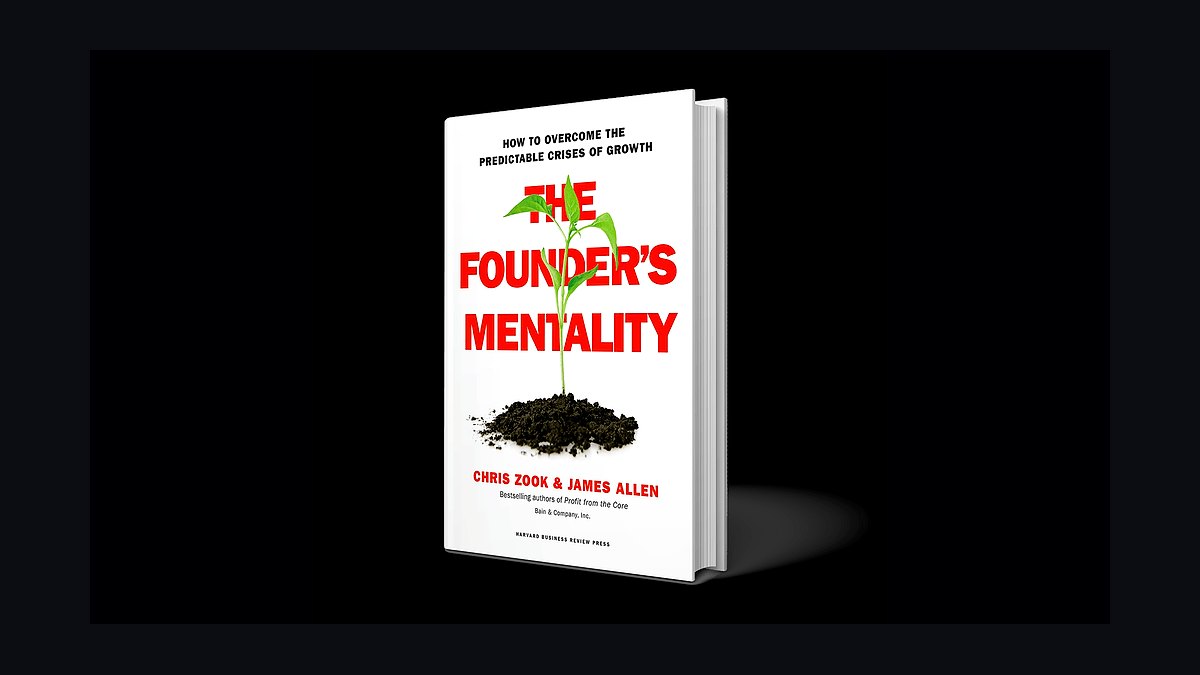
*The Founder's Mentality* by Chris Zook and James Allen (Harvard Business Review Press, 2016) argues that companies fail from the inside, not the market. Bain's research found roughly one in nine firms sustains profitable growth; the rest hit Overload, Stall-Out, or Free Fall. The antidote is insurgent mission, front-line obsession, and owner's mindset.
The two forces the book pits against each other
Every business book worth summarizing has an argument, and the argument in *The Founder's Mentality* is a fight between two forces that both look like progress. On one side sits the founder's posture — speed, customer intimacy, a clear enemy, personal accountability for cash. On the other sits the scaling apparatus — process, hierarchy, functional specialization, professional management, financial engineering. The comfortable story executives tell is that you trade the first for the second as you grow up, and that this trade is the price of maturity. Zook and Allen's whole book is a refusal of that story.
Their claim is sharper than "culture matters." They argue the trade is not necessary, that the apparatus is supposed to be a *carrier* of the founder's judgment rather than a *replacement* for it, and that the companies that treat scaling structure as a substitute for founder posture are the ones that decay. The book's often-quoted framing — the founder's mentality is the antidote to scaling poison — is deliberately medical. Growth is not the disease. Growth uncorrected by posture is.
Option A, then, is the default path: hire the experienced operators, add the layers, install the systems, let the CEO move from the field to the dashboard. This path is not stupid. It genuinely solves real problems — an organization of 800 people cannot run on the founder's memory and a group chat. Option A produces predictability, auditability, and a management bench. Its failure mode is that each individual layer is defensible while the cumulative effect is a company where nobody can name the customer, nobody can kill an initiative, and every decision routes upward.

Option B is the founder's-mentality path: scale the *judgment*, not the *hours*. Build repeatable operating models that encode how the founder decides, keep the number of layers between the CEO and the front line deliberately small, define what you are FOR and what you are AGAINST in language a new hire can repeat on day two, and push cash accountability down instead of centralizing it. Option B is harder, slower to feel safe, and more dependent on the leader's calendar. Its failure mode is a company that stays scrappy past the point where scrappiness is charming — chaos rebranded as culture.
The book's honest position is that these are not exclusive. The winners run both: they add the structure Option A demands and refuse the posture erosion Option A tends to smuggle in. What makes the argument useful rather than platitudinous is that Zook and Allen tie the choice to a diagnosis. You do not pick between structure and soul in the abstract. You pick based on which of three specific crises you are currently in — and the wrong cure, applied confidently, is what actually kills companies.
The three crises deserve naming precisely because the symptoms are so easy to misread. Overload hits young insurgents whose ambition outruns their operating system: too many priorities, hiring outpacing onboarding, founders working absurd weeks, every decision bottlenecked at the top, and the original culture diluting as new hires outnumber original believers. Stall-Out hits companies that made it through scale and then let bureaucracy metabolize the energy: politics, slowing decision velocity, meetings that have replaced work, and a leadership team that mistakes launching initiatives for having a strategy. Free Fall is the rarest and worst — the core market shifts, and the organization has so little residual ownership and energy left that it cannot pivot.
How to decide which path you are actually on

The single most useful move in the book is diagnostic, not prescriptive. Zook and Allen argue that most CEO failures are pattern-matching errors: a leader applies the cure that worked at their last company, or the cure they are temperamentally drawn to, without checking which crisis they are actually in. The cure for Overload is *more structure*. Apply that at Stall-Out and you accelerate the decay. The cure for Stall-Out is *brutal focus* — killing initiatives, flattening layers, returning power to the front line. Apply that carelessly at a company whose core is genuinely eroding and you can strip the very capabilities you need to survive.
The book's self-assessment instrument is a 5×3 grid: five traits scored across the three dimensions of the founder's mentality. The five traits are a bold external mission, spikiness (genuinely distinctive capabilities rather than generic competence), limited layers between the CEO and the front line, speed of decision-making, and anti-bureaucratic energy. Score each cell one to five and you get a fifteen-point map of where the posture is intact and where it has quietly eroded.
The practical value is not the score — it is the *disagreement*. Run the grid with your executive team and your front line separately. A five-point gap between how the C-suite rates decision speed and how the field rates it is more diagnostic than either number alone. Gaps concentrated in the front-line-obsession column usually mean the leadership calendar has drifted. Gaps in the owner's-mindset column usually mean incentives are rewarding quarterly optics. Gaps in the insurgent-mission column usually mean the company can no longer name its enemy.

Two adjacent diagnostics are worth borrowing here, because they cross-check the grid cheaply. First, the *repeat-the-mission test*: pull five people at random from different functions and tenures and ask them what the company is FOR and what it is AGAINST. If you get five different answers, the mission is a poster, not a posture. Second, the *decision-latency audit*: pick ten real decisions from the last quarter, and log the calendar days from "someone first raised it" to "someone was accountable for executing it." Companies in Stall-Out are usually shocked by their own median. Both tests take under a week and neither requires a consultant.
There is also a timing dimension the summaries usually flatten. The crises are sequenced, not simultaneous, and each recovery creates the conditions for the next. Solve Overload by importing seasoned managers from much larger firms and you often import their operating assumptions wholesale — the layers, the committee reviews, the planning calendar — which is precisely the pathway into Stall-Out a few years later. That is not an argument against experienced hires. It is an argument for hiring them with an explicit brief: bring the discipline, leave the bureaucracy, and here is how we will measure which one you brought.
What the numbers actually say, and how much weight they carry
The headline statistic — roughly one in nine companies achieving sustained profitable growth over a long horizon — is the number everyone quotes, and it deserves both respect and precision about what it is. It comes from Bain's own multi-year analysis of a large set of public companies, using a definition of "sustained profitable growth" that combines revenue growth, profit growth, and returns above cost of capital held over a decade-plus window. Change the threshold and the fraction moves. That is not a knock on the finding; it is how every study of this shape works. Treat it as an order-of-magnitude claim — sustained compounding is rare, single-digit-percentage rare — rather than a precise constant.

The second number that carries real weight in the book is the executive-attribution finding: a large majority of leaders surveyed pointed at *internal* obstacles rather than market conditions when explaining stalled growth. This one is more robust than it looks, because it is measuring perception rather than outcome, and the perception is remarkably stable across industries and cycles. It is also the number with the most direct operational implication. If your own leadership team believes the constraint is internal, then a strategy offsite spent on market sizing is spending the scarcest resource — leadership attention — on the wrong variable.
The third number is the Stall-Out base rate: a substantial majority of companies that reach meaningful scale eventually stall, and most that stall never fully recover. Whatever the precise fraction, the directional claim is well-supported by outside research on growth persistence, and it reframes the planning question. Stall-Out is not a tail risk to hedge. It is the modal outcome to plan around, which means the interesting question is not *whether* you will stall but *how quickly you will notice*.
Where readers should apply skepticism is the causal arrow. The book presents the founder's mentality as the driver of sustained growth, and reports that companies scoring high across the three dimensions are several times more likely to be in the winners' bracket. But sustained growth also *produces* the conditions the diagnostic measures — a winning company finds it much easier to maintain energy, keep layers thin, and rally people around a mission. Some of the correlation runs backward. This does not invalidate the framework; it means you should treat the grid as a set of leading indicators worth managing rather than proof that managing them guarantees the outcome.

The case evidence has a similar texture. LEGO's near-collapse and recovery, Home Depot's early years, and the founder-return stories at Dell, Schwab, and Starbucks are genuinely instructive, but they are selected for narrative clarity. Every one of them is a company that survived long enough to be written about. The founder-return pattern in particular is over-fitted: for each celebrated return that reignited a company, there are returns that changed nothing and companies that recovered under professional CEOs with no founder involved at all. What generalizes is the *mechanism* — someone with the authority and credibility to kill initiatives, cut layers, and re-anchor the mission actually did so — not the biography of the person who did it.
The most defensible way to use the numbers is as calibration, not proof. Sustained compounding is rare. Your own executives probably believe the binding constraint is internal. Stalling is the base case. Those three facts, taken together, justify spending real leadership time on posture — which is all the framework needs them to do.
Where this lands for revenue organizations
The book devotes real attention to sales and revenue teams, and the reason is structural: revenue organizations run through the three crises faster and more visibly than any other function, because headcount, quota, and pipeline make the decay legible in a way that engineering or finance decay is not.
Overload in a revenue org looks like a team that doubled headcount inside a year while ramp times quietly stretched. The leading indicator is not attainment — attainment lags by two or three quarters — it is the ratio of tenured to untenured reps and the drift in time-to-first-deal. When more than half the floor is under six months tenured, the org is running on onboarding capacity it does not have, and every additional hire makes the next one worse. The cure is the same as everywhere else: encode the judgment. Write down what a qualified opportunity actually looks like in your business, in specifics, and make the ramp a curriculum rather than a shadowing arrangement.

Stall-Out in a revenue org is the layer problem in its purest form. The pattern is familiar: a CRO adds RevOps, sales ops, enablement, strategy, and deal desk — each individually justified — and two years later the CRO's information about a deal arrives fully processed, through four intermediaries, in a slide. The rep no longer speaks to the leader and the leader no longer speaks to the customer. Zook and Allen's prescription is calendar-level and unglamorous: leaders should spend a meaningful share of their week — the book pushes toward roughly a third — on actual selling motions, customer conversations, and deal reviews conducted at the rep level rather than the manager level. The point of rep-level reviews is not oversight. It is unfiltered signal.
Free Fall in a revenue org is a motion that no longer matches how buyers buy. The market moves to product-led adoption, or committee-based buying, or self-serve evaluation, and the org's entire muscle memory is built for a motion that has stopped working. Comp plans, territory design, and hiring profiles are all optimized for the old world, and each is expensive to change. This is where the ordering of the cure matters most: mission first, then front line, then ownership. Reorganize the territories before you have re-answered *what are we FOR now*, and you get a reorg that changes the org chart and nothing else.
The chapter that ages best is the one on mission as motivation. Zook and Allen argue that the insurgent mission is the most underused motivational instrument in B2B selling — that compensation, SPIFs, and club trips move behavior in the short run, but sustained energy on a sales floor comes from people believing they are FOR something a customer genuinely needs and AGAINST something complacent in their industry. The test is simple and brutal: can a rep two months in state the FOR and the AGAINST in one sentence, without reading it? If not, the mission is marketing copy, and the floor is running on quota math alone.
Implementation: a sequence that survives contact with a real quarter

Frameworks fail in implementation for a boring reason — they get assigned to a working group. The founder's mentality is a posture, and postures are set by what leaders spend time on, not by what a task force documents. So the sequencing below is deliberately calendar-first.
Weeks one to two — write the sentence. One sentence, two clauses: what you are FOR, on behalf of a specific customer, and what you are AGAINST in your industry. Test it by asking people to repeat it back from memory a week later. If it does not survive a week, it is too long or too abstract.
Weeks two to four — score twice and read the gap. Run the fifteen cells with the leadership team and, separately, with a cross-section of the front line. Do not average them. The delta is the finding. Publish both sets of scores internally; the act of publishing is itself an owner's-mindset signal.
Month two — name one crisis and pick one cure. The discipline is singularity. Organizations in Stall-Out are congenitally inclined to respond to a diagnosis of initiative sprawl by launching an initiative-sprawl-reduction initiative. Pick the one cure that matches the diagnosis and commit a quarter to it.
Month two, same week — change the calendar. This is the step that gets skipped and the step that determines whether anything else happens. Block recurring, non-cancellable time for customer conversations and rep-level reviews. Non-cancellable is doing the work in that sentence; the whole mechanism of front-line obsession is that it is the first thing sacrificed when the quarter gets tight.
Month three — cut something structural. Either kill or merge the lowest-conviction initiatives, or remove one layer between the leader and the front line, or push a real cash decision down a level with a genuine threshold and no shadow approval. One structural cut, executed and visible, teaches the organization more than a communications plan does.
Quarterly — re-score and compare. Movement in the fifteen cells, tracked over four to six quarters, is the actual instrument. Any single reading is noise.

Two caveats about where the book under-serves the modern reader, both worth planning around. First, front-line obsession was written for a world of physical offices and in-person customer visits; distributed work makes it structurally harder *and* structurally more important, and the book offers no playbook for that tension. Recorded call review, async deal threads, and periodic in-person field weeks are the closest substitutes, and none fully replaces sitting in the room. Second, the owner's-mindset material leans on equity as the primary mechanism, which does not describe the reality of most employees at most companies. The transferable part is decision rights and cash accountability — letting people own a budget, a threshold, a real trade-off — which works regardless of the cap table.
Read alongside the rest of the strategy shelf, the book slots in cleanly. *Good to Great* asks what makes a company great; *The Innovator's Dilemma* explains why incumbents miss the next thing; Zook and Allen's own earlier work — *Profit from the Core*, *Beyond the Core*, *Repeatability* — builds toward this one. The distinct contribution of this summary's subject is the diagnosis of *internal* decay as the dominant failure mode of growth, and a named sequence for treating it.
Related questions
Is the founder's mentality only relevant if the founder is still around?
No. The framework describes a posture, not a person. The recovery cases where founders returned are memorable, but the mechanism was authority to kill initiatives and re-anchor the mission — something a professional CEO or a determined board can also exercise.
How does this differ from Zook and Allen's earlier books?
*Profit from the Core* and *Beyond the Core* are about where to compete and how far to expand. *Repeatability* is about the operating model. This one is about the internal posture that lets any of those strategies survive scale — the missing behavioral layer under the earlier strategy work.
Which crisis is most companies actually in?

Stall-Out, by a wide margin. It has the largest population and the lowest recovery rate. Its symptoms — slower decisions, more meetings, more initiatives — resemble ordinary maturity, so it is routinely mistaken for the normal cost of being a bigger company.
Can you run the 5×3 diagnostic without a consultant?
Yes. It is fifteen cells scored one to five. The value comes from scoring it separately with executives and the front line and examining the gaps, which requires candor and a willingness to publish uncomfortable numbers, not external facilitation.
Does the book work for companies under 50 people?
Partially. Small teams rarely have Stall-Out or Free Fall, but Overload is very real below fifty people. The useful early move is building repeatable operating models before you need them, so the eventual scaling structure carries founder judgment instead of replacing it.
FAQ
What is the founder's mentality, in one definition?
It is a three-part posture: an insurgent mission that names both what you are FOR on behalf of customers and what you are AGAINST in your industry; a front-line obsession that keeps leaders in genuine contact with customers and the people serving them; and an owner's mindset in which people across the organization take responsibility for cash, outcomes, and the long term rather than behaving like employees of a system.
What are the three predictable crises of growth?

Overload, when growth outpaces the organization's ability to absorb complexity; Stall-Out, when scale brings bureaucracy, politics, and initiative sprawl that slow the company to a crawl; and Free Fall, when the core market shifts and the organization has lost the energy and ownership required to adapt. Zook and Allen call them predictable because they arrive in a recognizable sequence tied to scale, not to luck.
Is this a book for founders or for executives at large companies?
Mostly for executives at established companies past the startup stage — the research base is drawn from large public and Bain-client organizations, and the altitude is board-and-CEO. Founders still benefit, particularly from the Overload material, but readers at director level often find it inspirational and under-specified for daily execution.
How does it compare to Good to Great or The Innovator's Dilemma?
They answer different questions. Collins studies what separates great companies from merely good ones; Christensen explains why capable incumbents miss disruptive shifts. Zook and Allen focus on the internal organizational dynamics that cause growth to stall — the erosion of insurgent energy — and offer a diagnosis plus a sequenced response rather than a market-level theory.
Does the book give a concrete implementation framework?
Yes, though it is a set of principles and a diagnostic rather than a step-by-step recipe. The core instrument is the 5×3 grid — five traits scored across the three dimensions — used to identify which crisis you are in, followed by the matching cure: structure for Overload, focus for Stall-Out, rebuilding from the core for Free Fall.
What is the single takeaway for a busy executive?
The binding constraint on your growth is almost certainly internal — complexity, layers, and lost purpose — rather than the market or a competitor. Sustained profitable growth is rare, stalling is the base case, and the companies that avoid it are the ones whose leaders actively fight bureaucracy, stay close to the front line, and push real ownership downward as they scale.
Sources
- https://www.bain.com/insights/topics/founders-mentality/
- https://store.hbr.org/product/the-founder-s-mentality-how-to-overcome-the-predictable-crises-of-growth/10032
- https://hbr.org/2016/03/reigniting-growth
- https://www.bain.com/about/media-center/press-releases/2016/founders-mentality-book-launch/
- https://www.hbs.edu/faculty/Pages/item.aspx?num=41542
- https://www.jimcollins.com/books/good-to-great.html
- https://www.claytonchristensen.com/books/the-innovators-dilemma/
- https://www.lego.com/en-us/aboutus/lego-group/the-lego-group-history/
- https://www.mckinsey.com/capabilities/strategy-and-corporate-finance/our-insights/the-granularity-of-growth
Related on PULSE
- The 12 Week Year by Brian Moran and Michael Lennington — Cliff Notes Summary for Sellers
- Contagious by Jonah Berger — Cliff Notes Summary for Sellers
- The Advantage by Patrick Lencioni — Cliff Notes Summary for Sales Leaders
- Good to Great by Jim Collins — Cliff Notes Summary for Sales Leaders
- The Innovator's Dilemma by Clayton Christensen — Cliff Notes Summary
This page will be disappearing soon. Save it to your device for $1 — or read it free while it is here.
@Kory-White- · if Venmo asks, the last 4 of my number are 2012
This page is gone.
This one is off the shelf now. $1 keeps it on your phone for good — the whole page, pictures and diagrams included.
 pulse-recentObviously Awesome by April Dunford — Top 10 Key Takeaways for Sales Leaders in 2027
 pulse-recentThe Collaborative Sale by Keith Eades — Top 10 Key Takeaways for Sales Leaders in 2027
 pulse-recentThe Customer Success Professional’s Handbook by Ashvin Vaidyanathan — Top 10 Key Takeaways for Sales Leaders in 2027
 pulse-recentCoaching Salespeople into Sales Champions by Keith Rosen — Top 10 Key Takeaways for Sales Leaders in 2027
 pulse-recentThe Sandler Rules by David Sandler — Top 10 Key Takeaways for Sales Leaders in 2027
 pulse-recentThe Greatest Salesman in the World by Og Mandino — Top 10 Key Takeaways for Sales Leaders in 2027
 pulse-recentSales EQ by Jeb Blount — Top 10 Key Takeaways for Sales Leaders in 2027
 book-summaryWhat factors drive the price of Book Summaries up or down in 2027?
 pulse-recentStart with No by Jim Camp — Top 10 Key Takeaways for Sales Leaders in 2027
 pulse-recentThe Challenger Customer by Brent Adamson — Top 10 Key Takeaways for Sales Leaders in 2027