


Running Lean by Ash Maurya — Cliff Notes Summary
Quality
Certified
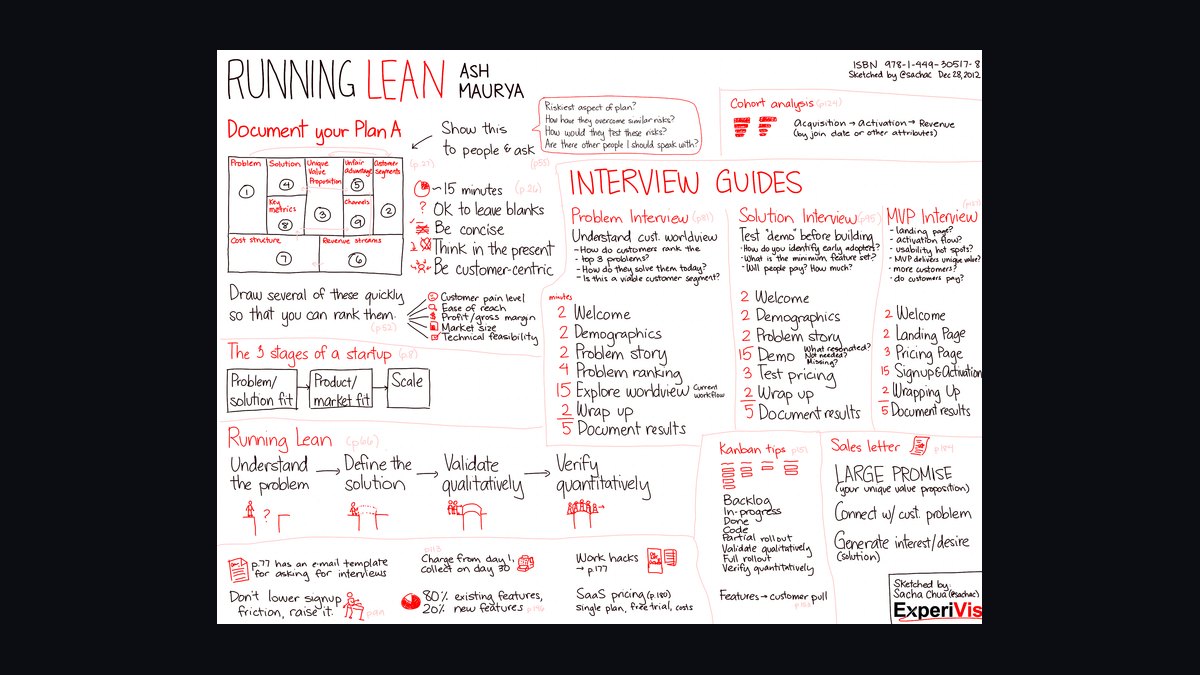
Running Lean by Ash Maurya is the tactical field manual for Lean Startup theory. Where Eric Ries supplied philosophy, Maurya supplies artifacts: the nine-box Lean Canvas, scripted problem and solution interviews, the four-force Customer Forces Diagram, and a repeating 90-day Continuous Innovation cycle that forces a documented pivot-or-persevere decision every quarter.
A founder with a beautiful deck and no evidence
Picture the situation the book was written for. A two-person team has spent seven months building a scheduling tool for independent physical therapy clinics. They have a 34-slide deck, a working product, a landing page, and a pipeline of exactly zero paying customers. Ask them why they built it and you get a story: the co-founder's sister runs a clinic, she complained about no-shows, and the idea was obvious. Ask them how many clinic owners they interviewed before writing code and the honest answer is one — the sister.
This is the failure Maurya wrote the book to prevent, and it is almost never a failure of engineering. The product works. The onboarding is clean. The problem is that the entire business model was a single untested assumption wearing seven months of shipped code as a disguise. Maurya's opening move is deliberately unglamorous: write Plan A down. Not the deck — the model. Who exactly has this problem, what does it cost them today, what would they pay to stop it, how would you reach them, and what number proves any of it. A plan you have not written cannot be falsified, and a plan that cannot be falsified is a belief system, not a strategy.
The same scenario replays constantly outside startups. A RevOps lead builds a lead-scoring model because one VP said inbound quality was bad. A product marketer rewrites positioning because a single lost deal mentioned pricing. An enterprise seller builds a mutual action plan around a champion's stated priority without ever testing whether the economic buyer shares it. In every case the structure is identical: one anecdote promoted to a business case, with months of downstream work resting on it. Running Lean is really a book about how to stop doing that — and the fact that its methods transfer cleanly from a garage startup to a Fortune 500 account plan is why it has outlived most of its 2010-era peers.

What makes the scenario painful is that the team is not lazy. They worked hard on the wrong thing, which is more expensive than working slowly on the right one. Maurya's three meta-principles — document Plan A, identify its riskiest parts, systematically test those parts — exist to route effort toward the assumptions that actually carry the business. If the physical therapy team had spent two weeks and roughly fifteen conversations before writing code, they would have learned whether no-shows are the top-ranked pain or the third-ranked one, and whether clinic owners believe a software product can fix a problem they currently attribute to patient behavior. That distinction determines whether the product is a vitamin or a painkiller, and no amount of shipping resolves it after the fact.
How the Lean Canvas and the interview sequence actually work
The Lean Canvas is a one-page adaptation of Alexander Osterwalder's Business Model Canvas from *Business Model Generation*. Maurya kept Customer Segments, Unique Value Proposition, Channels, Revenue Streams, and Cost Structure, and replaced Key Partners, Key Activities, Key Resources, and Customer Relationships with four boxes that carry real risk before product-market fit: Problem, Solution, Key Metrics, and Unfair Advantage. The reasoning is blunt. A pre-revenue startup has no key partners worth naming and no resources to speak of; what it has is an unproven guess about a problem, a guess about a solution, a guess about which numbers matter, and usually no defensible advantage at all.
The nine boxes work as a system rather than a checklist:
- Problem — the top three problems this segment has today, plus how they cope right now. The existing alternative matters more than the problem statement, because that is your real competition.
- Customer Segments — who has the problem, with early adopters called out by name. "SMBs" is not a segment. "Owner-operated PT clinics with three to eight providers and no dedicated front desk manager" is.
- Unique Value Proposition — one sentence that converts an unaware visitor into an interested prospect. If it could appear on a competitor's homepage without anyone noticing, it is not unique.
- Solution — the top three features that address the top three problems, deliberately capped so scope creep has to be argued for.
- Channels — the paths to reach that segment, split free versus paid and inbound versus outbound.
- Revenue Streams — pricing model and a rough lifetime value estimate, however crude.
- Cost Structure — acquisition cost and burn, the two numbers that set the clock.
- Key Metrics — the three to five numbers that would prove the model works.
- Unfair Advantage — something a funded competitor cannot copy or buy. Most first drafts leave this honestly blank, which is the correct answer at the start.
Maurya's instruction is to fill it in fifteen to twenty minutes and then iterate weekly. The speed is the point. A canvas is not a plan document; it is a snapshot of your current beliefs, timestamped so you can watch which boxes churn. Boxes that never change are either genuinely settled or never tested. If Customer Segments has read the same for four months while Solution changes every sprint, you are optimizing a delivery vehicle for a destination you have not verified.
From the canvas, Maurya derives a sequence. Rank the segments by acuteness of pain, size of budget, and reachability, then take one — building parallel canvases per segment is allowed, working them in parallel is not. Then run problem interviews, which he scripts to roughly thirty minutes: welcome and set context without pitching (2 min), collect demographics to confirm segment fit (2 min), tell a story describing the problem you believe they have (2 min), have them rank the top three problems by pain (4 min), explore their worldview — how they solve it today, what it costs, who else is involved (15 min), then wrap up by asking for a referral and permission to follow up (2 min). The rule that everyone violates is the first one: no demo. The seller's reflex to show the product is the single most destructive impulse at this stage, because a demo converts an information-gathering session into a politeness contest where nobody tells you the truth.
After ten to fifteen problem interviews, solution interviews begin. Now you show something low fidelity — slides, a mockup, a paper prototype — and the success metric is not enthusiasm but behavioral commitment: a pre-order, a pre-payment, a signed letter of intent, a scheduled pilot, a calendar hold with an actual stakeholder. Verbal interest costs nothing and is priced accordingly.
The Customer Forces Diagram, from Chapter 7, is where the book earns its keep for anyone in a revenue role. It operationalizes Clayton Christensen's Jobs-to-be-Done into four competing forces on any switching decision: the push of the current situation, the pull of the new solution, the anxiety the new solution creates, and the habit of the status quo. A switch happens only when push plus pull exceeds anxiety plus habit. That inequality reframes discovery entirely. Most sellers spend the whole call amplifying pull — features, differentiation, ROI math — when the deal is actually blocked by anxiety (will this break our billing integration?) or habit (we have done it this way for eleven years and nobody gets fired for that). Measuring all four forces, then working on whichever is largest, is a different call than the one most reps run.
The numbers, cadences, and thresholds the book commits to
Running Lean is unusually specific about quantities, which is why it survived when vaguer books did not. The numbers worth carrying out of it:
Canvas timing: 15–20 minutes, revisited weekly. Anything longer means you are writing a business plan again. The weekly revisit is what converts it from an artifact into an instrument.
Problem interviews: 10–15 before moving on, roughly 30 minutes each. That is about eight to twelve hours of conversation, which almost always beats eight to twelve weeks of building. Maurya's structure allocates fifteen of those thirty minutes to exploring the customer's worldview — half the call spent on how they cope today, not on what you plan to sell.
Solution and MVP interviews: also around 30 minutes, with MVP sessions run live so you watch someone use the product rather than hearing them describe using it. Score each on three binaries — did they reach the activation moment, did they ask to buy, did they refer a peer.
Build cadence: 30-day sprints, with the canvas re-reviewed each sprint. Maurya draws on his own companies, CloudFire and USERcycle, for the rhythm: small team, weekly customer demos, monthly canvas iteration.
Decision cadence: 90-day cycles. Long enough for a meaningful experiment, short enough to force a verdict. His framing — Continuous Innovation is a 90-day cycle, not a one-time exercise — maps almost perfectly onto quarterly OKR planning, which is why it slots into a mature company without an argument about process.
The scaling threshold: CAC below one-third of LTV. A 3:1 LTV-to-CAC ratio is the widely used SaaS convention and Maurya adopts it as the gate before spending on growth. Below it, paid acquisition is a machine for converting funding into churn. He also cites the Startup Genome Report's finding that premature scaling is the dominant killer of post-seed startups — the number that gives Chapter 13 its spine.
The metric that decides everything: cohort retention. Not signups, not traffic, not pipeline. Take users by the week they joined and plot how many are still active at week four, week eight, week twelve. If the curve flattens or bends upward, you have a business worth pouring fuel on. If it decays toward zero, no acquisition budget on earth fixes it — you are refilling a bucket with a hole. This is the single hardest number to argue with in a board meeting and the one most decks quietly omit.
The stage model gives all of this an ordering. Stage 1, problem-solution fit: do I have a problem worth solving? Stage 2, product-market fit: have I built something people want? Stage 3, scale: how do I accelerate growth? Each stage has different experiments, different metrics, and often different people. The classic error — and it is genuinely the most common one — is running Stage 3 experiments during Stage 1: buying ads to drive traffic to a product nobody has validated, hiring a sales team before anyone has closed a deal by hand, or building a partner program before a single customer renews.
Adjacent frameworks reinforce the same discipline. Pirate Metrics (AARRR — acquisition, activation, retention, referral, revenue) is Maurya's quantitative funnel for Stage 2, and the transition from interviews to cohort analysis is precisely the boundary between problem-solution fit and product-market fit. Downstream, *Lean Analytics* by Croll and Yoskovitz extends the measurement layer with stage-appropriate "one metric that matters" guidance; Dan Olsen's *The Lean Product Playbook* formalizes the hierarchy of needs beneath the same fit question. Upstream, Steve Blank's Customer Development is the direct ancestor of the whole interviewing apparatus.
Trade-offs, alternatives, and where a different tool fits better
No framework is free, and Running Lean's costs are real enough to name.
The Lean Canvas trades completeness for speed. By deleting Key Partners, Key Activities, Key Resources, and Customer Relationships, it becomes useless for exactly the situations where those boxes carry the risk — a marketplace whose viability depends on supply partners, a regulated fintech whose key activity is compliance, a hardware startup whose key resource is a contract manufacturer. Post-PMF, the Osterwalder canvas becomes the better instrument again because at scale, partners and resources are where the business actually lives. Use Lean Canvas to find the model; use Business Model Canvas to run it.
Interview-driven discovery trades statistical confidence for speed and depth. Fifteen conversations is not a sample; it is a set of anecdotes gathered systematically. That is fine for detecting whether a problem exists and how people currently cope, and inadequate for estimating willingness to pay across a market or sizing a segment. Pair qualitative interviews with quantitative work — pricing surveys, landing page tests, existing market data — when the decision hinges on magnitude rather than existence.
The 90-day cycle trades responsiveness for decisiveness. In fast-moving categories a quarter can be too long to wait for a verdict; teams running weekly discovery, in the style of Teresa Torres's *Continuous Discovery Habits*, catch signals faster. The counter-argument is that shorter loops produce whiplash — teams that re-plan weekly often never run an experiment long enough to see a retention curve form. The pragmatic answer most mature teams land on is layered: weekly discovery interviews inside a 90-day decision boundary.
Maurya's interview scripts have been superseded on wording. Rob Fitzpatrick's *The Mom Test* is sharper about the specific phrasing that avoids false positives — asking about past behavior instead of future intent, about what they have already paid for instead of what they would pay for. Maurya gives you the container; Fitzpatrick gives you better questions to put in it. Reading Running Lean without The Mom Test tends to produce well-structured interviews full of politely misleading answers.
The MVP definition has drifted with practice. Maurya tightened Ries's version to "the smallest product that delivers the unique value proposition end to end" — the full loop, not a feature subset. Product-led growth practice has pushed further: the modern PLG MVP is a self-serve activation flow with onboarding analytics instrumented from day one, because the measurement is the product. A hand-demoed prototype still works for enterprise motions with a small number of high-value prospects; it does not work when your funnel is thousands of self-serve signups.
When another approach fits better. For an existing product with a large user base, jobs-to-be-done research and behavioral analytics beat canvas work — you have real usage data, so use it. For genuinely novel technology where customers cannot articulate the need, design-led prototyping and long-horizon research fit better than problem interviews about a problem nobody has language for. For enterprise B2B with a five-account market, every framework degrades into structured account planning, though the nine boxes still make an unusually clean account-plan template: Problem maps to pain, Customer Segments to personas, UVP to value message, Channels to sales motion, Revenue Streams to ACV, Key Metrics to MEDDPICC metrics, and Unfair Advantage to competitive moat.
Pitfalls that show up every time this gets adopted

Filling the canvas once and framing it. A canvas that has not changed in a quarter is decoration. The fix is a standing calendar hold — fifteen minutes, weekly — where the team names which box moved and what evidence moved it. If nothing moved, that is a finding: you ran no experiments.
Interviewing to confirm. The most common corruption of the problem interview is a founder who describes their solution in the story step, then hears agreement and records it as validation. Two structural defenses: have someone who did not build the product run at least a third of the interviews, and write your prediction of the answer *before* the call. Predictions you got right are cheap; the ones you got wrong are the entire value of the exercise.
Counting verbal enthusiasm as commitment. "This is great, send me pricing" is not a signal. A calendar hold with a stakeholder who controls budget, a signed pilot agreement, or money changing hands are signals. Maurya's insistence on behavioral commitment in the solution interview exists precisely because polite people generate false positives at an alarming rate.
Running Stage 3 experiments in Stage 1. Hiring an SDR team, launching paid acquisition, or building a partner program before retention proves out. Each of these takes real money and produces numbers that look like progress — meetings booked, traffic acquired, logos signed — while the underlying model stays unvalidated. Ask one question before any growth spend: does the week-four cohort curve flatten? If nobody can answer, the spend is premature by definition.

Optimizing the vanity end of the funnel. AARRR is ordered the way it is for a reason, but teams reliably work it backwards, pouring effort into acquisition because it is the easiest to influence. Activation and retention are upstream of everything; a 10% improvement in week-four retention compounds through every future cohort, while a 10% improvement in traffic is a one-time linear gain you have to keep paying for.
Treating the pivot as failure. In Maurya's framing, pivot-or-persevere is a scheduled decision, not a crisis. Teams that treat pivots as admissions of defeat delay them past the point of usefulness, then pivot from a position of low cash and low morale. Putting the decision on a fixed 90-day boundary strips out the drama: the question comes up because it is the date, not because someone lost faith.
Skipping the "existing alternative" question. The Problem box has a companion field that gets ignored — how do they solve this today? Answering "nothing, this is a greenfield need" is almost always wrong. People solve problems with spreadsheets, interns, workarounds, and tolerance. Your real competition is usually a spreadsheet and a habit, and if you have not characterized that spreadsheet in detail you cannot say what switching would cost.
Choosing the wrong edition. The third edition (2022) is the one to read; it folds in a decade of teaching, the Continuous Innovation framing, and modern workflow updates including using LLMs to accelerate canvas iteration and synthesize interview transcripts. The first edition is a historical artifact at this point. Any Cliff Notes Summary of Running Lean built on the 2010 text will miss the Continuous Innovation material entirely — worth checking before you trust a secondhand summary of Maurya's argument or hand one to a team as strategy input.
Related questions
Should a non-startup team use the Lean Canvas?
Yes, for any initiative with unproven demand — a new product line, an internal tool, a pricing change. The nine boxes force explicit assumptions about who benefits and what proves it. Skip it for work with known requirements and known users.
How many problem interviews are actually enough?

Maurya says ten to fifteen before moving to solution interviews. The practical stopping rule is saturation: when three consecutive interviews surface nothing you have not heard, you have learned what this segment will tell you.
What replaces the canvas after product-market fit?
The Osterwalder Business Model Canvas becomes more useful again, because Key Partners, Key Activities, and Key Resources start carrying real risk at scale. Many teams also shift to opportunity solution trees for ongoing discovery.
Is the Customer Forces Diagram just Jobs-to-be-Done?
It is Maurya's four-force operationalization of Christensen's theory. JTBD explains why switching happens; the Forces Diagram gives you four things to actively measure and address on a specific discovery call.
Does Running Lean apply to services businesses?
Yes, with adjustments. Problem and solution interviews transfer directly. The MVP becomes a manually delivered version of the service, and cohort retention becomes repeat engagements or renewal rate rather than product usage.
FAQ
How is Running Lean different from The Lean Startup?
Ries supplied the philosophy — build-measure-learn, minimum viable products, validated learning. Maurya supplied the playbook: the specific canvas, the timed interview scripts, the four-force switching model, and the 90-day decision cadence. Read Ries to understand why the method works; read Maurya to know what to do Monday morning. They are complements, not competitors, and most people who bounced off Ries as "too abstract" find Maurya's version immediately actionable.
Do I have to use the Lean Canvas instead of the Business Model Canvas?
Before product-market fit, yes. The four boxes Maurya swapped in — Problem, Solution, Key Metrics, Unfair Advantage — are the four that carry risk early, while Key Partners and Key Resources are hypothetical for a team with no product. Once you have fit and are scaling, Osterwalder's version becomes more useful again because partnerships, activities, and resources become the actual constraints on growth.
What is the fastest way to get value from the book if I only have an hour?
Read Chapter 2 for the canvas structure and Chapter 7 for the Customer Forces Diagram, then fill in a canvas for whatever you are currently working on. Those two chapters carry most of the operational payload. Chapter 7 in particular tends to pay for the book on a single discovery call, because it reframes objection handling from persuasion into force measurement.
Can the Lean Canvas serve as an enterprise B2B account plan?
It is one of the cleanest applications. Problem becomes documented pain, Customer Segments becomes your persona map, UVP becomes the value message, Channels becomes the sales motion, Revenue Streams becomes ACV and expansion path, Key Metrics becomes the MEDDPICC metrics, and Unfair Advantage becomes the competitive moat. Keeping it to one page also makes it something a deal team will actually maintain, which is more than most account plan templates achieve.
What should I read alongside it?
Ries for the underlying theory, Rob Fitzpatrick's *The Mom Test* for sharper interview question wording that avoids false positives, Teresa Torres's *Continuous Discovery Habits* for a weekly discovery rhythm and the opportunity solution tree, and Croll and Yoskovitz's *Lean Analytics* for stage-appropriate metric selection. Steve Blank's *The Four Steps to the Epiphany* is the ancestor of the whole customer development approach if you want the origin.
Is the 90-day cycle too slow for fast-moving markets?
The cycle is a decision boundary, not a work cadence. Inside those ninety days you should be interviewing weekly and shipping in roughly monthly sprints. What the boundary prevents is the opposite failure — teams re-planning so often that no experiment ever runs long enough for a retention curve to form or a pivot decision to be made on evidence rather than mood.
Sources
- https://www.oreilly.com/library/view/running-lean-3rd/9781098108762/
- https://leanstack.com/lean-canvas
- https://www.strategyzer.com/library/the-business-model-canvas
- https://theleanstartup.com/principles
- https://steveblank.com/2010/01/25/whats-a-startup-first-principles/
- https://hbr.org/2016/09/know-your-customers-jobs-to-be-done
- https://www.momtestbook.com/
- https://www.producttalk.org/continuous-discovery-habits/
- https://leananalyticsbook.com/
- https://www.forentrepreneurs.com/saas-metrics-2/
Related on PULSE
This page will be disappearing soon. Save it to your device for $1 — or read it free while it is here.
@Kory-White- · if Venmo asks, the last 4 of my number are 2012
This page is gone.
This one is off the shelf now. $1 keeps it on your phone for good — the whole page, pictures and diagrams included.
 pulse-recentHow to Apply Strategic Selling — Step-by-Step Playbook in 2027
 pulse-recentNever Split the Difference by Chris Voss — Top 10 Key Takeaways for Sales Leaders in 2027
 pulse-recent$100M Offers by Alex Hormozi — Top 10 Key Takeaways for Sales Leaders in 2027
 pulse-recentHyper Sales Growth by Jack Daly — Top 10 Key Takeaways for Sales Leaders in 2027
 pulse-recentThe Transparency Sale by Todd Caponi — Top 10 Key Takeaways for Sales Leaders in 2027
 pulse-booksWhat are the most common mistakes in Book Summaries in 2027?
 pulse-recentWhat is the first concrete step in SPIN Selling by Neil Rackham for structuring a discovery call in 2027?
 pulse-recentHow do you implement the Sandler Rules in your first 30 days as a new sales rep in 2027?
 pulse-booksRework by Jason Fried and David Heinemeier Hansson — Cliff Notes Summary
 pulse-recentSales EQ by Jeb Blount — Top 10 Key Takeaways for Sales Leaders in 2027