


The Mom Test by Rob Fitzpatrick — Cliff Notes Summary
Quality
Certified
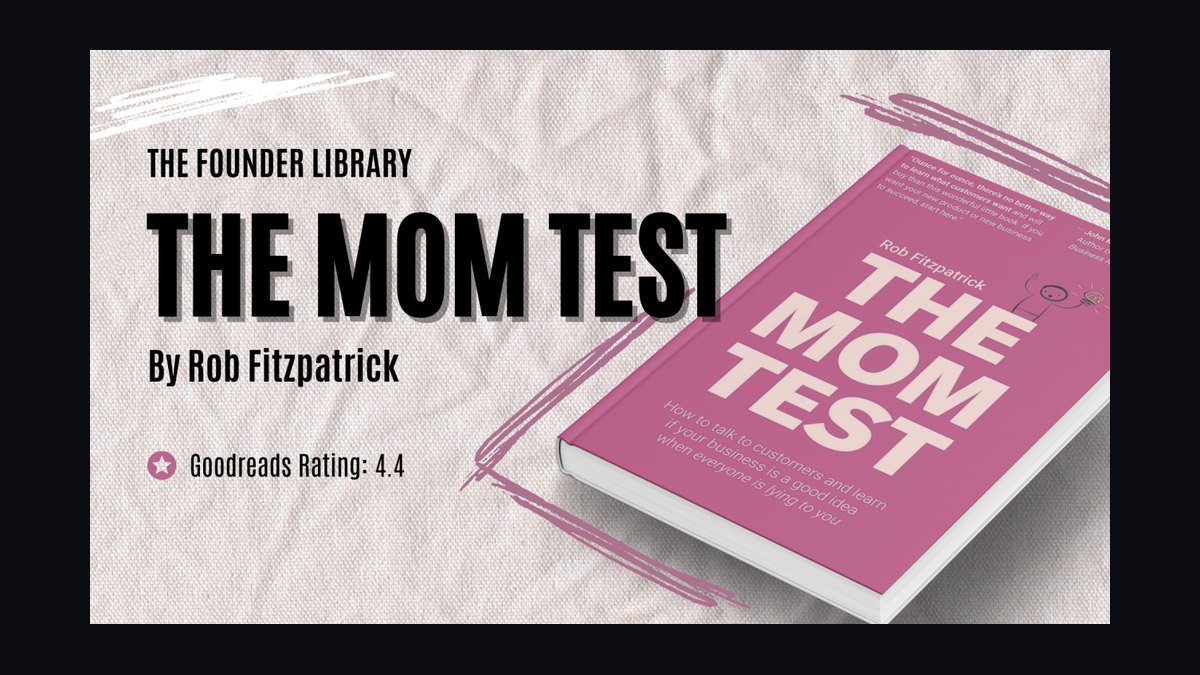
*The Mom Test* by Rob Fitzpatrick is a short tactical manual on customer conversations. Its core argument: people lie to spare your feelings, so stop asking about your idea and ask about their life instead. Three rules govern it — talk about their life, ask about specific past behavior, talk less and listen more.
The coffee meeting that teaches you nothing
Picture the scene Fitzpatrick opens with. A founder takes their mother to coffee, describes the app they have been building for four months, and watches her face light up. "That sounds wonderful, honey. I would absolutely use that." The founder walks out convinced. The mother walks out having done exactly what mothers do — protected someone she loves from disappointment. Nothing false was said. Nothing useful was learned either.
Now transpose that scene into B2B. An account executive runs a discovery call with a VP of Operations. Forty minutes in, the AE has shown eleven slides, the prospect has nodded through most of them, and the call ends with "This looks really interesting — send me some materials and let's reconnect after the quarter." The AE logs it as a positive discovery call. The forecast gets a new line item. Ninety days later the opportunity closes as no-decision, and nobody can point to the moment it died, because it was never alive.
These are the same failure. Both conversations were structured so that the polite response and the honest response were indistinguishable. The founder asked "would you use this?" The AE asked "does this resonate?" Both questions invite a courtesy answer, and courtesy answers cost the respondent nothing. Fitzpatrick's insight is that this is not a skill problem — a more charming interviewer gets more enthusiastic lies, not more truth. It is a question-design problem, and question design is fixable.
The pattern shows up well beyond startups. A product manager surveying users about a proposed redesign gets approval ratings that evaporate the moment the redesign ships. A consultant scoping an engagement hears "yes, that's exactly our problem" from a stakeholder who has no budget authority and no intention of championing anything. A recruiter asks a candidate whether they would consider a role, hears yes, and then watches them decline the offer. In every case the respondent answered a hypothetical about their own future behavior, which is the least reliable data any human can produce about themselves.

What makes the book durable is that it does not ask you to become a better judge of sincerity. It asks you to build conversations where sincerity is irrelevant — where the answers are about things that already happened and are therefore checkable. That reframing is why a 130-page book written for first-time founders keeps getting handed to enterprise sellers, product managers, agency owners, and internal operations teams who have never raised a dollar of venture capital.
How the rules actually change the data you collect
The mechanism is simpler than most discovery methodologies and that is precisely its strength. Fitzpatrick's three rules each close a specific leak.
Talk about their life, not your idea. The moment your idea enters the conversation, the respondent's job changes. They stop being a witness to their own experience and start being a critic of your work — and most people are bad at critiquing work in front of its author. Remove the idea and there is nothing to be polite about. You are just asking someone to describe their Tuesday. Nobody softens a description of their Tuesday to protect your feelings, because they do not know what would hurt them.
Ask about specifics in the past, not generics or opinions about the future. "Would you pay for this?" is a question about a future self the respondent has never met. "What did you do the last time this happened?" is a question about a past self who left evidence. The second question has a wrong answer; the first does not. That asymmetry is the whole game. Past behavior can be wrong, incomplete, or embarrassing — which is exactly what makes it informative.

Talk less, listen more. Fitzpatrick's practical version of this is the five-second pause: when someone says something interesting, say nothing for five seconds. The instinct to fill silence is strong, and the person you are interviewing usually breaks first. The second half of what they say — the part after the pause — is where hedges, exceptions, and real constraints live. The first half is the polished version they have told before.
Underneath the three rules sits a filter for bad data. Fitzpatrick names three categories that founders reliably mistake for signal. Compliments are the most seductive and the most worthless — they feel like validation and predict nothing. Fluff covers generics ("I usually..."), hypotheticals ("I would..."), and future promises ("I'll definitely..."), all of which describe an imagined world. Ideas are the sneakiest, because a customer who starts designing features for you feels like an engaged partner, and the resulting roadmap is built on a stranger's untested guess.
Each has a redirect. Deflect a compliment by moving to specifics: "Thanks — but honestly, when did this last come up for you?" Anchor fluff in a real event: "The last time you tried to solve that, what did you actually do?" Dig under an idea to the pain that produced it: "What would that let you do that you can't do today?" You are not arguing with the person. You are steering the conversation back onto ground where the truth is retrievable.
Currency, commitment, and what a good meeting actually produces
The chapter most people quote is the one on commitment. Fitzpatrick's claim is that founders and sellers alike mistake politeness for progress, and the antidote is to judge every conversation by what the other person gave up. He calls it currency, and there are three kinds.
Time. A specific next meeting on the calendar with a date and a time, not "let's reconnect soon." A commitment to a working session that will cost them real hours. Agreement to a pilot where their team has to do setup work. The test is whether the time is scheduled and specific — a vague promise of future availability is not time currency, it is fluff wearing a calendar's clothes.

Reputation. An introduction to three named colleagues, not "I'll ask around." A referral upward to whoever controls budget. Willingness to be quoted, to appear on a reference call, or to bring you into a team meeting. Reputation currency is expensive to spend, which is why it is such a clean signal — people do not stake their standing on something they privately think is nonsense.
Money. A letter of intent, a deposit, a pre-order, a signed contract, a paid pilot. Even small amounts work, because the transition from zero to nonzero is where the real information lives. Someone who pays fifty dollars has crossed a line that someone promising fifty thousand has not.
A conversation that produces none of the three is what Fitzpatrick calls a zombie lead — it looks alive and it is not. The practical discipline is the commitment ladder: know which rung the relationship is on, and ask for the next rung before the meeting ends. Never leave the ask for a follow-up email, because the email arrives after the enthusiasm has decayed.
This maps almost one-to-one onto enterprise sales qualification. Frameworks like MEDDIC and MEDDPICC ask whether pain has been identified, whether a champion exists, and whether decision criteria are known. Every one of those is a Mom Test question in disguise. Identifying pain means asking what the buyer did the last time this problem cost them something, not whether the problem sounds bad. Champion validation means asking about the last internal initiative they pushed for and what happened to it — a champion who has never successfully driven anything through procurement is not a champion, they are an enthusiast. Decision criteria means asking how the last comparable purchase actually got approved, who signed, and what nearly killed it.
The currency framing also fixes a chronic pipeline hygiene problem. If a deal can only advance a stage when the buyer has spent time, reputation, or money, then stage definitions stop being about what the seller did and start being about what the buyer did. That single change deflates the polite-nod portion of a forecast, which for most teams is a meaningful share of committed pipeline.
Sourcing, slicing, and the numbers that make the process work

Two chapters get skipped more than any others, and they are the ones that determine whether the method survives contact with a calendar.
Finding conversations. Fitzpatrick covers cold outreach, warm introductions, conferences, meetups, advisor networks, and the underrated tactic of going where your customers already complain in public — industry forums, subreddits, professional groups, review-site comment threads. The framing rule matters more than the channel: every outreach is a request for help, not a pitch. "I'm trying to learn about how teams handle X, and I'm not selling anything — could you spare fifteen minutes?" outperforms a pitch by a wide margin, because it asks for something cheap and offers status in return. People like being the expert.
The second sourcing insight is that the best conversations often happen before either party realizes a conversation is happening. A hallway chat at a conference, a ten-minute swing past a trade show booth, a coffee with someone's former colleague — these produce better data than a scheduled interview with a recording app running, because a formal setting triggers formal answers. Conference rooms produce professional respondents: polite, generic, useless.
Customer slicing. This is the framework practitioners underuse most. The mistake is targeting demographics — "small business owners," "mid-market sales teams," "operations leaders." Those are census categories, not markets. Slicing means cutting by behavior until the segment is narrow enough that you could write down twenty specific names.
The slicing dimensions Fitzpatrick uses are pain pattern, purchase behavior, willingness to pay, and reachability. Run them in sequence. "Small business owners" becomes "fitness studios," becomes "yoga studios," becomes "yoga studios with two to five locations that already pay for scheduling software and complain about it." That last segment is reachable, has demonstrated willingness to pay for the category, and shares a pain pattern specific enough to build against. The first segment is a fantasy.

Reachability deserves particular attention because founders routinely slice their way to a segment they cannot actually contact. A segment you can define but not reach is worse than a broader one you can — you will end up interviewing whoever answers, then generalizing their answers to a population you never spoke to.
Running the process. The operating discipline is light but non-negotiable. Before each conversation, write down the three most important things you need to learn — if you cannot name three, you are not ready to spend someone's time. After each conversation, write notes within about thirty minutes, while the phrasing is still recoverable; quotes matter more than paraphrase, because a verbatim complaint carries urgency that a summary launders out. Fitzpatrick's three-line note format is pain, context, currency, which lets a team scan dozens of interviews in a few minutes and spot the pattern nobody caught individually.
Share weekly. The lone-wolf founder who hoards interview insight destroys most of the value, because discovery compounds only when several people are pattern-matching against the same raw material. The same applies to sales teams: call recordings nobody reviews are an archive, not a learning system.
On volume, the honest answer is that the book does not prescribe a fixed number and you should be suspicious of anyone who states one confidently. What it prescribes is a stopping condition — keep going until the same pain, in the same words, shows up across independent conversations in your sliced segment. If every conversation surfaces a new and unrelated problem, your slice is too broad. If you hear the same sentence three times from people who have never met, you have found something. Teams practicing continuous discovery in the Torres tradition treat a small number of interviews per week, sustained indefinitely, as more valuable than a large batch run once — steady contact catches drift that a single research sprint cannot.
Where the method has limits and what to use alongside it

The Mom Test is not a complete research program, and treating it as one causes predictable failures. It is worth being precise about what it does and does not cover.
It is a validity tool, not a sampling tool. The rules ensure that what a given person tells you is true. They do nothing to ensure that person is representative. You can run flawless interviews with twelve people who all share an unusual constraint and conclude the world works a way it does not. Slicing helps, but slicing is a targeting instrument, not a statistical one. If a decision depends on prevalence — how many people have this problem, what share would pay — interviews cannot answer it and you need instrumentation, surveys with real sample discipline, or a market test.
It is weak on solution design. Fitzpatrick is explicit that customers are good witnesses to their problems and poor architects of solutions. That is correct, but it leaves a gap: once you know the pain is real, something has to convert pain into a product decision. This is where Teresa Torres's continuous discovery work and its opportunity mapping fill in, and where usability testing, prototype testing, and design partnerships take over. Mom Test interviews are the front of the funnel for evidence, not the whole pipeline.
It can be over-applied to existing customers. The rules are optimized for talking to strangers about problems before you have built anything. With an existing customer who already uses your product and pays you, direct questions about your product are legitimate — they have behavioral skin in the game, and their complaints are grounded in real usage. Applying full Mom Test indirection to a renewal conversation is not rigor, it is evasion.
Casual has a floor. The advice to keep conversations informal is right for early exploratory work and wrong for regulated or high-stakes contexts. Enterprise research involving procurement, compliance, or anything touching legal review needs structure, consent, and documentation. The underlying question-design principles survive the formality; the coffee-shop staging does not.

The complements are worth naming. Steve Blank's customer development work is the upstream theory that Fitzpatrick operationalizes into scripts. Eric Ries's build-measure-learn loop is the surrounding cycle that interview evidence feeds. Giff Constable's *Talking to Humans* is a shorter visual companion. Marty Cagan's product management books treat this class of discovery as baseline competence for PMs. And on the sales side, call-analytics platforms provide the quantitative counterpart: they can measure question-to-pitch ratios and talk-time balance across thousands of calls, which is the kind of prevalence data interviews structurally cannot produce.
The failure modes that survive reading the book
Most people who read *The Mom Test* agree with it immediately and then violate it within a week. The failures are consistent enough to enumerate.
Asking Mom Test questions and then pitching anyway. The interviewer runs a clean first ten minutes, hears a real pain, gets excited, and spends the remaining twenty minutes explaining how their thing solves it. Everything after that moment is contaminated — the respondent now knows what you want to hear. If you must pitch, do it at the very end, after the learning is banked, and treat any reaction to it as marketing feedback rather than discovery data.
Treating enthusiasm as currency. A prospect who says "this is exactly what we need" and commits to nothing has given you nothing. Enthusiasm is cheap and refundable. The correction is mechanical: before ending any conversation, ask yourself what this person gave up, and if the answer is nothing, ask for something small before you hang up.
Interviewing the reachable instead of the relevant. Founders talk to friends, former colleagues, and whoever replies to LinkedIn messages, then generalize to a buyer population that shares none of those characteristics. If your interview list skews toward people who like you, your findings will skew toward liking your idea.

Recording nothing and remembering wrong. Memory reconstructs conversations toward whatever conclusion you were already leaning on. Verbatim notes within half an hour are the cheapest correction available, and the discipline is the first thing to slip when the week gets busy.
Stopping at the first person who confirms the hypothesis. Confirmation is a stopping cue for motivated reasoning, not for research. The correct stopping condition is repetition from independent sources, not agreement from any single source.
Asking about the problem but never about the cost. Knowing that something is annoying tells you nothing about whether it is fundable. The follow-up questions that matter are: what did you try, what did that cost you in time or money, what happened, and what are you doing about it now. A pain with no attempted workaround is usually not urgent, because urgent problems generate improvised solutions long before a vendor shows up.
Skipping the scary question. Every venture has one question whose answer could end it — usually about price, about whether anyone has budget, or about whether an incumbent already solves this well enough. Founders route around it for months. Fitzpatrick's position is to march directly at it, because learning it in week one costs a coffee and learning it in month nine costs everything you have spent since.
Confusing a Cliff Notes summary with the reading. A condensed treatment like this one gives you the frameworks and the vocabulary. What it cannot give you is the experience of noticing yourself, mid-sentence, about to ask a fluff question and stopping. The book is roughly one evening's reading, and the appendix cheat sheet is designed to be reread before conversations. The rules only become useful when they are reflex, and reflex comes from repetition, not from a summary.
The broader strategy point is that this method is cheap insurance against the most expensive mistake available: building something competently that nobody wanted. Fitzpatrick's contribution was not discovering that founders fool themselves — that was already well documented. It was producing a set of rules concrete enough that a nervous first-timer can follow them in a real conversation, and that is why the book keeps outliving the tooling built around it.
Related questions

How is this different from Steve Blank's customer development?
Blank's work is the strategic framework — get out of the building, test hypotheses, iterate. Fitzpatrick supplies the tactical layer underneath it: the specific questions to ask and the answers to distrust. You use Blank to decide what to test and Fitzpatrick to run the conversation itself.
Does the Mom Test work for existing customers, not just prospects?
Partially. With paying customers you can ask directly about your product, because their usage is behavioral evidence rather than speculation. Keep the past-behavior discipline for questions about new directions or unbuilt features, where they are guessing exactly as much as a stranger would.
How many interviews are enough before deciding?
The book gives a stopping condition rather than a number: continue until the same pain appears in similar language across independent conversations within one sliced segment. Scattered, unrelated answers usually mean the segment is too broad, not that you need more volume.
Can this be used for internal stakeholder interviews?
Yes, and it transfers cleanly. Ask an internal stakeholder what they did the last time a process broke, what it cost, and what workaround they built — not whether they would use a proposed tool. Internal politeness is at least as distorting as customer politeness.
What is the fastest way to apply it tomorrow?
Before your next call, write the three things you need to learn. Ask only past-tense questions. Pause five seconds after anything interesting. Before hanging up, ask for a specific next step. Write three lines afterward: pain, context, currency.
FAQ

**What is *The Mom Test* in one sentence?**
It is a set of interview rules designed so that nobody — including people who love you and want you to succeed — can give you a polite lie, achieved by removing your idea from the conversation and asking about the other person's actual life instead.
What are the three rules?
Talk about their life, not your idea. Ask about specific things that happened in the past rather than opinions about the future. Talk less and listen more. Everything else in the book is an application of one of these three.
Why are compliments considered worthless data?
Because a compliment is a social act, not an assessment. It costs the speaker nothing, carries no commitment, and is the default output of a polite person confronted with someone else's work. It correlates with the respondent's manners, not with their future behavior.
What counts as currency in a conversation?
Time, reputation, or money — a specifically scheduled next meeting, an introduction to named colleagues, or an actual payment or signed commitment. All three cost the giver something real, which is precisely why they carry information that verbal enthusiasm does not.
How does this apply to B2B sales discovery calls?
Directly. Pain identification, champion validation, and decision-criteria discovery in frameworks like MEDDIC are all Mom Test interviews wearing sales vocabulary. Ask what the buyer did the last time this problem hit, what it cost, what they tried, and how the last comparable purchase got approved.
Is a Cliff Notes summary enough, or should I read the book?
A summary transfers the frameworks and the vocabulary, which is genuinely useful. The book is short — one evening — and its value is in the worked examples and the cheat sheet you reread before calls. Read it if customer conversations are a regular part of your job.
Sources
- https://www.momtestbook.com/
- https://www.ycombinator.com/library/6g-how-to-talk-to-users
- https://www.youtube.com/watch?v=MT4Ig2uqjTc
- https://steveblank.com/2010/01/25/whats-a-startup-first-principles/
- https://www.producttalk.org/2021/08/product-trio/
- https://svpg.com/product-discovery/
- https://www.talkingtohumans.com/
- https://review.firstround.com/how-to-conduct-user-interviews-that-actually-uncover-insights/
- https://hbr.org/2016/09/know-your-customers-jobs-to-be-done
Related on PULSE
This page will be disappearing soon. Save it to your device for $1 — or read it free while it is here.
@Kory-White- · if Venmo asks, the last 4 of my number are 2012
This page is gone.
This one is off the shelf now. $1 keeps it on your phone for good — the whole page, pictures and diagrams included.
 pulse-recentBlue Ocean Strategy by W. Chan Kim and Renee Mauborgne — Top 10 Key Takeaways for Sales Leaders in 2027
 pulse-recentSell or Be Sold by Grant Cardone — Top 10 Key Takeaways for Sales Leaders in 2027
 book-summaryWhat factors drive the price of Book Summaries up or down in 2027?
 pulse-recentWhat is the first concrete step in SPIN Selling by Neil Rackham for structuring a discovery call in 2027?
 pulse-recentHow do you implement the Sandler Rules by David Mattson in your first 30 days as a new sales manager in 2027?
 pulse-recentWhat is the most actionable step in The Sandler Rules for Sales Leaders by David Mattson to improve discovery in 2027?
 book-summaryLittle Red Book of Selling by Jeffrey Gitomer — Cliff Notes Summary
 pulse-recentSelling Above and Below the Line by Skip Miller — Top 10 Key Takeaways for Sales Leaders in 2027
 pulse-booksWhat are the most common mistakes in Book Summaries in 2027?
 pulse-booksTop 10 practical takeaways from Atomic Habits for building a new routine in 2027.