


Trillion Dollar Coach by Schmidt Rosenberg Eagle — Cliff Notes Summary
Quality
Certified
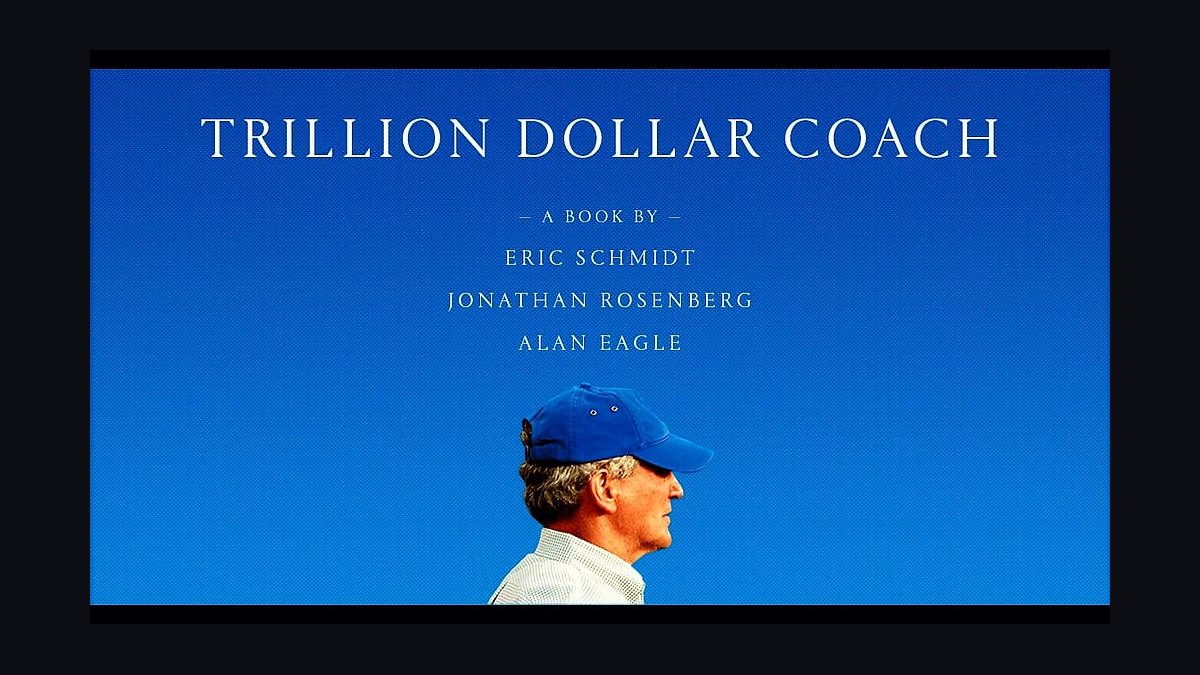
*Trillion Dollar Coach* (Eric Schmidt, Jonathan Rosenberg, Alan Eagle; HarperBusiness, 2019) argues that at scale, coaching is the highest-leverage act a leader performs. Drawn from interviews with Bill Campbell's mentees, it codifies a team-first operating model: humans before business, trust before feedback, and the team above any individual star.
The Monday morning that exposes why this book exists
Picture a VP of Sales with four managers and thirty-one reps. Quarter is closing. The staff meeting opens at 9:00 with a pipeline dashboard on the screen, moves through territory-by-territory forecast, ends at 9:50 with an action-item list nobody reads, and adjourns. Nothing said in that room was untrue. Nothing said in that room was useful either, because the actual problem — that the two best managers privately do not trust each other, and one has been routing deals around the other for six weeks — was never on the agenda. It cannot be. There is no agenda slot for it.
That gap is the exact condition Bill Campbell built a career around. Campbell (1940–2016) coached Columbia football to a losing record, sold Kodak film, ran marketing at Apple under John Sculley, served as CEO of Intuit from 1994 to 1998, and then spent the rest of his life as an unpaid executive coach. He sat on Apple's board from 1997 until his death. He held standing weekly one-on-ones with Eric Schmidt, Larry Page, Sergey Brin, Steve Jobs, Tim Cook, Sheryl Sandberg, Dick Costolo, David Drummond, John Donahoe, and roughly a dozen more. He never billed any of them, never took equity after Intuit, and never wrote a book. The one you can buy exists because three people who were coached by him decided the playbook shouldn't die with him.
The framing scene the authors use is a back booth at a Palo Alto sports bar on a Sunday morning, mid-2000s, where a rotating cast of the most powerful operators in technology showed up to listen to a gruff Italian-American from Homestead, Pennsylvania. The mystery the book sets out to solve: how did a football coach become the most important person in every one of those rooms? The answer is not charisma. It is a repeatable set of meeting mechanics and personnel rules that any sales leader, RevOps head, or engineering director can run starting next Monday.

The reason the opening scenario matters more than the celebrity roster is that the failure it describes is structural, not personal. A staff meeting with no ritual slot for the biggest unspoken problem will reliably surface the third-most-important issue and bury the first. Campbell's fix was not a better dashboard. It was a different order of operations.
How the operating model actually works, meeting by meeting
Campbell's method decomposes into a small number of rituals that fit inside meetings you already hold. Nothing here requires new software or a reorg.
Trip reports. Every meeting — one-on-one, staff, board prep — opens with five minutes of genuinely personal check-in. Where you went last weekend, how the kid's season is going, what happened with the move. Campbell's position was that this is not warm-up before the work; the small talk *is* the work, because a group that knows each other as people argues productively and a group that doesn't argues politically. In a distributed or hybrid sales org this has gotten more load-bearing, not less: the five minutes at the top of a Zoom is often the only unstructured human contact a remote rep gets all week.

The one-on-one, in a fixed order. Campbell's structure: performance against job requirements first, then peer relationships, then management and leadership, then innovation and best practices. The order is deliberate. Performance first means the hard conversation never gets crowded out by whatever is loudest that week. Peer relationships second — before leadership — because lateral trust is where orgs actually break, and it is the thing a manager is least likely to ask about unaided. Innovation last, because it is the only item that can safely be deferred.
The staff meeting, in a fixed order. Trip reports. Then the biggest problem on the table. Then operational review. Then decisions. Putting the biggest problem *before* the operational review is the whole trick — run it the other way and the ops review consumes the clock every single time, and the real issue slides another week.
Free aircover. Praise in public, criticize in private, and defend your people externally with total commitment while holding them to a brutal private bar. To the board, the press, and peer executives, the team is beyond reproach. Inside the room, the standard is unforgiving. Sandberg has credited this rule with the durability of Facebook's leadership team through its hardest years.
Diagnosis before prescription. Before offering any advice, Campbell would sit in on staff meetings, one-on-ones, and board interactions for weeks. He also screened for coachability — honest, humble, hardworking, willing to learn — and declined people who failed the screen. A coach who prescribes in week one is guessing.
The loop is closed on purpose. Celebration feeds back into trust, trust makes the next biggest-problem disclosure cheaper, and cheaper disclosure is what makes the whole cadence compound instead of decay.
The personnel rules, and the numbers around them

Four rules govern who is on the team and what they are paid. These are the parts of the book with the sharpest operational teeth.
The team is the number one priority. Campbell's reflexive first question on any problem was not what the data says or what the customer says — it was *what is the team telling you?* The stated version in the book: the team is the number one priority, and individual stars who hurt the team get cut. That is a harder rule than it reads, because the star in question is usually carrying real quota.
Manage the aberrant genius. The corollary is not "fire the difficult people." It is: coach them first, seriously and repeatedly, and if they cannot change, cut them regardless of output. The book references — without naming — engineers at Google and executives at Apple who were extraordinary and corrosive. Campbell forced the call every time.
Pay well; money is love. Compensation is not just a retention calculation, it is a public statement of value that the whole team reads. Underpay a great performer and you have told everyone what they're worth to you. Pay top of market and treat it as gratitude.

Innovate and differentiate. Pour money and attention into the one or two things that genuinely differentiate the company and starve everything else until those are world-class. Campbell's repeated argument to Schmidt was that Google's durable moat was search quality and ads matching; the rest was distraction until proven otherwise.
On numbers, be careful about which ones the book actually supports. The verifiable ones: Campbell was Intuit's CEO from 1994 to 1998, joined Apple's board in 1997, died in 2016, and the book was assembled from more than eighty interviews with people he coached. The "trillion dollar" figure in the title is the authors' estimate of the combined market value of companies Campbell coached — it is a framing device, not an attribution of causality, and the book does not claim a controlled measurement of coaching's contribution.
Where you *can* get real numbers is your own org, and that is the useful move. Track the ratio of staff-meeting minutes spent on the biggest problem versus operational review; most teams start near zero and the ritual is working when it holds steady in the ten-to-twenty-minute range on a sixty-minute meeting. Track one-on-one cancellation rate — a manager who cancels more than roughly one in five is not running the cadence, whatever the calendar says. Track voluntary regretted attrition on each manager's team separately; team-first failures show up there long before they show up in attainment. And track how many of your managers were internally developed versus hired in, because the coaching-tree effect is the only one of these that compounds across years.

Comparable benchmarks from the surrounding literature help set expectations. Google's Project Oxygen work, published openly by the company, found manager quality measurably predicted team outcomes and that coaching ranked at the top of the behaviors that separated the best managers — an independent line of evidence that lands on the same conclusion Campbell reached by instinct. Gallup's long-running engagement research repeatedly attributes a large share of variance in team engagement to the manager. Neither study is about Campbell; both make his central claim less anecdotal than it looks.
Where the model strains, and what you'd run instead
The book is a tribute, and it reads like one. Every Campbell story ends in vindication. A practitioner should hold three reservations.
The attribution problem. Campbell advised companies he did not run. Crediting a coach with a trillion dollars of market cap is generous arithmetic — the counterfactual is unknowable and the sample is drawn entirely from survivors. Intuit's performance during his own CEO tenure was solid rather than legendary, which is the one case where he held the wheel. Read the book for the mechanics, not for the causal claim.
The scaling problem. Campbell's leverage came partly from technique and partly from an irreplaceable cross-CEO network — he could tell Schmidt what he was seeing at three other boards without breaching anyone's confidence, because everyone trusted him equally. A hired coach has the technique and none of the network. That is why the honest answer to "should we hire an executive coach" is usually: hire one for a specific person with a specific gap, not as a culture program.

The cast problem. The mentee list is overwhelmingly male and entirely Bay Area technology. The rituals generalize; the social dynamics of a 2000s Palo Alto boardroom do not automatically.
The alternatives are worth knowing because they trade off against each other rather than compete outright. Lencioni's *The Five Dysfunctions of a Team* covers the same territory with a diagnostic model instead of a biography, and is the better choice when you need to explain to a skeptical exec team *why* trust precedes conflict. Sinek's *Leaders Eat Last* argues the same team-first case from a different evidentiary base. Slootman's *Amp It Up* is the direct tonal counterweight — raise standards, compress timelines, increase intensity — and reads as a corrective to anyone who mistakes team-first for conflict-avoidant. Grant's *Give and Take* supplies the academic grounding for why the unpaid-coach posture generated so much return. And the authors' own *How Google Works* is the companion volume where the "smart creative" concept the book leans on originates.
The last branch is the one people skip. A coaching cadence layered onto an incoherent go-to-market strategy produces a team that trusts each other while marching off the same cliff together. Campbell's own record is consistent here — he pushed leaders toward the one or two differentiating bets rather than treating culture as a substitute for a decision.
The five ways teams get this wrong

Treating trip reports as forced fun. The failure mode is a manager who opens with "so, weekend, anyone?" reads the silence, and moves on to pipeline. The check-in only works if the leader goes first with something real and if it is unfailingly consistent — every meeting, not the ones with slack in them. Skipping it when the quarter is tight teaches everyone it was optional.
Putting the biggest problem last. Almost every team that adopts this ritual puts it after the ops review "so we have context." The ops review then runs long, as it always does, and the problem gets five rushed minutes at 9:55. Put it second, immediately after the check-in, before anyone has spent political capital.
Confusing free aircover with never giving feedback. The rule is two-sided. Leaders who adopt the public-defense half without the private-brutal-bar half end up protecting underperformance, and the team notices faster than the leader does. If your private conversations aren't harder than your public ones, you're running half the rule.
Waiting too long on the aberrant genius. The book's rule is coach then cut; in practice the coaching phase stretches to a year because the person is producing. A useful discipline: write down the specific behavior change, the date you'll evaluate it, and who else knows about the deadline. Without a date, "we're coaching them" becomes permanent.
Buying coaching instead of doing it. The most common misreading is that the book is an argument for hiring executive coaches. It is mostly an argument for managers coaching their own people — the coaching tree runs founders to reports to the next generation. An external coach for one person with a defined gap is reasonable. An external coach as a substitute for managers who won't run a real one-on-one is expensive theater.

Two smaller traps worth naming. First, importing the rituals without the honest-humble-hardworking screen: the cadence assumes people who want to be coached, and it degrades into performance art with people who don't. Second, prescribing before observing — a new sales leader who restructures the staff meeting in week one, before sitting through four of them, is doing exactly what Campbell refused to do.
Related questions
Is this book useful if I only manage individual contributors, not other managers?
Yes, though less of it applies. The one-on-one structure, trip reports, and free aircover work at any level. The coaching-tree and aberrant-genius material assumes you have managers under you and enough authority to cut a high performer.
How is this different from *How Google Works*?
*How Google Works* is Schmidt and Rosenberg on operating a technology company — hiring smart creatives, decision-making, product strategy. *Trillion Dollar Coach* is narrower and more personal: one man's leadership method, reconstructed after his death, focused almost entirely on people rather than product.
Should I hire an executive coach after reading it?
Only for a defined gap in a specific person, with an evaluation date. The book's actual argument is that managers should coach their own teams. Hiring a coach because your managers won't run real one-on-ones treats the symptom.
What is the fastest thing to implement from it?

Reorder your next staff meeting: five minutes of personal check-in, then the biggest problem on the table, then operational review, then decisions. It costs nothing, requires no permission, and surfaces problems within two or three cycles.
Does the team-first rule really mean cutting a top performer?
Yes, after genuine coaching fails. The stated position is that individual stars who hurt the team get cut. The practical guardrail is a written behavior change with a deadline, so "coaching them" doesn't become an indefinite state.
FAQ
**Who wrote *Trillion Dollar Coach* and when was it published?**
Eric Schmidt, Jonathan Rosenberg, and Alan Eagle, published by HarperBusiness in 2019. All three worked closely with Bill Campbell at Google; Schmidt was CEO and then executive chairman, Rosenberg led products, and Eagle was a longtime Google executive and co-author with them on *How Google Works*.
**Why is it called *Trillion Dollar Coach*?**
The title refers to the authors' estimate of the combined market value of the companies Campbell coached — Apple, Google, Intuit, and others. It is a framing device for the scale of his influence rather than a measured attribution, since he advised these companies rather than running them.

What are trip reports?
The five minutes of genuinely personal check-in that open every meeting Campbell ran — travel, family, life outside work. His argument was humans first, business second: teams that know each other as people disagree productively instead of politically. In hybrid and remote orgs it is often the only unstructured contact people get.
What does "free aircover" mean?
Defend your people completely in public — to the board, the press, peer executives — while holding them to an unforgiving standard in private. Praise in public, criticize in private. Run only the public half and you protect underperformance; run only the private half and people stop bringing you problems.
How does any of this apply to a sales organization specifically?
Directly. Trip reports become the top of the pipeline meeting. Free aircover is the sales leader defending reps to the CRO while coaching them hard in the one-on-one. Team-first shows up in comp design and in whether a corrosive top rep gets cut. The coaching tree means sales leaders who develop other sales leaders are your highest-leverage hires.
What are the book's main weaknesses?
Its tone is hagiographic — every story resolves in Campbell's favor, and the sample is entirely successful Bay Area technology companies. It also under-addresses whether the method scales without Campbell's unique cross-CEO network. Treat it as a mechanics manual, not as evidence of causation.
Sources
- https://www.trilliondollarcoach.com/
- https://www.harpercollins.com/products/trillion-dollar-coach-eric-schmidtjonathan-rosenbergalan-eagle
- https://rework.withgoogle.com/guides/managers-identify-what-makes-a-great-manager/steps/learn-about-googles-manager-research/
- https://hbr.org/2009/01/what-can-coaches-do-for-you
- https://www.gsb.stanford.edu/insights/bill-campbell-coach-silicon-valley
- https://www.gallup.com/workplace/231593/why-great-managers-rare.aspx
- https://www.intuit.com/company/executive-leadership/
- https://www.nytimes.com/2016/04/20/technology/bill-campbell-coach-to-silicon-valleys-elite-dies-at-75.html
Related on PULSE
- The Five Dysfunctions of a Team by Patrick Lencioni — Cliff Notes Summary for Sellers
- The 12 Week Year by Brian Moran and Michael Lennington — Cliff Notes Summary for Sellers
- Contagious by Jonah Berger — Cliff Notes Summary for Sellers
- How to run a sales one-on-one that actually changes rep behavior
- Coaching cadence vs. inspection cadence in RevOps
This page will be disappearing soon. Save it to your device for $1 — or read it free while it is here.
@Kory-White- · if Venmo asks, the last 4 of my number are 2012
This page is gone.
This one is off the shelf now. $1 keeps it on your phone for good — the whole page, pictures and diagrams included.
 pulse-recentProActive Selling by Skip Miller — Top 10 Key Takeaways for Sales Leaders in 2027
 pulse-recentNever Split the Difference by Chris Voss — Top 10 Key Takeaways for Sales Leaders in 2027
 pulse-recentSell or Be Sold by Grant Cardone — Top 10 Key Takeaways for Sales Leaders in 2027
 pulse-recentGetting to Yes by Roger Fisher and William Ury — Top 10 Key Takeaways for Sales Leaders in 2027
 pulse-recentWhat are the first three concrete steps in Sandler Rule #1 for a new sales rep in 2027?
 pulse-recentSandler Rule #1: What is the first concrete step to build a prospect's trust in a sales conversation in 2027?
 pulse-recentThe Sales Acceleration Formula by Mark Roberge — Top 10 Key Takeaways for Sales Leaders in 2027
 pulse-recentSales Engagement by Manny Medina — Top 10 Key Takeaways for Sales Leaders in 2027
 book-summaryLittle Red Book of Selling by Jeffrey Gitomer — Cliff Notes Summary
 pulse-recentConceptual Selling by Robert Miller and Stephen Heiman — Top 10 Key Takeaways for Sales Leaders in 2027