


The Hard Thing About Hard Things by Ben Horowitz — Cliff Notes Summary
Quality
Certified
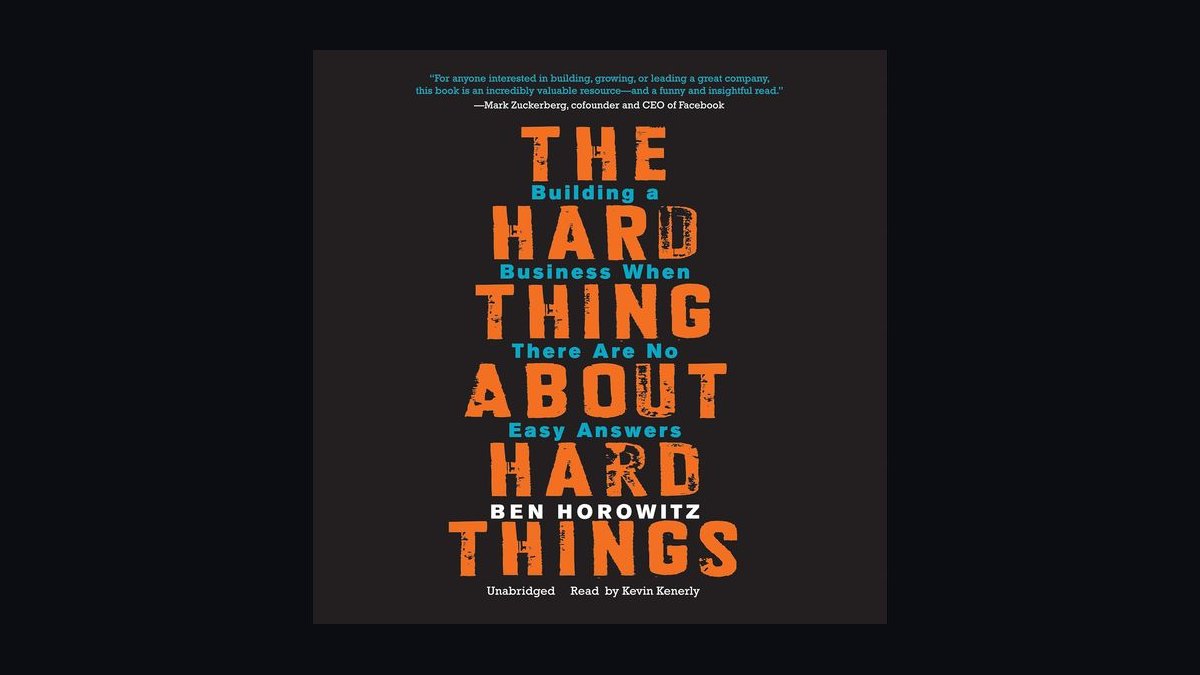
*The Hard Thing About Hard Things* by Ben Horowitz (HarperBusiness, 2014) is a founder-CEO memoir built from running Loudcloud through the dot-com crash into Opsware and a $1.6B HP sale. Its core lesson: the hard thing is never the plan, it's executing layoffs, demotions, and survival calls when no good option exists.
What the book is and why it still gets handed to operators
Ben Horowitz wrote this book because the management shelf annoyed him. His own framing is that every business book tells you to set a big hairy goal, and none of them tell you what to do when you miss it and now have to lay off a quarter of the company on a Tuesday. That gap is the whole premise. *The Hard Thing About Hard Things: Building a Business When There Are No Easy Answers* is not a framework book in the McKinsey sense — it's a field record of specific decisions made under specific pressure, with the emotional cost left in rather than edited out.
The spine of the narrative is Loudcloud. Horowitz co-founded it in 1999 with Marc Andreessen, fresh off Netscape, selling what we'd now call managed cloud infrastructure roughly a decade before the market was ready. Loudcloud IPO'd in March 2001 — effectively the last window before the dot-com market slammed shut — and the aftermath is the book's engine. Customers went bankrupt before paying invoices. Revenue forecasts evaporated. Horowitz cut staff from around 550 down to roughly 150, sold the managed-services business to EDS for $63.5M, renamed what was left Opsware, and bet the remaining company on the data-center automation software that had been an internal tool. Opsware sold to HP for $1.6B in September 2007. Horowitz and Andreessen then founded Andreessen Horowitz, and the book's second layer is pattern-matching from mentoring hundreds of portfolio CEOs after the fact.
Why it survives on operator reading lists more than a decade later is a question of category. There are books about strategy, and there are books about the felt experience of being the person who has to execute a strategy nobody believes in yet. Horowitz's book is squarely the second. It sits next to Andy Grove's *Only the Paranoid Survive* and *High Output Management* as the wartime-leadership canon — Grove is explicitly Horowitz's most-cited influence, and the one-on-one ritual Horowitz mandates is lifted directly from Grove's operating model. For revenue leaders specifically, the value is less about the cloud-infrastructure war stories and more about the sections on firing executives, restructuring comp, and telling the truth to a board that wants a different number.

The adjacent read matters too. Horowitz's follow-up, *What You Do Is Who You Are* (2019), picks up culture as a design problem rather than a values-poster problem — it's the natural second volume, because *Hard Things* tells you to make brutal calls and the sequel tells you what those calls teach everyone watching. Elad Gil's *High Growth Handbook* covers the same operator terrain with more process scaffolding and less blood. If you want one sentence of positioning: *Hard Things* is the emotional manual, *High Growth Handbook* is the mechanical one, and most operators need both.
The actual operating process the book prescribes
Strip the war stories out and there's a repeatable loop underneath. Horowitz doesn't present it as a numbered process — he'd probably object to the diagram — but the sequence is consistent across every crisis chapter.
It starts with truth-telling. Horowitz's strongest claim is that companies don't die from bad news, they die from concealed bad news, because concealment removes the organization's ability to work the problem. The CEO who hides a missed quarter from the sales org has taken 200 brains off the field. The corollary is his "shit sandwich is not OK" rule: don't bury hard feedback between compliments. Say the hard thing plainly, then help.
Next comes mode diagnosis — is this company at war or at peace? That determination changes every downstream decision, and getting it wrong is more expensive than any single tactical mistake.
Then execution, which is where Horowitz gets specific. The layoff playbook: get absolutely clear on why you're cutting and don't apologize for the decision itself, train managers to deliver the news themselves in person (HR does not do this for them), compress the whole event into one day rather than letting it bleed across a week, and have the CEO address the entire company in person within hours — not days, not by memo. The reason is that the people who remain are the ones who matter now, and they're watching how you treated the people who left. A leaked, staggered layoff destroys more trust than the cuts themselves.
The demotion conversation follows the same rules with a sharper edge. Horowitz's rule is: make the decision based on what the company needs, hold the conversation in person, and be honest about why. Do not dress a demotion as a lateral move or a "new focus area." Everyone in the org will decode it within a day, and the dishonesty is what they'll remember.
After execution comes the priority stack that gets quoted more than anything else in the book: take care of the people, the products, and the profits — in that order. Horowitz's reasoning is mechanical, not sentimental. If your best engineers don't want to come in tomorrow, the product decays; if the product decays, the profits follow. Reversing the order feels rigorous and produces a company nobody good will stay at.
The maintenance layer under all of it is the weekly one-on-one, and Horowitz is unusually prescriptive here. The employee owns the agenda. The manager's job is to shut up and listen. The subject is what isn't working. He cites Grove's arithmetic — skip one of ten direct reports' one-on-ones and you've cut your management bandwidth by ten percent — and treats the ritual as the cheapest early-warning system a CEO can buy. Most organizational failures show up in a one-on-one months before they show up in a dashboard.
What the hard things actually cost, in time and in people
The book's numbers are worth pulling out because they set expectations that most first-time operators get wrong by an order of magnitude.
Headcount. Loudcloud went from roughly 550 employees to roughly 150 in the crash sequence — a cut of about 70% across multiple rounds. Horowitz is clear that multiple rounds is itself a failure mode: cut deep once rather than shallow three times, because each round destroys trust and productivity again. If your model shows you need to cut 15%, most experienced operators will tell you to cut 20-25% and be done. The company that cuts three times in nine months has spent a year with everyone's résumé open.
Time. The layoff event compresses into a single day. Decision to execution should be measured in days, not weeks — Horowitz's argument is that a leaked layoff in progress is strictly worse than a fast one, because the leak period produces zero output and maximum anxiety. The CEO's all-hands happens within hours. By contrast, the *decision* upstream of it — accepting that the cut is necessary — is where CEOs burn months they don't have.
Money. Loudcloud's managed-services business went to EDS for $63.5M, which funded the Opsware bet. Opsware exited to HP at $1.6B in September 2007. The spread between those numbers is the entire argument for pivoting under fire rather than winding down. But note the survivorship problem: Horowitz is telling you about the pivot that worked, and there's no chapter from the founders whose identical bet didn't.
Personal cost. Horowitz reports losing around 40 pounds during the worst stretch and describes compulsively checking the stock price. He's explicit about waking at 3am with his heart racing. The reason this belongs in a costs section rather than a color section is that founders systematically underprice it. If you're modeling a turnaround, model the 12-18 months of degraded personal capacity too, because it's real and it affects decision quality.
Hiring cost, which the book treats obliquely but matters for revenue orgs: Horowitz's scale anticipation fallacy — hiring a VP of Sales built for a $200M company when you're at $5M — is a mistake he watched repeatedly at a16z. The visible cost is a large comp package. The invisible cost is 9-12 months of wrong motion, a sales team hired against the wrong playbook, and the second search you now have to run. A mis-hired revenue executive at a Series A typically costs a year of pipeline development, not one quarter of salary.
Where teams and readers get this book wrong
The most common misread is treating "wartime CEO" as a personality license. Horowitz describes wartime leadership as a *mode required by a context* — an existential threat, a closing window, a competitor about to eat the category. It is not a permission slip to be abrasive when the company is growing 40% a year with 30 months of runway. The founders who mislabel peacetime as wartime burn out their best people fighting an imaginary siege, and the damage tends to surface as unexplained senior attrition about a year later.
The second misread is the opposite failure: refusing to acknowledge war when it arrives. A revenue org that has missed three consecutive quarters, watched win rates slide, and lost two enterprise logos to a cheaper competitor is at war whether or not anyone has said so in a leadership meeting. Peacetime behaviors — broad consensus-building, long strategy offsites, protecting every function's headcount equally — actively destroy value in that context.
Third: cherry-picking "take care of the people" into a no-hard-decisions culture. Horowitz fires people constantly in this book. Taking care of people means being honest with them fast, paying them fairly, and not letting a bad performer poison a team — not avoiding difficulty. A manager who cites Horowitz to avoid a performance conversation has inverted the entire thesis.
Fourth, and specific to revenue teams: reading the "hire for strengths, not lack of weaknesses" advice as an excuse for unstructured interviewing. Horowitz's point is that most interview loops screen out anyone with a visible flaw and therefore select for inoffensive generalists when the role needs one or two genuine superpowers. That's a valid critique of consensus hiring. It is not an argument against structured process — and this is the part of the book that has aged least well. *Who* by Geoffrey Smart and Randy Street, and Brad Smart's *Topgrading*, offer the structured counterweight, and modern work-sample testing catches things instinct doesn't. Take Horowitz's diagnosis and someone else's method.
Fifth: skipping the org-design chapter because it looks abstract. Functional organizations — engineering, sales, marketing as distinct silos — optimize for knowledge sharing within a discipline and suit earlier stages. Divisional structures optimize for end-to-end accountability and suit scale. Most reorgs fail because a CEO copies a structure from a company at a different stage. If you run a 60-person revenue org and you're importing an operating model from a 6,000-person company, you're importing its coordination overhead without its coordination problem.
Sixth: assuming the book is only for founders. The chapters on managing a demotion, running a real one-on-one, and telling a board an unpleasant truth apply directly to a VP of Sales, a CRO, or a RevOps lead who has to tell leadership the pipeline coverage math doesn't work. The scope is CEO-shaped, but the mechanics transfer down two levels without modification.
A decision framework for using the book's ideas
The practical way to use *The Hard Thing About Hard Things* is not front-to-back. It's as a lookup table keyed to the decision in front of you. Below is the routing logic that follows from the book's own structure.
The selling-the-company logic deserves its own note, because it's the cleanest decision tree in the book. Horowitz's test has two variables: is the market bigger or smaller than you thought, and can you win it? Bigger market plus a credible path to winning means do not sell — you are early in the compounding. Smaller market than you modeled, or a bigger market you can't realistically take, means sell. Opsware went to HP because Horowitz believed BMC and IBM would close the gap, and because HP's need was more acute than HP had yet admitted. Timing the sale against the acquirer's need, not your own fatigue, is the transferable lesson.

The founder-CEO argument is the other framework worth extracting as a decision rule. Horowitz's position — first published as an a16z essay, then folded into the book — is that the founder-CEO premium is real for three reasons: founders take long-horizon risks a hired executive's incentive structure punishes, founders carry moral authority for painful decisions that employees will not extend to an outsider, and founders are emotionally invested enough to actually do the hard things rather than optimize for a clean exit from their own tenure. The names he uses as proof — Bezos, Page, Zuckerberg, Hastings, Musk — are the standard set. The practical implication is directed at boards: replacing a founder mid-Struggle frequently destroys the thing the board was trying to protect.
One honest caveat on the framework, since the point of a summary is to tell you what it doesn't cover. The book predates remote and hybrid work entirely. "Address the company in person within hours" was written for a company in one building. The distributed translation — live all-hands video, no pre-recorded message, managers available immediately after in small groups, no written-first announcement — is inferable but not in the text. Its examples also skew heavily male and heavily 2014 Valley; readers building a mental model of wartime leadership should add operators outside that set. And it's light on async management, the post-2020 talent-leverage shift, and anything resembling modern comp design.

What holds up is most of it. The Struggle — Horowitz's name for the 3am, why-did-I-start-this, everyone-is-looking-at-me-and-I-have-no-answer condition — remains the most-quoted passage because nothing else in the business canon names that state honestly. The wartime/peacetime distinction entered the language to the point where "wartime founder" is now a standard label people use without attribution. The layoff playbook shows up nearly verbatim in the public layoff communications of the 2022-2024 cycle. The one-on-one ritual, borrowed from Grove, is still the highest-leverage hour on a manager's calendar.
The Monday-morning version, if you take exactly one action from this summary: book a real one-on-one with your most difficult direct report this week, let them set the agenda, ask what isn't working, and listen without defending a single point. That habit is the cheapest insurance against The Struggle that Horowitz has to offer, and it costs an hour.
Related questions
What is "The Struggle" in Horowitz's terms?
The Struggle is the state where the company may die, everyone is looking to you, and you genuinely don't know the answer. Horowitz's point is that it's universal and rarely discussed. His advice is narrow: don't quit, and lean on what makes you unusual.
Is wartime or peacetime leadership better?
Neither — they're responses to different contexts. Wartime suits existential threat: narrow focus, fast calls, minimal debate. Peacetime suits an expanding market: culture-building, process investment, consensus. The rare skill is recognizing which one you're in and switching modes without ego.
How does this compare to *Good to Great*?

Collins builds data-backed theory about sustained excellence. Horowitz writes from inside near-death and offers no formula. Read Collins for pattern; read Horowitz for the messy emotional mechanics of firing a friend, which the polished management canon skips entirely.
What should I read alongside it?
Andy Grove's *High Output Management* for the operating mechanics Horowitz borrows, *Only the Paranoid Survive* for strategic inflection points, Horowitz's own *What You Do Is Who You Are* for culture design, and *Who* for the structured hiring rigor this book lacks.
Does it help non-CEOs?
Yes. The one-on-one method, the demotion conversation, the truth-telling default, and the org-design trade-offs transfer directly to VPs and directors. Only the sell-the-company and board-management chapters are genuinely CEO-only.
FAQ
Is this book only for tech startup founders?
No. The examples come from Silicon Valley infrastructure companies, but the decisions — cutting headcount, moving a loyal person out of a role, telling a board a number they don't want, choosing between accountability and knowledge-sharing in an org chart — are industry-agnostic. Operators in manufacturing, agencies, and healthcare services quote the same chapters.
Does it give step-by-step formulas?
Mostly not, and deliberately so. The layoff sequence and the one-on-one format are the closest thing to prescriptions. Everything else is framework plus story: The Struggle, wartime versus peacetime, the people-products-profits stack. Horowitz's stated position is that recipes fail precisely at the moments that matter.
Is a 2014 book still current?
The leadership content is, because the underlying decisions haven't changed. The dated parts are the technology context — managed services and data-center automation — and the absence of remote work, async management, and post-2020 talent dynamics. Read it for judgment, not for tooling.
Does it cover fundraising or VC relationships?
Only indirectly. There's substantial material on managing board dynamics and investor pressure during a crisis, and the founder-CEO argument is partly aimed at boards. It is not a fundraising guide. The book starts after the money is in the account.
How long does it take to read?
Roughly six to eight hours cover to cover, and it reads faster than most business books because it's structured as narrative. That said, the chapters on layoffs, demotions, and wartime leadership reward re-reading at the moment you actually need them, which is the way most operators end up using it.
What's the single most useful takeaway for a revenue leader?
Tell the truth faster than feels comfortable — to your team about the number, to your CEO about the pipeline, to yourself about the rep who isn't going to make it. Every expensive failure in the book traces back to a delayed honest conversation.
Sources
- https://www.harpercollins.com/products/the-hard-thing-about-hard-things-ben-horowitz
- https://a16z.com/
- https://en.wikipedia.org/wiki/Ben_Horowitz
- https://en.wikipedia.org/wiki/Opsware
- https://www.wsj.com/articles/SB118843135550301970
- https://www.intel.com/content/www/us/en/history/virtual-vault/articles/end-of-memory-chips.html
- https://press.stripe.com/high-growth-handbook
- https://www.penguinrandomhouse.com/books/97462/high-output-management-by-andrew-s-grove/
- https://www.ycombinator.com/library
- https://review.firstround.com/
Related on PULSE
This page will be disappearing soon. Save it to your device for $1 — or read it free while it is here.
@Kory-White- · if Venmo asks, the last 4 of my number are 2012
This page is gone.
This one is off the shelf now. $1 keeps it on your phone for good — the whole page, pictures and diagrams included.
 pulse-recentThe Transparency Sale by Todd Caponi — Top 10 Key Takeaways for Sales Leaders in 2027
 pulse-recentWhat are the first three concrete steps in Sandler Rule #1 for a new sales rep in 2027?
 pulse-recentBlue Ocean Strategy by W. Chan Kim and Renee Mauborgne — Top 10 Key Takeaways for Sales Leaders in 2027
 book-summaryLittle Red Book of Selling by Jeffrey Gitomer — Cliff Notes Summary
 pulse-recentGetting to Yes by Roger Fisher and William Ury — Top 10 Key Takeaways for Sales Leaders in 2027
 pulse-recentThe Challenger Customer by Brent Adamson — Top 10 Key Takeaways for Sales Leaders in 2027
 book-summaryWhat factors drive the price of Book Summaries up or down in 2027?
 pulse-recentThe Collaborative Sale by Keith Eades — Top 10 Key Takeaways for Sales Leaders in 2027
 pulse-recentThe Sales Acceleration Formula by Mark Roberge — Top 10 Key Takeaways for Sales Leaders in 2027
 pulse-recentThe Customer Success Professional’s Handbook by Ashvin Vaidyanathan — Top 10 Key Takeaways for Sales Leaders in 2027