


The Effective Executive by Peter Drucker — Cliff Notes Summary
Quality
Certified
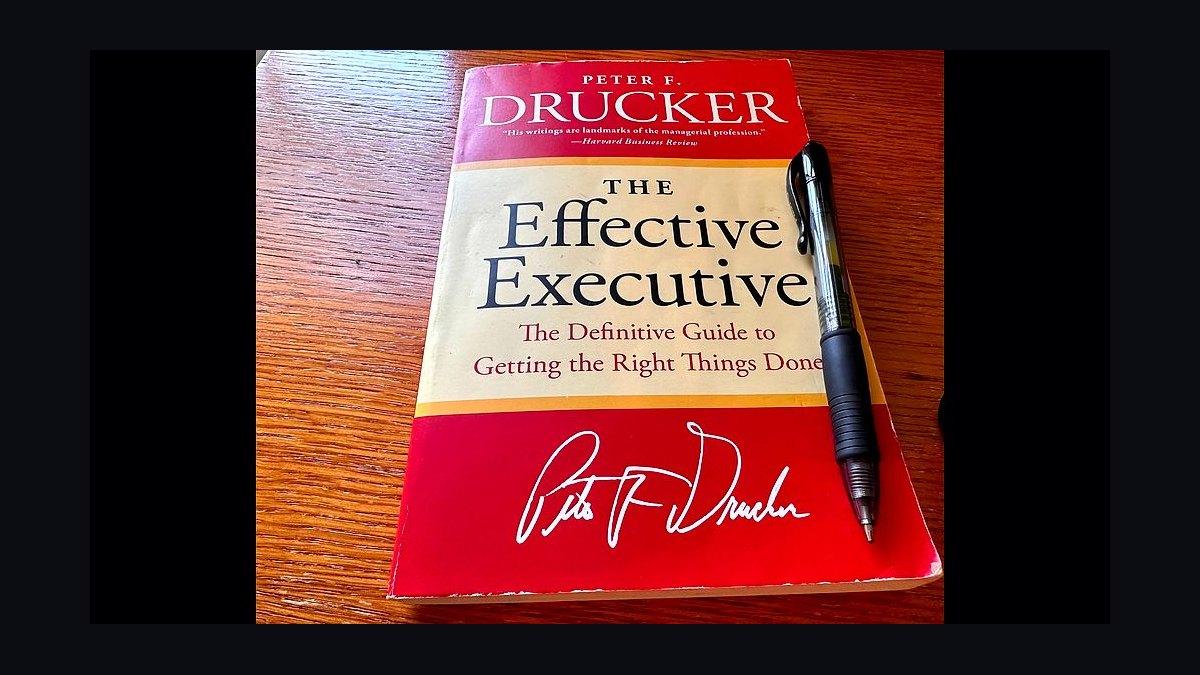
Peter Drucker's *The Effective Executive* (1967) argues that effectiveness is a learnable discipline, not a personality trait. Five habits carry the book: know where your time goes, ask what you can contribute, build on strengths, do first things first, and make decisions systematically. Any knowledge worker who practices them becomes effective.
The outcome you should expect from working the five habits
Read honestly, this book does not make you smarter or faster — it makes you *selective*, and selectivity is what actually moves a number. The realistic outcome after a full pass is not inspiration; it is a shorter list. Executives who run Drucker's time log for three or four weeks almost always discover the same thing he reported watching happen across his consulting practice: their estimate of how they spend their week and the actual log disagree substantially, usually in the direction of "I thought I was doing strategy and I was doing coordination." That gap is the whole payoff. You cannot reallocate time you cannot see.
The second thing to expect is discomfort with your own calendar. Drucker's three-question audit — what am I doing that need not be done at all, what could be done as well or better by someone else, and what am I doing that wastes other people's time — is designed to be uncomfortable. The third question in particular is the one most managers skip, because it requires asking your own team a question you may not like the answer to. In practice, when leaders actually ask it, the answers cluster: the weekly status meeting nobody needed, the approval step that adds a day and changes nothing, the "quick sync" that pulls four people out of focused work to relay information a message would have carried.
The third outcome is slower, better decisions. This runs against every instinct a revenue organization has. Drucker's claim is that effective executives make *fewer* decisions, more deliberately, at a higher level of generality — because most of what looks like a novel situation is a recurring one wearing a costume, and the correct response to a recurring situation is a rule, not a ruling. A sales leader who re-litigates discount approvals deal-by-deal is spending decision capacity on something that should have been a discount policy solved once. The outcome you should expect is fewer meetings that end in "let's decide next week" and more that end in a written boundary condition.

What you should *not* expect is speed. The habits compound over quarters. Time-log improvements show up in weeks; contribution reframing and strength-based staffing show up in a hiring cycle or two; the decision discipline shows up when a bad decision you would have made in 2025 does not get made in 2026 and nobody notices, because nothing broke. Effectiveness is mostly invisible when it works — that is the honest sales pitch for it.
What drives that outcome — the mechanics under the five habits
The habits are not five independent tips. They form a dependency chain, and skipping a link degrades everything downstream. Time comes first because it is the one truly non-substitutable resource — you can raise capital, hire people, buy tools, and license data, but the supply of hours is fixed and perishable. Drucker's insistence on a *recorded* log rather than a remembered one is the methodological core: memory is a reconstruction, and reconstructions flatter the reconstructor. Record in short increments, in real time or near it, and repeat the exercise periodically rather than once, because calendars drift back toward fragmentation within months of any cleanup.
Once time is visible, consolidation matters more than elimination. Drucker's point is that knowledge work has a minimum viable block size: analytical work, writing, a genuine strategy session, a real one-on-one with a struggling rep — none of these survive being sliced into fifteen-minute slivers between calls. Twelve scattered fragments do not equal ninety continuous minutes. This is why the second-order move after the audit is defragmentation: batching, blocking, and refusing to let the calendar fill by default.

Contribution is the habit that redirects the freed time. The reframe is small and consequential: stop asking what the job requires and start asking what you can uniquely add to the institution's results. Drucker breaks the answer into three dimensions an executive owes — direct results, building and reaffirming values, and developing people for tomorrow. His argument is that all three are obligatory, not a menu. The leader who hits the number while hollowing out the team has borrowed against dimension three; the leader who builds a beloved culture and misses badly has failed dimension one. In a revenue org this maps cleanly: bookings and pipeline are direct results, the standards you enforce in deal reviews are values, and the enablement bench you build is tomorrow's capacity.
Strengths is the habit most organizations get exactly backwards. The default hiring and staffing reflex is weakness-avoidance — scan the résumé for gaps, hire the candidate with the fewest visible flaws, and end up with a team of people who are bad at nothing and exceptional at nothing. Drucker's reversal is to ask what a person is genuinely strong at and then whether there is a role where that strength produces outsized results, treating irrelevant weaknesses as irrelevant. His illustration is Lincoln appointing Grant despite Grant's reputation for drinking, on the reasoning that Grant won battles and the previous, more respectable generals had not. The organizational translation is unglamorous but real: match rep archetypes to segment demands rather than forcing every seller through one motion.
First things first is the enforcement mechanism. Drucker states it plainly — concentration is the closest thing to a secret of effectiveness, and effective executives do one thing at a time. Priorities are the easy half; the hard half is what he calls posteriorities, the deliberate decision about what will *not* get done. His diagnostic is the cleanest test in the book: if you were not already doing this, would you start it today? A "no" is an instruction, not an observation. Most executives who fail do not fail at picking priorities; they fail at killing yesterday's commitments, which quietly consume the capacity the new priority needed.

Decision-making is the capstone, and Drucker gives it a five-step structure: classify the problem as generic or genuinely unique, define the boundary conditions the solution must satisfy, decide what is right before compromising toward what is acceptable, build the action into the decision itself, and build a feedback loop that tests the decision against reality. He is emphatic on the third step — worrying about acceptability before you know what would be right produces mush. He is equally emphatic on the fifth — go and see, because reports are filtered by the people writing them.
The loop closes deliberately. Feedback returns to the time log, because every decision that survives contact with reality creates new commitments, and new commitments re-fragment the calendar. Drucker's system is cyclical, not linear — which is why he prescribes repeating the time log rather than doing it once and declaring victory.
Benchmarks, realistic ranges, and how the book sits against its descendants
A few of Drucker's own numbers are worth holding onto because they are the ones practitioners actually use. He recommends logging time in short increments for three to four weeks, and repeating the exercise roughly twice a year — not continuously, which nobody sustains, and not once, which decays. He estimates the overwhelming majority of executive decisions are generic rather than unique, which is the justification for solving them at the policy level. And he treats a substantial uninterrupted block — on the order of an hour and a half — as the floor for real analytical work. Those three figures are the operational spine of the book.
Where the book sits in the canon is the other useful benchmark. *The Effective Executive* is upstream of most of the management shelf you already own. Andy Grove's *High Output Management* narrows Drucker's frame to managerial leverage and output measurement. Stephen Covey's *7 Habits* lifts "first things first" almost by name and expands it into a personal-effectiveness system. John Doerr's *Measure What Matters* traces the OKR lineage from Drucker's management-by-objectives through Grove to Google. Jim Collins' *Good to Great* studies the same question empirically rather than from consulting observation. Reading Drucker first makes the others feel like specialized elaborations, which is roughly what they are.

Length and difficulty are worth calibrating too. It is a short book — a couple of hundred pages depending on edition — but the prose is dense and argumentative rather than anecdotal, so it reads slower than its page count suggests. Modern business books pad a single idea to three hundred pages; Drucker compresses eight ideas into two hundred. Budget more time per page than you would for a contemporary title, and expect to reread the decision chapters.
On adjacent tooling: the discipline Drucker described by hand has been partially industrialized. Calendar analytics, automatic time-tracking, and focus-block scheduling tools now produce something resembling his log without the manual capture. This is genuinely useful for step one and genuinely useless for steps two through five — a tool can tell you where the hours went, but it cannot tell you which meeting need not exist, and it certainly cannot tell you what your unique contribution is. Treat automated tracking as the instrument and the three-question audit as the judgment. The failure mode is a beautiful dashboard of your own fragmentation that changes nothing.
One more comparison worth making: the book predates the behavioral-economics literature by decades. Drucker's decision chapters are about structure — classification, boundary conditions, dissent, feedback — not about cognitive bias. Kahneman's *Thinking, Fast and Slow* covers the territory Drucker does not, and the two pair well: Drucker gives you the process, Kahneman explains why intelligent people running a good process still reach bad conclusions. If you only read one, read Drucker for the operating system and treat bias-awareness as a patch.
Risks, edge cases, and the ways this goes wrong in practice
The most common failure is the audit that becomes an artifact. People run the time log, produce a tidy summary, feel briefly enlightened, and change nothing — because the log is diagnostic and the cure is political. Killing a recurring meeting means telling its owner it was not worth their time. Delegating work means accepting that it will be done differently, and possibly worse, for a while. If you are not willing to absorb that friction, skip the log; you will only have documented your own dissatisfaction.
The second failure mode is misapplying "build on strengths" as a license to ignore genuine disqualifiers. Drucker's argument is that *irrelevant* weaknesses should be ignored, not that all weaknesses are irrelevant. A brilliant closer whose weakness is fabricating deal status is not a strength-staffing opportunity; that weakness is directly load-bearing on the job. The test is whether the weakness touches the mission. If it corrupts the output, it is not a quirk to route around — it is a reason to make a different decision. Teams that misread this end up protecting a high performer whose behavior is quietly costing more than their bookings.
Third: posteriorities generate real casualties, and Drucker does not soften this. Killing a project kills someone's work, sometimes someone's identity at the company. He is right that failed executives usually fail at enforcement rather than selection, but the enforcement cost is a relationship cost, and it lands unevenly — on the person whose pet project you ended, on the team whose scope you cut. The mitigation is not to avoid posteriorities but to make the reasoning explicit and public, so the decision reads as a judgment about priority rather than a judgment about the person.
Fourth: the "decide what is right before what is acceptable" rule can be weaponized into paralysis or arrogance. Used well, it prevents pre-compromising a solution into uselessness before you know what the correct answer even was. Used badly, it becomes a leader who designs an ideal that no one will fund, refuses to adapt, and calls the resulting failure a lack of organizational courage. Drucker's sequence includes the compromise step — right first, *then* compromise. Skipping the second half is a misreading.
Fifth, and specific to sales organizations: the concentration habit collides directly with the reactive nature of revenue work. Deals slip, prospects escalate, a champion leaves, a competitor discounts. You cannot block ninety minutes and refuse to look at a burning enterprise renewal. The workable adaptation is asymmetric — protect blocks for the work that only compounds if uninterrupted (territory design, comp modeling, enablement content, pipeline diagnosis) and accept fragmentation in the hours explicitly reserved for reactive load. The mistake is letting reactive work colonize the entire calendar by default, which is what happens absent a decision.
Sixth: the book's examples are historically distant. Its cases lean on mid-century American institutions — the war-era federal government, large industrial corporations, hospital administration — and readers under forty will need to do translation work. This is a presentation problem rather than a substance problem, but it is real friction, and it is why so many people bounce off Drucker and land on a derivative that says less in more accessible packaging.
Finally, the structural edge case: Drucker assumed the knowledge worker sits inside one institution with a stable role. Fractional executives, contractors, remote-first teams, and people whose work is increasingly mediated by automated systems all break that assumption. The habits arguably apply *harder* under those conditions — nobody is supervising the inside of your head, and now nobody is even in the room — but the institutional scaffolding Drucker took for granted has to be self-supplied. If you are a fractional revenue leader across three accounts, you are running the five habits without the org chart that used to enforce them.
A practical rollout plan for a team, not just an individual
Individual adoption is easy to describe and easy to abandon. Team adoption sticks better, because the posteriorities require other people's consent anyway. Here is a sequence that survives contact with a real quarter.

Weeks one through four — instrument only. Every leader on the team runs the time log. No changes, no commentary, no shaming. The single rule is honest capture. The reason for the no-change period is that premature optimization contaminates the data: the moment people know they are being judged on the log, the log becomes a performance. Four weeks of unmodified baseline is worth more than a year of edited weeks.
Week five — the three-question audit, done aloud. Each leader answers Drucker's three questions in a shared session and, critically, asks their direct reports the third one: what am I doing that wastes your time? Collect the answers in writing. Expect the same handful of themes to appear across every leader — that convergence is the signal, and it is what justifies structural changes rather than individual ones.
Week six — cut and consolidate. Take the audit output and make two lists: things that stop entirely, and things that move to someone better positioned to do them. Then defragment: identify the two or three categories of work that require uninterrupted blocks and place them on the calendar as recurring commitments before the reactive load fills the space. Publish both lists. Silent cuts get quietly reinstated.
Weeks seven and eight — the contribution rewrite. Each leader rewrites their role from a duties list into a contribution statement covering all three Drucker dimensions: the direct result they own, the standard they enforce, and the person or capability they are building. Keep them short enough to say out loud. Review them against the actual calendar from weeks one through four — if the contribution statement and the time log describe different jobs, one of them is fiction, and it is usually not the log.
Weeks nine through twelve — strength-based staffing, one move at a time. Pick a single role or territory and re-staff it for strength-asymmetry rather than gap-minimization. One move, not a reorg. Reorgs make the method impossible to evaluate; a single move against a defined baseline is measurable. Define in advance what result would count as evidence and check it at the end of the quarter.

Ongoing — one decision per cycle through the full five steps. Choose the largest decision of each planning cycle and run it formally: written classification of generic versus unique, written boundary conditions, the right answer stated before any compromise, an action plan naming owners and dates, and a scheduled feedback review where someone goes and looks at the actual outcome. One decision per cycle is enough. The purpose is to build the reflex, and the written boundary conditions become the reusable artifact — the third time a similar decision appears, you will notice it is generic and write a policy instead.
Add one quality gate borrowed from the book: treat unanimous agreement as a warning sign. Drucker's account of Alfred Sloan tabling decisions his committee agreed on unanimously — on the grounds that consensus meant the disagreements had not surfaced yet — is the practical version of a red team. Before a pricing change, a comp redesign, or a territory carve, assign someone to argue the other side in writing, and do not schedule the decision until that document exists.
The reason this rollout works better than solo adoption is that four of the five habits are social. Only the time log is genuinely private. Contribution requires someone to receive the contribution; strengths require staffing authority; posteriorities require permission to stop; and decisions require dissent from people willing to give it. A leader practicing Drucker alone inside a team that is not gets frustrated within a quarter.
Related questions
Is *The Effective Executive* only for senior leaders?
No. Drucker defines an executive as any knowledge worker whose decisions materially affect the organization's results. That includes individual contributors with specialized judgment, team leads, and analysts. The title is a role description, not a rank.
How does this compare to *High Output Management*?
Grove is downstream and narrower. He focuses on managerial leverage, output metrics, and meeting design inside a specific operating context. Drucker sets the broader frame — time, contribution, strengths, concentration, decisions — that Grove's tactics assume. Read Drucker first, Grove second.
Do the five habits work outside corporate settings?

Yes. Drucker wrote extensively about nonprofits and public institutions, and the contribution and strengths habits translate especially well where there is no revenue scoreboard to substitute for judgment about what actually matters.
What is the single highest-leverage exercise from the book?
The time log followed by the three-question audit. It is concrete, self-administered, produces evidence rather than opinion, and every other habit depends on having discretionary time to allocate in the first place.
Should I read the summary or the full book?
A summary conveys the framework; it cannot convey Drucker's reasoning, which is where the persuasive force lives. Use a summary as a refresher or a decision aid for whether to read it. Read the original if you intend to actually change how you work.
FAQ
Is the book still relevant given it was published in 1967?
The principles are durable because they address stable human behavior: how attention gets spent, where effort concentrates, and how judgment gets exercised under uncertainty. The examples are dated and require translation, but the underlying mechanics apply cleanly to remote teams, agile delivery, and distributed knowledge work — arguably more forcefully, since fewer external structures enforce focus now than did in a 1967 corporate office.
What is a posteriority and why does Drucker treat it as equal to a priority?
A posteriority is a deliberate decision about what will not get done. Drucker treats it as equal because priorities without posteriorities are just an aspirational list — the new top priority starves unless something is actively killed to free the capacity. His diagnostic is direct: if you were not already doing this activity, would you begin it today? A no is an instruction.
Does Drucker's advice conflict with OKRs, agile, or modern planning frameworks?
It underwrites them. Management by objectives, which Drucker introduced in earlier work, is the direct ancestor of OKRs. "First things first" is agile prioritization stated in 1967 language. What Drucker adds is the executive discipline that makes those frameworks function — a planning system cannot supply the willingness to kill yesterday's commitments, and without that willingness any framework degrades into a longer list.
How long before the habits produce visible results?
Time-log improvements show up in weeks, because the intervention is mechanical. Contribution reframing and strength-based staffing take a hiring or planning cycle to evaluate honestly. The decision discipline is the slowest and hardest to measure, since its payoff is mostly bad decisions that never got made. Drucker frames effectiveness as a continuing practice, not a project with a completion date.
What should I read alongside it?
Kahneman's *Thinking, Fast and Slow* covers the cognitive-bias territory Drucker's decision chapters do not address. Grove's *High Output Management* supplies operational tactics. Collins' *Good to Great* tests adjacent claims empirically. Drucker's own *Managing Oneself* essay is the compressed personal-effectiveness version if you want the shortest possible entry point.
Is there a version of this for a sales or revenue-operations leader specifically?
Not from Drucker, but the mapping is direct. The time audit becomes a calendar review against pipeline-impacting work. Contribution becomes the question of what you uniquely add to next-quarter revenue rather than what your job description lists. Strengths becomes segment-to-archetype rep matching. Posteriorities become the deals, programs, and reports you formally stop. The five-step decision process becomes the discipline behind any pricing, comp, or territory change.
Sources
- https://www.harpercollins.com/products/the-effective-executive-peter-f-drucker
- https://hbr.org/2004/06/what-makes-an-effective-executive
- https://www.drucker.institute/
- https://www.claremont.edu/
- https://www.britannica.com/money/Peter-F-Drucker
- https://www.penguinrandomhouse.com/books/86167/high-output-management-by-andrew-s-grove/
- https://www.penguinrandomhouse.com/books/565051/measure-what-matters-by-john-doerr/
- https://www.jimcollins.com/books.html
- https://us.macmillan.com/books/9780374533557/thinkingfastandslow
Related on PULSE
This page will be disappearing soon. Save it to your device for $1 — or read it free while it is here.
@Kory-White- · if Venmo asks, the last 4 of my number are 2012
This page is gone.
This one is off the shelf now. $1 keeps it on your phone for good — the whole page, pictures and diagrams included.
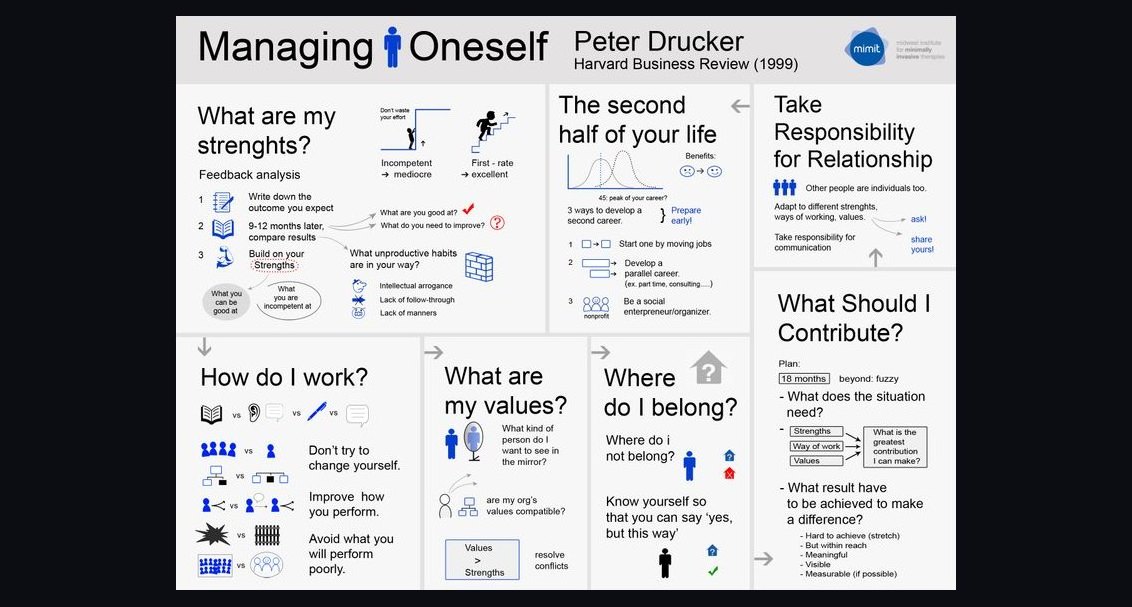 book-summaryManaging Oneself by Peter Drucker — Cliff Notes Summary
 pulse-recentHyper Sales Growth by Jack Daly — Top 10 Key Takeaways for Sales Leaders in 2027
 pulse-recentWhat is the first concrete step in The Sandler Rules by David Mattson for a sales leader to implement the system in 2027?
 pulse-recentConceptual Selling by Robert Miller and Stephen Heiman — Top 10 Key Takeaways for Sales Leaders in 2027
 pulse-recentThe Closer’s Survival Guide by Grant Cardone — Top 10 Key Takeaways for Sales Leaders in 2027
 pulse-recentHow do you implement the Sandler Rules by David Mattson in your first 30 days as a new sales manager in 2027?
 pulse-recentSandler Rule #1: What is the first concrete step to build a prospect's trust in a sales conversation in 2027?
 pulse-recentTraction by Gabriel Weinberg and Justin Mares — Top 10 Key Takeaways for Sales Leaders in 2027
 pulse-recentNever Lose a Customer Again by Joey Coleman — Top 10 Key Takeaways for Sales Leaders in 2027
 pulse-recentHow to Apply Strategic Selling — Step-by-Step Playbook in 2027