


Managing Oneself by Peter Drucker — Cliff Notes Summary
Quality
Certified
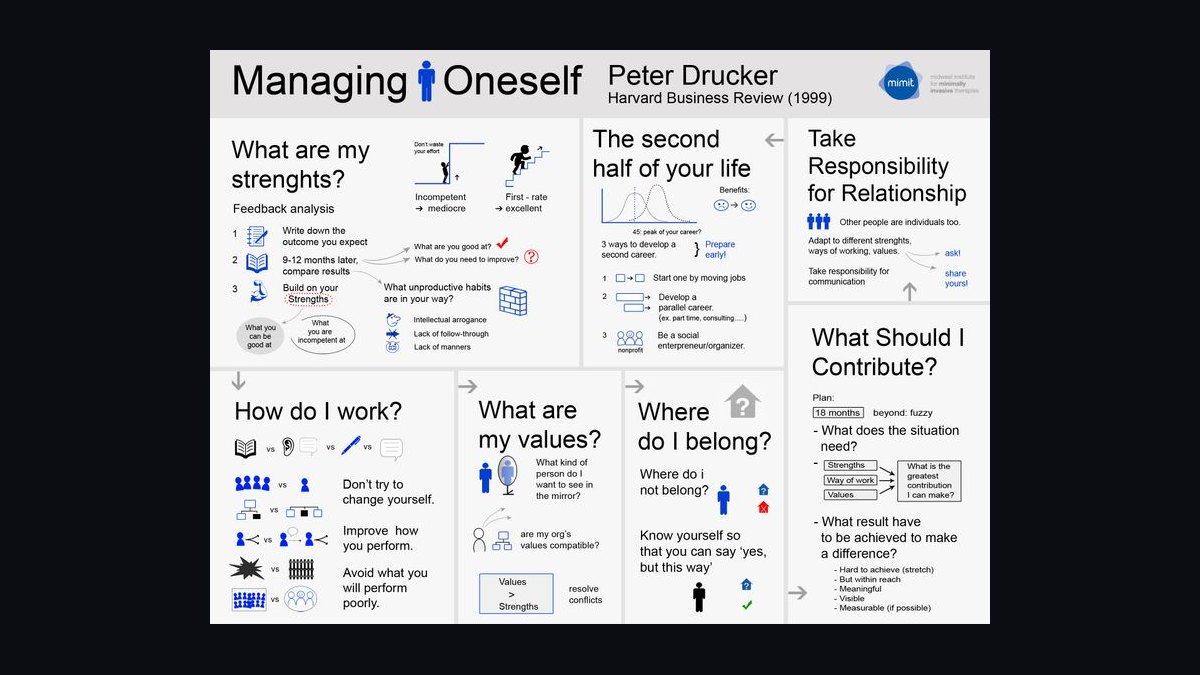
Peter Drucker's "Managing Oneself" (Harvard Business Review, 1999) argues that knowledge workers must take complete ownership of their careers because no employer will manage them. The essay's core strategy centers on seven questions — strengths, performance style, values, belonging, contribution, relationships, and second half — answered through Feedback Analysis over years, not introspection.
The Problem: A Career Mismanaged by Default
Consider the typical path of a high-performing individual contributor promoted into management. They excelled at execution, so the organization assumed they would excel at leading others. Eighteen months later, they are struggling, their team is disengaged, and their own performance reviews have slipped. Drucker's diagnosis is blunt: this person never asked whether their strengths and performance style suited the new role. They accepted a promotion because it was offered, not because it fit.
Drucker opens "Managing Oneself" with a historical observation that reframes the entire problem. For most of human history, people did not choose careers — they inherited them. A peasant's child became a peasant. A craftsman's child took the workshop. Even the exceptional achievers Drucker cites — Napoleon, Leonardo, Mozart — were outliers who managed themselves while everyone else followed assigned stations. The knowledge-worker era changed this permanently. For the first time, ordinary professionals must run their careers the way Mozart ran his, and most are unprepared for the responsibility.

The cost of this unpreparedness is staggering. Drucker notes that most people are systematically wrong about what they are good at. They confuse what they enjoy with what they deliver, or what they were once praised for with what they can sustain. The mirror test he introduces — the German diplomat who resigned an ambassadorship rather than serve a monarch he found morally objectionable — captures the deeper problem. The diplomat's line, "I do not want to see a pimp in the shaving mirror in the morning," became Drucker's lifelong heuristic. When a job conflicts with the person you want to see in the mirror, your effectiveness collapses regardless of how well the work matches your skills.
The compounding nature of career misalignment makes the problem urgent. Every year spent in the wrong role is a year of skill development, network building, and reputation that goes toward the wrong end. A salesperson who is actually a farmer — better at expansion and renewals than net-new hunting — who spends five years in a hunter role has lost five years of compounding relationship capital. A brilliant adviser forced into a decision-maker role has spent five years demonstrating what they are not good at rather than what they are. Drucker's answer is not a personality test or a career coach. It is a discipline: Feedback Analysis, applied consistently over two to three years, that reveals strengths and weaknesses empirically rather than intuitively.
How Feedback Analysis Works

The mechanism Drucker prescribes is deceptively simple. Whenever you make a key decision or take a key action, write down what you expect will happen. Nine to twelve months later, compare the actual results with your expectations. Repeat this process consistently, and patterns emerge within two to three years.
Drucker traces this method to the Jesuits and Calvinists of the sixteenth century, who independently invented it to evaluate their members. The insight is that introspection fails because people are unreliable narrators of their own performance. Personality tests like Myers-Briggs or StrengthsFinder tell you about preferences, not results. Only empirical comparison of expectations against outcomes reveals what you actually deliver.
The discipline reveals four distinct categories of information. First, your strengths — areas where you systematically deliver more than you expected. Second, your weaknesses — areas where you systematically deliver less. Third, areas of intellectual arrogance, where you assumed competence you did not have. Fourth, bad habits, including projects you should drop and skills — often basic manners or communication — you must learn.
The prescription that follows is counterintuitive for most professionals raised on the improvement mindset. Drucker argues you should work from your strengths, not on your weaknesses. Improving from incompetent to mediocre wastes energy that should go to moving from competent to excellent. A salesperson who is exceptional at discovery but poor at closing should not spend a year on closing training. They should structure their workflow to maximize discovery time and partner with a closer. The math is simple: the gap between incompetent and mediocre is large but the payoff is small. The gap between competent and excellent is smaller but the payoff is enormous.

The practical application requires a decision log. Every time you make a significant choice — taking a project, accepting a role, declining an opportunity — record your expectation of what will happen and when you will check. The nine-to-twelve-month window is critical because it is long enough for real results to materialize but short enough to keep the loop tight. After two to three years of this discipline, you will have a body of evidence about your actual strengths that no performance review or personality assessment can match.
Real Numbers, Ranges, and Benchmarks
The timeframes Drucker specifies are concrete and worth treating as design parameters rather than suggestions. The Feedback Analysis loop runs nine to twelve months per cycle. Two to three years of consistent application yields reliable patterns. The contribution question operates on an eighteen-month horizon. The second half of life should begin in your forties, not your sixties.
The nine-to-twelve-month feedback window exists for a reason. Shorter periods — one to three months — capture noise rather than signal. A single quarter's results are distorted by seasonality, market conditions, and random variation. Longer periods — two years or more — delay the learning loop too long and allow bad patterns to compound. The nine-to-twelve-month window is long enough for meaningful outcomes to materialize and short enough to maintain the discipline. Most people who start Feedback Analysis abandon it within the first cycle because they expect immediate insight. The method requires patience, but the compounding effect is real.

The two-to-three-year pattern recognition threshold is equally important. One Feedback Analysis cycle reveals data points. Two cycles reveal tendencies. Three cycles reveal patterns. A salesperson who closes deals consistently in the first quarter of the year but stalls in the fourth quarter has a pattern, not an anomaly. A manager whose projects deliver on time but whose teams show high turnover has a pattern. The three-year mark is when the evidence becomes reliable enough to make major career decisions — whether to pursue a promotion, change functions, or leave an organization.
The eighteen-month contribution horizon is Drucker's answer to the question "What should I contribute?" The timeframe is long enough to deliver a meaningful result but short enough to be concrete. Beyond eighteen months, the world changes faster than the plan. Inside eighteen months, you can commit to results that are demanding but reachable, visible and measurable, and that stretch beyond comfort. The question is not "What do I want to do?" — passion-first thinking that Drucker dismisses — and not "What does the organization want?" — compliance-first thinking that produces mediocrity. The right question is: "Given my strengths, my performance style, and my values, what can I uniquely contribute that would make a real difference in the next eighteen months?"
The second-half timing is Drucker's most prescient observation: knowledge workers outlive their organizations. A twenty-five-year-old joining a company in 2027 should expect to outlive that company. The average Fortune 500 company lifespan has shrunk from over sixty years in the 1950s to under twenty years today. A forty-year employer relationship is obsolete. Drucker's prescription is to start planning the second half in your forties, not your sixties. Waiting until burnout or forced retirement is too late to build the skills, network, and reputation the second career requires.
The three paths Drucker prescribes for the second half are concrete. The first is a second career — a clean break, often into nonprofit leadership, teaching, or independent consulting. The second is a parallel career — keeping the main career while adding a part-time venture such as board seats, adjunct teaching, or fractional roles. The third is social entrepreneurship — launching a nonprofit or community organization while still in the main career, transitioning to it full-time later. The rise of fractional executive roles and operator-to-investor pivots in the 2020s is direct evidence of Drucker's framework playing out at scale.
Trade-offs and Alternatives

Drucker's framework is not without trade-offs, and understanding them is essential to applying it well. The most significant tension is between working from strengths and the practical demands of organizational life. Not every organization allows you to design your role around your strengths. A company may need you to close deals, not just discover opportunities. A team may need a decision-maker, not an adviser. Drucker's answer is stark: refuse work you cannot perform or will perform only poorly. But this refusal has real costs — slower advancement, political friction, and sometimes termination.
The second trade-off is between the empirical rigor of Feedback Analysis and the time it requires. Two to three years of disciplined expectation-setting and review is a significant investment. Most professionals are not willing to maintain a decision log for that long. The alternative — relying on intuition, personality tests, or annual performance reviews — is faster but systematically less reliable. Drucker's implicit argument is that the cost of wrong self-knowledge compounds for decades, dwarfing the upfront investment of the Feedback Analysis discipline.
The third trade-off is between the individualist frame of the essay and the reality of organizational power dynamics. Drucker's claim that office politics is mostly a failure of two-way communication under-models genuine power dynamics, especially in matrixed organizations. Knowing your strengths and communicating them does not protect you from a boss who feels threatened by your competence or a peer who undermines you politically. The disclosure prescription — telling colleagues what your strengths are, how you perform, and what you intend to contribute — works in functional organizations but can be weaponized in dysfunctional ones.

The fourth trade-off is between the essay's linear career assumption and the modular reality of the modern economy. Drucker assumes a relatively stable knowledge-worker career with a second half beginning in the forties. The gig economy, portfolio careers, and creator economy require a more flexible frame. A professional in 2027 might have three distinct careers across two decades, each requiring its own Feedback Analysis cycle and contribution question. The essay's structure still applies, but the boundaries between first and second halves blur.
The fifth trade-off is between values and strengths when they conflict. Drucker is explicit: values trump strengths. A great salesperson at a pharmaceutical company that promotes drugs they consider overpriced will burn out — not because the work is hard, but because the value conflict corrodes effectiveness day by day. The mirror test is the arbiter. When a job, organization, or industry conflicts with the person you want to see in the mirror tomorrow morning, your effectiveness will collapse no matter how well-suited the work is to your strengths. This is a hard truth for professionals who have built careers in industries they have come to question.
Common Pitfalls and How to Avoid Them
The most common pitfall in applying "Managing Oneself" is treating the seven questions as a one-time exercise rather than an ongoing discipline. Professionals read the essay, answer the questions once, and file the results. Drucker's method requires continuous Feedback Analysis — every key decision logged, every nine-to-twelve-month review completed, every pattern integrated into the next decision. The people who benefit most are those who maintain the discipline for years, not weeks.

The second pitfall is skipping the Feedback Analysis step entirely and relying on personality tests or introspection. Drucker is emphatic that most people are systematically wrong about what they are good at. Myers-Briggs and StrengthsFinder tell you about preferences, not delivered results. The only reliable method is empirical: write down what you expect, compare with what happens, repeat. Professionals who skip this step are designing careers on assumptions that have never been tested.
The third pitfall is working on weaknesses instead of strengths. The improvement mindset — the belief that you should fix your gaps — is deeply embedded in corporate culture. Performance reviews, development plans, and coaching all focus on weaknesses. Drucker's counterintuitive prescription is to invest in strengths and stop wasting energy on moving from incompetent to mediocre. The exception is bad habits — including manners and basic communication skills — that undermine your effectiveness regardless of your strengths. These must be fixed, not optimized around.
The fourth pitfall is ignoring the values question until a crisis forces it. The mirror test is not a luxury for late-career reflection; it is a daily check. The salesperson who stays in a quota-or-quit culture for the money, the executive who stays in an industry they find ethically questionable, the manager who stays in an organization that rewards behavior they despise — all are corroding their effectiveness while telling themselves they will leave eventually. Drucker's advice is to apply the mirror test early and often, and to treat value conflicts as career emergencies.

The fifth pitfall is waiting too long to plan the second half. Drucker is explicit: start in your forties, not your sixties. The skills, network, and reputation required for a second career take years to build. A fifty-five-year-old who begins planning for retirement from their career at sixty-five has already missed the window. The professionals who land fractional executive roles, board seats, and advisory positions in their sixties started building those relationships in their forties. The parallel career is not something you start when you need it; it is something you build while you do not yet need it.
The sixth pitfall is failing to take responsibility for relationships and communication. Drucker's two principles are simple: other people are individuals with their own strengths, performance styles, and values, and you must tell them what yours are. The boss who is a reader needs written briefs, not verbal updates. The peer who is a listener needs conversations, not memos. The subordinate who learns by doing needs projects, not instructions. Professionals who assume others perceive the world as they do are perpetually frustrated by miscommunication and office politics. The antidote is disclosure: tell people what you are good at, how you perform, what you value, and what you intend to contribute.
Related Questions
What are the seven questions in Managing Oneself by Peter Drucker?
The seven questions are: What are my strengths? How do I perform? What are my values? Where do I belong? What can I contribute? What is my responsibility for relationships? And how do I plan for the second half of my life? Each builds on the previous ones to create a complete self-management framework.
How does Feedback Analysis work in practice?
Every time you make a key decision, write down what you expect will happen. Nine to twelve months later, compare actual results to expectations. Repeat consistently for two to three years until patterns emerge. The method reveals strengths, weaknesses, intellectual arrogance, and bad habits empirically rather than through introspection.
What is the mirror test in Managing Oneself?

The mirror test is Drucker's value-clarification heuristic, drawn from a German diplomat who resigned rather than serve a monarch he found objectionable. When a job conflicts with the person you want to see in the mirror each morning, your effectiveness collapses regardless of how well the work matches your strengths.
How does Managing Oneself apply to sales careers?
The seven questions map directly: Feedback Analysis reveals whether you are a hunter or farmer, performance style determines whether you thrive in end-of-quarter pressure or long-cycle relationship building, the mirror test filters quota-or-quit cultures, and the second-half framework guides transitions to fractional CRO, advisory, or coaching roles.
What is the 18-month contribution horizon?
Drucker's answer to "What should I contribute?" is an 18-month window — long enough to deliver meaningful results but short enough to be concrete. The question is not what you want to do or what the organization wants, but what you can uniquely contribute given your strengths, style, and values.
FAQ
What is the main idea of Managing Oneself by Peter Drucker?
The core idea is that in the knowledge-worker era, no employer will manage your career for you. You must take full responsibility for understanding your strengths, performance style, values, and contributions through Feedback Analysis over years, then design your career and second half of life accordingly.
How long does Feedback Analysis take to show results?

Each cycle runs nine to twelve months. Reliable patterns emerge within two to three years of consistent application. Some people notice clearer career direction within a year, but the full picture of strengths, weaknesses, and where you belong typically requires multiple cycles.
Is Managing Oneself only for executives?
No, Drucker wrote it for any knowledge worker — from entry-level professionals to senior leaders. The principles apply to anyone whose work relies on thinking, judgment, and continuous learning. The essay is widely prescribed for mid-career professionals but is equally relevant early in a career.
What is the difference between strengths and values in Drucker's framework?
Strengths are what you empirically deliver through Feedback Analysis. Values are what you find ethically and morally acceptable. Drucker is explicit that when they conflict, values trump strengths. A great performer in a value-conflicting role will burn out regardless of their effectiveness.
How should I start applying Managing Oneself tomorrow?
Start a decision log. Write down three key decisions you made this week, what you expect to happen, and a nine-month review date. Commit to maintaining the log for at least two years. The discipline is simple but requires consistency to reveal patterns.
What are the three paths for the second half of life?
Start a second career as a clean break, develop a parallel career while keeping your main role, or become a social entrepreneur launching a nonprofit while transitioning later. Start in your forties, not your sixties, to build the skills and network required.
Sources
- https://hbr.org/1999/01/managing-oneself
- https://www.drucker.institute/
- https://www.hbs.edu/faculty/Pages/item.aspx?num=10667
- https://en.wikipedia.org/wiki/Managing_Oneself
- https://www.goodreads.com/book/show/101270.Managing_Oneself
- https://www.mckinsey.com/featured-insights/leadership/the-mckinsey-quarterly-peter-drucker-on-managing-oneself
- https://www.forbes.com/sites/kevinkruse/2012/08/13/peter-drucker-on-managing-yourself/
- https://www.manager-tools.com/2007/01/managing-oneself-peter-drucker
Related on PULSE
This page will be disappearing soon. Save it to your device for $1 — or read it free while it is here.
@Kory-White- · if Venmo asks, the last 4 of my number are 2012
This page is gone.
This one is off the shelf now. $1 keeps it on your phone for good — the whole page, pictures and diagrams included.
 book-summaryThe Effective Executive by Peter Drucker — Cliff Notes Summary
 pulse-recentHigh-Profit Prospecting by Mark Hunter — Top 10 Key Takeaways for Sales Leaders in 2027
 pulse-recentHow do you implement the Sandler Rules in your first 30 days as a new sales rep in 2027?
 pulse-recentThe Closer’s Survival Guide by Grant Cardone — Top 10 Key Takeaways for Sales Leaders in 2027
 pulse-recentProActive Selling by Skip Miller — Top 10 Key Takeaways for Sales Leaders in 2027
 pulse-recentHyper Sales Growth by Jack Daly — Top 10 Key Takeaways for Sales Leaders in 2027
 pulse-recentSandler Rule #1: What is the first concrete step to build a prospect's trust in a sales conversation in 2027?
 pulse-recentConceptual Selling by Robert Miller and Stephen Heiman — Top 10 Key Takeaways for Sales Leaders in 2027
 pulse-recentWhat are the concrete steps in Strategic Selling for building a sales plan in 2027?
 pulse-recentNever Split the Difference by Chris Voss — Top 10 Key Takeaways for Sales Leaders in 2027