


Pre-Suasion — Cliff Notes Summary
Quality
Certified
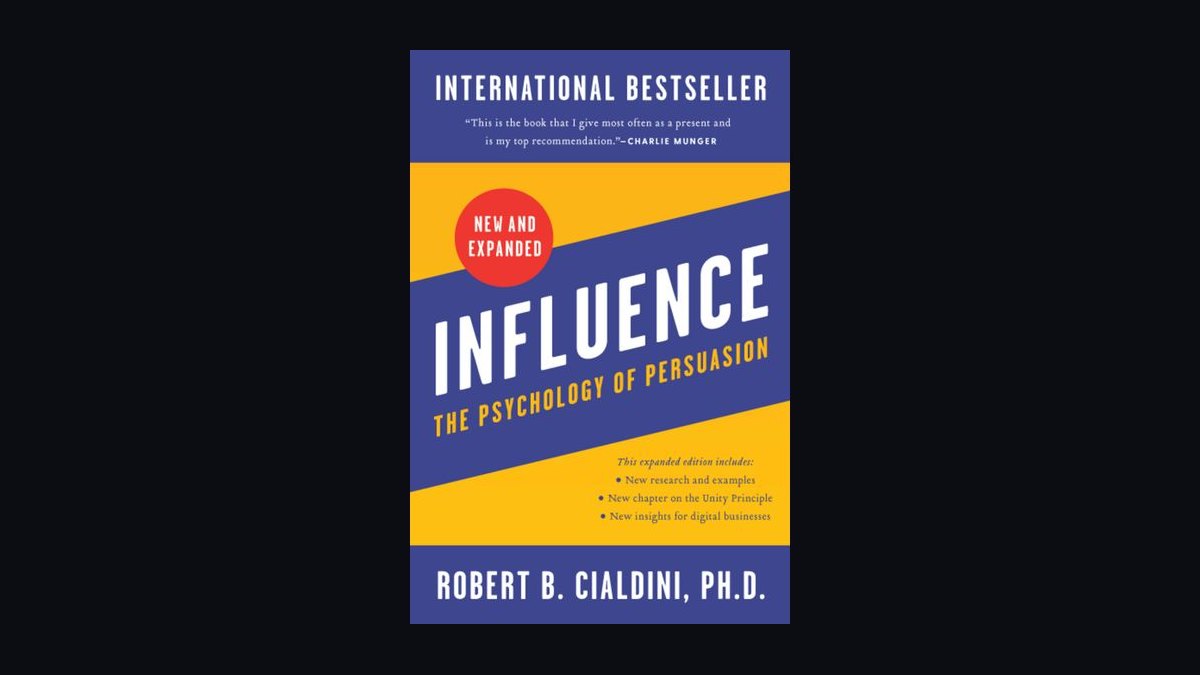
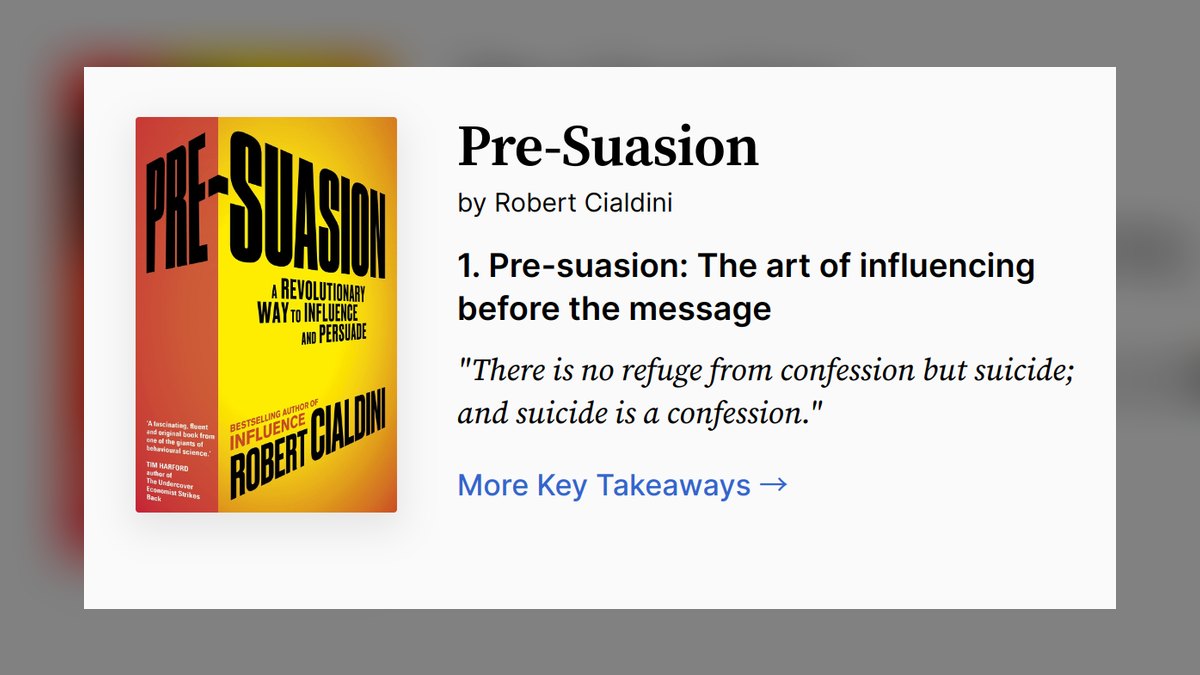
Pre-Suasion by Robert Cialdini (2016) argues that the moments *before* a pitch matter more than the pitch itself — whatever you get a buyer focused on right before you ask determines whether they say yes. This summary distills the book's core mechanism (attention as pre-suasion), the six classic weapons of influence plus a seventh — Unity — and a practical strategy sellers can lift directly into discovery calls and cold outbound.
The outcome you should expect
Read correctly, Pre-Suasion changes what you do in the sixty seconds before you make any ask — not what you say during the ask itself. The book's central claim is that attention is causal: whatever a listener happens to be focused on in the moment right before a request gets treated by their brain as the most relevant, most important factor in deciding how to respond. Cialdini's opening story sets the pattern for the whole book — a veteran home-safe salesman never leads with price. He first asks homeowners, "How much would you say your valuables are worth?" The homeowner names a number out loud, and from that instant on, the safe is no longer an expense; it is insurance against the exact figure the buyer just spoke. Nothing about the safe changed. What changed was what the homeowner was thinking about the instant before the pitch arrived.
For a RevOps leader or seller, the realistic outcome of applying this correctly is not a dramatic script overhaul — it is a disciplined edit to the first fifteen to sixty seconds of every conversation, email, or deck. Expect three concrete shifts once the frame is installed: openers become questions instead of statements, discovery decks lead with a self-relevant prompt instead of a company overview slide, and asks get sequenced to land while the primed concept is still active in the listener's mind, not five slides later. Cialdini reports a street-level test of this exact mechanic: researchers trying to collect strangers' email addresses raised their agreement rate from 29% to 77.3% simply by opening with, "Do you consider yourself a helpful person?" The opener manufactured a self-image the target then felt obligated to act consistently with for the next thirty seconds. That is the kind of lift — multiples, not marginal percentage points — you should expect from a well-placed pre-suasive opener, though it decays fast and does not compound if the follow-up ask is delayed or mismatched to the prime.
The other outcome to expect is diagnostic, not tactical: once you understand attention-as-causality, you start noticing where your own funnel loses deals not because of price or fit objections, but because the wrong thing was focal when the ask happened. A demo that opens with your company's origin story instead of the buyer's stated pain primes the wrong frame — the buyer evaluates the rest of the call through "tell me about you" instead of "solve my problem," and every subsequent slide underperforms relative to its content because the frame was wrong before a single feature was shown.
What drives that outcome
The mechanism underneath all of this is what Cialdini calls "what's focal is causal" — people treat whatever currently occupies their attention as the most likely explanation for their own feelings and decisions, even when the connection is coincidental. He cites a Coca-Cola-versus-Pepsi taste-preference study that flipped simply by changing which brand's logo sat in the room's visual focal point before tasting began; nothing about the drink changed, only what the participant's eyes landed on first. Two levers create that focal shift: attractors and magnetizers. Attractors are things brains are wired to notice reflexively — sex, threat, novelty, anything self-relevant ("your name," "your industry," "your numbers"). Magnetizers hold attention once it's captured — the unfinished, the mysterious, the personally consequential. Cialdini's warning here matters for anyone building outbound: attractors like shock value or sexualized imagery pull attention onto themselves, not onto the product, so a loud attention-grab can actively work against the sale it's meant to support.

Underneath attractors and magnetizers is a second, quieter mechanism: association. Cialdini argues that thinking itself is a process of linking concepts, and priming one concept makes semantically related concepts easier to access moments later. The mechanic he formalizes runs in three steps — open a concept, link that concept to the desired action, then make the ask while the concept is still active, because the activation fades in roughly three to five minutes without reinforcement. This is why a call that buries the ask forty minutes after a strong opener loses most of the pre-suasive lift; the frame decayed long before the moment of decision.
Cialdini also revisits his original six weapons of influence from Influence — reciprocity, liking, social proof, authority, scarcity, and commitment/consistency — and reframes each as conditional on attention. Social proof ("10,000 customers trust us") only lands hard if the buyer's attention was pre-tuned to trust-seeking behavior moments earlier, for instance by an opener like "How do you usually decide which vendors to trust?" The proof point does not create the receptiveness; the opener does. Then he adds a seventh mechanism entirely: Unity, the sense of shared identity rather than merely shared interest. Liking says "we get along"; Unity says "we are the same kind of person" — shared hometown, alma mater, profession, or even a coincidentally shared birthday, which in one negotiation study Cialdini cites raised settlement rates from 6% to 50%. Unity splits further into "being together" (shared category membership) and "acting together" (co-creation), and Cialdini repeatedly draws out the difference between asking a buyer for their opinion, which casts them as a judge, versus asking for their advice, which casts them as a collaborator.
Benchmarks and realistic ranges
Because Pre-Suasion draws on field experiments rather than a single business dataset, the realistic benchmarks to plan against are ranges pulled from Cialdini's cited studies, not guaranteed conversion math for any specific pipeline. The clearest and most repeatable one is the "helpful person" opener test: baseline compliance around 29%, primed compliance around 77.3% — roughly a 2.5x to 2.7x lift from a single well-placed self-image question asked before the actual request. The unity/birthday-coincidence negotiation study showed an even larger swing, from a 6% settlement rate to 50% — roughly an 8x lift — though Cialdini is explicit that this is a laboratory negotiation setting and the effect size should be treated as a ceiling, not a typical outcome, when translated to B2B sales cycles with multiple stakeholders and longer timelines.
On the donation and fundraising side, Cialdini reports roughly a doubling of gift rates when a fundraiser opens with a self-image question ("Do you think of yourself as a charitable person?") before the ask, versus asking cold. For written commitment artifacts, he cites a Fidelity-style savings study in which people who wrote out their goals by hand achieved them at an 8.4% higher rate than people who only stated the same goals verbally — a smaller, more conservative lift, and a useful benchmark for how much a signed mutual action plan might realistically add to close-rate consistency versus a verbally agreed next step.

The realistic range to plan around, translated into a sales or RevOps context, is this: opener and framing changes at the top of a call or email sequence tend to produce the largest measured swings in the underlying research (2x to 8x in controlled settings), while artifact-based post-suasion tactics (written recaps, signed mutual action plans, explicit identity statements) tend to produce smaller, more durable single-digit-to-low-double-digit percentage lifts. Neither number should be imported directly into a forecast — Cialdini's studies are mostly single-interaction, single-variable lab or field tests, and a real B2B sales cycle stacks dozens of variables on top of any one prime. Treat these figures as directional evidence that sequencing and framing matter enormously, not as a multiplier to apply to your own win rate.
Risks, edge cases, and failure modes
The most common failure mode is using a pre-suasive opener that is technically clever but focuses attention on the wrong concept. A demo that opens with a flashy, novel visual (an attractor) can pull attention onto the visual itself and away from the product's value — Cialdini's own example is a Super Bowl ad with a topless model that sells the model, not the beer. In a sales context, the parallel mistake is opening a call with an impressive but irrelevant stat or story: it captures attention, but the wrong thing becomes focal, and the rest of the pitch gets evaluated through an unhelpful frame.
A second failure mode is timing decay. Because a primed concept fades in roughly three to five minutes without reinforcement, sequences that bury the actual ask deep into a long call or a multi-touch email chain lose most of the pre-suasive lift by the time the ask arrives. Sellers who build a strong opener but then spend forty minutes on unrelated feature walkthroughs before circling back to the ask are effectively wasting the prime.

The ethical risk is the sharpest edge case in the book, and Cialdini spends a full chapter on it. He documents a case involving a German bank where managers pressured staff to use deceptive priming tactics — fabricated scarcity, invented social proof. Within about eighteen months, employee turnover doubled and sick leave tripled, with the most ethical employees leaving first and leaving behind a workforce more willing to cut corners, which compounded the reputational damage. Cialdini's conclusion is blunt: dishonest pre-suasion poisons the organization deploying it at least as much as it harms the target. His practical filter for avoiding this failure mode is a three-question test applied before any tactic ships — is the claim true, is the technique appropriate for this audience, and would you be comfortable if the target saw exactly how the moment was engineered. A tactic that fails any one of the three should be dropped, not softened.
A subtler edge case is the replication problem. A portion of the lab-based priming research Cialdini cites — some "warm cup, warm person" style associative studies in particular — did not hold up during the 2015-2020 priming-replication crisis in psychology. Cialdini addressed this directly in a 2017 NPR interview, arguing that his field studies (the safe salesman, the fundraising openers, the negotiation settlements) replicate more reliably than the abstract lab priming studies, and that practitioners should weight the field evidence more heavily. Anyone applying this material should treat the flashier lab-only findings with more skepticism than the field-tested ones, and should expect variation across industries — most of the book's illustrative examples are B2C retail and direct-mail scenarios, and translating them into long-cycle B2B or PLG SaaS motions requires deliberate adaptation rather than a literal copy of the script.
A practical rollout plan

Applying Pre-Suasion inside a sales or RevOps motion works best as a short, sequenced rollout rather than a single sweeping rewrite of every script at once, because each change needs to be evaluated against its own baseline before stacking the next one on top of it. Start with the highest-leverage, lowest-effort change: rewrite the first line of your primary cold-email sequence and your discovery-call opener as a question that primes the frame you want the rest of the conversation judged against, rather than a statement about your company. Run that change alone for one to two weeks against a held-out control group of sequences using the old opener, and track reply and booked-meeting rate specifically, not just overall pipeline, since the opener effect is concentrated at the top of the funnel.
Once the opener is validated, add a Unity sentence to the discovery deck or the first live call — something genuinely true (shared industry, shared prior employer, shared tooling stack) rather than an invented commonality, since a fabricated unity claim fails Cialdini's own honesty test and risks the trust cost documented in the ethics chapter. In parallel, retrain the language your team uses when soliciting buyer input: replace "What do you think of this proposal?" with "What would you change about this proposal?" — the shift from opinion to advice recasts the buyer as a co-creator rather than a judge, which is the "acting together" branch of Unity Cialdini treats as the stronger of the two.
Next, address timing: map where the actual ask lands in your current call structure relative to the opener, and if it is more than five minutes downstream, restructure the agenda so discovery, the value link, and the ask happen inside one continuous arc rather than being separated by an unrelated product tour. Finally, close the loop with a post-suasion artifact — a written, ideally buyer-authored mutual action plan or recap sent within the same day — since written commitment consistently outperforms verbal-only agreement in the cited research, and it hardens the yes before the buyer's attention moves on to the next vendor conversation.
Related questions

Is Pre-Suasion the same book as Influence?
No. Influence (1984) documents the six weapons of persuasion. Pre-Suasion (2016) is the follow-up, focused on what happens in the moments *before* those weapons are deployed — priming attention rather than the persuasive appeal itself.
What is the single most useful tactic from the book for a seller?
The opener question — a self-relevant question asked before the pitch that primes the frame the rest of the conversation gets judged against, such as "What's the biggest revenue leak you'd want to plug this quarter?"
Does pre-suasion work in written channels like email, or only live conversation?
It works in both. The first line of a cold email functions exactly like a verbal opener — it sets the frame the reader evaluates the rest of the message against, which is why subject lines and opening sentences carry outsized weight.
How is Unity different from simply being likeable?
Liking is "we get along"; Unity is "we are the same kind of person" — shared identity markers like alma mater, industry, or hometown, which Cialdini's research shows can move agreement rates far more than rapport alone.
FAQ

Is Pre-Suasion just about first impressions? Not exactly — first impressions are a related but broader idea. Cialdini is specifically focused on the narrow window immediately before an ask, where a deliberately chosen prime shapes how the ask itself is received, not the general tone of an early meeting.
Does this apply to B2B sales or only consumer marketing? Both, and arguably more powerfully in B2B, where longer cycles and multiple stakeholders give more opportunities to install a frame early and reinforce it, versus a single impulse-driven consumer transaction.
How long does a pre-suasive prime last before it fades? Roughly three to five minutes without reinforcement, per Cialdini's formalized mechanism — which is why the ask needs to follow the prime quickly rather than being buried later in a long call.
Can this backfire if it feels manipulative? Yes. Cialdini's own ethics chapter documents real organizational damage from deceptive priming, including elevated turnover at a German bank that pressured staff into dishonest tactics. His three-question honesty test is the safeguard against this failure mode.
Is Pre-Suasion still relevant now that AI SDRs handle so much outbound? Arguably more relevant — Cialdini's argument is that once the pitch itself becomes commoditized (as AI-generated outbound has made it), the differentiator shifts entirely to the human judgment of what to prime and when, which AI has not replicated.
Do I need to read Influence before Pre-Suasion? No, Pre-Suasion stands on its own, though it references concepts from Influence (reciprocity, authority, scarcity) throughout, so readers who want the deeper grounding in the original six weapons may want to circle back to Influence afterward.
Sources
- Pre-Suasion (Amazon hardcover page)
- Robert Cialdini's official site, Influence At Work
- Pre-Suasion on Goodreads
- Internet Archive scan of Pre-Suasion
- Hardcore Closer review of Pre-Suasion by Ryan Stewman
- John Livesay interview notes with Cialdini
- CG Life marketing-book summary of Pre-Suasion
- Kajabi blog on applying pre-suasion to conversion rates
- Samuel J. Woods, "30 Principles from Pre-Suasion"
- The Power Moves deep breakdown of Pre-Suasion
Related on PULSE
This page will be disappearing soon. Save it to your device for $1 — or read it free while it is here.
@Kory-White- · if Venmo asks, the last 4 of my number are 2012
This page is gone.
This one is off the shelf now. $1 keeps it on your phone for good — the whole page, pictures and diagrams included.
 pulse-recentThe Sales Acceleration Formula by Mark Roberge — Top 10 Key Takeaways for Sales Leaders in 2027
 pulse-recentSPIN Selling by Neil Rackham — Top 10 Key Takeaways for Sales Leaders in 2027
 pulse-recentGetting to Yes by Roger Fisher and William Ury — Top 10 Key Takeaways for Sales Leaders in 2027
 pulse-recentHyper Sales Growth by Jack Daly — Top 10 Key Takeaways for Sales Leaders in 2027
 book-summaryLittle Red Book of Selling by Jeffrey Gitomer — Cliff Notes Summary
 pulse-recentSales EQ by Jeb Blount — Top 10 Key Takeaways for Sales Leaders in 2027
 pulse-recentCrossing the Chasm by Geoffrey Moore — Top 10 Key Takeaways for Sales Leaders in 2027
 pulse-recentWhat are the first three concrete steps in Sandler Rule #1 for a new sales rep in 2027?
 pulse-booksTop 10 practical takeaways from Atomic Habits for building a new routine in 2027.
 pulse-recentStart with No by Jim Camp — Top 10 Key Takeaways for Sales Leaders in 2027